
NASA Reveals Ambitious Plan to Build a Permanent Moon Base for Human Life
This is in AI generated video, not a real video
NASA Reveals Permanent Moon Base Plan - Humans Could Live on the Moon by 2030s
Watch: NASA reveals rendering for lunar city - CBS News
Key Points
NASA has unveiled new details about its long-term Moon Base program.
The agency plans to establish a permanent human presence on the Moon during the 2030s.
The lunar base will likely be built near the Moon’s south pole.
NASA plans to use robotic landers, lunar rovers, hopping drones, cargo systems, and resource extraction technology.
The first robotic Moon Base missions are expected to begin later in 2026.
More than a dozen lunar missions are planned over the next several years.
NASA says the Moon base will help prepare humanity for future missions to Mars.
Private companies including Blue Origin, Astrolab, Lunar Outpost, and Firefly Aerospace are involved in the project.
The plan comes amid an intensifying lunar race between the United States and China.
advertisement
NASA has officially revealed its latest roadmap for building a permanent human settlement on the Moon, marking one of the most ambitious space exploration projects in modern history. The announcement expands the agency’s Artemis program and outlines how astronauts could eventually live and work on the lunar surface for extended periods during the 2030s.
According to NASA, the future Moon Base will likely be constructed near the Moon’s south pole, a region scientists consider highly valuable because it may contain frozen water deposits inside permanently shadowed craters. Water could become one of the most important resources for future lunar astronauts because it can potentially be converted into drinking water, breathable oxygen, and even rocket fuel.
The agency explained that the Moon Base project will happen in multiple phases over the next decade. The first phase focuses on robotic missions, including advanced lunar landers, autonomous cargo systems, hopping drones capable of exploring difficult terrain, and large rovers designed to transport equipment and astronauts across the lunar surface. NASA Administrator Jared Isaacman described these missions as the first steps toward creating “humanity’s first outpost on another celestial world.”
NASA says three major Moon Base missions are already scheduled for later in 2026. These early missions will test transportation systems, navigation technology, communications equipment, cargo delivery operations, and surface mobility systems needed for long-term survival on the Moon. Officials stated that more than a dozen additional missions are expected to follow in the coming years.
One of the most important parts of the program involves partnerships with private aerospace companies. Blue Origin, the space company founded by Jeff Bezos, has received contracts related to lunar transportation and cargo delivery systems. Other companies including Astrolab, Lunar Outpost, Firefly Aerospace, Astrobotic, and Intuitive Machines are also helping develop rovers, landers, drones, and infrastructure technologies for the lunar surface.
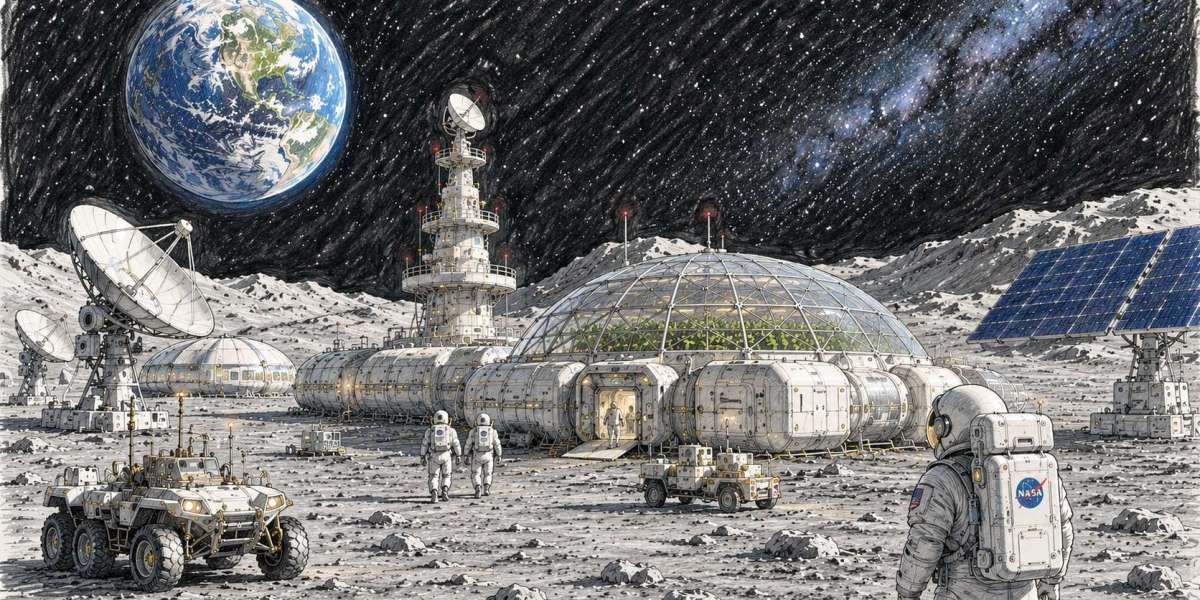
NASA’s long-term vision includes building semi-permanent habitats, power systems, communication networks, and scientific laboratories on the Moon. Reports indicate the base may eventually rely on a combination of solar power and nuclear energy systems to provide electricity and heat for astronauts working in the harsh lunar environment, where temperatures can swing dramatically between extreme heat and freezing cold.
The agency also hopes to develop technologies capable of extracting resources directly from lunar soil, reducing the need to transport every supply from Earth. Scientists believe the Moon could provide valuable materials for construction, fuel production, and long-duration exploration. NASA says learning how to survive using local resources is essential before humans attempt missions to Mars.
The Moon Base initiative represents a major shift in NASA’s exploration strategy. Earlier plans focused heavily on the Lunar Gateway space station orbiting the Moon, but NASA has now prioritized building sustainable infrastructure directly on the lunar surface instead. The agency believes surface operations will provide more practical experience for future deep-space exploration.
NASA’s Artemis missions remain central to the project. Artemis II recently completed a historic crewed lunar orbit mission, while future Artemis flights are expected to return astronauts to the Moon’s surface for the first time since the Apollo era. NASA currently hopes astronauts could begin early habitation missions near the end of the decade, eventually leading to continuous human operations in the 2030s.
The announcement also reflects growing geopolitical competition in space exploration. China has accelerated its own lunar ambitions and aims to send astronauts to the Moon before 2030. NASA officials openly acknowledged that the Moon Base program is part of a broader effort to maintain American leadership in space exploration while opening the door for international scientific cooperation and future commercial activity beyond Earth.
Key Points Summary
NASA plans to build a permanent Moon Base near the lunar south pole.
Robotic missions will begin testing systems in 2026.
The project includes rovers, drones, cargo landers, and lunar habitats.
NASA wants astronauts to eventually live and work on the Moon for extended periods.
The Moon Base will support scientific research and future Mars missions.
Private companies are playing a major role in building lunar infrastructure.
Water ice and local resources are critical to the project’s success.
The initiative is part of the growing global race for lunar exploration.
advertisement
Frequently Asked Questions (FAQ)
Why does NASA want to build a base on the Moon?
NASA says the Moon Base will help scientists learn how humans can survive long-term on another world while preparing for future missions to Mars.
Where will the Moon Base be located?
The base is expected to be built near the Moon’s south pole because the region may contain frozen water and receives useful sunlight for power generation.
When will humans live on the Moon permanently?
NASA hopes to begin long-duration human missions near the end of the decade, with more permanent habitation possible during the 2030s.
What technologies will NASA use on the Moon?
The program includes robotic landers, cargo systems, rovers, drones, habitats, communication systems, and power infrastructure.
Will private companies participate in the Moon Base project?
Yes. Companies like Blue Origin, Astrolab, Lunar Outpost, Firefly Aerospace, Astrobotic, and Intuitive Machines are helping develop lunar technologies.
How much could the Moon Base project cost?
Some reports estimate the broader Moon Base initiative could eventually cost around $20 billion over multiple phases.
Why is the Moon’s south pole important?
Scientists believe the region may contain water ice that astronauts can use for drinking water, oxygen production, and rocket fuel.
Sources
Thank you !