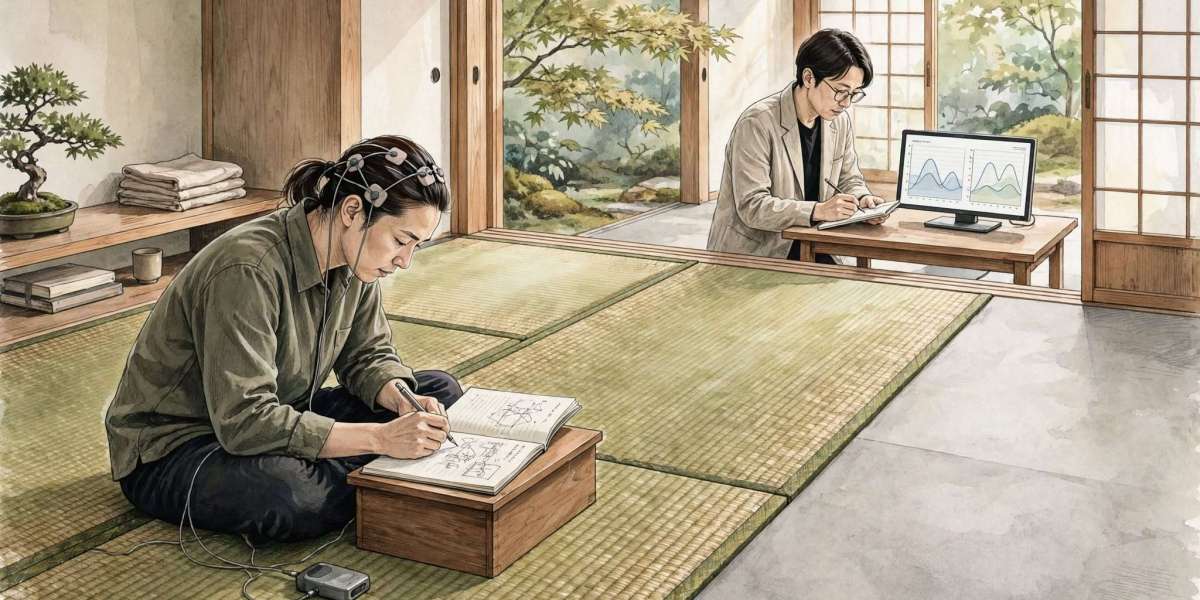

Sitting on Japanese Tatami Mats May Reduce Anxiety and Improve Task Engagement, Study Finds
Key Points
Researchers at Kyushu University studied whether sitting on traditional Igusa (rush-grass) mats could influence stress, anxiety and cognitive engagement.
The study involved 17 volunteers, with an average age of 21.5 years.
Participants completed tasks while sitting on Igusa mats and on unscented polypropylene plastic mats.
EEG measurements showed increased beta-wave activity in certain brain regions during tasks on Igusa mats, a pattern the researchers associated with greater focus and cognitive engagement.
Participants also reported lower tension and anxiety after using the Igusa mats, although the researchers stressed that the study examined only short-term responses.
advertisement
A traditional material found in Japanese homes may have effects that extend beyond its familiar texture and distinctive scent. A new study from Kyushu University suggests that sitting on mats made from Igusa, a type of rush grass used in traditional Japanese tatami, may be associated with lower anxiety and changes in brain activity linked to concentration and task engagement.
The findings, published in Scientific Reports, come from a small crossover study involving 17 volunteers with an average age of 21.5 years. Researchers compared participants' responses while they sat on Igusa mats with their responses while sitting on unscented polypropylene plastic mats, using both brain-wave measurements and psychological questionnaires.
The researchers were interested in a question that has long been connected with Japanese living environments: whether the sensory experience of traditional Igusa mats might influence how people feel and perform during everyday activities.
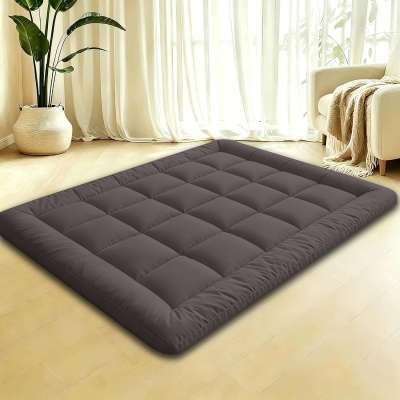
Tatami has been part of Japanese culture and architecture for centuries, and the surface of traditional mats is made from Igusa, which is cultivated, dried and woven before being attached to the mat's base. The material is also responsible for much of the distinctive smell associated with traditional Japanese-style rooms, known as Washitsu.
According to Kuniyoshi Shimizu, an associate professor at Kyushu University's Faculty of Agriculture who led the research, the scent of Igusa has traditionally been associated in Japan with comfort and relaxation. However, the researchers noted that there has been relatively little scientific evidence supporting broader claims about its effects on people.
The team therefore set out to examine potential effects beyond smell, including mood, stress resilience and task engagement.
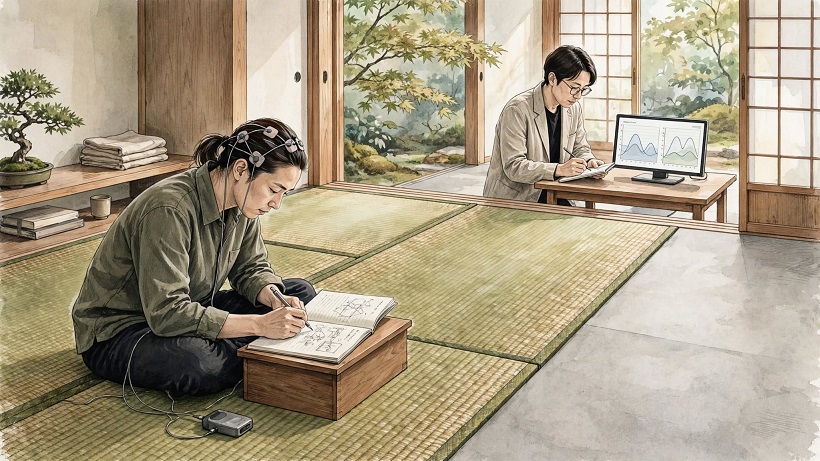
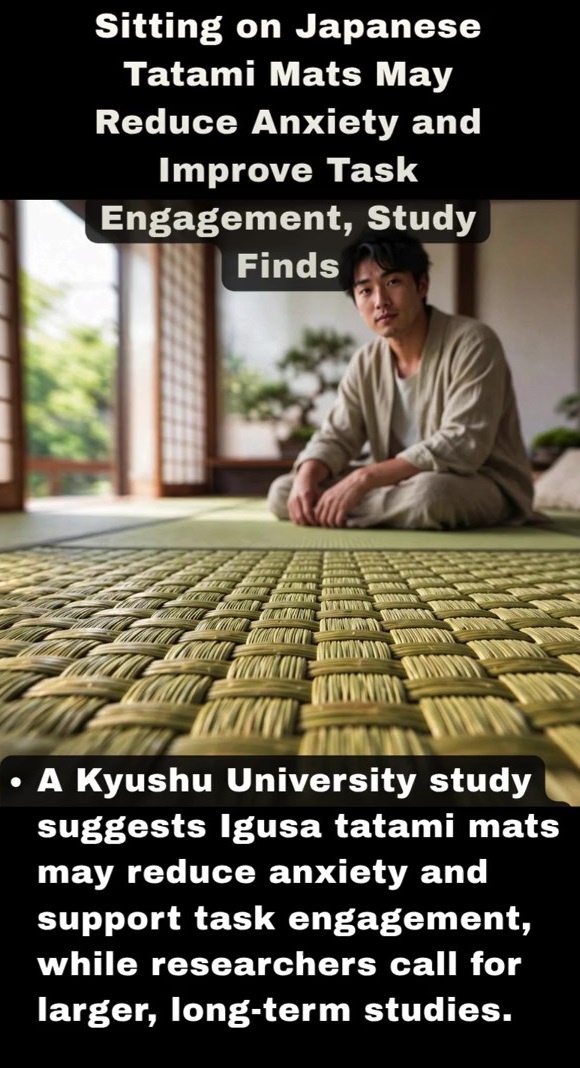
To test those effects, volunteers participated in an experimental setup inside a soundproof room. They experienced two conditions: sitting on Igusa mats and sitting on unscented polypropylene plastic mats. While in the different conditions, participants completed simple tasks, while researchers recorded their reaction times and monitored their brain activity using electroencephalography, or EEG. Psychological questionnaires were administered afterward to assess measures including stress and comfort.
The EEG results provided one of the study's main findings.
When participants completed tasks while sitting on the Igusa mats, researchers observed increased beta-wave activity in certain regions of the brain. Beta activity is commonly examined in research involving mental activity and attention, and the researchers interpreted the observed pattern as indicating greater focus and cognitive engagement during the tasks.
The researchers also reported changes involving other types of brain-wave activity. Under the Igusa condition, gamma-wave activity changed between resting and task periods across many areas of the brain, while alpha-wave activity remained more stable during rest periods.
Taken together, the researchers said these patterns could indicate greater stress resilience through more efficient relaxation. However, the findings should not be interpreted as proof that sitting on tatami directly produces a lasting improvement in concentration or stress resilience. The study was designed to examine short-term responses under controlled experimental conditions.
The psychological results added another dimension to the findings.
After using the Igusa mats, participants reported reduced tension and anxiety. Other aspects of mood, however, did not show significant changes. That distinction is important because it means the researchers did not find a broad improvement across every psychological measure they examined.
The study therefore points to a potentially interesting relationship between a traditional natural material and human responses, rather than demonstrating that tatami is an anxiety treatment.
One possible reason the researchers are interested in the material is that Igusa provides more than a visual or cultural element in a room. Its characteristic sensory qualities may form part of the overall experience of sitting in a traditional Japanese environment. The current experiment, however, specifically compared Igusa mats with unscented polypropylene mats, meaning the study was designed to examine differences between those conditions rather than establish that every element of a traditional Japanese room contributes to the observed effects.
The distinction between Igusa mats and tatami rooms more generally is particularly important. The experiment focused on the material used in the mat, not on an entire Japanese architectural environment. Therefore, the findings should not automatically be extended to claims that Japanese-style rooms, floor-level furniture, traditional architecture or other aspects of Japanese culture independently reduce anxiety.
The researchers also emphasized the limitations of their work.
With only 17 participants, the study had a relatively small sample. The volunteers also had an average age of 21.5 years, meaning the results cannot automatically be assumed to apply in the same way to older adults, children or people with different backgrounds and characteristics.
Another important limitation is the study's duration. The researchers evaluated short-term responses, rather than determining whether regularly using Igusa mats over weeks, months or years would produce lasting changes in anxiety, stress resilience or cognitive performance. Shimizu said that future research should involve a larger and more diverse population and examine the long-term effects of Igusa use.
That caution matters because the current findings are best understood as an early piece of evidence rather than a definitive conclusion about the psychological benefits of tatami.
Still, the research offers an intriguing scientific perspective on a material with a long cultural history.
Igusa has been used in Japan for generations, but its use has declined as lifestyles and housing environments have changed. The Kyushu University team hopes that research into the material's effects could help scientists better understand how traditional materials influence human experiences and potentially identify new applications for them in modern environments.
The research also illustrates how seemingly ordinary environmental features can become subjects of scientific investigation. A floor covering that has traditionally been valued for cultural and practical reasons is now being examined through EEG measurements, behavioral tasks and psychological assessments.
For now, the evidence suggests that sitting on an Igusa mat may be associated with reduced tension and anxiety and with brain-activity patterns linked by the researchers to greater task engagement. But the study does not establish that tatami can prevent or treat anxiety disorders, nor does it show that the effects persist over the long term.
The next step, according to the researchers themselves, is broader testing. Larger and more diverse studies could help determine whether the findings observed in these 17 young volunteers can be reproduced in other populations and whether the short-term responses translate into meaningful long-term effects.
For now, the study adds a new scientific dimension to a traditional Japanese material: Igusa may influence how people respond to their environment, but more research is needed before its potential psychological benefits can be firmly established.
Key Points Summary
Kyushu University researchers examined the effects of sitting on Igusa mats, the rush-grass material used in traditional tatami.
The study included 17 volunteers, averaging 21.5 years old.
Participants were tested while sitting on Igusa mats and unscented polypropylene plastic mats.
EEG recordings showed increased beta-wave activity in certain brain regions during tasks performed on Igusa.
Participants reported lower tension and anxiety after using the mats.
Changes in gamma and alpha activity were also observed.
The researchers interpret the overall findings as potentially indicating improved task engagement and stress resilience.
The study examined only short-term effects.
Its small sample means the results require replication in larger and more diverse populations.
The research does not establish Igusa mats as a treatment for anxiety.
What This Means
The study provides preliminary evidence that the material used in traditional Japanese tatami may influence short-term psychological and brain responses.
The most interesting finding is the combination of reduced self-reported tension and anxiety with EEG patterns that the researchers associated with greater focus and cognitive engagement.
However, readers should view the findings as early research rather than medical advice or proof of an anxiety treatment. The study involved only 17 young volunteers and examined short-term responses.
What researchers need to establish next is whether the findings can be reproduced in larger and more diverse groups and whether any effects remain over longer periods.
advertisement
Frequently Asked Questions [FAQ]
Does sitting on tatami mats reduce anxiety?
The study found that participants reported reduced tension and anxiety after using Igusa mats. However, the research was small and evaluated short-term responses, so it does not establish that tatami can treat anxiety or anxiety disorders.
What are Igusa mats?
Igusa is a rush grass used to make the surface of traditional Japanese tatami mats. The grass is cultivated, dried and woven before being incorporated into the mat.
How many people participated in the study?
The experiment involved 17 volunteers, whose average age was 21.5 years.
What did researchers compare?
Participants were tested while sitting on Igusa mats and on unscented polypropylene plastic mats. They completed tasks while researchers monitored their brain activity and later assessed psychological responses.
What did the EEG measurements show?
Researchers reported increased beta-wave activity in certain brain regions while participants completed tasks on Igusa mats. They interpreted this as indicating enhanced focus and cognitive engagement.
Did every measure of mood improve?
No. Participants reported reduced tension and anxiety, but other aspects of mood showed no significant change.
Were the effects long-lasting?
The researchers did not establish that. The experiment evaluated short-term responses, and they specifically said future studies should investigate long-term effects.
Can tatami mats be considered an anxiety treatment?
No. The study does not establish Igusa or tatami mats as a treatment for anxiety disorders. It provides preliminary evidence of an association between the material and certain short-term psychological and brain responses.
What research comes next?
The researchers said they want to repeat the experiment with a larger, more diverse population and investigate the long-term effects of Igusa use.
Sources
Thank you !