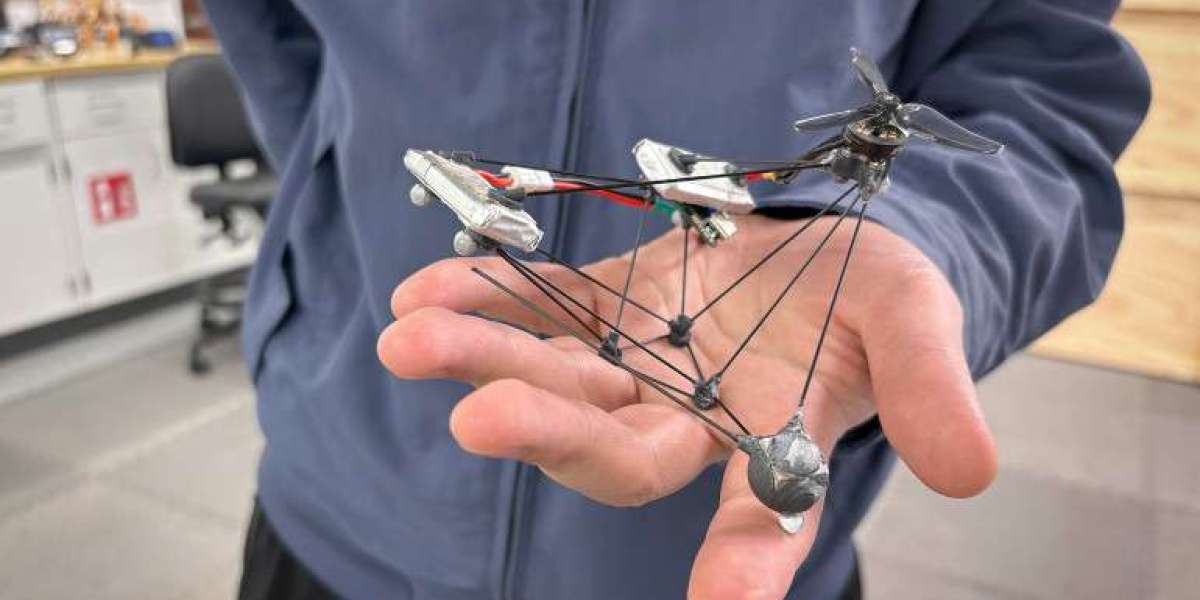

article image source: news.northwestern.edu (Link)
New Spinning Drone Uses Motion Blur to Hide in Plain Sight
Key Points
Northwestern University researchers developed Phantom Twist, an experimental drone designed to be harder for humans to see while flying.
The drone uses rapid full-body rotation and motion blur instead of traditional camouflage.
It uses one motor and one propeller, with the propeller rotating in one direction while the rest of the drone rotates in the opposite direction.
An AI-assisted computational design process evaluated about 20,000 stable-flight configurations to optimize the drone's design.
Researchers say the final design is approximately 10 times less visually perceptible than a conventional quadcopter according to their visibility metric, although it remains audible and some components can still be seen.
advertisement
Researchers at Northwestern University have developed an experimental drone designed to become harder for humans to see while flying, using rapid rotation and motion blur rather than conventional camouflage.
Called “Phantom Twist,” the drone is based on how human vision processes rapidly moving objects. Instead of trying to make the aircraft resemble its surroundings, researchers designed it to continuously rotate so that its components become visually blurred.
The project was presented on July 16, 2026, at Robotics: Science and Systems 2026 in Sydney, Australia, according to Northwestern University. The research was supported by the National Science Foundation.
Unlike a conventional quadcopter, which typically keeps its main body relatively stationary while its four rotors spin, Phantom Twist uses one motor and one propeller. The propeller rotates in one direction while the rest of the drone rotates in the opposite direction.
“For a typical quadrotor drone, the propellers are spinning, but the robot is stationary,” Michael Rubenstein, an associate professor of computer science and mechanical engineering at Northwestern's McCormick School of Engineering, said in the university's announcement. “So, you still see its body. For our drone, the whole thing is rotating, so there are no stationary parts.”
The drone can rotate at up to 25 times per second. At that speed, its components can blur together, making the aircraft appear more like a faint haze than a clearly defined drone.
Researchers used artificial intelligence and computational optimization to develop the design. They evaluated approximately 20,000 configurations capable of stable flight, adjusting the positions of components such as the motor, propeller, circuit board, counterweight and batteries.
The team then simulated candidate designs against 100 real-world backgrounds and used a perception model intended to approximate aspects of human vision. The 500 lowest-scoring designs were further optimized to reduce their visual perceptibility.
According to the researchers' visibility metric, the final design is approximately 10 times less visually perceptible than a conventional quadcopter.
However, Phantom Twist is not invisible. Its propeller remains audible, while wires and support rods can still be seen. The researchers describe it as a low-visibility drone, rather than a completely invisible aircraft.
Potential applications include wildlife monitoring, environmental surveys and infrastructure inspections, where a drone's visible presence could affect what it is observing. Future versions could potentially use more transparent materials or quieter propulsion systems to further reduce its detectability.
For now, Phantom Twist remains an experimental research project. Its significance lies in a different approach to drone design: instead of primarily changing what a machine looks like, researchers are exploring how changing the way it moves can influence how easily humans perceive it.
Key Points Summary
Phantom Twist is a low-visibility experimental drone from Northwestern University.
It uses rapid rotation and motion blur to reduce its visual perceptibility.
The drone can rotate up to 25 times per second.
AI-assisted optimization evaluated approximately 20,000 stable-flight configurations.
Researchers say it is about 10 times less visually perceptible than a conventional quadcopter according to their metric.
It is not invisible and can still be heard and partially seen.
What This Means
The Phantom Twist project demonstrates a different approach to low-visibility robotics, using rapid movement and human visual perception instead of relying mainly on camouflage.
The concept could potentially be useful for wildlife monitoring, environmental surveys and infrastructure inspections. However, the prototype remains experimental, with noise and visible structural components still presenting limitations.
advertisement
Frequently Asked Questions [FAQ]
What is Phantom Twist?
Phantom Twist is an experimental drone developed by Northwestern University researchers to make it less visually perceptible to humans.
How does it become harder to see?
The entire drone rotates rapidly, causing its components to blur together and making its shape more difficult to distinguish.
How fast can it spin?
The drone can rotate at up to 25 times per second.
Is the drone invisible?
No. It remains audible, and some wires and structural components can still be seen.
How did AI help?
Researchers used computational optimization to evaluate approximately 20,000 stable-flight configurations and optimize the placement of the drone's components.
What could it be used for?
Potential applications include wildlife monitoring, environmental surveys and infrastructure inspections.
Verified Sources
Thank you !