
Scientists May Have Finally Found Evidence That “Empty” Space Isn’t Really Empty
Key Points
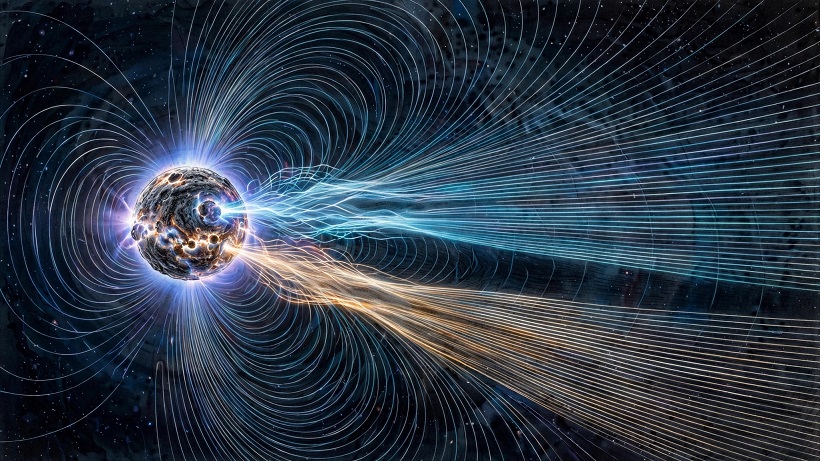
Astronomers studying the magnetar 1E 1547.0−5408 have found evidence consistent with a long-predicted quantum effect called vacuum birefringence.
The effect suggests that an extremely strong magnetic field can make what appears to be empty space influence how light travels and becomes polarized.
The observations detected unusually high X-ray polarization, reaching about 65% on average at 2 keV and nearly 80% at certain rotational phases.
Researchers combined observations from NASA’s Imaging X-ray Polarimetry Explorer (IXPE), the NICER X-ray telescope and Murriyang, CSIRO’s Parkes radio telescope.
The finding is not yet presented as a definitive proof: the researchers say additional observations and improved simulations are needed to distinguish vacuum birefringence from other processes around magnetars. (Nature)
advertisement
For decades, physicists have wondered whether a perfect vacuum is truly empty. According to quantum electrodynamics, or QED, the theory describing how light and matter interact, the vacuum can behave in ways that are very different from the simple emptiness of classical physics. Now, astronomers studying one of the most extreme objects in the universe may have found some of the strongest evidence yet for one of those predictions: vacuum birefringence, a phenomenon in which an extraordinarily strong magnetic field can change how light propagates through apparently empty space. (Nature)
The research, published in Nature in August 2026, focuses on the radio-emitting magnetar 1E 1547.0−5408, a rare type of neutron star with an exceptionally powerful magnetic field. The study brought together X-ray and radio observations to examine how radiation from the object becomes polarized as the magnetar rotates. The researchers found polarization patterns that are difficult to explain using conventional models in which light travels through space without the predicted vacuum-refractive effects. (Nature)
The result matters because vacuum birefringence has remained an unconfirmed prediction of quantum electrodynamics for decades. The Nature paper describes strong magnetic fields as capable of producing polarization-dependent refractive indices in the vacuum. In simpler terms, under sufficiently extreme conditions, empty space itself can behave as though it has optical properties. (Nature)
That does not mean space is filled with ordinary matter or particles in the everyday sense. The quantum explanation involves the behavior of the vacuum at the subatomic level. The Swinburne University of Technology account describes the vacuum in terms of virtual particles, which quantum theory predicts can briefly appear and disappear. In the presence of an extraordinarily powerful magnetic field, these quantum effects can influence the propagation of light. (Swinburne University)
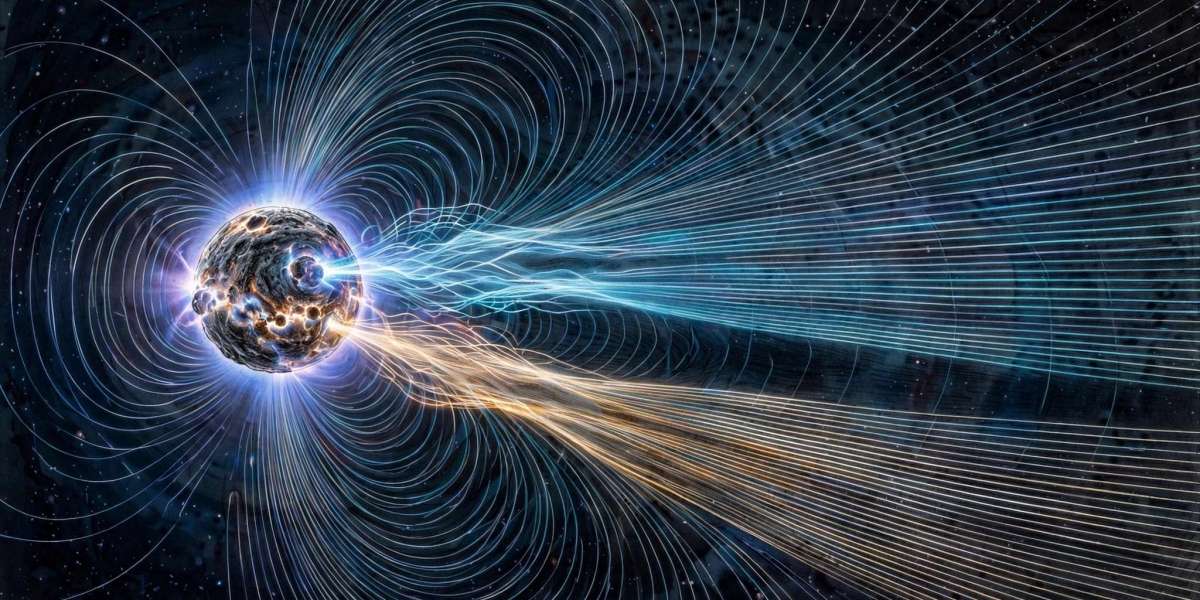
This is where magnetars become particularly important. A magnetar is a highly magnetized neutron star, and the Nature study notes that these objects have surface magnetic fields exceeding 10¹⁴ gauss. Such fields are vastly beyond anything scientists can produce on Earth, making magnetars natural laboratories for testing quantum physics under extreme conditions. (Nature)
According to Swinburne University of Technology, detecting vacuum birefringence would require a magnetic field more than 100 million times stronger than any magnetic field humans have produced on Earth. The extraordinary environment surrounding a magnetar therefore provides an opportunity that terrestrial experiments cannot easily reproduce. (Swinburne University)
The team focused on 1E 1547.0−5408, also known as 1E1547, because its geometry makes it unusually useful for this investigation. By studying the polarization of radio waves emitted by the magnetar, researchers determined that its magnetic and rotational axes are nearly aligned and that the object is viewed almost pole-on. That combination gives astronomers a particularly favorable perspective for examining how radiation behaves around the star. (Swinburne University)
The researchers then examined X-rays from the magnetar using NASA’s Imaging X-ray Polarimetry Explorer, or IXPE. The observations were supported by the Neutron Star Interior Composition Explorer (NICER) aboard the International Space Station and by Murriyang, CSIRO’s Parkes radio telescope in Australia. Radio observations and subsequent analysis, including work using Swinburne’s Ngarrgu Tindebeek supercomputer, helped the team compare the behavior of radiation across different wavelengths. (Swinburne University)
One of the most important observations was the unusually high degree of polarization in the magnetar's X-ray emission. The Nature study reports phase-averaged polarization reaching 65% at 2 keV, followed by a substantial decrease between 2 and 4 keV. At particular rotational phases, the polarization in the 2–3 keV range rose to nearly 80%, while remaining above 40% throughout the crossing of the radio beam. (Nature)
Polarization describes the orientation in which electromagnetic waves oscillate. It can provide astronomers with information that ordinary measurements of brightness and energy cannot reveal. In this case, the researchers found that the changing X-ray polarization was consistent with the geometry of the magnetar's large-scale magnetic field. The X-ray and radio polarization angles followed patterns consistent with the rotating vector model, strengthening the connection between the observed radiation and the star's magnetic structure. The researchers also found an approximately 21-degree offset between the X-ray and radio polarization angles, a detail that further informs their analysis of the magnetar's geometry. (Nature)
The combination of observations is important because the team was not simply looking for a large magnetic field. It was looking for a particular pattern in how radiation behaves as it moves through the magnetar's magnetosphere. The Nature paper says that vacuum-birefringence-governed propagation can naturally explain the observed X-ray polarization signals, while also noting that the findings challenge standard surface-emission models that do not include refractive propagation effects. (Nature)
The Swinburne researchers describe the result as a possible first detection of vacuum birefringence. Dr. Marcus Lower, a Swinburne astronomer involved in the international team, said the observations provide an opportunity to investigate a prediction that has remained elusive since it was proposed in the 1930s. (Swinburne University)
But there is an important scientific qualification.
Despite the striking observations, the researchers have not declared the century-old quantum prediction definitively proven. The Nature paper describes the work as a marked advance in probing vacuum birefringence, while the Swinburne account says the result could be the first direct detection. The researchers expect additional data and improved computer simulations to help determine whether the observed signal can be separated confidently from other physical processes occurring around magnetars. (Nature)
That distinction is especially important because magnetars are themselves extraordinarily complicated environments. Their intense magnetic fields, hot surfaces and powerful radiation create conditions that are difficult to model completely. A convincing identification of vacuum birefringence therefore requires researchers to demonstrate that the observed polarization pattern cannot be adequately explained by other magnetospheric or surface processes.
The current observations nevertheless represent a significant step. The study brings together X-ray polarization, radio polarization, rotational behavior and magnetic-field geometry to investigate a quantum effect that is extraordinarily difficult to observe directly. Rather than attempting to create an Earth-based magnetic field strong enough to reveal the effect, researchers are using a natural cosmic laboratory that already possesses the necessary extreme conditions. (Nature)
The underlying idea also changes the intuitive meaning of the word “vacuum.” In everyday experience, empty space is simply the absence of matter. In quantum physics, however, the vacuum has physical properties of its own. Under normal conditions those effects are extraordinarily subtle. Around a magnetar, where magnetic fields reach levels far beyond terrestrial capabilities, they may become observable through the way light is polarized and propagated. (Nature)
For researchers, the significance extends beyond the particular magnetar. If future observations confirm the interpretation, magnetars could become powerful laboratories for studying quantum electrodynamics in extreme magnetic fields. The Nature study describes the observations as opening a new cosmic window into superstrong-field quantum physics and encouraging further observational and theoretical work. (Nature)
The next stage will therefore be critical. Researchers plan to use additional data and improved simulations to better distinguish the predicted vacuum-birefringence signal from competing physical processes. If those efforts strengthen the current interpretation, scientists could have a much firmer observational foundation for one of QED's long-standing predictions. (Swinburne University)
For now, the most accurate conclusion is not that scientists have proved that space is literally filled with something. Rather, the observations provide compelling evidence that the quantum vacuum can influence the propagation and polarization of light when subjected to an extraordinarily strong magnetic field. That is a subtle distinction, but an important one.
The research leaves scientists with a fascinating possibility: what appears to be empty space may have measurable physical properties after all. A rare magnetar, more than 100 million times beyond the strongest magnetic fields humans can create, may have provided the extreme natural laboratory needed to reveal them. The answer could become clearer as new observations and simulations put the result to a more demanding test. (Nature)
Key Points Summary
Vacuum birefringence is a quantum electrodynamics prediction in which a strong magnetic field can affect how light propagates through a vacuum.
Researchers studied the magnetar 1E 1547.0−5408, whose magnetic field provides an extreme natural laboratory.
IXPE detected highly polarized X-rays, with polarization reaching 65% at 2 keV on average and nearly 80% at some rotational phases.
Radio and X-ray polarization patterns were consistent with the magnetar's magnetic-field geometry.
The findings are a major advance but not yet a definitive confirmation; further observations and simulations are needed. (Nature)
What This Means
Why it matters: The observations offer a new way to test quantum electrodynamics under extreme magnetic conditions, something that is extraordinarily difficult to reproduce on Earth.
Who may be affected: Primarily astrophysicists, quantum physicists and astronomers studying neutron stars, quantum electrodynamics and X-ray polarization.
What to watch next: Researchers will need additional observations and improved simulations to determine how strongly the observed polarization can be attributed to vacuum birefringence rather than other magnetar processes. (Nature)
advertisement
Frequently Asked Questions
What is vacuum birefringence?
Vacuum birefringence is a predicted quantum effect in which an extremely strong magnetic field changes the way light propagates through what would otherwise be considered a vacuum. (Nature)
Does this mean empty space contains ordinary matter?
No. The finding concerns the quantum properties of the vacuum, not ordinary matter floating through space. The quantum explanation involves virtual-particle effects that can influence light under extreme conditions. (Swinburne University)
What is a magnetar?
A magnetar is an isolated neutron star with an exceptionally powerful magnetic field. The Nature study notes that magnetar surface fields can exceed 10¹⁴ gauss. (Nature)
Which magnetar did the researchers study?
The team studied 1E 1547.0−5408, also called 1E1547, a radio-emitting magnetar with particularly useful magnetic and viewing geometry. (Nature)
How was the effect investigated?
Researchers combined X-ray polarization measurements from IXPE with observations from NICER and radio observations from Murriyang, CSIRO's Parkes radio telescope. (Swinburne University)
How strong was the observed polarization?
The Nature study reports a phase-averaged polarization degree of 65% at 2 keV. At some rotational phases, polarization in the 2–3 keV range approached 80%. (Nature)
Has vacuum birefringence been definitively proven?
Not yet. The researchers describe the observations as a major advance and a possible first detection, but additional data and improved simulations are needed to confirm the interpretation. (Nature)
Why can't scientists simply reproduce the effect on Earth?
The Swinburne researchers say the magnetic field required is more than 100 million times stronger than any magnetic field humans have produced on Earth, making magnetars natural laboratories for the phenomenon. (Swinburne University)
Sources
ScienceDaily — “Scientists may have finally proved that ‘empty’ space isn’t really empty”
Nature — “Vacuum birefringence and the polarized X-ray emission from a radio magnetar”