
Instagram Labels Real Photos “Made With AI”: Why It Happens and What the Label Really Means

Key Points
Instagram’s AI labeling system can identify content using technical signals and metadata associated with AI tools.
A genuine photograph can receive an AI-related label even when AI was used only for limited editing or retouching.
Meta acknowledged in 2024 that minor AI modifications could trigger labels that did not always match creators’ expectations.
Meta changed the wording from “Made with AI” to “AI info” and later refined how labels are displayed for AI-generated versus AI-modified content.
The issue highlights a growing challenge for social platforms: explaining how AI was used, rather than simply indicating that AI was involved.
advertisement
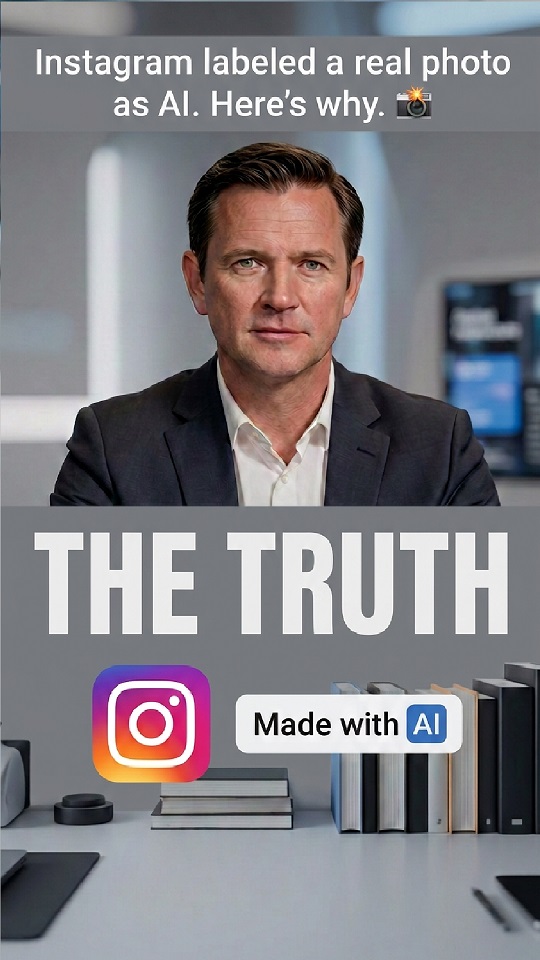
Instagram’s system for identifying artificial intelligence-generated content has created an unexpected source of confusion for photographers and creators: authentic photographs can sometimes become associated with an AI label after relatively limited AI-assisted editing.
For someone scrolling through Instagram, seeing “Made with AI” or “AI info” next to a photograph can naturally suggest that the entire image was generated by artificial intelligence.
But that interpretation is not necessarily correct.
A photograph can originate from a real camera, depict a real person or location and still contain information indicating that an AI-powered editing tool was used somewhere during its production.
That distinction has become increasingly important as artificial intelligence has moved beyond dedicated image generators and into everyday photography and editing software.
Modern editing applications can use AI for tasks such as removing unwanted objects, filling parts of an image, expanding backgrounds, retouching photographs and performing other adjustments that may affect only a small portion of the final picture.
The result is a complicated question for platforms such as Instagram: when should an image be described as AI-generated, and when should it instead be understood as a real photograph that has simply been modified with AI?
The issue became particularly visible after Meta introduced its broader system for labeling AI-generated content across Facebook, Instagram and Threads.
Meta said it was working with industry partners and using technical signals associated with industry standards to identify AI-generated images. Among the standards involved are C2PA — the Coalition for Content Provenance and Authenticity — and information contained in IPTC technical metadata.
The basic objective was straightforward. As generative AI became increasingly capable of producing realistic photographs, videos and other media, people needed additional context to help them understand whether something they were seeing had been generated or manipulated using artificial intelligence.
But the technical process is more complicated than simply examining an image and determining whether it “looks like AI.”
Digital files can carry information about how they were created or edited. When compatible AI tools add provenance or metadata signals to a file, platforms can potentially use that information when determining whether an AI-related notice should appear.
That creates an important distinction between visual authenticity and technical provenance.
A photograph may be visually authentic in the sense that its underlying scene was captured with a camera, while its digital file can simultaneously contain information showing that AI-assisted software was used during editing.
This is one reason an Instagram user can encounter an AI-related label on a photograph that does not appear to have been generated from scratch.
The issue was significant enough that Meta itself acknowledged the problem in 2024.
The company explained that some content was receiving the “Made with AI” label even when creators had used AI only for relatively minor modifications, including certain retouching functions. Meta subsequently changed the wording to “AI info”, in part because the original wording could imply a greater degree of AI involvement than had actually occurred.
Meta later made another adjustment to its approach.
In its updated policy, the company said that when content was detected as having been modified or edited using AI, the AI information could be displayed in the post’s menu. Content that Meta detected as generated by AI could receive a more prominent label.
That change was important because it acknowledged that not every use of artificial intelligence produces the same kind of content.
A photograph created almost entirely by a generative AI system is fundamentally different from a photograph captured by a camera and subsequently adjusted using an AI-powered editing function.
Yet both workflows can leave technical signals associated with artificial intelligence.
The distinction is also at the center of concerns raised by AI Metadata Cleaner, which has examined why Instagram can associate AI information with photographs that users consider genuine.
The site points specifically to modern image-editing workflows, including Adobe Photoshop’s Generative Fill and AI-assisted functions that can generate or replace pixels in an image.
For example, a photographer might begin with a conventional photograph and use an AI feature to remove an unwanted object from the background. The majority of the photograph may remain exactly as originally captured, while only a relatively small area is altered using generative technology.
From the perspective of the creator, calling the entire photograph “AI-generated” could therefore seem misleading.
From the perspective of an automated labeling system, however, the file may contain technical information indicating that an AI-powered function was used.
That difference between the creator’s understanding of the image and the platform’s interpretation of technical signals is at the heart of the controversy.
The creator-focused discussion has continued beyond Meta’s original policy announcements.
In an August 17, 2026 article and podcast episode, Instagram strategist Nicole Ialeggio discussed reports from creators who encountered AI-related labels on content they believed did not qualify as AI-generated.
Her discussion included examples involving relatively limited uses of AI-powered features and emphasized the confusion surrounding what exactly triggers the platform’s AI information system.
Those creator experiences are useful for understanding the practical problem, but they should not automatically be interpreted as a universal list of actions that will cause Instagram to display an AI label.
Different applications can handle metadata differently, files can be processed in different ways, and platform detection systems can change over time.
That is why it is important to distinguish between documented Meta policy and individual creator reports.
The strongest confirmed point is that Meta has itself acknowledged that minor AI modifications could cause labeling that did not necessarily match a creator’s expectations.
That admission is significant because it demonstrates that the company recognizes the difference between detecting evidence of AI involvement and determining how extensively artificial intelligence contributed to the final image.
It also helps explain why the wording and placement of Meta’s labels have evolved.
Another important question for creators is whether receiving an AI label automatically affects the distribution of their content.
According to Ialeggio’s discussion, Meta has stated that an AI info label itself does not reduce the number of people who can see the content. That is different from the possibility that users may react differently when they see an AI-related notice.
This distinction matters.
A platform algorithmic penalty and a change in audience behavior are two very different things.
If a viewer sees an AI label and becomes less interested in the image, that could potentially influence engagement. But that does not establish that Instagram itself is deliberately suppressing the post because of the label.
The AI Metadata Cleaner article discusses this audience-response issue, but claims about specific engagement reductions should not be confused with an official Meta statement that AI-labeled posts are algorithmically penalized.
For creators, the safest conclusion is therefore that an AI label should not automatically be interpreted as evidence of an Instagram distribution penalty.
The larger issue is transparency.
AI-generated imagery is becoming increasingly realistic, making it more difficult for people to determine authenticity simply by looking at an image.
At the same time, artificial intelligence is becoming an ordinary part of professional creative software.
A photographer can now use AI without abandoning photography as the foundation of the creative process.
This means the old distinction between “real photo” and “AI image” is becoming less useful.
There are now many points along the spectrum.
At one end is an unedited photograph captured entirely by a camera.
At another is an image generated almost entirely from an AI prompt.
Between them are countless hybrid workflows: photographs enhanced by AI, objects removed using generative tools, backgrounds expanded with generated pixels, faces retouched with AI-assisted software and images that combine conventional photography with synthetic elements.
A single label cannot always communicate those differences.
That is why Meta’s terminology change from “Made with AI” to “AI info” was more than a cosmetic adjustment.
The newer wording is broader and less likely to imply that the entire image was generated artificially.
Meta’s subsequent decision to distinguish between content that was AI-generated and content that was only modified or edited using AI tools represented another attempt to provide more context.
The technical foundation behind these systems is also evolving.
C2PA is an industry initiative designed to provide standardized information about the provenance and history of digital content.
Such systems can help communicate information about where content came from and how it was modified.
But provenance information should not be confused with a perfect artificial intelligence detector.
Meta has acknowledged that it cannot currently identify every piece of AI-generated content. The company has also explained that some invisible markers or other technical signals can potentially be removed or altered.
That creates a second side to the problem.
A real photograph that contains AI-related metadata can potentially receive an AI-related label even though only a small part of the image was modified.
Meanwhile, an AI-generated image that does not carry a detectable signal may not necessarily receive the same treatment.
In other words, an AI label is useful information, but it should not be treated as an infallible verdict about the entire history of an image.
This distinction is especially important in journalism and documentary photography.
When an image records a real event, the fact that it was captured with a camera can be fundamentally different from an image depicting an event that never happened and was generated entirely by software.
At the same time, responsible journalism has always recognized that photographs can be edited without becoming fictional. Cropping, color correction and conventional retouching have long been part of photography.
AI-assisted editing adds another layer to that longstanding debate.
The challenge for technology companies is therefore becoming increasingly nuanced.
It is not enough to ask whether AI was involved.
Platforms also need to communicate, as accurately as possible, what role AI played in producing the final content.
Meta’s policy changes indicate that the company recognizes this distinction.
Its approach has generally been to provide additional context about AI-generated or manipulated content rather than automatically treating all AI-assisted material as prohibited. At the same time, Meta has said that more prominent labeling and other enforcement can apply in situations involving manipulated or synthetic media that could materially deceive people about important matters.
That policy also extends beyond photographs.
Meta has stated that creators can face enforcement if they fail to disclose certain altered or synthetic audio or video that materially deceives people about a matter of importance.
For the present story, however, the central issue remains photographs and the way AI information is communicated to Instagram users.
For creators, the practical lesson is relatively simple: do not assume that an AI-related label means your entire photograph was generated by artificial intelligence.
Likewise, creators should not assume that the absence of such a label proves that AI played no role in creating or editing an image.
The underlying technical information, editing workflow and platform detection systems all matter.
For audiences, the lesson is equally important.
Seeing “AI info” next to a photograph should prompt a more nuanced interpretation rather than an immediate conclusion that the entire image is fake.
The label indicates that Instagram has identified information associated with AI involvement. It does not necessarily tell the complete story of how much of the photograph was generated, how much was edited or whether the original image came from a real camera.
As artificial intelligence becomes increasingly embedded in everyday creative software, this distinction will become more important.
The technology industry is moving toward a world in which AI may be involved in small parts of almost every digital creative workflow. Image editing, photography, video production and even ordinary smartphone applications are increasingly incorporating machine-learning tools.
That makes the question facing platforms such as Instagram increasingly difficult: how can a simple label communicate a complicated creative process without misleading the audience itself?
For now, Meta’s evolving labeling system represents an attempt to address that problem.
The move from “Made with AI” to “AI info”, followed by a distinction between AI-generated and AI-modified content, reflects an effort to make the labeling system more precise.
But the broader challenge remains unresolved.
As AI tools become ordinary components of photography rather than separate generators of synthetic images, users will increasingly need to understand the difference between AI-generated content, AI-assisted editing and conventional photography.
The next stage of the debate will therefore not simply be about whether Instagram can detect AI.
It will be about whether platforms can explain how AI was used clearly enough for creators and audiences to understand what they are actually looking at.
For photographers and Instagram users, that may be the most important point of all: an AI-related label is not necessarily a declaration that an authentic photograph is fake. It may simply indicate that artificial intelligence played some role in the image’s digital creation or editing history.
Key Points Summary
Instagram’s AI information system can use metadata and technical signals to identify AI involvement.
Authentic photographs can contain AI-related information after limited AI-assisted editing.
Meta acknowledged that minor AI modifications could previously result in confusing labels.
The company changed “Made with AI” to “AI info” and refined how AI-generated and AI-modified content are presented.
AI labeling does not automatically prove that an entire photograph was generated by AI.
What This Means
Why it matters: AI is becoming part of ordinary photography and editing software, making a simple “AI” label increasingly difficult to interpret without additional context.
Who may be affected: Photographers, content creators, journalists, businesses and everyday Instagram users may encounter AI-related labels on photographs they consider authentic.
What readers should watch next: The continued development of AI provenance standards, metadata systems and platform labeling policies, particularly as AI-assisted editing becomes more common.
advertisement
Frequently Asked Questions [FAQ]
Why did Instagram label my real photograph as AI?
Instagram can use technical information and metadata associated with AI tools to help identify AI-related content. A genuine photograph may therefore receive an AI-related notice if AI-assisted software was used during editing.
Does an “AI info” label mean the entire photograph was generated by AI?
No. Meta has acknowledged that relatively minor AI modifications could trigger AI-related labels. The company subsequently refined its terminology and labeling approach to better distinguish AI-generated content from content that was only modified using AI.
What happened to Instagram’s “Made with AI” label?
Meta changed the wording to “AI info” in 2024 after acknowledging that the original wording could be misleading when AI was used only for limited modifications or retouching.
What is C2PA?
C2PA, the Coalition for Content Provenance and Authenticity, is an industry initiative developing technical standards for communicating information about the origin and history of digital content.
Can Photoshop AI tools contribute to an AI label?
AI-assisted Photoshop functions, including Generative Fill, can modify an image using generated pixels and may leave technical information associated with AI involvement. However, the presence of such information does not mean that the entire photograph was generated by AI.
Does an AI label reduce Instagram reach?
An AI label should not automatically be interpreted as an algorithmic penalty. Meta has stated that an AI info label itself does not affect how many people can see the content. Audience reactions to the label are a separate issue.
Can Instagram detect every AI-generated image?
No. Meta has acknowledged limitations in AI-content detection. Technical markers and metadata may not always be available, and some signals can potentially be removed or altered.
Can a photograph be both real and AI-edited?
Yes. A photograph can originate from a real camera and depict a real scene while also being modified using AI-assisted editing software.
Why does this distinction matter?
Because AI-generated content and AI-assisted photography are not the same thing. A completely synthetic image and a genuine photograph with a small AI-assisted edit can have very different creative histories even if both contain AI-related technical signals.
Sources
Nicole Ialeggio — Episode 80: “Why Your Posts Are Suddenly Getting Flagged as AI Info”
Nicole Ialeggio — Episode 80AI Metadata Cleaner: “Why Instagram Labels Photos AI — Minor Edits”
AI Metadata Cleaner — Why Instagram Labels Photos AI
Additional Verified Sources
Meta — Labeling AI-Generated Images on Facebook, Instagram and Threads
Meta explains its use of C2PA and IPTC technical standards, metadata and invisible markers to identify AI-generated images, as well as the limitations of automated AI detection.Meta — Our Approach to Labeling AI-Generated Content and Manipulated Media
Meta explains why it changed “Made with AI” to “AI info”, including its acknowledgment that some minor AI modifications, such as retouching, could trigger the original label.
Thank you !