
Could Black Holes Have “Hair”? A New Test May Reveal Hidden Structure
Key Points
Researchers from Nagoya University and collaborators have developed a theoretical method for searching for possible “hair” around black holes.
The proposed test uses the ringdown gravitational waves emitted after a black hole is disturbed, such as after two black holes merge.
The study predicts that surrounding matter can alter the frequency and damping rate of the ringdown in different ways.
The researchers model the hair as an anisotropic fluid and apply their framework to Schwarzschild and Kerr black holes.
The work could eventually help scientists distinguish an ordinary black hole from one surrounded by additional matter or affected by physics beyond the simplest vacuum predictions of general relativity.
advertisement
Black holes are among the most extreme objects predicted by Einstein's theory of general relativity, but scientists still do not know whether every real black hole behaves exactly like the simplest mathematical solutions of the theory.
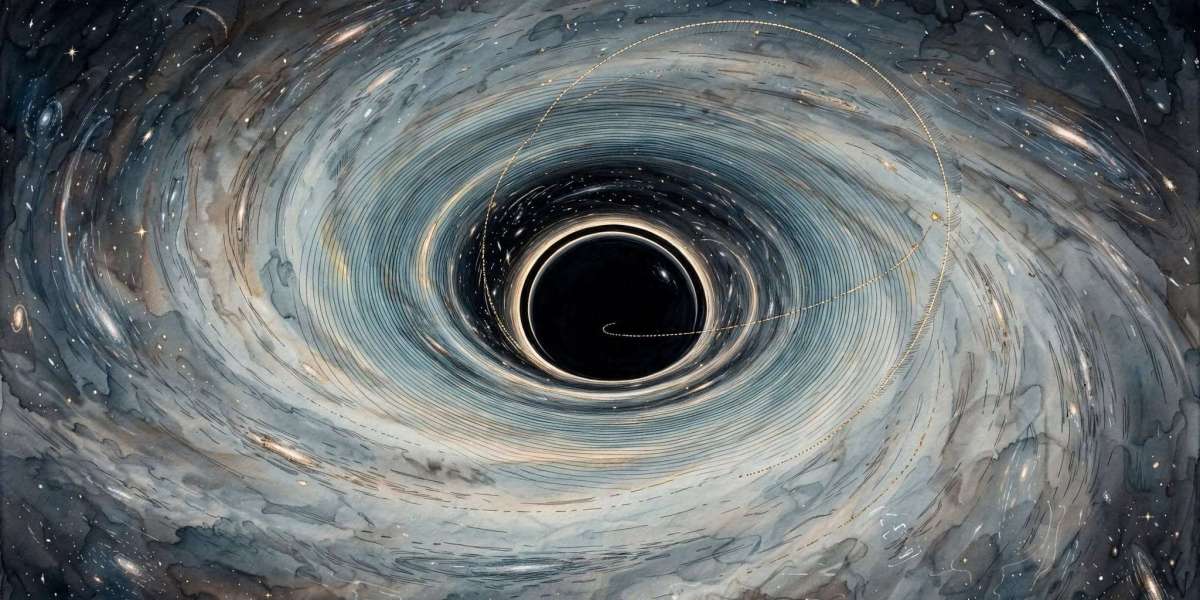
A new theoretical study has now proposed a way to look for possible evidence of something that physicists call “black hole hair” — not literal hair, but additional physical structure around a black hole that could leave subtle fingerprints in the gravitational waves it produces.
The research, led by Ariadna Uxue Palomino Ylla of Nagoya University together with Kosuke Makino, Akane Tanaka, Akihiro Ishibashi and Chul-Moon Yoo, examines how possible surrounding matter could modify the characteristic gravitational-wave signal known as ringdown. The study, titled “Ringdown waves from hairy black holes,” was published in the Journal of Cosmology and Astroparticle Physics and is also available through arXiv.
The result is a theoretical framework that could give researchers a more systematic way to ask whether a black hole's gravitational-wave signal contains evidence of additional structure.
Importantly, the study does not report the detection of a hairy black hole. Instead, it calculates what scientists should look for if such additional structure exists.
When two black holes merge, the newly formed black hole does not immediately become completely quiet. It undergoes a short period of oscillation, producing gravitational waves that gradually fade. This stage is known as ringdown.
The ringdown can be thought of as the characteristic “sound” of the newly formed black hole. Its oscillations are described by mathematical quantities called quasinormal modes, whose frequencies and damping behavior depend on the properties of the black hole and its surrounding spacetime.
For the simplest vacuum black holes considered in general relativity, the ringdown is governed by the black hole's basic properties, particularly its mass and angular momentum. But if additional matter or another form of new physics affects the region around the black hole, the researchers expect the ringdown to change.
That is where the new method comes in.
The researchers treated black-hole hair as an anisotropic fluid — a mathematical description in which the pressure can differ depending on direction — and considered it as a small perturbation added to otherwise standard Schwarzschild and Kerr black holes.
A Schwarzschild black hole is non-rotating, while a Kerr black hole has rotation. The researchers first examined static, spherical systems and then extended their analysis to rotating black holes.
The central idea depends on a relationship between the way light behaves near a black hole and the way the black hole rings.
Close to a black hole, light can follow unstable paths around it. The researchers use the unstable circular photon orbit, together with its orbital frequency and Lyapunov exponent, which characterizes how rapidly nearby trajectories diverge.
Through the established eikonal/WKB correspondence, these properties can be related to the leading behavior of black-hole quasinormal modes. In simplified terms, the orbital frequency is connected to the oscillation frequency of the ringdown, while the Lyapunov exponent controls its damping behavior.
This connection allows the researchers to calculate how a small amount of surrounding matter would modify the expected ringdown without having to solve the complete quasinormal-mode problem separately for every possible model of black-hole hair.
One of the study's most important findings is that the two main characteristics of the signal do not necessarily change in the same way.
The presence of additional matter can modify the oscillation frequency of the ringdown, but the rate at which the oscillations fade can receive an additional contribution related to the tangential pressure of the surrounding matter.
The paper expresses the leading changes in terms of the matter's density and equation-of-state parameters. In the static case, the researchers find that the fractional shift in the orbital frequency and the fractional shift in the damping parameter share a geometric contribution, while the damping shift contains an additional term involving the tangential pressure.
That difference is potentially useful.
If both properties were changed in exactly the same way, it could be harder to determine whether a modification simply reflected a change in the black hole's basic parameters. But if the frequency and damping respond differently, the relationship between them could contain information about whatever additional structure is influencing the spacetime.
The researchers therefore suggest that the pattern of the ringdown itself could potentially provide more information than simply detecting a deviation from the standard black-hole prediction.
According to the study, the effect depends not only on how much matter is present but also on how that matter's pressure is distributed. This means that a future measurement could, in principle, provide clues about the physical characteristics of the material or effective field responsible for the deviation.
The researchers also investigated several specific theoretical examples to demonstrate how their framework behaves.
For static black holes, they examine Bardeen, Hayward and Kiselev models. The Kiselev example describes a black hole surrounded by a particular effective matter distribution and allows the researchers to explore how different equation-of-state parameters alter the ringdown quantities.
The analysis was also extended to rotating black holes.
Rotation introduces additional complexity because the direction in which a photon orbit moves relative to the black hole's spin matters. The researchers therefore examine co-rotating and counter-rotating equatorial photon orbits, corresponding to rays moving with or against the black hole's rotation.
The paper emphasizes that this rotating analysis is restricted to that particular eikonal sector and should not be interpreted as a complete description of the entire rotating quasinormal-mode spectrum.
That qualification is important because the method itself has limitations.
The researchers are working in a perturbative regime, treating the additional matter as a small deviation from standard Schwarzschild or Kerr solutions. Their formulas therefore describe leading-order effects rather than arbitrary, strongly modified black holes.
There is another important limitation: the relationship between photon orbits and quasinormal modes used by the researchers is an eikonal/WKB approximation, rather than an exact statement about the full quasinormal-mode spectrum.
The paper specifically notes that this approximation is most appropriate when the angular quantum number is large. It is therefore not expected to provide precise values for the dominant gravitational-wave ringdown mode normally associated with the (2,2,0) mode. The authors describe their results as first-order, leading-eikonal predictions, rather than a full calculation of the gravitational quasinormal spectrum for every hairy black-hole model.
The researchers nevertheless argue that the framework provides a useful common language for studying a broad class of possible hairy black holes.
Rather than constructing an entirely different calculation for every proposed form of new physics, their approach connects the expected ringdown changes directly to the properties of the effective matter surrounding the black hole.
That could be particularly useful because the phrase “black hole hair” covers more than one possible physical scenario. In the study, it can represent surrounding matter, dark-sector fields, or effects associated with modified theories of gravity.
The researchers' approach also builds on the idea that black holes provide an unusually sensitive environment for testing gravity. Their intense gravitational fields can amplify subtle differences between the predictions of standard general relativity and alternative descriptions.
The Phys.org report accompanying the study explains the concept more simply: if hidden matter affects the black hole, it could alter the spacing and fading of the gravitational-wave oscillations in distinctive ways. Measuring those differences could potentially reveal information about material or physics that cannot be seen directly.
But for now, the result remains a theoretical prediction and a proposed method, rather than an observational discovery.
The authors themselves identify several directions for future work. Their current construction uses first-order perturbative effects and simple equations of state. They note that future analyses could extend the framework to higher-order perturbations and more general equations of state, including polytropic models.
Such developments would be important before the method could be applied with the precision necessary to interpret real gravitational-wave observations.
The broader goal is straightforward: listen carefully to the fading gravitational waves from black-hole mergers and determine whether their frequencies and damping behavior match what is expected from an ordinary vacuum black hole.
If they do, increasingly precise measurements could place stronger constraints on possible additional structure.
If they do not, the pattern of the discrepancy could potentially provide clues about matter surrounding the black hole or deviations from the simplest vacuum form of general relativity.
The new research therefore does not answer the question of whether black holes actually have hair. Instead, it provides scientists with a more systematic theoretical way to ask the question — and, potentially, a method for turning the faint final “ringing” of merging black holes into a probe of what surrounds them.
For now, the next step is observation: whether future gravitational-wave data contain the distinctive combination of frequency and damping changes predicted by the models remains to be determined.
Key Points Summary
“Black hole hair” refers to possible additional structure, matter or new-physics effects around a black hole — not literal hair.
Researchers developed formulas connecting possible hair to changes in ringdown gravitational waves.
The method uses the relationship between quasinormal modes, unstable photon orbits and the Lyapunov exponent.
The predicted changes in frequency and damping rate can differ depending on the surrounding matter's properties.
The work is theoretical and does not establish that hairy black holes have been observed.
What This Means
Why it matters: The study offers a systematic framework for testing whether black holes deviate from the simplest vacuum solutions of general relativity.
Who may be affected: The work is primarily relevant to researchers studying black holes, gravitational waves, general relativity and possible dark-sector physics.
What to watch next: The important question is whether increasingly precise gravitational-wave observations can reveal the predicted differences between oscillation frequency and damping behavior.
advertisement
Frequently Asked Questions (FAQ)
What is “black hole hair”?
In this research, hair refers to additional physical structure associated with matter surrounding a black hole or possible deviations from the simplest vacuum black-hole solutions. It does not mean literal hair.
Have scientists discovered a hairy black hole?
No. The study develops a theoretical method for identifying possible signatures of black-hole hair. It does not report an observational detection.
What is black-hole ringdown?
Ringdown is the period after a black hole has been disturbed — such as following a merger — when it emits damped gravitational-wave oscillations.
How could ringdown reveal hidden matter?
The research predicts that additional matter can change the oscillation frequency and damping rate differently. That difference could potentially provide clues about the presence and properties of the surrounding matter.
What kinds of black holes did the researchers study?
The framework was developed for Schwarzschild and Kerr black holes, representing non-rotating and rotating cases. The researchers also examined Bardeen, Hayward and Kiselev models as examples.
What is the main limitation of the study?
The analysis treats the additional matter as a small perturbation and relies on an eikonal/WKB approximation. The authors emphasize that their results are leading-order predictions rather than a complete calculation of the full gravitational quasinormal-mode spectrum.
Sources
Phys.org — “Do black holes have hidden hair? Scientists find a new way to check” (Phys.org)
Journal of Cosmology and Astroparticle Physics — “Ringdown waves from hairy black holes”
Thank you !