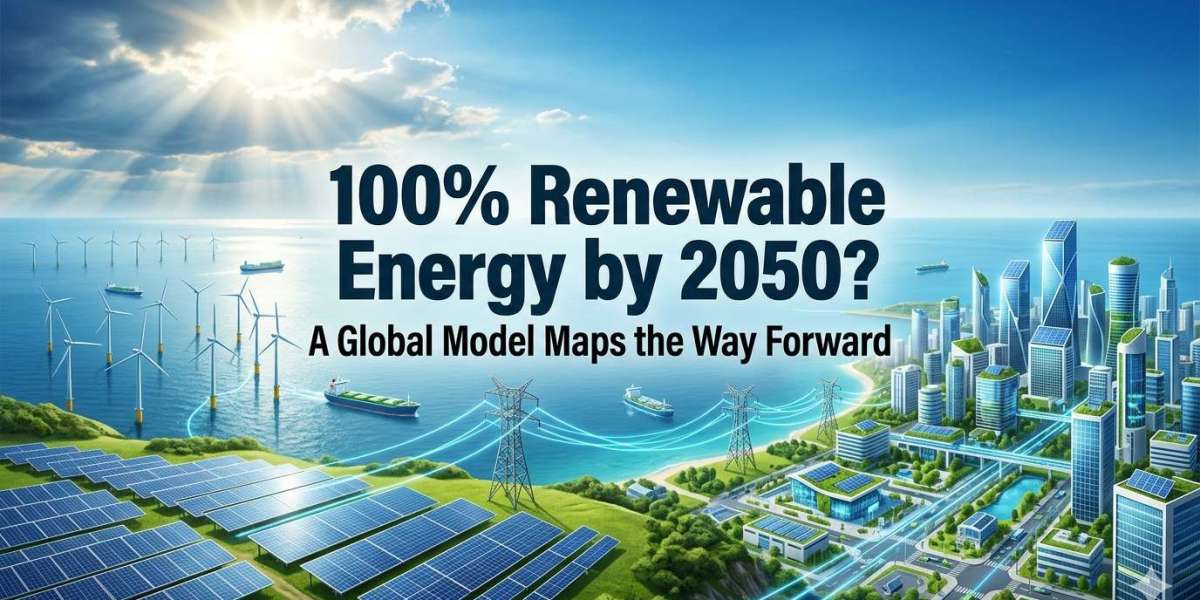

100% Renewable Energy by 2050? New Global Model Reveals a Possible Path Forward
Key Points
Researchers developed a global hour-by-hour electricity model to test whether the world can rely entirely on renewable energy by 2050.
The study found that a fully renewable global power system is technically feasible with current renewable technologies.
The model estimates the world would need approximately 15–20 terawatts (TW) of variable renewable energy (VRE) capacity, mainly from solar and wind.
More than 80% of renewable energy generation sites would be located within 200 kilometers of major electricity demand centers.
Researchers emphasized that renewable energy expansion could improve energy access and climate justice, especially in low-income regions such as Africa.
Land use remains a major challenge, with solar photovoltaic systems alone requiring over 9 million hectares globally.
The findings align with broader international net-zero roadmaps from organizations like the International Energy Agency (IEA) and other global renewable energy studies.
advertisement
A new international study has provided one of the clearest pictures yet of how the world could transition to a 100% renewable electricity system by 2050, offering a detailed global model that maps renewable energy production and demand hour by hour across every major region on Earth. According to the research published by Tech Xplore, scientists created an advanced simulation designed to determine whether solar and wind power, supported by modern energy infrastructure, could reliably meet global electricity needs while supporting decent living standards worldwide. The researchers examined renewable energy potential on a massive scale, analyzing land availability for solar panels and wind farms while also calculating how close energy generation sites would be to populated areas requiring electricity.
The findings suggest that a fully renewable global electricity system is technically achievable, although it would require enormous investments in renewable infrastructure and grid modernization. The study estimates that humanity would need between 15 and 20 terawatts of variable renewable energy capacity, primarily from wind and solar technologies, to sustain worldwide energy demand by mid-century. Importantly, the model found that more than 80% of renewable energy resources could be located within 200 kilometers of demand centers, reducing transmission challenges and improving efficiency. Researchers also highlighted that renewable resources are abundant enough to provide cost-effective electricity access for developing and low-income regions, particularly across Africa, where increased access to clean power could help advance both economic development and climate justice goals.
However, the study also underscored several major obstacles that governments and industries must address to achieve such a transition. One of the biggest concerns is land use, as solar photovoltaic installations alone may require more than 9 million hectares of land globally. Expanding renewable infrastructure at this scale would demand careful planning to minimize environmental disruption and conflicts over land allocation. The report arrives as renewable energy deployment accelerates worldwide, with countries increasingly investing in massive solar and wind projects while attempting to meet international climate targets. Recent renewable energy initiatives, including large-scale solar hubs and advanced wind turbine projects, demonstrate how nations are rapidly expanding clean energy infrastructure in preparation for long-term decarbonization goals.
The research also connects to broader international climate strategies such as the International Energy Agency’s “Net Zero by 2050” roadmap, which argues that transforming the global energy sector is essential to limiting dangerous climate change. Multiple studies over recent years have increasingly concluded that renewable-heavy energy systems are economically and technically possible, though achieving them will require faster policy action, upgraded electricity grids, large-scale energy storage, and sustained political commitment. Experts note that while renewable energy growth has exceeded expectations in many regions, challenges including infrastructure limitations, public opposition, energy storage needs, and policy uncertainty continue to affect progress toward full decarbonization.
advertisement
Frequently Asked Questions (FAQ)
What does the new renewable energy study claim?
The study claims that the world could technically operate on 100% renewable electricity by 2050 using existing renewable technologies such as solar and wind power.
How much renewable energy capacity would be needed?
Researchers estimate that around 15–20 terawatts of renewable energy capacity would be required globally to meet future electricity demand.
Which renewable energy sources are most important?
The model relies mainly on solar photovoltaic systems and wind energy, supported by modern power grids and infrastructure.
What are the biggest challenges to achieving 100% renewable energy?
Major challenges include land use requirements, grid modernization, energy storage, infrastructure expansion, and long-term political commitment.
Why is Africa important in the study?
Researchers found that renewable resources in Africa could provide affordable electricity access while supporting economic development and climate justice goals.
Is renewable energy already growing globally?
Yes. Solar and wind power are expanding rapidly worldwide, with many countries investing heavily in renewable infrastructure and net-zero initiatives.
Sources
Tech Xplore – 100% renewable energy by 2050? A global model maps the way forward
Wärtsilä – The five-step path towards a renewable energy future
Thank you !