
How Earth's Ancient Spin Helped Shape Its First Crust
Science | Earth History | Planetary Geology | November 5, 2026
Key Points
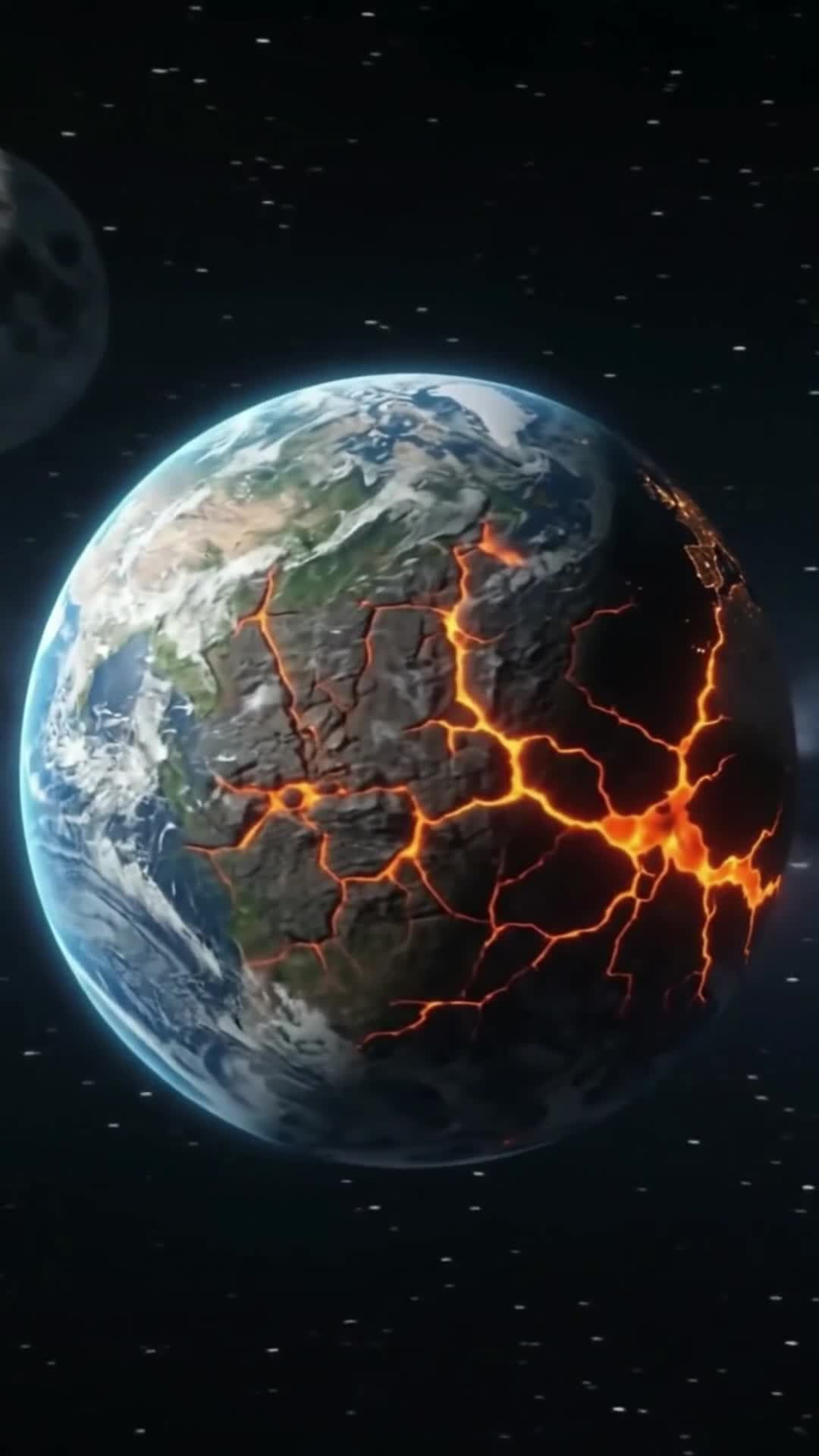
A new study published on November 2, 2026, suggests that Earth's rapid early rotation may have produced substantial differences in the thickness of its first crust.
Following the Moon-forming impact, Earth's day may have lasted between approximately 2.3 and 5 hours, depending on the formation scenario.
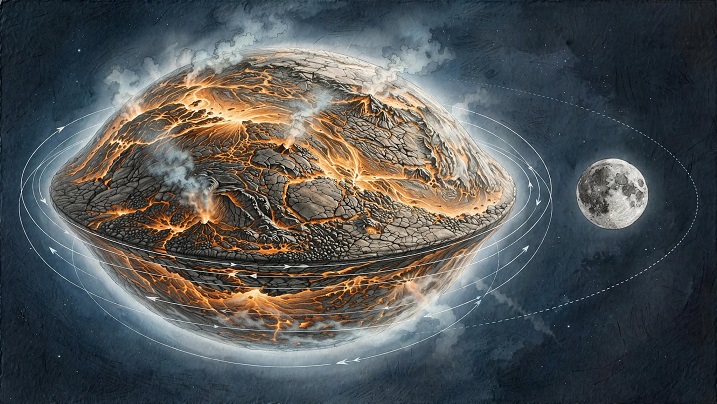
As tidal interactions slowed Earth's rotation, the planet gradually became rounder, stretching its crust near the poles and compressing it around the equator.
In some high-angular-momentum models, the resulting crustal movements could have reached rates comparable to those associated with the formation of the modern Himalayas.
The proposed mechanism could help explain early volcanism, crustal recycling and the diversity of Earth's earliest rocks.
advertisement
Earth's Changing Rotation May Have Influenced Its Earliest Crust
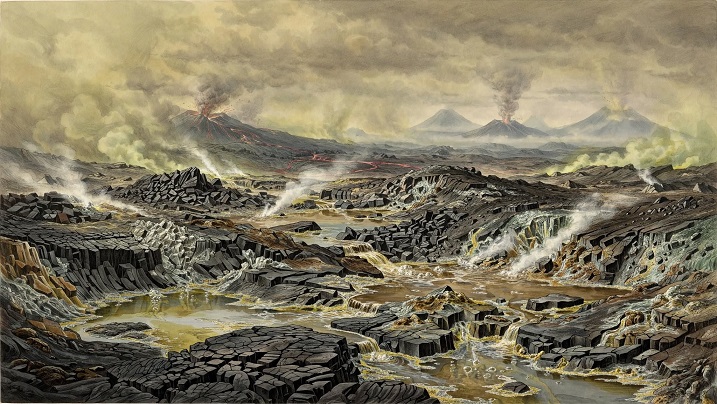
A new scientific study suggests that Earth's changing rotation may have played a previously overlooked role in shaping the planet's earliest crust, potentially influencing geological processes that helped establish the foundations of its surface.
The research, published on November 2, 2026, in the Journal of Geophysical Research: Solid Earth, examines how Earth's shape changed as its rotation gradually slowed following the giant impact associated with the formation of the Moon.
The study, conducted by S. J. Lock, combines planetary-structure calculations with models of the Moon's orbital evolution. Its findings suggest that the early Earth's rapid spin may have created significant differences in crustal thickness between equatorial and polar regions. As the planet gradually became more spherical, the resulting changes in its shape could have driven extensive deformation of its surface.
Importantly, the research presents a geophysical explanation based on numerical modelling rather than direct observations of Earth's vanished primordial crust. Almost all evidence of Earth's earliest crust has been destroyed or altered by billions of years of geological activity and erosion, making models particularly important for investigating this period.
How the Moon-Forming Impact Left Earth Spinning Rapidly
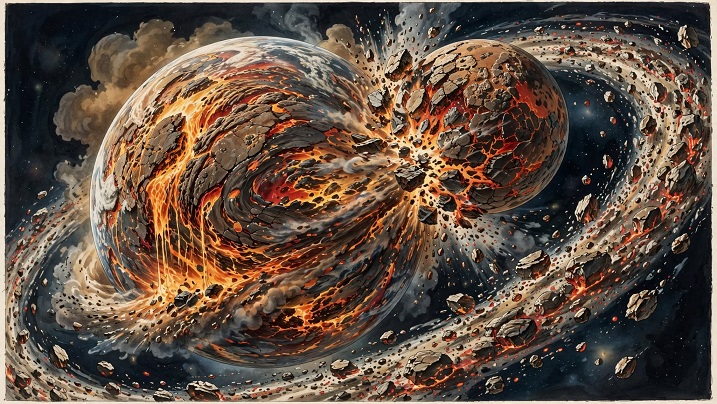
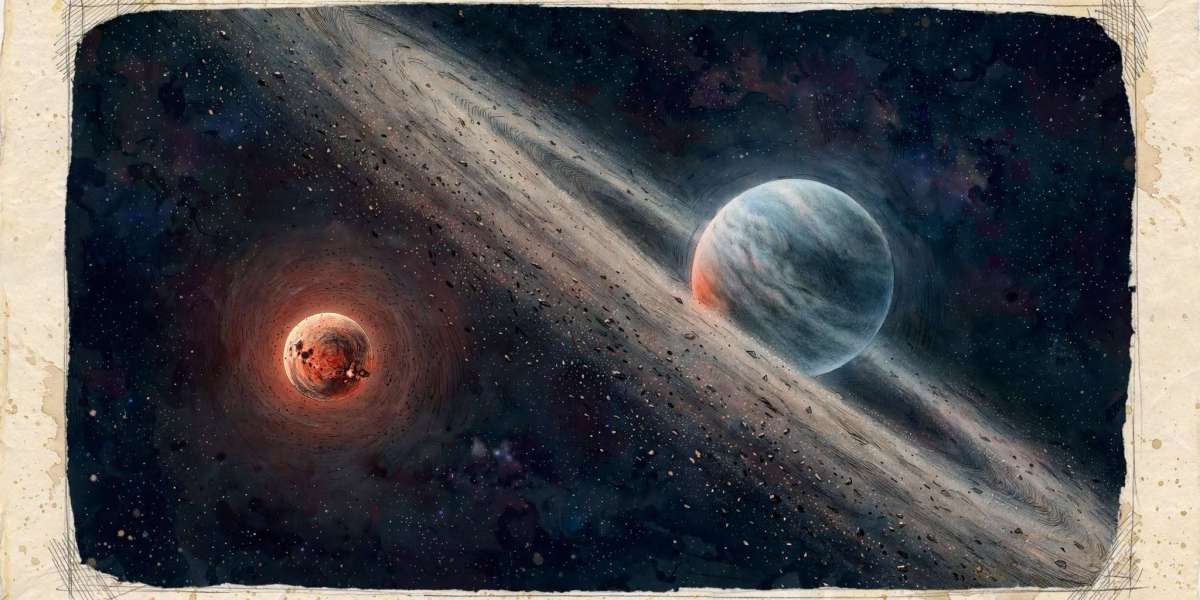
Earth's early rotational history is closely connected to the event that produced the Moon approximately 4.5 billion years ago. According to the giant-impact model, a planetary-sized object collided with the young Earth, releasing enormous quantities of material into orbit. Much of that debris eventually accumulated to form the Moon.
The collision also left the Earth-Moon system with substantial angular momentum, much of which was initially concentrated in Earth's rapid rotation. The resulting planet was very different from the relatively spherical Earth familiar today.
Lock's calculations examine different possible initial conditions for the Earth-Moon system. In the conventional, or canonical, scenario, Earth's day lasted approximately five hours after the Moon formed. In alternative high-angular-momentum scenarios, the rotational period could have been as short as approximately 2.3 hours.
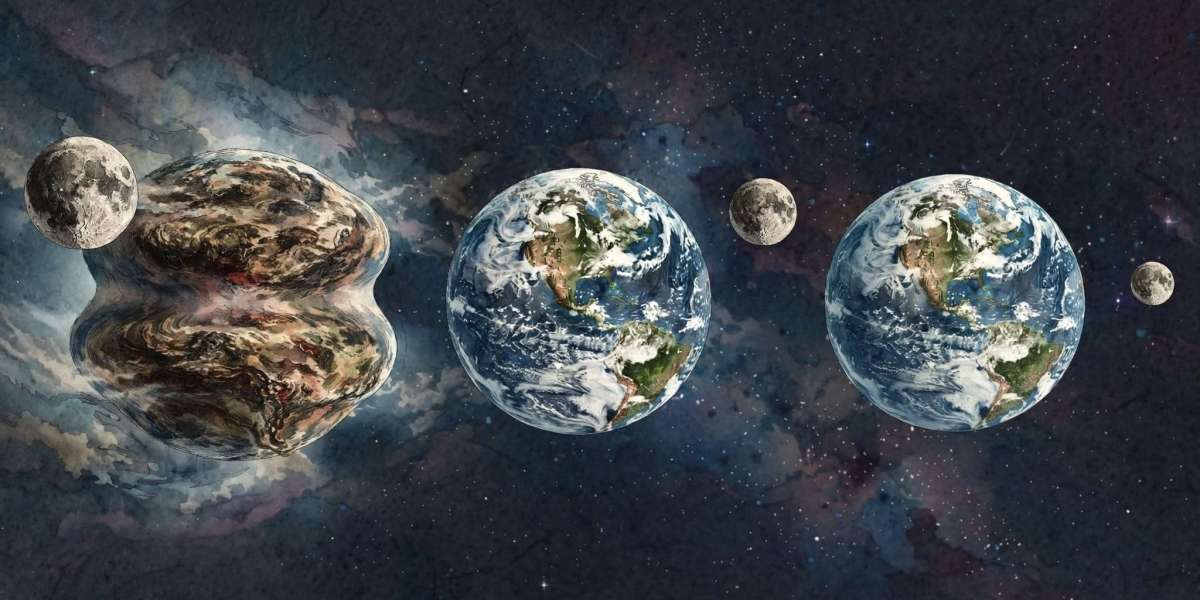
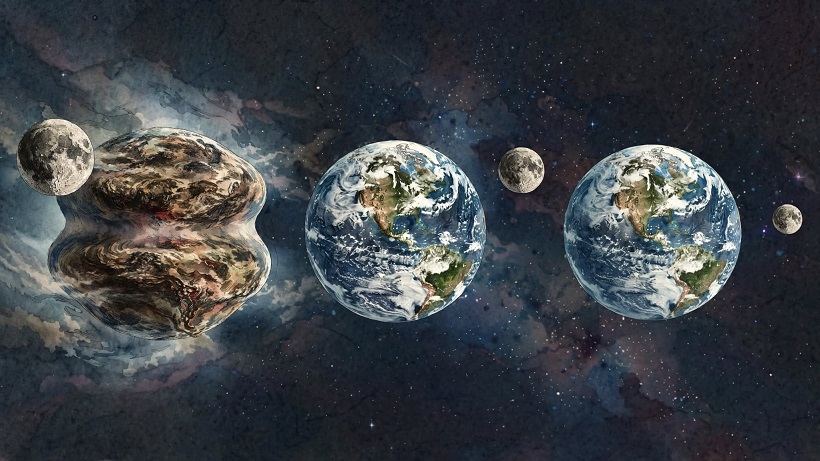
Such rapid rotation would have produced a pronounced equatorial bulge. Instead of having an almost spherical shape, Earth would have been significantly flattened at its poles and expanded around its equator.
In the most extreme scenarios considered, the equatorial radius could have been approximately twice the polar radius. This is a model-dependent possibility rather than a claim that every proposed early-Earth scenario produced such an extreme shape.
The Moon's Gradual Recession Changed Earth's Shape
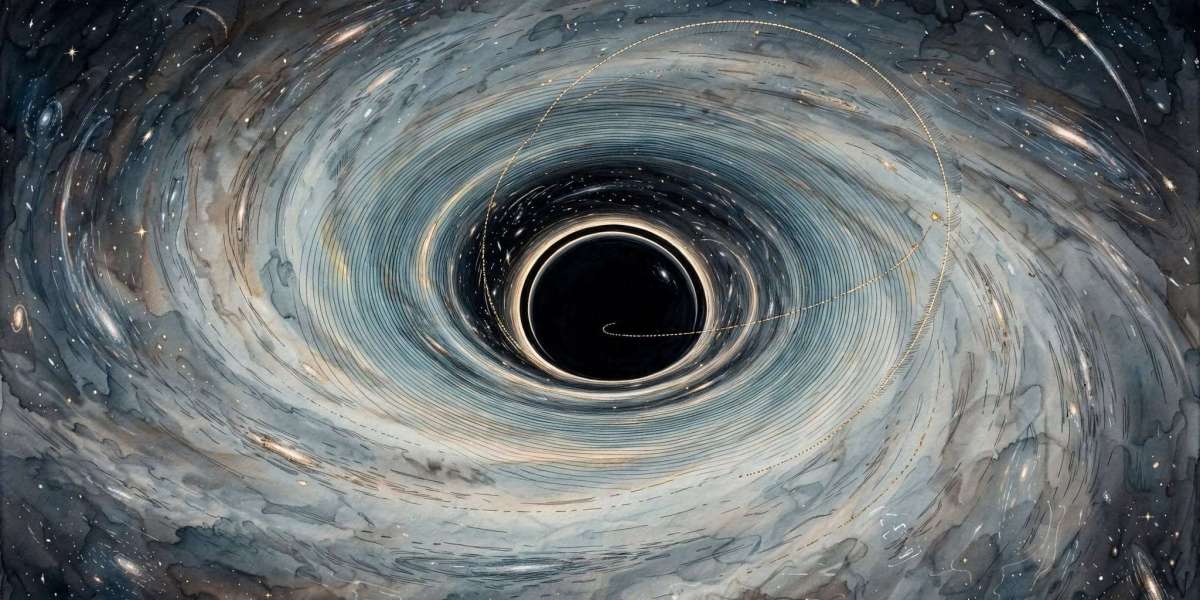
The early Earth's unusual shape did not remain permanent. Gravitational interactions between Earth and the Moon gradually transferred angular momentum from Earth's rotation into the Moon's orbit. As a result, the Moon moved farther away while Earth's rotational speed decreased.
This process, known as lunar tidal recession, is closely connected to the gradual lengthening of Earth's day. The reduced centrifugal effect of rotation allowed the planet to become progressively more spherical, reducing its pronounced equatorial bulge.
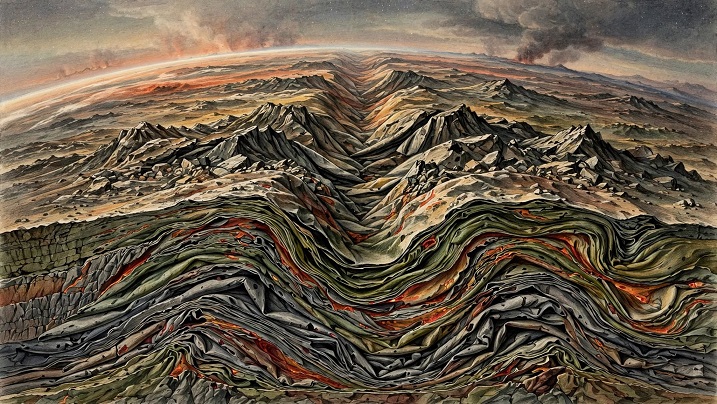
The study examines how this transition affected the planet's internal structure and surface. As Earth's shape changed, the gravitational field and pressure distribution also evolved. These changes created conditions under which the young crust could be compressed in some regions while being stretched in others.
The timing is important. Models of magma-ocean solidification suggest that Earth's surface could have formed a crust within approximately a couple of million years after the Moon-forming impact. The research argues that this crust likely developed while Earth was still rotating rapidly and subsequently experienced deformation as the Moon moved outward.
Why Earth's First Crust May Have Been Thicker at the Equator
One of the study's central findings concerns the relationship between Earth's rapid rotation, surface gravity and the formation of its first crust.
On a rapidly rotating planet, centrifugal effects partially counteract gravity, particularly around the equator. This means that the effective surface gravity would have been considerably weaker in equatorial regions than near the poles.
That difference could have influenced how molten material separated from Earth's early mantle. As the magma ocean cooled, crystals accumulated and melt moved upward, eventually contributing to the formation of the first solid crust.
According to Lock's calculations, lower gravity near the equator would have allowed a larger volume of mantle material to remain partially molten at the time the surface solidified. This could have provided more material for crust formation in equatorial regions than near the poles.
The predicted differences depend strongly on the initial angular momentum of the Earth-Moon system. In the conventional scenario, the variation in crustal thickness between the equator and poles would have been approximately 15%. In the highest-angular-momentum scenarios, however, the difference could have reached a factor of 10.
These figures represent modelled possibilities rather than measurements of actual ancient crust. Nevertheless, they suggest that the first crust may have been considerably more uneven in thickness than traditional simplified models of early Earth would indicate.
A Planet-Wide Pattern of Compression and Extension
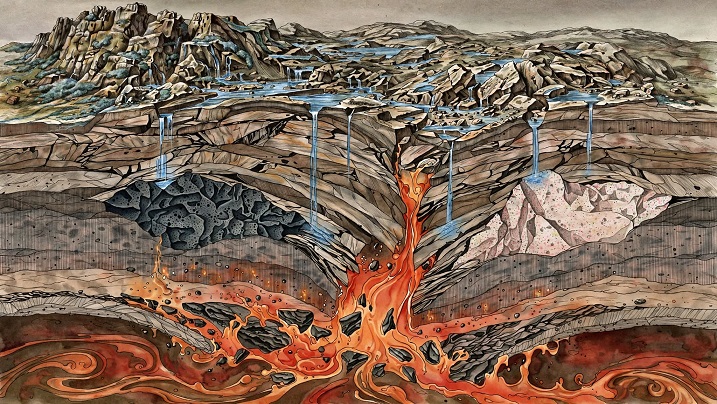
The study's second major finding concerns what happened after the first crust formed.
As Earth's rotation slowed and the planet became rounder, its surface underwent substantial changes in shape. The equatorial regions experienced a reduction in surface dimensions, while regions closer to the poles expanded.
This created two different patterns of geological deformation. Around the equator, the crust was compressed, encouraging convergence and potentially increasing crustal thickness. At higher latitudes, particularly beyond approximately 20–40 degrees north and south, the surface experienced extension, which could have stretched and thinned the crust.
The scale of these changes depended on the original angular momentum of the Earth-Moon system. In the conventional scenario, the total change in local surface area was generally several percent. In some high-angular-momentum scenarios, the calculated cumulative change could exceed 100%.
Such deformation would not necessarily have produced modern-style plate tectonics in the same configuration seen today. The early crust was hotter, potentially thicker and mechanically different from the present lithosphere. The study therefore considers several possible ways in which the crust could have accommodated the stresses, including faulting, localized deformation and movement along developing tectonic boundaries.
Could Early Earth Have Experienced Tectonic Activity Comparable to the Himalayas?
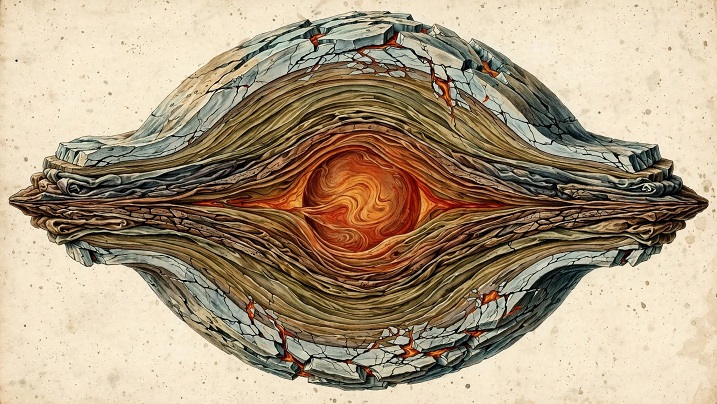
One particularly striking result involves the possible speed of crustal deformation.
In certain high-angular-momentum scenarios, changes in Earth's rotation and shape could have produced short-lived episodes of particularly rapid deformation. The study calculates that some of these episodes could have reached rates comparable to those associated with the convergence responsible for forming the modern Himalayan mountain system.
The comparison requires careful interpretation. The research does not suggest that an ancient Himalayan mountain range existed around Earth's equator. Instead, it compares calculated deformation rates with those associated with modern tectonic processes.
In one example, the model produces deformation-rate peaks lasting approximately one million years, reaching around 2 millimeters per degree of longitude per year along the equator. The author compares this with the average deformation rate across the Himalayan convergence zone.
Unlike the modern Himalayas, however, the proposed deformation would have occurred around the entire equatorial region rather than being concentrated along a single continental collision zone.
Even in the conventional scenario, the research finds that early crustal deformation rates could have exceeded or matched those accommodated by some modern tectonic features during the first few million years of lunar tidal evolution.
How Crustal Recycling Could Have Produced Different Types of Rocks
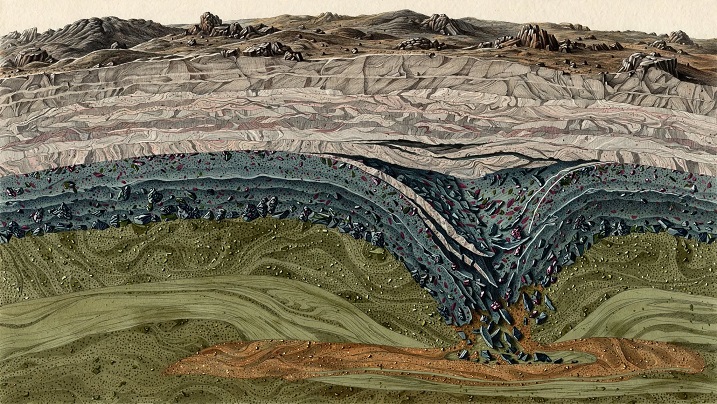
The implications extend beyond the physical shape of Earth's crust. The researchers also explore how the proposed deformation could have contributed to the development of different rock types during the planet's earliest history.
As the equatorial crust experienced compression, surface material altered by water and chemical weathering could have been pushed deeper into the planet. Increasing pressure and temperature at depth could then have encouraged partial melting.
Water and carbon can lower the melting temperature of silicate rocks, making the melting of buried crustal material more likely under suitable conditions. The resulting magma could have cooled and solidified into more evolved, silica-rich rocks, including felsic compositions.
At the same time, stretching and faulting in polar regions could have encouraged material from deeper parts of the crust and mantle to rise and undergo decompression melting. This would provide another possible pathway for producing different rock compositions.
These processes offer a potential explanation for why evidence from ancient zircons and surviving rocks indicates that chemically diverse crust appeared relatively early in Earth's history.
The research suggests that the combination of crustal compression, burial, melting and subsequent recycling could have contributed to the development of this diversity within tens of millions of years after the Moon-forming impact.
Changes Deep Inside Earth Could Have Left Long-Term Geological Evidence
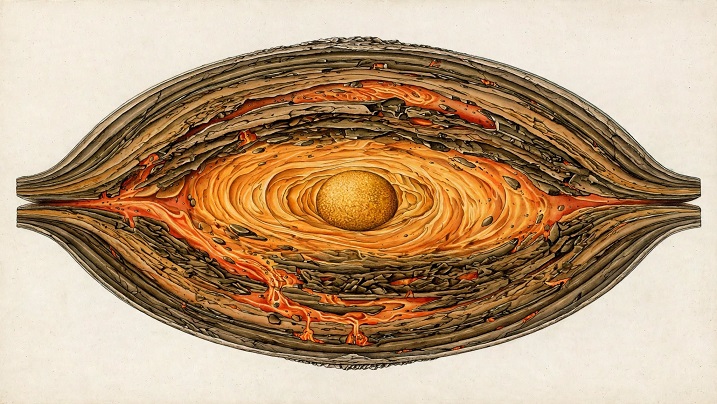
Another proposed consequence involves the relationship between Earth's crust and its mantle.
As the planet became more spherical, the pressure within its crust increased. Under certain conditions, this could have triggered mineral transformations that changed the density of some crustal materials.
The study discusses the possibility that parts of the lower crust could have developed minerals associated with denser rock compositions, including garnet-bearing eclogite. If these materials became denser than the underlying mantle, sections of the crust could have detached and descended into the deeper interior through a process known as delamination.
This process could have transported chemically enriched material into the mantle while leaving behind regions with a different composition.
Over geological time, these contrasting regions could have contributed to chemical and isotopic variations within Earth's interior. The author suggests that such ancient mantle reservoirs may be relevant to interpreting geochemical evidence preserved in some of Earth's oldest rocks.
These consequences remain proposed mechanisms rather than directly demonstrated events. Their importance will depend on the composition of the early crust, its temperature, pressure and ability to deform or detach.
What the Findings Could Mean for Earth's Early Environment
The proposed geological changes may also have influenced the environment at Earth's surface.
The study explores how early tectonic activity could have affected volcanic activity, the release of gases from Earth's interior and the chemical composition of the atmosphere and oceans.
For example, extension in polar regions could have encouraged material from deeper layers to rise and melt, potentially increasing the release of gases from the mantle and crust. Meanwhile, the formation and weathering of different rock types could have changed the availability of chemical elements in early oceans.
The author also considers whether the formation of lower-density, more evolved crust could have allowed some regions to rise high enough to emerge above the ocean. Such exposed land could have provided environments for weathering and chemical interactions between rocks, water and the atmosphere.
However, the researchers caution that the early lithosphere may have been too thin to support substantial, long-lasting elevated terrain. Although lower-density evolved crust could potentially have risen high enough to emerge above the ocean, the extent and stability of such dry land remain uncertain and require further modelling.
One proposed possibility is that weathering and carbonate formation could have helped remove some carbon from the early atmosphere. However, the study emphasizes that the ability of early crust to support long-lasting dry land remains uncertain and requires further modelling.
These findings are relevant to discussions about Earth's early habitability, but they do not establish that rotation-driven tectonics caused life to emerge. Rather, they identify a possible geological influence on the conditions that eventually developed on the young planet.
Scientific Limitations and What Researchers Need to Investigate Next
Despite the potential importance of the findings, several uncertainties remain.
The most significant challenge is the limited geological record. Almost all of Earth's earliest crust has been destroyed, transformed or recycled through billions of years of tectonic activity and erosion. Scientists therefore cannot directly measure the original crustal thickness or reconstruct its complete geological history.
There are also uncertainties surrounding the early Earth-Moon system. The initial angular momentum, the Moon's orbital evolution and the tidal properties of the young, partially molten Earth remain subjects of scientific investigation. Different assumptions can produce substantially different estimates of how quickly Earth's rotation slowed and how much its shape changed.
Another important limitation concerns the mechanical properties of the early crust. Its response to compression and extension would have depended on its temperature, composition, thickness and ability to deform.
The study also distinguishes between rotational effects on Earth's shape and their influence on internal convection. Although Earth's rapid spin would have affected fluid-dominated regions of the early magma ocean, the author concludes that the Coriolis force would have had a negligible effect on convection within the highly viscous solid mantle and partially molten, crystal-locked regions. Instead, the proposed tectonic mechanism primarily involves the deformation caused by changes in Earth's shape and gravitational field. How these processes interacted with mantle convection and other geological forces remains an important question for future research.
The author therefore describes the research as an exploratory study based on first-order calculations and qualitative interpretations. Future work will need to combine more detailed models of tidal evolution, planetary cooling, mantle convection and crustal deformation.
Such investigations could help determine how important rotational changes were compared with other forces, including mantle convection and impacts, in shaping the first geological environment on Earth.
A New Factor in Understanding Earth's Geological Origins
The research introduces Earth's changing rotation as an additional factor that scientists may need to consider when investigating the formation and evolution of the planet's earliest crust.
Its central contribution is the connection between lunar orbital evolution, changes in Earth's shape and the mechanical and chemical development of the young crust. Rather than treating early Earth as a planet with a fixed structure, the study examines how its changing rotational state could have influenced geological processes across different latitudes.
Although further research is needed to establish the magnitude of these effects, the proposed mechanism could help explain some features of Earth's early rock record that remain difficult to understand through existing models alone.
The findings also highlight the broader relationship between Earth's history and the Moon. The gradual separation of the two bodies may have influenced not only the length of Earth's day but also the physical conditions under which the planet's earliest crust evolved.
For scientists investigating how Earth became the geologically diverse and potentially habitable planet it is today, understanding this early period remains an important part of the larger story.
Key Points Summary
Earth's rapid rotation following the Moon-forming impact may have significantly influenced the structure of its first crust.
The earliest crust may have been substantially thicker around the equator than near the poles.
As the Moon moved away, Earth's slowing rotation changed the planet's shape and generated crustal compression and extension.
Some modelled deformation rates were comparable to those associated with modern Himalayan tectonic activity.
Crustal recycling and remelting could help explain the early appearance of diverse rock compositions.
The research introduces rotational evolution as an important additional factor in understanding Earth's geological history.
Further research is needed to establish how these processes interacted with mantle convection and other geological forces.
What This Means
Why these developments matter
The findings provide a possible explanation for how Earth's earliest crust developed and became chemically and structurally diverse. They also highlight how the Moon's gradual recession may have influenced geological processes on Earth.
Who may be affected
The research is particularly relevant to planetary scientists, geologists and researchers studying Earth's early history, crust formation, mantle evolution and the conditions that supported the development of life.
What readers should watch next
Future research will need to establish how tidal evolution, planetary cooling and mantle convection interacted. Scientists will also need to determine whether the proposed processes can explain specific chemical and isotopic signatures preserved in ancient rocks.
advertisement
Frequently Asked Questions (FAQ)
1. Why was early Earth spinning so quickly?
The giant impact associated with the Moon's formation left the Earth-Moon system with substantial angular momentum. This contributed to Earth's extremely rapid rotation, with an estimated day lasting between approximately 2.3 and 5 hours in the scenarios examined.
2. How did the Moon affect Earth's rotation?
Gravitational tidal interactions transferred angular momentum from Earth's rotation into the Moon's orbital motion. As the Moon moved farther away, Earth's rotation gradually slowed.
3. Was early Earth really shaped like a flattened sphere?
According to the study's most extreme high-angular-momentum scenarios, Earth's equatorial radius could have been approximately twice its polar radius. Less extreme scenarios produced smaller differences.
4. Why could the first crust have been thicker near the equator?
Rapid rotation reduced effective gravity around the equator. This could have allowed more mantle material to remain partially molten and contribute to crust formation in those regions.
5. How much thicker could the equatorial crust have been?
The study estimates that the equator-to-pole variation could have reached a factor of 10 in the highest-angular-momentum scenarios. In the conventional scenario, the difference was approximately 15%.
6. Did the early Earth experience plate tectonics like today?
The study proposes that changes in Earth's shape could have driven or influenced tectonic deformation. However, the exact mechanisms through which the early crust accommodated these stresses remain uncertain.
7. What does the Himalayan comparison mean?
Some high-angular-momentum models produced short-lived deformation rates comparable to those associated with the modern Himalayan convergence zone. This is a comparison of geological deformation rates, not evidence that a Himalayan-like mountain range existed on early Earth. The modelled equatorial deformation rate is expressed per degree of longitude, not latitude.
8. Could these processes explain the diversity of ancient rocks?
Potentially. The proposed mechanisms include the burial and remelting of weathered crust, decompression melting and crustal recycling, which could have contributed to the formation of different rock compositions.
9. Can scientists directly observe Earth's original crust?
Almost none of the earliest crust has survived unchanged. Geological activity and erosion over billions of years destroyed or transformed most of this ancient record, which is why researchers rely on geological evidence and numerical modelling.
10. Does the study prove that Earth's rotation helped create life?
No. It proposes that rotationally driven geological processes may have influenced the early surface environment and conditions relevant to habitability. It does not demonstrate that these processes caused life to emerge.
Sources
S. J. Lock — Tectonics on Early Earth Driven by Earth's Changing Shape During Tidal Recession of the Moon. Journal of Geophysical Research: Solid Earth, November 2, 2026.
https://agupubs.onlinelibrary.wiley.com/doi/10.1029/2025JB033676
Sam Jarman — Earth's slowing spin may have shaped its primordial crust. Phys.org, November 5, 2026.
https://phys.org/news/2026-11-earth-primordial-crust.html
Additional Verified Sources
No additional sources used.
Thank you !