
Scientists Trace Global 60-Second Power Grid Fluctuations to Synchronized Battery Systems
Key Points
Researchers have identified the cause of unexplained electricity-grid frequency fluctuations recurring every 60 seconds.
The phenomenon originates primarily from synchronized software routines in battery-based uninterruptible power supply (UPS) systems.
Measurements across 12 electricity grids on five continents revealed the recurring pattern.
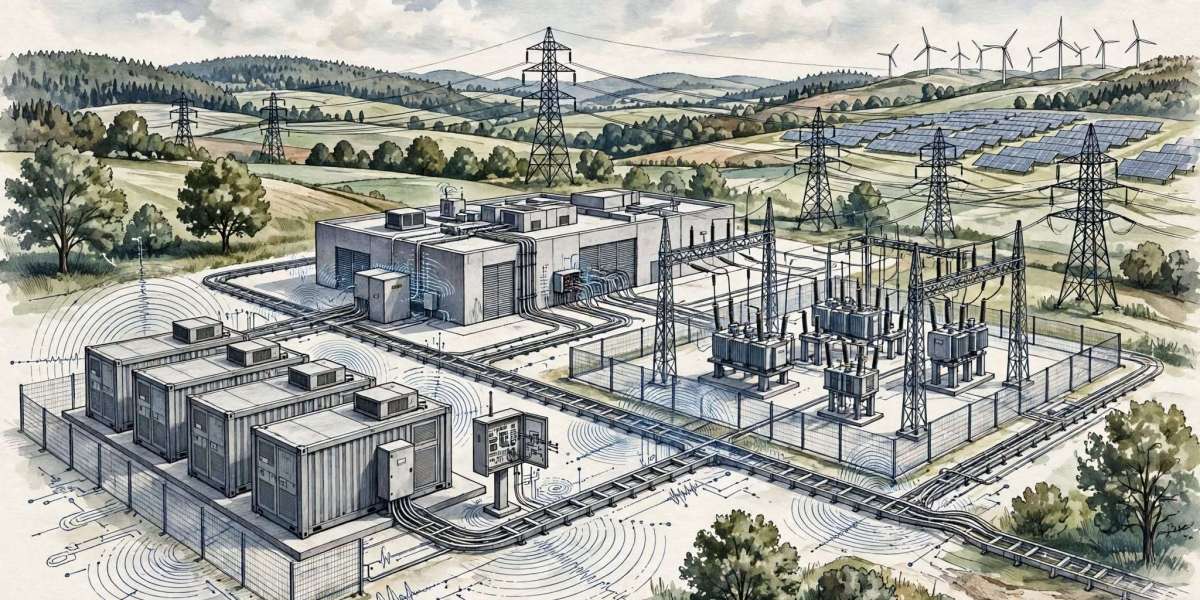
The researchers traced periodic battery current peaks through electrical infrastructure to a connection with the 110-kilovolt high-voltage grid.
Randomized scheduling and improved software control could reduce the fluctuations and help protect power infrastructure from unnecessary wear.
advertisement
A Mysterious Pattern Appearing Across Electricity Grids
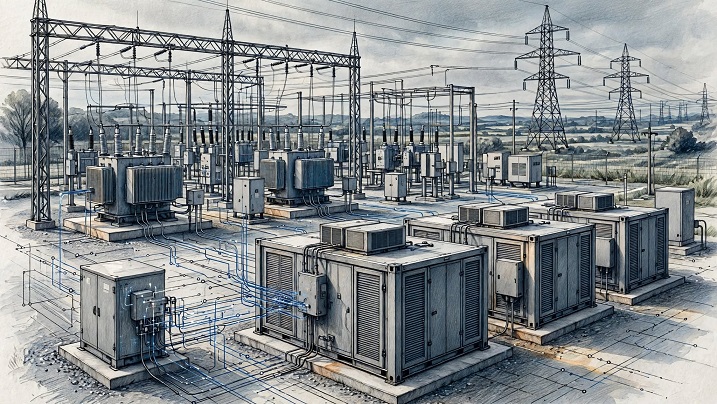
Researchers have identified the source of a persistent electrical disturbance that has appeared in power-grid measurements around the world: a remarkably regular fluctuation repeating every 60 seconds. The phenomenon, which remained unexplained for years, is linked to digitally controlled energy equipment whose software routines operate in synchronization with external clocks.
The findings, published in Nature Energy on October 30, 2026, reveal how battery-based uninterruptible power supply (UPS) systems can produce recurring electricity-demand peaks through periodic battery self-tests. When numerous devices perform these operations at synchronized times, their individual power demands combine into a measurable disturbance that can propagate through electricity networks.
The research, titled One-minute frequency disturbances from unintended synchronization in cyber–physical power systems, was conducted by researchers associated with Forschungszentrum Jülich, RWTH Aachen University, the University of Cologne and the Karlsruhe Institute of Technology, alongside collaborators.
The discovery matters because it identifies a previously overlooked connection between software-controlled equipment and the physical operation of electricity grids. Although the observed signal has not reached a safety-critical level, the researchers warn that its magnitude could increase as battery storage, data centers and connected electronic devices become more widespread.
A Global Pattern Across 12 Electricity Grids

The investigation began with an unusual observation by electricity-grid operators: frequency measurements repeatedly showed a brief disturbance at intervals of exactly one minute.
To establish whether the phenomenon was limited to a particular network, the researchers examined electricity-frequency measurements from 12 power grids across five continents. The investigated systems included Continental Europe, Great Britain, Scandinavia, Australia, the western and eastern United States, Malaysia, South Korea, South Africa, Mallorca, Ireland and Iceland.
The results revealed a narrow, clearly identifiable signal at a period of one minute across all the investigated grids. It appeared in both large interconnected electricity systems and smaller networks, including island grids.
The consistency of the pattern was particularly important. Its waveform remained phase-coherent over multiple years, suggesting that the disturbance was not simply a random fluctuation or a conventional oscillation arising naturally from the physical characteristics of a power network.
The researchers also identified a weaker signal with a period of approximately 100 seconds. However, its origin remains uncertain and was not explained by the study.
Why a 60-Second Frequency Fluctuation Matters
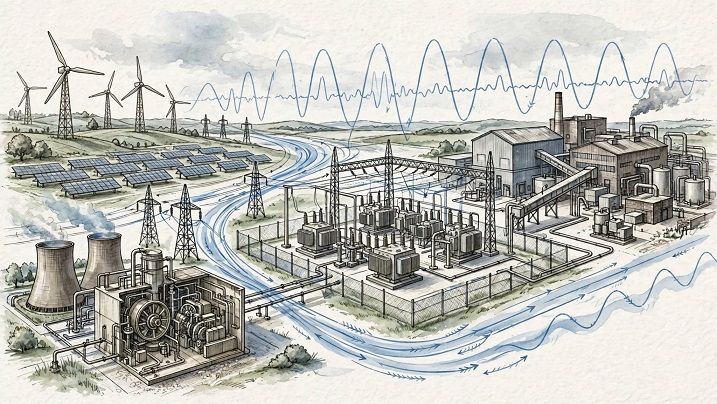
Electricity-grid frequency provides an important indication of the balance between electricity generation and consumption. When generation exceeds demand, frequency tends to rise. When demand exceeds available generation, frequency falls.
Electricity systems must continuously maintain their operating frequency around a nominal value, commonly 50 Hz or 60 Hz, depending on the network.
The newly identified disturbance represents a recurring imbalance between electricity supply and demand. The researchers found that the frequency typically decreases during the first part of each minute, indicating that consumption temporarily exceeds generation.
For the Continental European synchronous grid, the researchers estimated that a frequency-pattern amplitude of approximately 3 millihertz (mHz) corresponds to a coherent power variation of around 80 megawatts (MW).
This illustrates how the combined activity of many relatively small devices can produce a measurable effect across a much larger electricity network.
The amplitude is not constant throughout the day. Measurements showed weaker signals during nighttime hours and stronger fluctuations during periods of higher daytime activity. The pattern also exhibits seasonal variations.
Battery Self-Tests Reveal the Missing Link
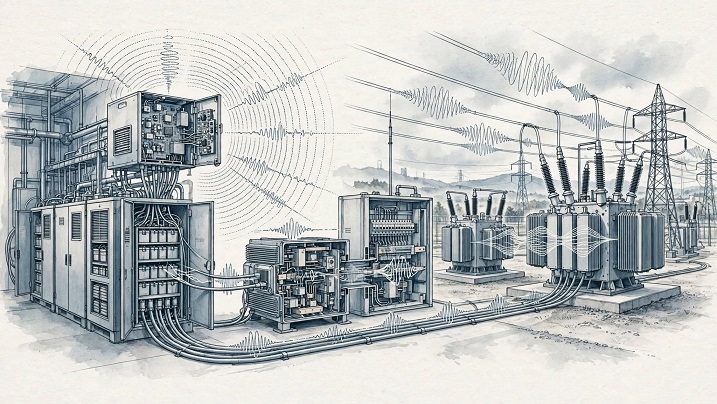
The researchers investigated several possible explanations, including the behavior of hydropower turbine-governor systems, which can amplify oscillations through feedback effects.
However, these mechanisms alone could not explain why the signal maintained such precise timing across different electricity grids for extended periods.
Attention therefore shifted toward digitally controlled equipment operating according to external clock signals or regularly scheduled software routines.
A major breakthrough came from measurements conducted at Forschungszentrum Jülich's research campus, where more than 80 power-quality meters monitor electricity consumption and grid behavior.
The researchers examined measurements from multiple buildings and transformers. They discovered that four buildings displayed a pronounced one-minute pattern in their electrical demand. Importantly, all four contained battery-based UPS installations, while the measured buildings without such systems did not show the same pattern.
The team then investigated one UPS installation in greater detail, monitoring battery current, electrical consumption and power flows at different points in the system.
Measurements revealed narrow current peaks occurring every minute at the battery terminals. The manufacturer independently confirmed that these peaks were caused by periodic self-tests performed by the battery's energy management system.
These diagnostic operations help monitor the battery system, but their synchronized timing creates a problem when many devices perform them together.
How Software Synchronization Spreads the Disturbance
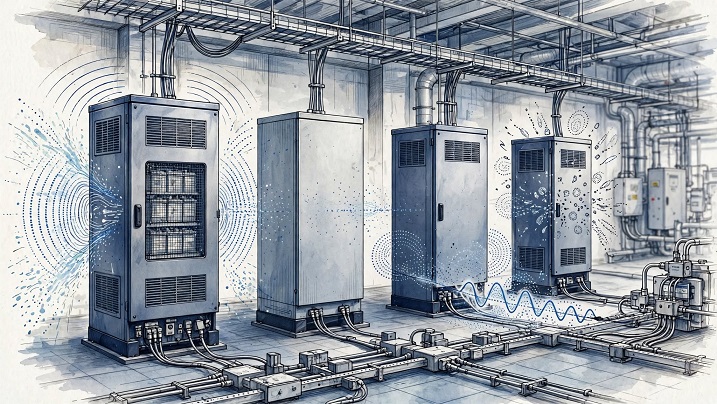
The researchers demonstrated that the disturbance does not remain confined to the battery itself.
By measuring electrical currents and power flows at different stages of the UPS installation, they traced the recurring signal from the battery's direct-current side through the alternating-current equipment and several transformers.
The measurements showed that the one-minute pattern could be identified in power demand along the electrical infrastructure, extending to the transformer connecting the campus network to the public 110-kilovolt high-voltage grid.
This provided direct evidence that relatively small, recurring operations inside digitally controlled equipment can influence electricity consumption at a much larger network level.
The role of clock synchronization was investigated using the Network Time Protocol (NTP), a system that synchronizes computer and equipment clocks with Coordinated Universal Time (UTC).
When NTP synchronization was disabled in the investigated UPS installation, the timing signatures of its self-tests gradually drifted relative to UTC.
When synchronization was enabled, the researchers observed a substantially more pronounced daily progression in the timing pattern, reaching approximately six seconds per day. The shift occurred in a discontinuous manner, with the phase remaining stable during the day and changing at midnight.
The findings indicate that internally scheduled battery-management routines can become synchronized through external clock adjustments, allowing recurring operations across multiple devices to produce a coherent electrical disturbance.
Ireland Shows How the Signal Can Become Stronger
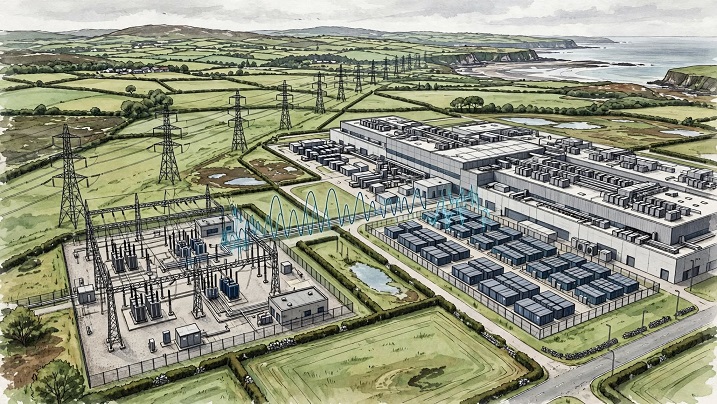
The research also highlights how the disturbance has changed over time in different electricity systems.
In Great Britain and Scandinavia, the researchers observed substantial increases in the signal's amplitude after 2015, with particularly high levels around 2020.
The study identifies declining system inertia as one factor that can make such disturbances more pronounced. System inertia describes the resistance of an electricity network to changes in frequency, traditionally supported by the rotating masses of synchronous generators.
As electricity generation increasingly relies on converter-connected renewable sources, the effective inertia of a power system can decrease. Consequently, the same power imbalance may produce a larger frequency response.
The researchers also examined Ireland, where data centers accounted for approximately 18% of national electricity consumption in 2022. The magnitude of the one-minute frequency drop increased from approximately 3 mHz in 2016 to 12 mHz in 2021.
More recent measurements discussed in the paper showed that individual frequency drops could exceed 20 mHz. When combined with larger frequency excursions, these disturbances could bring the system closer to the limits of its target operating range.
The researchers associate the increasing relevance of the phenomenon with the expansion of data centers equipped with large UPS installations, although the study does not attribute every change in the Irish signal to data centers alone.
Hydropower Turbines and Other Digital Devices Face Potential Consequences
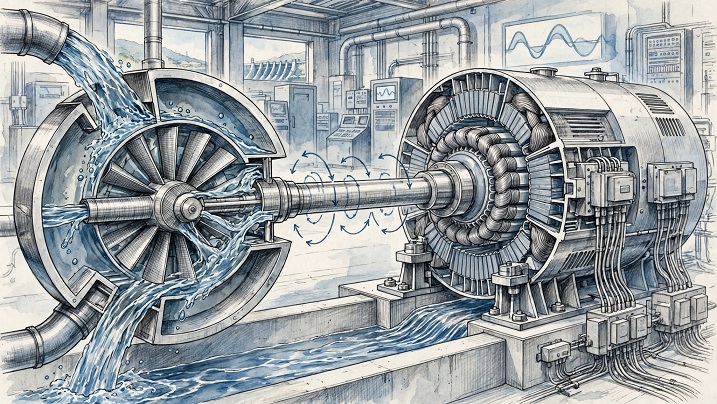
The recurring fluctuations have implications beyond frequency measurements.
According to the researchers, periodic power imbalances can affect hydropower turbine-governor systems. Brief changes in electricity demand cause turbines to adjust their rotational speed, potentially contributing to additional mechanical wear and tear.
The issue has already attracted attention in Scandinavia. The research reports that oscillation amplitudes in the Scandinavian grid regularly exceeded 10 mHz, raising concerns among grid operators and utilities.
In response, Scandinavian transmission system operators revised frequency-containment reserve requirements in 2023. The revised procedures included sine-wave testing over periods of 10 to 300 seconds, alongside stricter requirements intended to improve the damping and activation behavior of frequency-control resources.
Following those changes, amplitudes above 10 mHz were no longer observed in the Scandinavian grid during 2025.
However, these measures primarily reduce the grid's response to disturbances rather than eliminate their underlying source.
The researchers also found periodic power signatures in other digitally controlled equipment, including a smart baking oven and Raspberry Pi clusters. This suggests that the synchronization problem may extend beyond battery storage systems.
Other devices operating through externally synchronized clocks or regularly scheduled software routines could potentially contribute to similar effects.
A Practical Solution: Randomizing Battery Checks
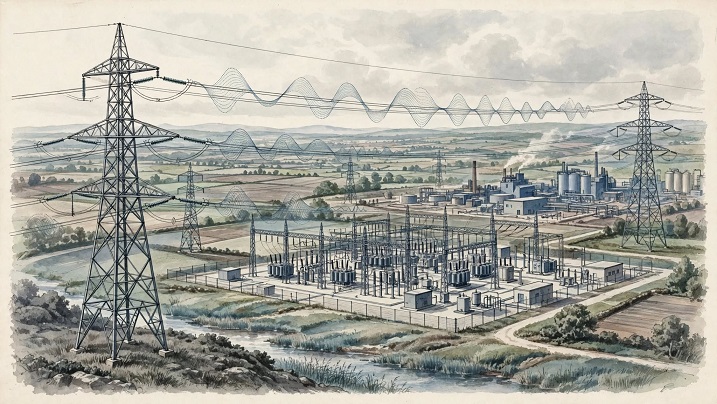
The study identifies improved software control as the most direct way to address the underlying cause.
Instead of allowing numerous devices to perform periodic checks at precisely synchronized times, manufacturers could distribute these operations across different moments using randomized scheduling, adaptive timing offsets or event-driven control routines.
Such approaches would reduce the likelihood that many devices generate additional electricity demand simultaneously.
The researchers also describe a software update applied to one of the investigated UPS battery-management systems. The update was designed to avoid strictly periodic current peaks and partially removed the recurring pattern.
This demonstrates that the problem can be addressed through changes to device-control software rather than relying exclusively on adjustments to electricity-grid infrastructure.
Nevertheless, implementing coordinated solutions across equipment from different manufacturers and across large populations of devices remains a challenge.
Why the Findings Matter for Future Electricity Networks
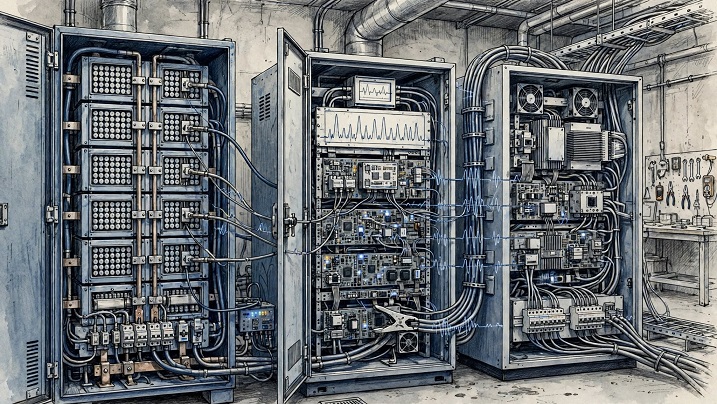
The research highlights an emerging challenge as electricity systems become increasingly dependent on digital technologies.
Large battery installations, data centers, renewable-energy inverters and Internet-connected appliances are becoming important parts of modern electricity infrastructure. Their operation depends not only on electrical engineering but also on software design, timing and communication between devices.
The researchers argue that power-system stability must therefore account for digital control routines and synchronization mechanisms alongside conventional electrical infrastructure.
The observed one-minute disturbance is not currently classified as a safety-critical threat. However, its demonstrated ability to propagate through electricity networks shows why seemingly minor software operations can have wider consequences when large numbers of devices behave in the same way.
As battery storage and connected energy technologies continue to expand, improving the timing and coordination of their control systems could become an important part of maintaining reliable electricity networks.
The central lesson is that grid stability depends not only on how electricity is generated and distributed, but also on how the software controlling millions of connected devices is designed to operate.
Source verification note: The main article above follows the original paper's distinction between the demonstrated UPS mechanism, possible amplification by hydropower systems, and the wider potential contribution of other digitally controlled devices. The paper does not establish that every type of connected appliance is responsible for the global signal.
Tech Xplore independently supports the account of the Jülich investigation, the battery self-test explanation and the potential turbine wear implications.
Key Points Summary
A study published in Nature Energy has explained recurring 60-second electricity-grid frequency fluctuations.
The main cause is periodic self-testing by battery-based UPS systems operating with synchronized software routines.
Researchers detected the signal in 12 electricity grids spanning five continents.
Measurements at Forschungszentrum Jülich traced the disturbance from battery terminals through transformers to the public high-voltage grid.
Ireland experienced an increase in the signal's amplitude from approximately 3 mHz to 12 mHz between 2016 and 2021.
Lower grid inertia can increase the frequency response to synchronized power disturbances.
Randomized battery testing schedules and improved software control could help reduce the phenomenon.
What This Means
Why it matters: The research demonstrates that software-controlled equipment can collectively influence the stability and operation of large electricity networks, even when individual devices operate normally.
Who may be affected:
Electricity transmission and distribution operators.
Data-center operators using large UPS installations.
Manufacturers of battery storage and energy-management systems.
Operators of hydropower facilities.
Organizations responsible for digitally controlled energy infrastructure.
What readers should watch next:
Whether battery manufacturers introduce randomized self-testing schedules.
Whether software updates become more widely adopted.
Whether grid operators introduce additional monitoring and mitigation requirements.
How the expansion of data centers, battery storage and connected devices affects the magnitude of these disturbances.
advertisement
Frequently Asked Questions (FAQ)
1. What causes the mysterious 60-second fluctuations in electricity grids?
The primary cause identified by the researchers is periodic battery self-testing in digitally controlled UPS systems. When many devices perform these operations at synchronized times, they produce recurring electricity-demand peaks.
2. What is a UPS battery system?
An uninterruptible power supply (UPS) is equipment designed to maintain electricity supply when the main power source is interrupted. Its battery-management system can perform periodic diagnostic checks to monitor battery operation.
3. Were the fluctuations detected in multiple countries?
Yes. Researchers identified the one-minute signal in 12 electricity grids across five continents, including Europe, North America, Australia, Asia and Africa.
4. How did researchers confirm the source of the disturbance?
They monitored electricity consumption at more than 80 locations on the Forschungszentrum Jülich campus. They identified recurring battery-current peaks and received independent confirmation from the manufacturer that these peaks were associated with periodic battery self-tests.
5. Why is Ireland important to the research?
Ireland provides an example of how the signal's magnitude can increase over time. The researchers found that the amplitude of the one-minute frequency drop increased from approximately 3 mHz in 2016 to 12 mHz in 2021.
6. Can these fluctuations damage power infrastructure?
The researchers identify additional wear and tear in hydropower turbine systems as a potential operational consequence of recurring power fluctuations. The paper does not classify the observed signal as an imminent grid-stability crisis.
7. How can the problem be reduced?
Randomized scheduling, adaptive timing offsets and event-driven software routines could prevent many devices from performing periodic operations simultaneously.
8. Are battery systems the only possible source?
The study identifies UPS battery-management systems as prime drivers of the observed phenomenon. It also demonstrates similar periodic power signatures in a smart baking oven and Raspberry Pi clusters, suggesting that the broader synchronization mechanism may affect other digitally controlled devices.
9. What is Network Time Protocol (NTP)?
NTP is a technology that synchronizes device clocks with Coordinated Universal Time. The researchers used it to investigate how external clock synchronization influences the timing of UPS battery self-tests.
Sources
- 1. Primary Scientific Source- Hartmann, C. et al. (2026). One-minute frequency disturbances from unintended synchronization in cyber–physical power systems. Nature Energy, October 30, 2026.
Read the original Nature Energy research paper
DOI: 10.1038/s41560-026-02144-0. - 2. Regine Panknin (2026). Mystery of 60-second fluctuations in power grids solved. Tech Xplore, October 30, 2026.
Read the Tech Xplore article.
Additional Verified Sources
No additional sources used.
Thank you !