
AI spending dears and Binance Security Shock put Technology and Crypto Stocks under pressure

Key Points
Alphabet’s latest results highlighted a mixed financial picture: revenue continued to grow strongly, but net income declined approximately 25% year over year.
Amazon reported $201.9 billion in third-quarter net sales, while its trailing 12-month free cash flow recorded a $42.4 billion outflow as investment in infrastructure increased.
Microsoft delivered strong quarterly growth, with revenue rising 19% and Azure revenue increasing 48%; its Copilot user metrics also pointed to expanding adoption.
A major security incident at Binance was estimated to have affected approximately $6.3 billion in cryptocurrency assets, although around $3 billion was reported frozen.
Bitcoin, Ether and BNB came under pressure, while shares of companies with exposure to cryptocurrency markets also declined.
advertisement
Technology Stocks Face New Questions About AI Spending and Future Growth

Technology shares came under pressure as investors assessed the latest financial results from some of the world's largest technology companies. The central issue was not simply whether these businesses were growing, but whether their substantial investments in artificial intelligence could generate sufficient returns over time.
Alphabet, Amazon and Microsoft all reported significant business activity and continued investment in AI-related infrastructure. However, their results presented different financial signals, giving investors reasons to reassess valuations, spending plans and the outlook for future profitability.
The market reaction reflected growing sensitivity to the cost of building AI infrastructure, competition in online search and cloud computing, and uncertainty about how quickly new AI products will translate into sustainable revenue.
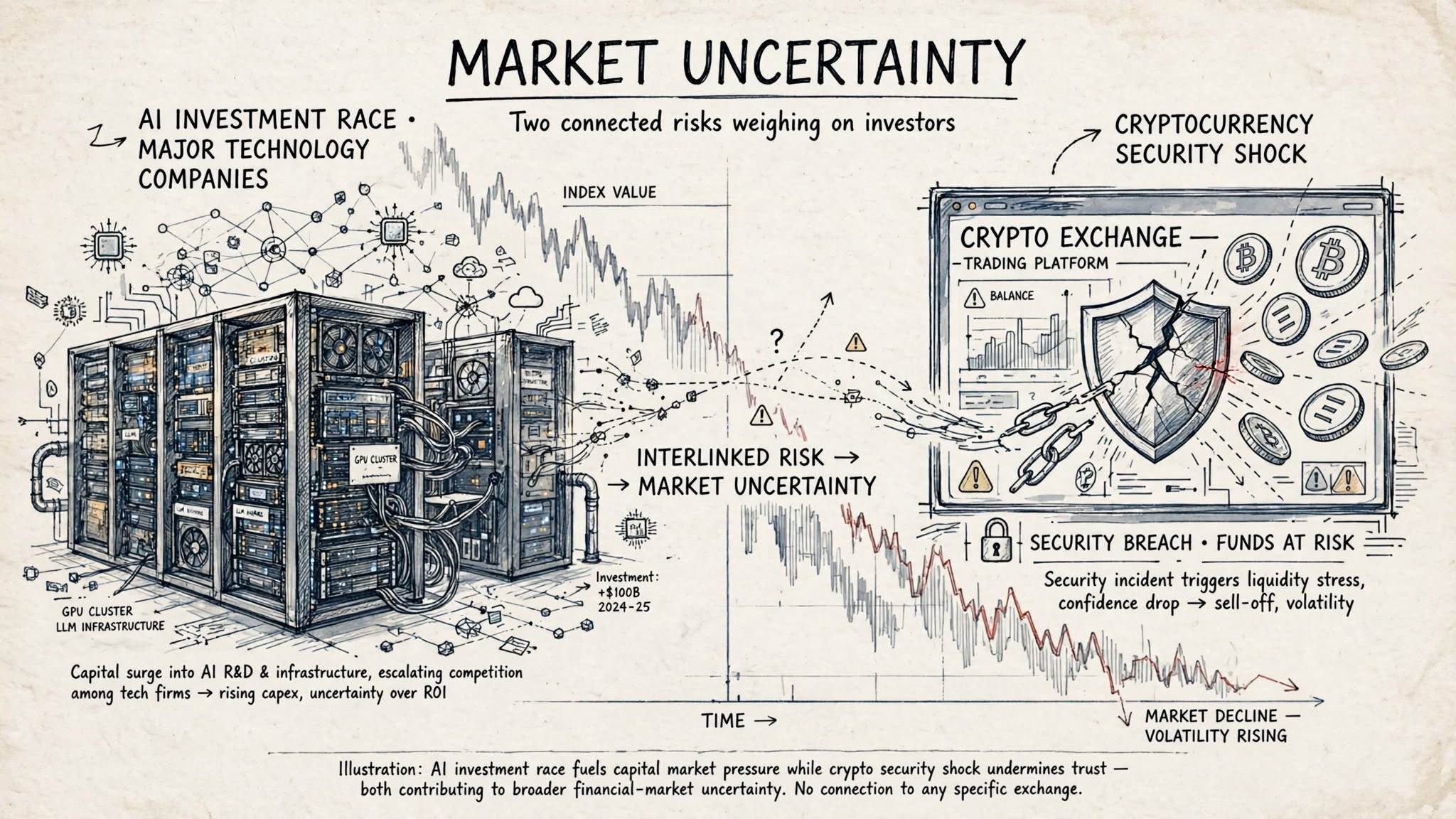
The concerns also emerged alongside a separate shock in cryptocurrency markets: a major security incident involving Binance, one of the world's largest digital-asset exchanges. Together, the developments added to uncertainty across technology-linked and cryptocurrency-related investments.
Alphabet's Results Highlight the Difference Between Revenue Growth and Profitability

Alphabet, Google's parent company, reported strong revenue growth in its latest quarterly results, but its earnings figures drew attention to a more complicated financial picture.
The company reported quarterly revenue of approximately $127.6 billion, an increase of about 25% year over year. Google Cloud was a particularly strong contributor, generating approximately $30.7 billion in revenue, up around 103% from the same period a year earlier.
However, Alphabet's net income declined to approximately $26.2 billion, compared with approximately $35.0 billion in the corresponding quarter of the previous year. That represented a decline of roughly 25%.
It is important to distinguish this decline in net income from the company's operating performance. Alphabet's operating income actually increased by approximately 30%, indicating that the movement in net income did not reflect a broad-based deterioration in operating income.
Investors were also evaluating the implications of AI for Google's core search business. AI-powered search experiences are changing how users discover information, potentially affecting the traditional advertising model that has historically supported a substantial portion of Google's business.
The concern is not that AI has already replaced conventional search advertising. Rather, investors are considering how changes in user behaviour, search-product design and competition could influence advertising growth and profitability over time.
Alphabet's capital spending also remains important to the outlook. The company is investing heavily in data centres, computing capacity and other infrastructure needed to develop and operate AI services. Such spending may support future growth, but it also raises questions about the timing and scale of returns.
The combination of strong revenue growth, expanding cloud operations, lower net income and substantial AI investment helps explain why investors are examining Alphabet's results beyond the headline sales figure.
Amazon's AI Infrastructure Investment Weighs on Free Cash Flow
Amazon also reported substantial growth in its latest quarterly results, but its cash-flow figures became a major focus for investors.
The company generated $201.9 billion in net sales, representing an increase of 12% year over year.
Its operating cash flow increased by 29% to $168.3 billion over the trailing 12 months ended September 30, 2026. However, free cash flow recorded an outflow of $42.4 billion over that same trailing 12-month period, compared with a positive free cash flow of $14.8 billion in the corresponding period a year earlier.
This distinction matters. The $42.4 billion figure represents a trailing 12-month free-cash-flow outflow, not a loss or cash-flow figure for the third quarter alone.
Amazon attributed the deterioration primarily to a substantial increase in investment in property and equipment. The company reported a year-over-year increase of approximately $94.8 billion in purchases of property and equipment, net of proceeds from sales and incentives.
A significant part of this investment reflects the infrastructure required to support artificial intelligence and cloud computing, including data centres and computing capacity.
For investors, the central question is whether these investments will generate enough additional revenue and operating profit to justify their scale. Amazon Web Services remains a major part of the company's long-term growth strategy, while AI-related demand could create further opportunities for cloud services.
Nevertheless, the pressure on free cash flow illustrates why investors are increasingly looking beyond revenue growth when evaluating companies making exceptionally large investments in AI.
Microsoft Shows Strong Cloud Growth as Copilot Adoption Expands

Microsoft's latest results provided another perspective on the technology sector's AI investment cycle.
The company reported first-quarter fiscal 2027 revenue of approximately $92.3 billion, an increase of 19% year over year. Microsoft Cloud revenue reached approximately $63.9 billion, up around 30%, while Azure and other cloud services revenue increased 48%.
These results demonstrated continued demand for Microsoft's cloud infrastructure and services, which are central to its AI strategy.
The company's Copilot products also remain an important part of its effort to turn AI adoption into a broader commercial opportunity.
Chief Executive Satya Nadella said automated tasks had nearly doubled since July. He also reported that daily Copilot users had increased nearly 50% quarter over quarter and more than fivefold year over year.
These figures suggest that Microsoft's AI tools are gaining wider use. However, user growth alone does not establish how much additional revenue or profit the products will ultimately generate.
Investors are therefore watching several factors together: cloud demand, infrastructure spending, AI-product adoption, commercial subscriptions and the ability to convert increased usage into recurring revenue.
Microsoft's results offered strong growth indicators, but the broader market remains focused on whether the financial returns from AI investment will keep pace with the enormous costs of developing and operating these systems.
Binance Security Incident Sends Shockwaves Through Cryptocurrency Markets

While technology investors were assessing AI-related spending, cryptocurrency markets faced a separate source of uncertainty after Binance reported a major security incident.
The exchange estimated the total financial impact at approximately $6.3 billion. It also said that around $3 billion had been frozen through actions involving various digital-asset networks and market participants.
The figures describe the estimated impact and the assets identified or frozen during the response. They should not automatically be interpreted as a final, independently audited calculation of permanently lost funds.
Binance said customer funds remained safe and that it would cover losses related to the incident. The company also reported that it had found no evidence that wallet private keys had been leaked.
The initial investigation pointed to a potentially compromised laptop belonging to a DevOps engineer. However, Binance later reported discovering additional points of breach. This indicates that the investigation expanded beyond its initial findings, and the full technical explanation had not yet been established in a complete public post-incident report.
The incident raised broader questions about operational security, internal access controls and the protection of infrastructure used by major cryptocurrency platforms.
Even when customer assets are not directly exposed, a security incident involving a major exchange can affect confidence across the wider digital-asset market.
Binance Updates Deposit and Withdrawal Services

Binance's service status changed as the exchange worked through its response.
The company initially suspended deposits and withdrawals while investigating the incident. In a subsequent update, however, Binance said deposits were operating normally while withdrawals remained paused pending additional security checks.
The exchange expected withdrawal services to resume within 48 hours, subject to the completion of its security procedures.
This distinction is important because the status of deposits and withdrawals was not the same throughout the incident. Reports describing both services as suspended reflected an earlier stage of the response.
The temporary withdrawal restrictions added to market uncertainty, as users and investors monitored the exchange's ability to restore normal operations.
Binance's commitment to cover losses and its statement that customer funds were safe were intended to reassure users. However, confidence will also depend on the results of the investigation, the transparency of subsequent disclosures and the effectiveness of any security improvements.
Tether and Circle Freeze Billions in Stablecoins

The incident also highlighted the role that stablecoin issuers can play in responding to suspicious cryptocurrency activity.
Tether, the issuer of USDT, reported freezing more than $1.567 billion in USDT associated with the incident. Circle, the issuer of USDC, reported freezing more than $800 million in USDC.
These actions formed part of the broader effort to restrict the movement of assets connected to the incident.
The reported stablecoin freezes should not be added to the approximately $3 billion total frozen as if they were separate amounts. They are components of the broader recovery and asset-freezing response.
The episode demonstrates an important characteristic of some stablecoins: issuers may have the technical and administrative ability to freeze tokens under certain circumstances.
That capability can assist law-enforcement and recovery efforts, but it also raises questions about centralised control, financial oversight and the differences between stablecoins and decentralised cryptocurrencies.
For the wider market, the response from Tether and Circle showed how quickly a security incident involving one exchange can involve several companies across the digital-asset ecosystem.
Bitcoin, Ether and BNB Come Under Pressure

Cryptocurrency prices declined as investors reacted to the Binance incident and reassessed the potential risks to market confidence.
Bitcoin fell to an intraday low reported at approximately $76,500 in one market update before recovering to around $78,100. Other reports recorded different price levels as trading continued, reflecting the fast-moving nature of cryptocurrency markets.
Ether also weakened, trading around $2,230 in one report, while BNB declined by approximately 6% in the same market snapshot.
The exact prices and percentage changes varied across reports because the figures were recorded at different times. They should therefore be understood as time-specific market snapshots rather than a single simultaneous price comparison.
The declines reflected more than the direct financial implications of the incident. A security event at a major exchange can prompt investors to reduce exposure, move assets into safer perceived holdings or reassess the operational risks associated with cryptocurrency trading platforms.
However, the incident alone does not establish a permanent change in the long-term outlook for Bitcoin or other digital assets. Market direction will also depend on broader liquidity conditions, investor demand, regulation and developments across the global financial system.
Cryptocurrency-Linked Stocks Also Decline

The pressure extended beyond digital tokens to publicly traded companies with exposure to cryptocurrency markets.
Shares of Coinbase, Strategy and Robinhood declined in market trading as investors assessed the potential implications of the Binance incident for trading activity, digital-asset prices and investor confidence.
Strategy, which trades on Nasdaq under the ticker MSTR, is a digital-asset-focused company known for holding substantial amounts of Bitcoin. Its share price can be sensitive to movements in Bitcoin as well as changes in investor sentiment toward digital assets.
The company was formerly known as MicroStrategy. It adopted the Strategy name in 2025, so referring to it as Strategy is correct for the period covered by this article.
Coinbase, a major cryptocurrency trading platform, may be affected by changes in trading volumes, digital-asset prices and the broader outlook for the cryptocurrency industry.
Robinhood has also expanded its presence in cryptocurrency trading and related financial services. A decline in digital-asset prices or a reduction in retail trading activity can influence investor expectations for its business.
The share-price declines do not necessarily indicate that these companies were directly involved in the Binance incident. Rather, they reflect the market's tendency to reassess companies exposed to the same asset class when a major security or confidence shock occurs.
What Investors Will Be Watching Next
The latest developments have created several issues for investors to monitor across both technology and cryptocurrency markets.
For Alphabet, the key questions include whether AI-powered search will change advertising economics, whether Google Cloud can sustain its rapid growth and how effectively the company can manage its AI investment.
For Amazon, attention is likely to remain on the relationship between capital expenditure, free cash flow and the long-term profitability of its cloud and AI businesses.
Microsoft's challenge is to convert growing Copilot adoption and strong cloud demand into durable financial returns while continuing to fund the infrastructure required for AI services.
In cryptocurrency markets, the next major test for Binance will be the completion and disclosure of its security investigation, the restoration of normal withdrawal services and the credibility of its recovery measures.
Investors will also monitor whether the incident produces a lasting change in trading activity, exchange usage or demand for digital assets.
The two developments are different in nature, but they share a common investment question: how much risk are investors willing to accept while major companies and financial platforms undergo rapid technological and operational change?
AI infrastructure investment may create significant opportunities, but it also requires substantial capital. Cryptocurrency markets may offer growth and innovation, but incidents involving security and platform reliability can quickly affect confidence.
For investors, the latest market reaction is a reminder that strong growth narratives do not eliminate the importance of cash flow, financial discipline, operational security and transparent corporate reporting.
Key Points Summary
Alphabet reported approximately $127.6 billion in quarterly revenue, up 25%, while net income declined around 25% to $26.2 billion.
Amazon generated $201.9 billion in quarterly sales, up 12%, but recorded a $42.4 billion free-cash-flow outflow over the trailing 12 months ended September 30, 2026.
Microsoft reported 19% revenue growth, 30% growth in Microsoft Cloud revenue and 48% growth in Azure and other cloud services.
Binance estimated the impact of its security incident at approximately $6.3 billion and said around $3 billion had been frozen.
Tether and Circle reported freezing more than $1.567 billion in USDT and $800 million in USDC, respectively.
Bitcoin, Ether and BNB declined, while shares of Coinbase, Strategy and Robinhood also came under pressure.
What This Means for Investors
The latest developments underline the importance of distinguishing between growth, profitability and risk.
Technology companies may continue to benefit from demand for AI and cloud services, but investors are increasingly examining whether the financial returns justify the scale of infrastructure spending. Revenue growth alone may not be enough to support high valuations if cash flow and profitability come under pressure.
In cryptocurrency markets, the Binance incident demonstrates how operational security problems at a major exchange can influence prices and related stocks well beyond the company directly involved.
Investors should therefore assess individual companies and digital assets on their own financial and operational fundamentals rather than treating the entire technology or cryptocurrency sectors as a single investment opportunity.
This article is for informational purposes only and does not constitute investment advice.
advertisement
Frequently Asked Questions [FAQ]
Why did technology stocks come under pressure?
Investors were reassessing the cost of artificial intelligence infrastructure, the potential impact of AI on established business models and the ability of major technology companies to generate sufficient returns from their investments.
Did Alphabet report a decline in revenue?
No. Alphabet reported quarterly revenue of approximately $127.6 billion, up around 25% year over year. Its net income declined approximately 25% to $26.2 billion, while operating income increased around 30%.
Why did Amazon's free cash flow turn negative?
Amazon reported a trailing 12-month free-cash-flow outflow of $42.4 billion, compared with a positive $14.8 billion in the previous-year period. The company attributed the deterioration primarily to increased investment in property and equipment, including infrastructure supporting AI and cloud computing.
How much did Microsoft revenue increase?
Microsoft reported first-quarter fiscal 2027 revenue of approximately $92.3 billion, an increase of 19% year over year. Microsoft Cloud revenue increased 30% to approximately $63.9 billion, while Azure and other cloud services revenue grew 48%.
How much was the estimated Binance security incident impact?
Binance estimated the total impact at approximately $6.3 billion. Around $3 billion was reported frozen, although the final status of all affected assets remained subject to investigation and recovery efforts.
Were Binance customer funds affected?
Binance said customer funds remained safe and that it would cover losses related to the incident. The company also said it had found no evidence that wallet private keys had been leaked.
Why did Bitcoin and other cryptocurrencies decline?
The incident increased uncertainty about exchange security and market confidence. Investors reacted by reducing exposure to some digital assets, although prices also reflect wider market conditions and can change rapidly.
What is the difference between Strategy and MicroStrategy?
MicroStrategy adopted the Strategy name in February 2025, and the company later completed its legal name change to Strategy Inc. Its Nasdaq ticker remained MSTR. Strategy is therefore the appropriate company name for the period covered in this article.
Sources
BBC News: Google value plunges by $500bn as AI search hits ad sales
https://www.bbc.com/news/articles/cm9qzdqpxy48o
Yahoo Finance: Bitcoin, digital assets tumble as Binance says $6.3 billion impacted in suspected record crypto hack
https://finance.yahoo.com/markets/article/bitcoin-drops-to-76000-as-binance-hack-spooks-investors-tether-circle-freeze-assets-083406383.html
Yahoo Finance: Binance Suspends Withdrawals After $6.3 Billion Cryptocurrency Hack as Bitcoin and Crypto Stocks Fall
https://finance.yahoo.com/markets/crypto/articles/binance-suspends-withdrawals-6-3-102432013.html
Additional Verified Sources
Alphabet – Third-quarter 2026 financial results (SEC filing):
https://www.sec.gov/Archives/edgar/data/1652044/000165204426000080/googexhibit991q32026.htm
Amazon – Third-quarter 2026 results:
https://ir.aboutamazon.com/news-release/news-release-details/2026/Amazon-com-Announces-Third-Quarter-Results/default.aspx
Microsoft – First-quarter fiscal 2027 results:
https://news.microsoft.com/source/2026/10/28/microsoft-announces-first-quarter-results-2/
Strategy – MicroStrategy is now Strategy:
https://www.strategy.com/press/microstrategy-is-now-strategy_02-05-2025
Strategy – Legal name change to Strategy Inc:
https://www.strategy.com/fr/press/strategy-announces-legal-name-change-from-microstrategy-incorporated-to-strategy-inc_08-14-2025
Binance – Deposit service update following the incident:
https://www.binance.com/en/square/post/10-30-2026-binance-deposits-are-no-longer-affected-pledges-to-cover-losses-related-to-the-incident-382683663031259
Reuters – Tether and Circle freeze assets following Binance security incident:
https://www.reuters.com/legal/transactional/tether-circle-freeze-238-billion-after-binance-reports-security-incident-2026-10-29/
Disclaimer:
This material may contain third-party opinions, none of the data and information on this webpage constitutes investment advice
The content shared in economics articles is solely for research and informational purposes.
We are not a financial advisory service, and the information provided should not be considered investment or trading advice.
Market quotations and forecasts are attributed to the supplied reports; figures that differ between reports have not been silently reconciled.
Thank you !