
article image source: arxiv.org (Link)
EgoExplorer turns human movement into Multimodal Data for Humanoid Robot learning
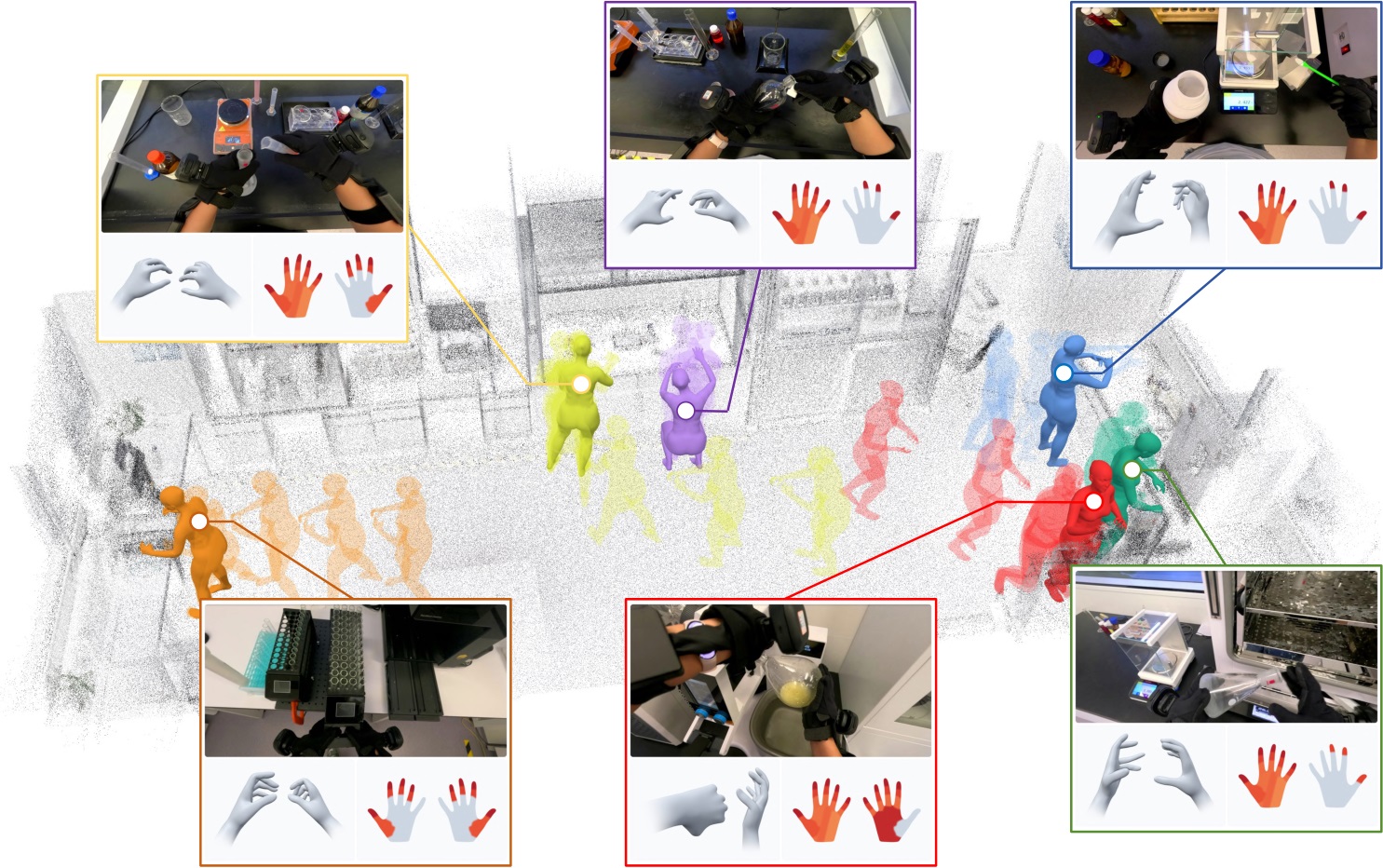
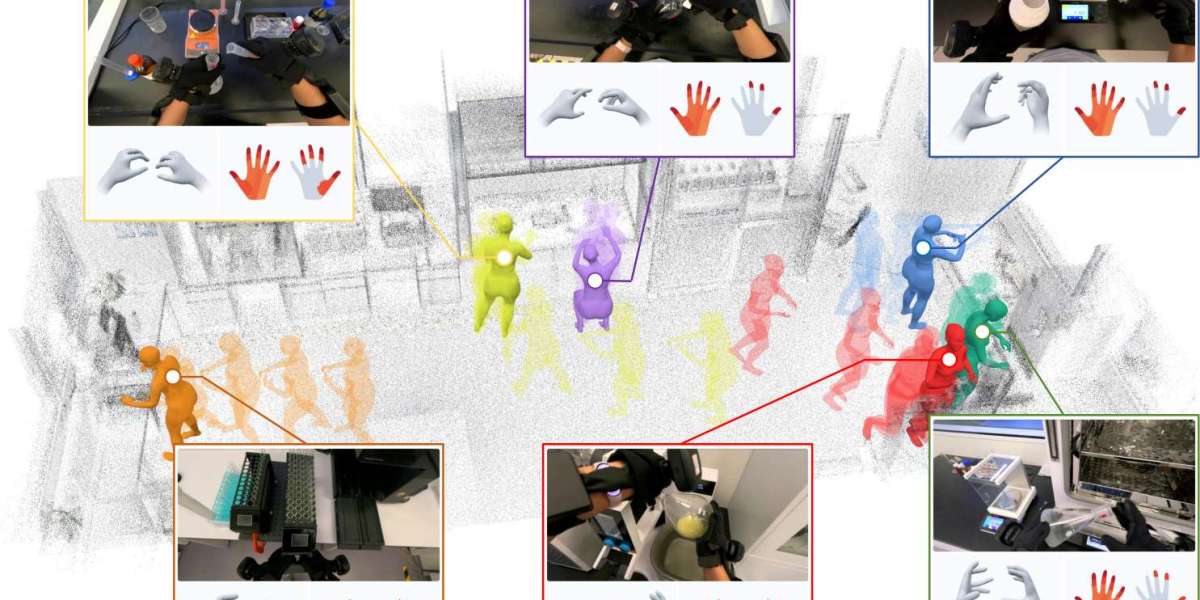
A glimpse of EgoExplorer. It shows human loco-manipulation across workstations, with reconstructed body motion overlaid on the scene point cloud. Each inset is linked to a corresponding body pose along with synchronized egocentric view, finger articulation, and tactile observation.
image source: arxiv.org
Key Points
- EgoExplorer is a wearable data-collection system designed to capture human whole-body movement, hand articulation, touch and first-person video for robotics research.
- Researchers collected 2,715 recordings totaling 100 hours across five environments and 10 task templates.
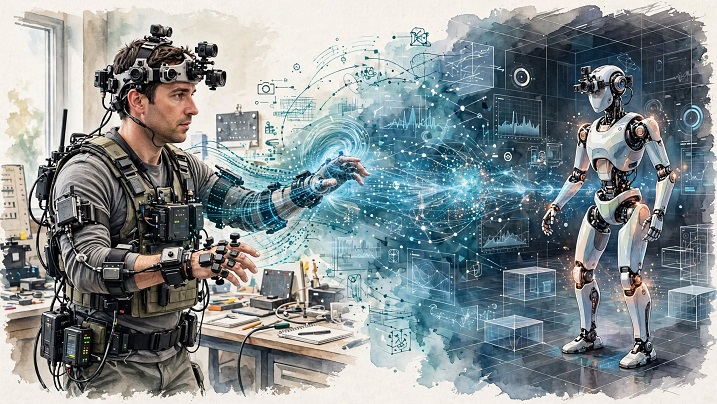
- The system combines a head-mounted GoPro HERO13, five VIVE Ultimate Trackers, and instrumented gloves that capture finger movement, with Wuji gloves also providing tactile measurements.
- Its Calibrate-Complete-Constrain (C³) pipeline reduced body-point error by 71.9% compared with the strongest evaluated baseline, according to the researchers.
- Early experiments transferred human movements to a simulated Unitree G1 humanoid robot, but the researchers emphasize that real-world robot performance remains unverified.
advertisement
A Wearable Approach to Human-to-Robot Learning
Researchers from the Shanghai AI Laboratory, Zhejiang University and Shanghai Jiao Tong University have developed EgoExplorer, a wearable system and dataset intended to give robots a richer picture of how humans move through environments while performing physical tasks.
The work addresses a challenge in humanoid robotics: teaching a robot to coordinate locomotion, body posture, hand movements and physical interaction with objects. Human demonstrations can provide useful examples, but collecting detailed demonstrations at scale can require specialized equipment and controlled environments. The researchers instead designed a portable system that can be worn while people carry out activities in different settings. arXiv
The resulting EgoExplorer dataset contains 2,715 recordings totaling 100 hours, covering 10 task templates across five environments. The recordings combine first-person video with reconstructed whole-body motion, detailed finger articulation, tactile observations where available, and descriptions of individual task steps. arXiv
The researchers describe the work in an arXiv preprint published October 13, 2026, while Tech Xplore reported on the research October 24, 2026. The arXiv paper is the primary scientific source for the system and experiments. arXiv
Why Human Movement Data Matters for Humanoid Robots
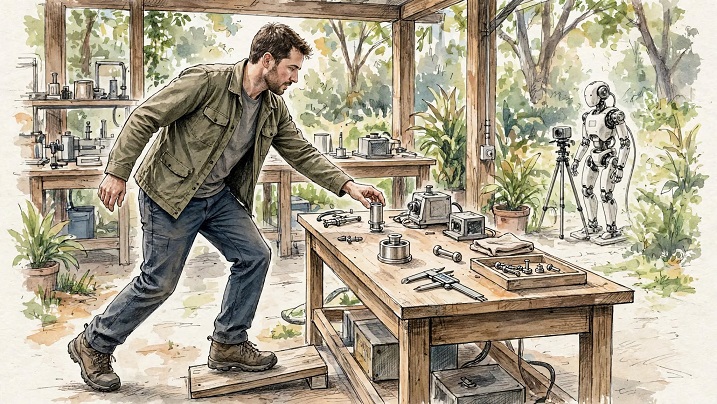
Humanoid robots are expected to operate in environments designed for people, where successful task completion often depends on more than simply moving an arm toward an object.
A person approaching a workstation may first walk toward a target, adjust their posture, position their feet, reach with one or both hands, grasp an object and then move it while maintaining balance. These actions are interconnected. The researchers argue that datasets capturing only one part of this process can miss the coordination that makes the complete task possible. arXiv
Traditional motion-capture systems can provide detailed measurements, but they commonly depend on instrumented spaces containing calibrated cameras and other equipment. Egocentric video, meanwhile, is easier to deploy but cannot directly observe everything happening outside the camera's field of view, particularly parts of the body such as the lower limbs.
EgoExplorer attempts to combine the advantages of several sensing approaches in a portable system. Instead of relying solely on cameras or body trackers, it synchronizes multiple types of information so that researchers can examine what a person sees, how their body moves, how their fingers articulate and, when tactile gloves are used, where their hands make contact. arXiv
Inside the EgoExplorer Wearable System
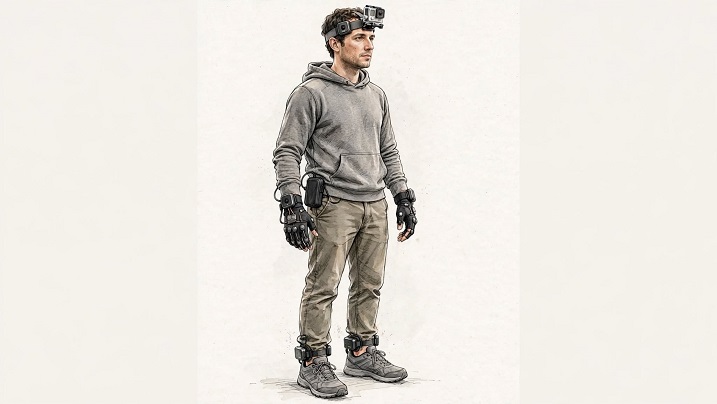
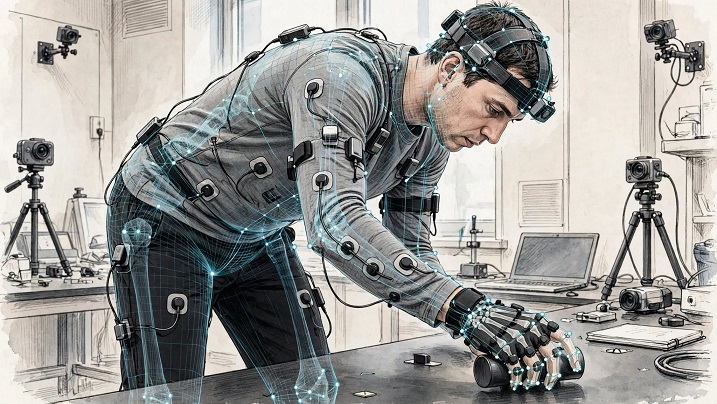
The capture rig combines several pieces of hardware.
At the center is a head-mounted GoPro HERO13 Black with Media Mod, which records the wearer's first-person view at 30 Hz with a 1,920 × 970-pixel recording format specified in the paper.
The system also uses five VIVE Ultimate Trackers. One is positioned on the head, two on the hands and two on the ankles. The trackers provide six-degree-of-freedom positioning without requiring external base stations. The head and hand trackers provide measurements of the camera and hand trajectories, while the ankle trackers capture foot placement and provide information about lower-body support that may be outside the camera's view. arXiv
The researchers use two interchangeable glove configurations. MANUS Metagloves Pro capture finger articulation, while Wuji gloves additionally provide tactile sensing. The paper reports five 6-DoF fingertip electromagnetic sensors per glove at a nominal 120 Hz rate. The Wuji tactile configuration contains a 24 × 31 matrix, corresponding to 744 taxels per hand, with 526 retained by the evaluation health mask used in the study. arXiv
Custom 3D-printed mounts and straps hold the devices in position. One important feature of the design is that the participant and sensor configuration can be calibrated once and reused for subsequent recordings as long as the equipment remains mounted in the same configuration. arXiv
Reconstructing the Body From Sparse Sensors
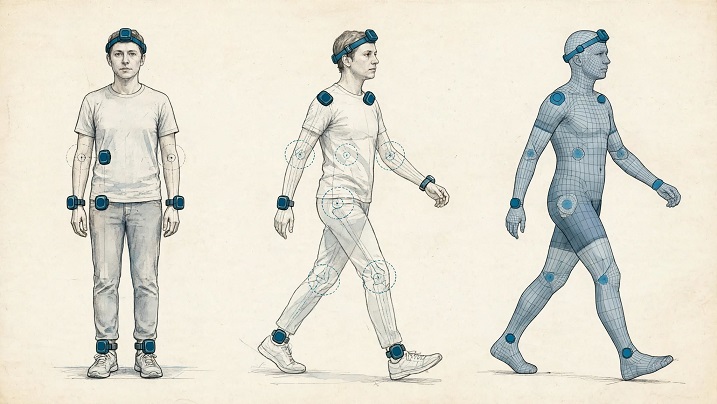
Five trackers cannot directly measure every joint in a human body. The researchers therefore developed a processing pipeline called Calibrate-Complete-Constrain, or C³, to reconstruct whole-body movement from sparse measurements.
The first stage is calibration. The system estimates the participant's body geometry and the precise relationship between each tracker and its corresponding body anchor. Participants perform a prescribed sequence of movements including standing, A- and T-poses, reaching, elbow and wrist movements, shallow squats, leg raises and ankle movements. The calibration process compares these movements with a reference motion library to estimate the body and sensor configuration. arXiv
The second stage is motion completion. A temporal motion prior is used to estimate joint movements that the trackers do not directly observe. In effect, the measured positions provide a sparse set of anchors, while the learned motion patterns help fill in the missing articulation.
The final stage applies layered constraints to refine the reconstructed movement. These constraints encourage the reconstructed skeleton to agree with the measured tracker data, maintain appropriate body-surface clearance and avoid penetration through the estimated ground plane. Finger motion and tactile measurements are then incorporated as direct evidence about hand interaction. arXiv
This approach is important because sensor-placement errors can otherwise become mixed with estimates of body movement. The C³ pipeline is designed to separate relatively fixed sensor-mounting geometry from the person's changing movements before reconstructing the full motion. arXiv
A 100-Hour Multimodal Dataset
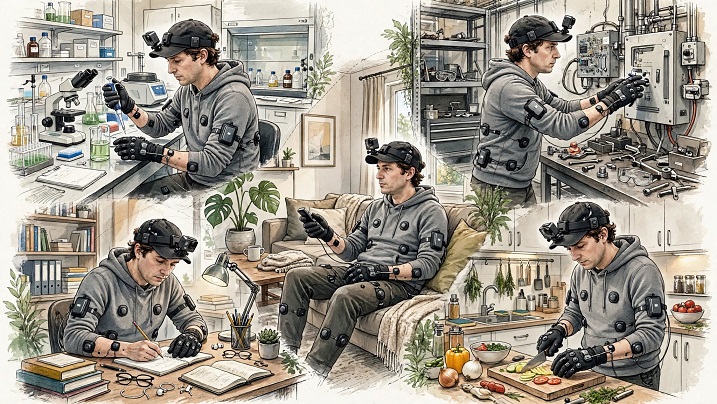
The researchers used the wearable system to build the EgoExplorer dataset, with 2,715 recordings covering 100 hours.
The recordings span five environments: a laboratory, industrial workspace, living room, food-preparation area and study. Laboratory activities represent 41% of recordings and 46% of total duration. Among the remaining recordings, the paper reports 8% in living rooms, 23% in studies, 11% in food-preparation areas and 17% in industrial workspaces. arXiv
The dataset places particular emphasis on professional activities. Its recordings preserve transitions between locomotion and manipulation rather than restricting the participant to a fixed workstation.
The available sensing also varies by recording. Among regular recordings, the head video and tracker streams are available throughout, while MANUS gloves cover 58% and Wuji gloves cover 41%. Tactile measurements are available in the recordings using the Wuji configuration, representing 41% of regular recordings. arXiv
The researchers also added procedural descriptions to the recordings. Annotation tools receive first-person video, task instructions and expert-written procedural context, after which operators review the video, reconstructed motion, available touch information and generated text for alignment and consistency. arXiv
Measuring Body, Hand and Contact Accuracy
The study evaluated the reconstruction system using a purpose-built evaluation subset covering whole-body movement, hand articulation and regional contact.
For whole-body reconstruction, EgoExplorer recorded an 18.0-millimeter body-point error, compared with substantially larger errors from the evaluated alternatives. For the 17 non-tracked joints, the reported error was 20.3 millimeters. arXiv
The researchers summarize the main result as a 71.9% reduction in body-point error relative to the strongest evaluated baseline. The improvement was not limited to the directly observed tracker locations; the researchers also reported improved recovery of other body points, including elbows and knees. arXiv
The hand measurements also performed strongly in the controlled evaluation. The glove-based approach produced a 0.4-millimeter holding RMS, compared with 4.5 millimeters for HaWoR and 11.3 millimeters for HandFlow in the reported comparison. It also achieved 100% kinematic target recovery in that test. arXiv
For regional contact detection, the system achieved an IoU of 0.915 and an F1 score of 0.956, compared with lower values for the RGB and hand-pose-only approaches evaluated by the researchers. arXiv
These results support the researchers' argument that directly sensing finger movement and contact can complement visual information when building multimodal human-motion datasets.
Multimodal Data Shows Promise for AI Training
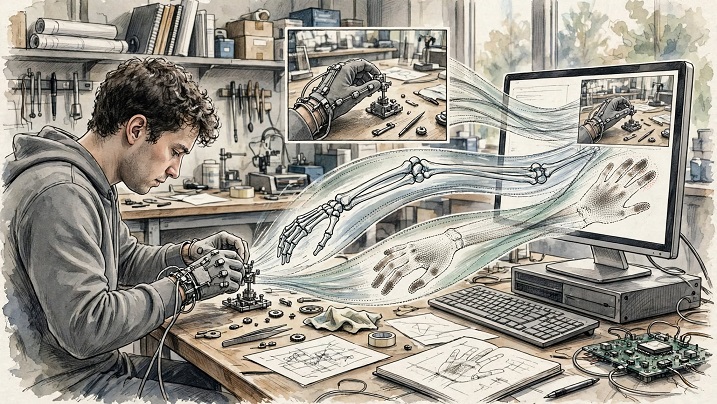
The researchers also conducted preliminary experiments to investigate whether combining the different data streams could benefit machine-learning systems.
Using an adapted Cosmos3-Edge setup, they compared models that generated video, action and touch information separately with a joint approach. The joint model improved reported video PSNR from 15.94 to 16.62 dB and contact F1 from 0.610 to 0.694, while also producing a lower action mean squared error. arXiv
The experiments also tested conditioning action generation on additional sensory information. Action mean squared error fell from 0.0478 without conditioning to 0.0277 when video was included, and to 0.0264 when both video and touch were added. The researchers interpret these results as evidence that the different modalities can provide complementary information. arXiv
However, these are preliminary training experiments, not evidence that the dataset has already produced a capable general-purpose humanoid robot.
Human Motion Transferred to a Simulated Humanoid
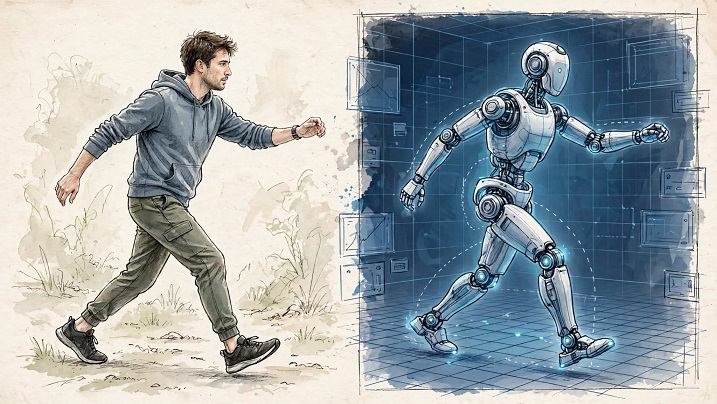
To examine the possibility of transferring human demonstrations into robot control, the researchers retargeted two recordings to a simulated Unitree G1 humanoid robot.
A whole-body controller based on a ZeroWBC-style approach was used to track the adapted human movements. According to the researchers, the simulated G1 followed both motion sequences without falling. arXiv
The result provides an initial demonstration that the captured human motion can be converted into robot-compatible movement in simulation. It does not, however, establish that a physical humanoid robot can reproduce the same activities reliably.
Tech Xplore specifically notes that the experiment did not demonstrate precise object interaction or strong performance on unfamiliar tasks, and the study did not test deployment on a physical robot. Tech Xplore
Data Quality and Remaining Limitations
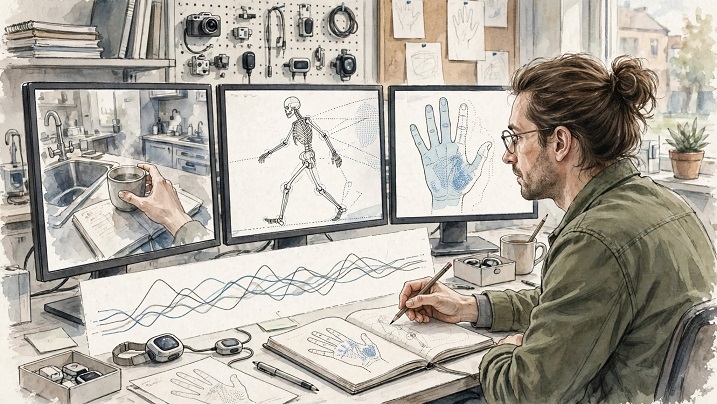
The researchers also identified limitations that are important when interpreting the results.
First, whole-body reconstruction is an inference problem. Sparse trackers do not directly observe every joint, so the reconstructed motion cannot guarantee exact recovery of all body movements. The paper explicitly states that reconstruction cannot guarantee exact recovery of all joints, while tactile sensing can have variable reliability. arXiv
Second, the evaluation references deserve careful interpretation. The controlled full-body evaluation did not use an independent optical motion-capture ground truth. Instead, the reference labels were produced through a refined five-tracker procedure with additional priors and were reviewed frame by frame. The researchers acknowledge that these labels share the same fitting model, calibration and constraints, meaning that the evaluation is not independent ground-truth accuracy and can favor related methods. arXiv
The text annotations also required human review. An expert audit found 11.09% factual errors in reviewed model-generated segments, along with 2.46% unsupported claims, 8.16% missed steps, 2.05% extra steps and 3.08% boundary corrections. The researchers therefore retain manual verification and correction in the workflow. arXiv
Most importantly for robotics, the authors say that the benefits of EgoExplorer for real-world humanoid learning remain unverified. The current robot-transfer demonstration is a simulation study rather than a physical deployment. arXiv
What Comes Next for EgoExplorer
The immediate significance of EgoExplorer is not that it has solved humanoid robot learning, but that it offers researchers a way to collect several forms of human activity information simultaneously in environments outside a conventional motion-capture studio.
The combination of first-person video, whole-body motion, detailed hand articulation, tactile observations and task-step descriptions could provide a richer training resource for future embodied-AI research. The dataset can also support studies of how these modalities complement one another when models attempt to predict actions or reconstruct human behavior. arXiv
The researchers suggest that future work could use EgoExplorer to train additional robot controllers in simulation and eventually investigate whether controllers developed from these recordings can improve humanoid robots' ability to perform tasks in real-world environments. The paper, however, stops short of claiming that this future capability has already been demonstrated. Tech Xplore
For now, EgoExplorer represents a research step toward making human demonstrations more useful for embodied robotics by recording not just what a person sees, but also how the body moves, how the hands articulate and where physical contact occurs.
Key Points Summary
- EgoExplorer combines wearable sensing and first-person video for robotics research.
- The dataset contains 2,715 recordings and 100 hours of human activity.
- Data was collected across five environments and 10 task templates.
- The system reconstructs whole-body movement using the C³ pipeline.
- Researchers report a 71.9% reduction in body-point error versus their strongest evaluated baseline.
- Direct glove sensing improved the reported hand and contact measurements.
- A simulated Unitree G1 successfully followed two transferred human motion sequences without falling.
- The robot experiments were preliminary and did not test a physical humanoid robot.
- The researchers acknowledge limitations in reconstruction accuracy and tactile reliability.
- Real-world benefits for humanoid learning remain unverified.
What This Means
Why it matters: Humanoid robots need training data that connects movement, posture, hand control and interaction rather than treating these as isolated problems. EgoExplorer is designed around that combined view.
Who may be affected: The work is primarily relevant to researchers developing humanoid robots, embodied AI, robot imitation learning and multimodal machine-learning systems.
What to watch next: The most important next step is whether this type of multimodal human data can translate into reliable robot behavior beyond simulation, particularly during physical interaction with objects and unfamiliar tasks.
advertisement
Frequently Asked Questions (FAQ)
What is EgoExplorer?
EgoExplorer is a multimodal dataset and wearable capture system designed to record human loco-manipulation, combining first-person video, reconstructed whole-body motion, finger articulation, tactile observations and task-step descriptions. arXiv
How much data does EgoExplorer contain?
The dataset contains 2,715 recordings totaling 100 hours across 10 task templates and five environments. arXiv
What sensors does the system use?
The system uses a head-mounted GoPro HERO13 Black, five VIVE Ultimate Trackers, and either MANUS Metagloves Pro or Wuji gloves. The Wuji configuration additionally records tactile information. arXiv
What is the C³ pipeline?
C³ stands for Calibrate-Complete-Constrain. It calibrates the relationship between the wearer's body and the sensors, uses a temporal motion prior to complete unobserved movement, and then applies constraints to refine the reconstruction. arXiv
How accurate was the body reconstruction?
On the study's evaluation subset, EgoExplorer reported 18.0 mm body-point error and 20.3 mm error at non-tracked points. The authors report this as a 71.9% reduction in body-point error relative to the strongest evaluated baseline. arXiv
Did the researchers make a humanoid robot perform human tasks?
They transferred two human recordings to a simulated Unitree G1 humanoid and used a whole-body controller to track the motions. The simulated robot followed both sequences without falling. arXiv
Was the system tested on a physical robot?
No. The reported robot experiment was performed in simulation, and the researchers state that the benefits for real-world humanoid learning remain unverified. Tech Xplore
Does the dataset contain tactile information for every recording?
No. Tactile measurements come from the Wuji glove configuration, which was available in 41% of regular recordings. arXiv
Are the generated task descriptions completely automatic?
No. Model-generated annotations are reviewed by operators for temporal alignment and semantic consistency. The researchers reported residual errors in the automated annotations, making human verification part of the workflow. arXiv
Sources
- arXiv — EgoExplorer: A Vision-Motion-Touch Observatory for Human Loco-Manipulation In Situ — Primary source, Yunsong Zhou et al., published October 13, 2026. arXiv
- Tech Xplore — Wearable system captures human activity data for robot training — Supporting source, published October 24, 2026. Tech Xplore
Additional Verified Sources
No additional sources were used.
Thank you !