
How Music shapes the Brain’s experience of Taste


Key Points
Music and taste engage some of the same anatomical brain regions. A functional MRI study found that combining music with sweet or sour tastes increased activity in several gustatory and sensorimotor brain areas compared with tasting alone.
Sweet-associated music increased reported pleasantness in one comparison. Participants rated sweet taste solutions as more pleasant when they were accompanied by sweet-associated music than when they were presented in silence.
The behavioral effects were limited. The study did not find a significant overall effect of sound on sweetness or sourness ratings, and the results do not establish that music makes complete meals taste better.
The relationship between sound and taste depends on the combination. Brain responses differed according to whether music and taste were paired, suggesting that auditory context may influence how the brain processes taste-related experiences.
More research is needed. The findings could inform future studies of sensory marketing, dining experiences and interventions for people with altered taste perception, but these applications have not been established by this experiment.
advertisement
How Music and Taste Interact in the Brain
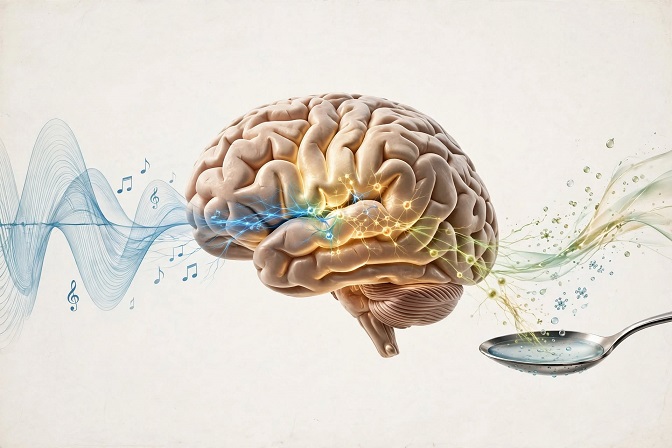
Music can influence the way people experience food, from shaping expectations about flavor to changing how enjoyable a dining experience feels. Scientists are increasingly investigating how sound and taste interact in the brain, including whether particular musical characteristics are associated with sweet or sour sensations.
A 2026 study published in Scientific Reports, titled Music–taste interactions enhance gustatory and sensorimotor brain activity, examined this relationship using behavioral testing and functional magnetic resonance imaging (fMRI). Rather than asking participants to eat complete meals, the researchers used controlled sweet and sour taste solutions while playing music designed to evoke corresponding taste qualities.
The study provides evidence that music and taste can interact at the level of brain activity. However, it also highlights an important distinction: changes in neural activity do not necessarily mean that a food will taste sweeter, more sour or more pleasant to everyone.
How the Researchers Tested the Relationship Between Music and Taste

The researchers recruited 48 healthy participants, 27 of whom were women. Complete MRI data were available for 28 participants, including 16 women, following technical issues that affected the usable imaging data.
Participants experienced sweet and sour taste solutions prepared using sucrose and citric acid. The researchers varied the proportions of the two components across five combinations, ranging from entirely sweet to entirely sour, with intermediate mixtures between them.
The experiment included three auditory conditions: music associated with sweetness, music associated with sourness and silence. The soundtracks were designed with different musical characteristics. The sweet-associated soundtrack featured a high pitch, legato articulation and consonant harmony, while the sour-associated soundtrack used a high pitch, sharper attacks and mild dissonance.
By comparing responses across these conditions, the researchers could investigate how music and taste interacted and whether combining them changed activity in brain regions involved in gustation and sensorimotor processing.
The use of controlled solutions allowed the researchers to isolate specific sensory interactions. At the same time, it meant that the experiment did not directly test how music affects the flavor of complex foods such as fruit, desserts or full meals.
Music and Taste Were Associated With Increased Brain Activity

The fMRI results showed that presenting music and taste together was associated with increased activity in several gustatory and sensorimotor brain regions compared with presenting taste alone.
For sweet combinations, increased activity included areas such as the right precentral gyrus, left postcentral gyrus, left precuneus and left rolandic operculum. These regions are associated with functions that include movement, bodily sensation and broader sensory processing.
For sour combinations, the researchers observed increased activity in areas including the right postcentral gyrus, left precentral gyrus, left lingual gyrus, regions around the right calcarine fissure and left cerebellar lobule VI. Additional local activity was reported in areas including the right rolandic operculum, left supramarginal gyrus and right precuneus.
These results suggest that adding music can change the brain’s response during taste perception. However, the regions identified were not identical across the sweet and sour conditions, and the findings should not be interpreted as showing that every region responds in the same way to every music-and-taste pairing.
The results also do not establish that music and taste use identical neural codes. Identifying shared anatomical regions is different from demonstrating that two senses are represented by the same underlying neural patterns.
What Happens When Sweet or Sour Music Is Paired With Taste?
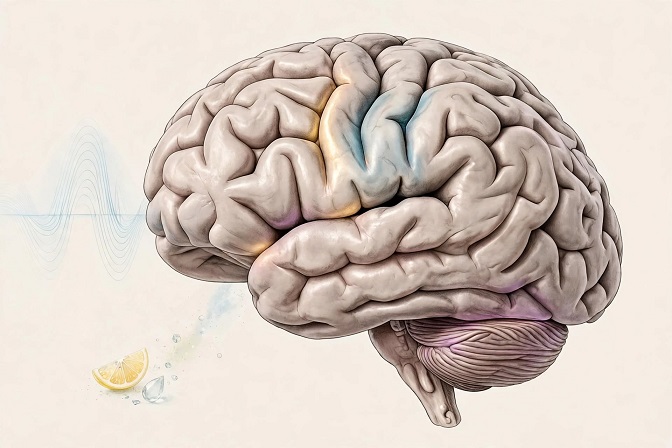
The researchers also examined whether the brain responded differently when the musical characteristics matched the taste being experienced.
When sweet taste was paired with sweet-associated music, compared with sweet taste paired with sour-associated music, increased activity was observed in the superior temporal gyri and rolandic operculum on both sides of the brain. These findings suggest that the relationship between a sound and a taste may matter, rather than the presence of music alone.
The corresponding comparison for sour taste did not produce statistically significant clusters. This means the study did not find equally strong evidence of a matching-versus-mismatching effect in the sour condition.
The researchers also investigated whether the brain regions responding to music overlapped with those responding to taste when the senses were presented separately. Some anatomical regions appeared in both sets of results. However, the sweet-condition conjunction analysis did not identify statistically significant overlapping voxels at the study’s cluster-corrected threshold. In the sour condition, a small significant overlap was found in the right postcentral gyrus.
These findings require careful interpretation. Anatomical overlap can suggest that different sensory experiences involve some of the same brain areas, but it does not by itself prove that the brain processes the two experiences in an identical way.
Can Sweet-Associated Music Make Taste More Pleasant?

The behavioral results offered some evidence that music may influence the pleasantness of taste. Among the 28 participants with complete MRI and behavioral data, sweet taste solutions received a higher mean pleasantness rating with sweet-associated music than in silence: 4.44 compared with 4.15. This difference was statistically significant, with a reported p-value of 0.016.
However, the overall effect of sound condition on sweetness ratings was not statistically significant. The researchers also did not find a statistically significant overall effect of sound condition on sourness ratings.
The findings therefore do not support the broad claim that music reliably makes food taste sweeter or more sour. Instead, they point to a more specific possibility: certain musical contexts may influence the pleasantness of some taste experiences, even when changes in perceived taste intensity are not consistently demonstrated.
These ratings concerned controlled sweet-and-sour taste solutions in a laboratory experiment, so they should not be interpreted as proof that sweet-associated music makes complete meals more enjoyable.
The paper also reports additional behavioral analyses involving the full group of 48 participants. In those analyses, sweetness ratings were higher with sweet-associated music than with sour-associated music or silence. The difference between these results and those from the smaller group with complete MRI data highlights why the sample used for each analysis matters when interpreting the findings.
Why These Findings Matter
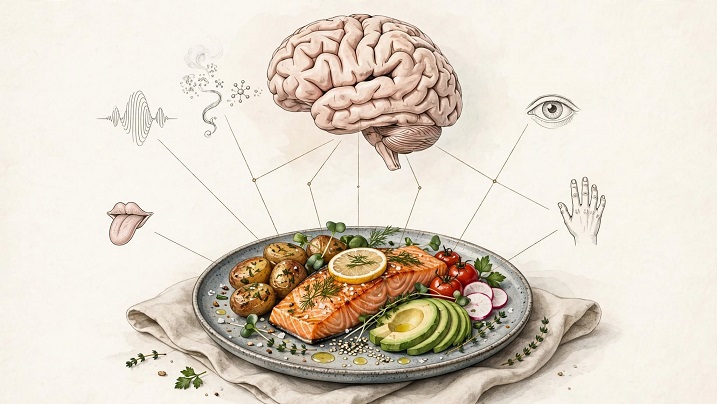
Taste perception is influenced by more than the chemical properties of food. The surrounding sensory environment, including sound, can contribute to the overall experience of eating. Research into these interactions may help explain why a meal can feel different depending on the sounds or music accompanying it.
The study adds evidence that music and taste can interact in brain regions involved in gustatory and sensorimotor processing. It also suggests that the correspondence between musical characteristics and taste may be relevant to the brain’s response.
In the future, this research could contribute to studies of sensory marketing, product design and the atmosphere of restaurants or other dining environments. Researchers might also investigate whether carefully designed sound environments could support people who experience changes in taste perception.
These are possible directions for further research, not established benefits of the current experiment. The study did not test commercial food products, measure the effects of music on an entire dining experience or demonstrate a clinical treatment for altered taste.
Study Limitations and What Comes Next

Several limitations should be considered when interpreting the findings.
First, the MRI analyses included 28 participants with complete imaging data, rather than all 48 recruited participants. The relatively small imaging sample may limit the ability to detect some effects and makes further replication important.
Second, the experiment used controlled sweet and sour solutions and a limited set of soundtracks. Real foods contain complex combinations of taste, smell, texture, temperature and other sensory cues. The effects observed with simple taste solutions may not translate directly to everyday eating.
Third, the behavioral results were mixed. Although sweet-associated music increased pleasantness ratings compared with silence in one analysis, the overall effects of sound on sweetness and sourness ratings were not statistically significant in the MRI-complete group.
The researchers also used a fixed order in which the multisensory interaction run preceded the separate taste and music runs. This design was intended to reduce the possibility that expectations formed during the separate sensory conditions would influence the combined condition. Nevertheless, task order, novelty or habituation could have contributed to the observed responses.
Finally, increased activity in a brain region does not necessarily establish a specific subjective experience or prove that two senses share the same neural representation. Further research using larger samples and methods capable of comparing neural activity patterns could help clarify how the brain combines auditory and gustatory information.
What This Means

The study offers evidence that music can alter brain activity during taste perception and that the pairing of musical characteristics with taste may influence how the brain responds. It also provides limited evidence that sweet-associated music can increase the pleasantness of a sweet taste solution under specific experimental conditions.
The central message is not that music automatically makes food taste better. Rather, sound appears to be one component of the sensory context in which taste is experienced. Understanding that relationship will require further research involving more participants, a broader range of tastes and sounds, and foods that more closely resemble everyday meals.
advertisement
Frequently Asked Questions (FAQ)
1. Can music change the way food tastes?
Music may influence aspects of taste perception and the pleasantness of a taste experience. This study found changes in brain activity when music was combined with sweet or sour taste solutions, but it did not establish that music consistently changes how complete meals taste.
2. What did the researchers discover about music and the brain?
The researchers found that combining music with taste was associated with increased activity in several gustatory and sensorimotor brain regions compared with taste alone. The affected regions differed between sweet and sour conditions.
3. Did sweet music make sweet tastes more enjoyable?
In the analysis of 28 participants with complete MRI and behavioral data, sweet taste solutions received higher pleasantness ratings with sweet-associated music than in silence. However, the overall effect of sound on sweetness ratings was not statistically significant, so the result should be interpreted cautiously.
4. Does music make food taste sweeter or more sour?
The study did not find a statistically significant overall effect of sound on sweetness or sourness ratings in the group with complete MRI data. It therefore does not establish that music reliably makes tastes seem sweeter or more sour.
5. Which brain regions were involved?
The reported regions included parts of the precentral and postcentral gyri, the rolandic operculum, the precuneus, the lingual gyrus and cerebellar regions. The findings varied according to the taste and auditory condition being compared.
6. Can this research be used to improve dining experiences?
It may inform future research into how sound environments influence sensory experiences in dining settings. However, the experiment used controlled taste solutions rather than complete meals, so practical benefits for restaurants or food products still need to be tested.
7. Could music help people with altered taste perception?
The findings may encourage future research into sound-based approaches for people who experience changes in taste. This study did not test a treatment or demonstrate that music improves taste function in a clinical setting.
8. What should future studies investigate?
Future studies could use larger samples, test a wider range of tastes and musical styles, examine real foods and investigate whether observed changes in brain activity correspond to consistent changes in perceived flavor or enjoyment.
Sources
Scientific Reports — “Music–taste interactions enhance gustatory and sensorimotor brain activity” (2026). DOI: https://doi.org/10.1038/s41598-026-53065-7
Phys.org — “Music can enhance the flavor of your food” (October 22, 2026): https://phys.org/news/2026-10-music-flavor-food.html
Additional Verified Sources
No additional sources were used.
Thank you !