
article image source: science.org (Link)
AI-Powered system brings Smell Sharing over the Internet closer to reality
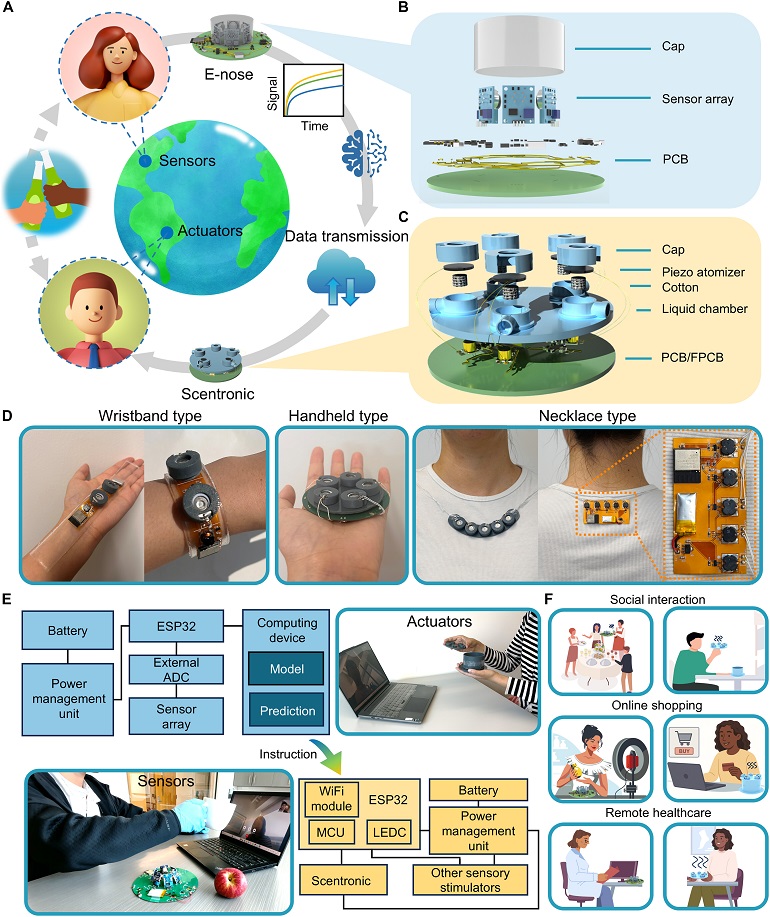
Overview and operation scheme of Scentronic for human-centric remote odor sharing and transmission.
image source: science.org
Key Points
Researchers at The Ohio State University and Zhejiang Laboratory developed Scentronic, an AI-assisted system designed to detect, transmit and recreate selected odors remotely.
The system combines a six-sensor electronic nose, machine-learning algorithms, internet connectivity and wearable piezoelectric odor actuators.
In tests involving five food-related odors, the machine-learning system achieved up to 100% accuracy on a held-out test set for one classification approach, while human participants identified individual generated odors with 72.86% accuracy.
The system transmitted sensor information through the internet with an average communication latency of about 65 milliseconds, while the complete sensor-to-actuator response could occur in about 0.6 seconds.
Researchers demonstrated potential applications in remote olfactory testing, healthcare, virtual and mixed reality, multisensory communication and digital flavor experiences, while stressing that the technology does not yet reproduce smells with full chemical precision.
advertisement
A Digital Link for Smell

Scientists have developed a system that could bring one of the human senses that has largely been left out of digital communication into connected devices. Called Scentronic, the platform combines an AI-assisted electronic nose, internet-based communication and a wearable odor-release device to detect selected smells at one location and generate corresponding odor cues at another.
The research was conducted by scientists from The Ohio State University and Zhejiang Laboratory and was published in Science Advances on October 21, 2026. The researchers describe Scentronic as an Internet of Things (IoT)-enabled olfactory interface designed to connect chemical sensing with digitally controlled odor stimulation.
The idea addresses a long-standing problem in human-machine interfaces. Digital systems can readily transmit images, sounds, touch-related signals and other forms of information, but smell is much harder to capture, encode and reproduce. The researchers say the absence of standardized stimulation methods and practical network-connected olfactory systems has limited the integration of smell into digital environments.
How Scentronic Detects an Odor

The first part of Scentronic is an electronic nose, or e-nose, built around an array of six metal-oxide semiconductor gas sensors. The sensors respond differently to volatile organic compounds, or VOCs, released by materials such as food.
The researchers used sensors based primarily on tin dioxide (SnO₂). When VOCs interact with the sensor surfaces, they alter the sensors' electrical resistance, producing electrical signals that can be analyzed by machine-learning algorithms.
For the initial classification experiments, the team tested five food-related odor categories: beer, cake, coffee, orange and red wine. The dataset contained 250 samples, with 50 samples for each food category. Each sample contained sensor-voltage data recorded over 200 seconds, and the data were divided into 80% for training and 20% for testing.
The researchers evaluated K-nearest neighbors (k-NN), Random Forest and Support Vector Machine approaches using either endpoint sensor measurements or full time-series data. The k-NN model using endpoint features produced 98.5% accuracy in five-fold cross-validation and 100% accuracy on the held-out test set. When time-series data were used, k-NN reached 99% cross-validation accuracy and 98% test accuracy.
These numbers describe the machine's ability to classify the tested samples, not the ability to reproduce every molecule responsible for a human smell perception. That distinction becomes important when evaluating what Scentronic actually achieves.
Turning Digital Signals Back Into Smell
After an odor is detected and classified, the information can be transmitted to the receiving device. Scentronic uses a wearable piezoelectric olfactory interface capable of releasing controlled amounts of odor.
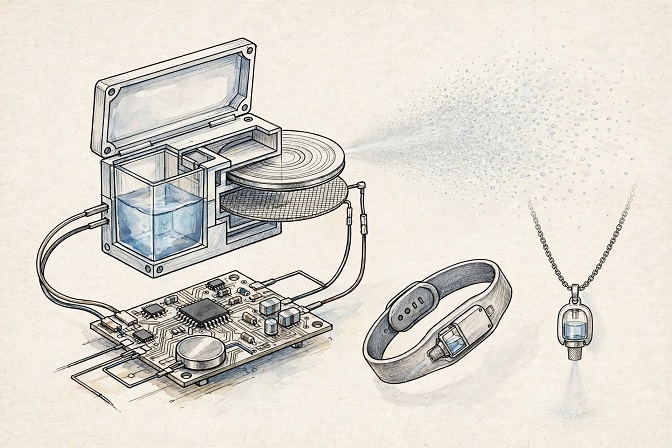
The device uses a small piezoelectric atomizer. When an alternating electrical signal is applied, the piezoelectric material vibrates rapidly, pushing liquid through microscopic openings and producing fine droplets containing odorants that disperse into the air. The release can be controlled electronically by adjusting the operating parameters of the atomizer.
The researchers produced several physical configurations, including wristband, handheld and necklace-style designs. The multi-channel versions can independently control several odor sources, allowing combinations to be delivered rather than relying on a single fixed scent.
The system also demonstrated programmable control of odor intensity. Increasing the actuator's duty rate increased the liquid transmission rate, while also shortening the operating time because the device's liquid supply was consumed more quickly. At a 10% duty rate, the actuator could operate for more than 35 minutes, while at 100% duty rate, operation dropped to less than 5 minutes.
Internet Transmission and Real-Time Response
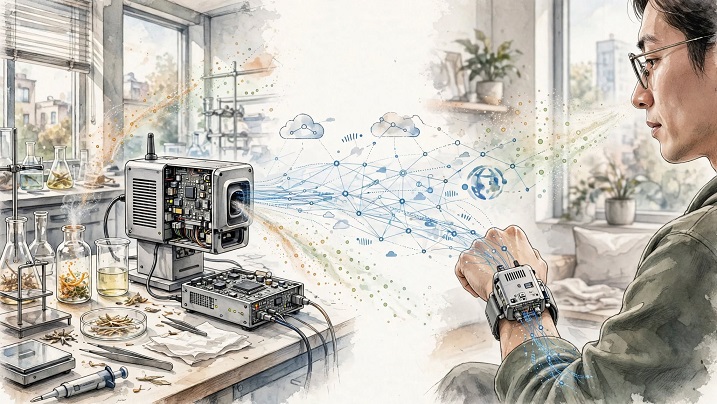
The researchers connected the sensing and actuation sides through Wi-Fi and cloud services. Sensor signals were digitized and transmitted to a program hosted on Google Cloud, where the information could be processed and sent onward to the receiving device.
In communication tests, the upload-and-download latency ranged from 57 to 76 milliseconds, with an average of approximately 65 milliseconds. The system then converted the received information into a pulse-width-modulated signal controlling the duration and intensity of odor release.
A separate real-time sensor-actuator experiment demonstrated an overall response latency of approximately 0.6 seconds. In that test, the release rate changed as an ethanol sample was moved closer to or farther from the sensor.
However, the researchers distinguish between the fast response of the sensor-actuator link and the time required for odor classification. In the digital flavor experiments, real-time classification of samples could take several to tens of seconds, depending on the process.
What Human Testers Experienced

The researchers also tested Scentronic with up to 16 healthy volunteers across various olfactory perception experiments. Participants were trained to recognize five food-related odors and then asked to identify odors released by the device.
For individual odors, participants achieved an identification accuracy of 72.86%. The five odors were cake, orange, coffee, beer and wine. For binary mixtures, participants were asked to distinguish combinations including coffee and orange, beer and cake, coffee and wine, orange and beer, and cake and wine. The accuracy for the binary combination task was 71.43%.
The researchers also examined the ability to recognize different odor intensities. In a test using five intensity levels of ethanol odor, participants' rankings matched the actual intensity ordering with 58.57% accuracy. The paper emphasizes that these rankings represent ordinal judgments rather than precise measurements of absolute odor intensity because olfactory perception varies between individuals.
The human experiments therefore demonstrate that the device can produce recognizable odor cues, but they also show that digital smell remains considerably more complicated than simply transmitting a conventional digital signal.
Potential Healthcare Applications
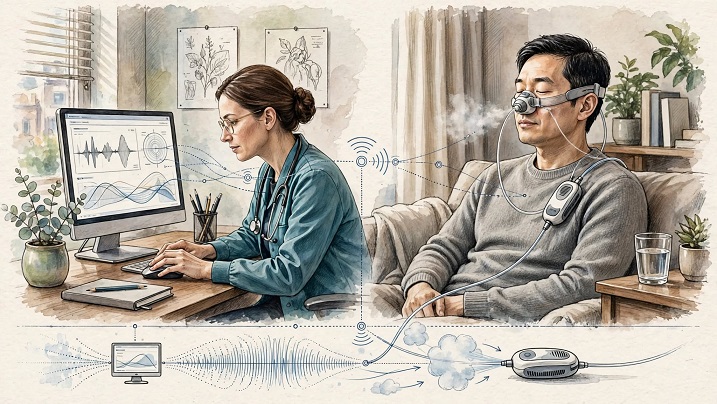
One of the most important applications proposed by the researchers is remote olfactory testing.
Changes in smell can occur in conditions involving post-viral illness, head trauma and neurodegenerative disease. The researchers note that conventional tools such as scratch-and-sniff cards and Sniffin' Sticks are useful for chemosensory testing but are not digitally connected and do not provide the same type of remote control.
Scentronic could allow clinicians to remotely adjust odor type and intensity while collecting responses from a patient. The researchers envision using such a system to investigate olfactory detection thresholds, identification thresholds and sensory impairment, potentially reducing the need for some in-person testing.
The paper also discusses potential applications involving olfactory training and sensory rehabilitation. Because the device can deliver programmed odor stimuli, researchers could use it in controlled experiments examining smell loss, smell distortion or increased sensitivity. The authors stress that future work will require more standardized testing protocols and collaboration with chemosensory specialists.
From Smell to Digital Flavor
The research goes beyond smell alone by combining olfactory and gustatory stimulation.
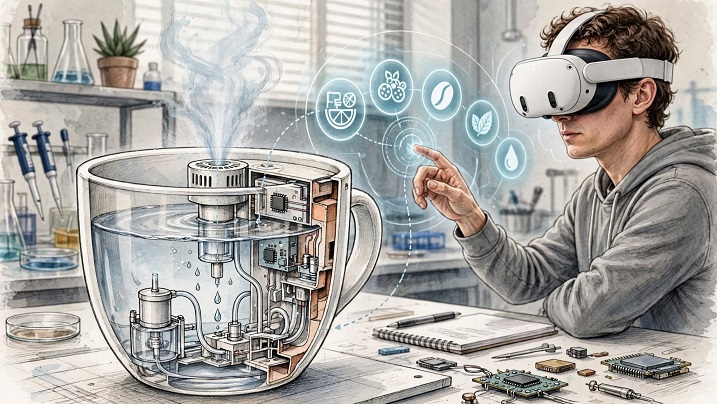
The team developed a prototype digital cup containing five odor channels and five taste stimulators. The system can coordinate the release of aromas and flavored liquids, allowing odor and taste cues to be delivered together.
In one demonstration, the researchers connected the system to a mixed-reality environment. A virtual shelf displayed beverage choices including beer and coffee. A user wearing a Meta Quest 3 headset could select virtual beverages using hand gestures. The interaction generated corresponding physical odor and liquid outputs from the digital cup.
The demonstration illustrates why smell may become particularly useful in immersive digital environments. Food perception is inherently multisensory, and combining visual, auditory, taste and smell cues could provide richer sensory feedback than systems that depend mainly on screens and speakers.
The researchers suggest possible applications in extended reality, education, communication technologies and sensory rehabilitation, while also discussing scenarios involving people with nutritional challenges and environments such as spaceflight or field operations. These are proposed application areas rather than established commercial uses.
Why This Is Not Yet a Digital Copy of Any Smell

Despite the striking concept, Scentronic should not be viewed as a machine that can currently capture any smell and reproduce its exact chemical composition somewhere else.
The researchers explicitly acknowledge that the current system has a limited number of sensor and actuator channels and does not match the odor-discrimination capabilities of humans or animals. Instead, it classifies odor information at the category level and reconstructs it using preloaded odor channels.
That means the system is closer to recognizing that an incoming sample belongs to a particular odor category and then producing a corresponding programmed odor than to transmitting every chemical component of the original smell. The authors say this approach sacrifices complete chemical fidelity but can still be useful when a recognizable sensory cue is sufficient.
The researchers also identify limitations in their experiments. Their odor-adaptation studies were relatively simple and included limited control conditions, which could introduce bias. They say future experiments should use more rigorous designs and larger populations to better understand individual differences in olfactory adaptation.
What Comes Next for Digital Smell

The next stage of development will require both better sensing and more sophisticated odor generation.
The researchers propose increasing the number of sensing channels, improving sensor sensitivity and selectivity, and developing software capable of more accurately analyzing odor concentration and composition. Expanding the number of actuator channels could also allow the system to generate more complex combinations of odors.
The study also points toward more standardized experiments in which digital odor delivery could be synchronized with measurements such as electroencephalography (EEG). Such experiments could help researchers investigate how the brain responds to controlled olfactory stimuli and how smell interacts with other senses.
For now, Scentronic represents an early framework for connecting chemical information, artificial intelligence, wireless communication and programmable sensory stimulation. The technology does not yet make the internet capable of reproducing every smell with perfect accuracy, but it demonstrates a practical route toward transmitting selected odor information between physically separated devices.
The broader significance is that digital interfaces could eventually move beyond sight and sound to include another major component of human perception. For healthcare researchers, that could mean more flexible olfactory testing. For virtual and mixed reality, it could mean adding recognizable aromas to digital experiences. And for human-to-human communication, it raises the possibility that some forms of chemical sensory information could one day become part of the connected world.
Key Points Summary
Scentronic links an AI-assisted electronic nose with remotely controlled odor-release hardware.
The e-nose uses six metal-oxide semiconductor gas sensors to analyze VOC patterns.
Tests covered beer, cake, coffee, orange and wine.
Machine-learning classification reached 100% accuracy on the held-out test set for the k-NN endpoint-feature approach.
Human volunteers identified individual generated odors with 72.86% accuracy and binary mixtures with 71.43% accuracy.
Internet communication averaged approximately 65 milliseconds, while the complete sensor-actuator response was demonstrated at about 0.6 seconds.
The system currently reconstructs odor categories using preloaded channels, rather than reproducing complete chemical compositions.
Potential uses include remote healthcare testing, olfactory research, rehabilitation, XR and multisensory experiences.
What This Means
Why it matters: The research demonstrates that smell can be incorporated into an IoT-based digital communication framework, rather than being treated only as a local physical sensation.
Who may be affected: The most immediate research interest could involve chemosensory researchers and healthcare professionals studying smell function. Longer term, the platform could also influence virtual reality, mixed reality, education and digital communication.
What to watch next: The most important developments will be improvements in sensor selectivity, the number of odor channels, chemical characterization, odor reconstruction and standardized human testing. The researchers also need larger and more rigorous experiments to determine how reliably the system performs across different people and real-world conditions.
advertisement
Frequently Asked Questions (FAQ)
What is Scentronic?
Scentronic is an AI-assisted olfactory interface developed to detect odor information, transmit it through an internet-connected system and generate corresponding odor cues using a wearable olfactory actuator.
Can Scentronic reproduce any smell?
No. The current system has a limited number of sensing and actuation channels. It classifies odors at the category level and recreates them through preloaded odor channels, rather than reproducing their complete chemical composition.
Which smells were tested?
The researchers tested beer, cake, coffee, orange and red wine, along with several binary combinations of these odors.
How accurate was the AI system?
For the five-category dataset, the k-NN model using endpoint features achieved 98.5% accuracy in five-fold cross-validation and 100% accuracy on the held-out test set. Time-series k-NN achieved 99% cross-validation accuracy and 98% test accuracy.
How accurately could people recognize the generated smells?
In the human tests, participants identified individual odors with 72.86% accuracy and binary odor combinations with 71.43% accuracy.
How quickly can Scentronic respond?
The complete sensor-actuator system demonstrated a response latency of approximately 0.6 seconds. Internet communication itself averaged about 65 milliseconds, while more complex odor classification could take several to tens of seconds.
Could Scentronic be used in healthcare?
The researchers propose it as a potential platform for remote olfactory testing, monitoring sensory dysfunction, psychophysical research and rehabilitation-related applications. These are research and potential applications, not established clinical treatments.
Does Scentronic also simulate taste?
The researchers developed a prototype cup combining five odor stimulators with five gustatory stimulators. The system can coordinate odor and taste delivery as part of a multisensory experience.
Was the technology tested with virtual reality?
Yes. The researchers demonstrated the digital cup in a mixed-reality environment using a Meta Quest 3 headset, where virtual beer and coffee selections triggered corresponding physical odor and liquid outputs.
What are the main limitations?
The current system has a limited number of sensor and actuator channels, does not reproduce complete chemical compositions and was tested under controlled experimental conditions. The researchers say more rigorous studies are needed to address possible bias and better characterize individual differences in smell perception.
Sources
Science Advances — Primary Source: Chunyu Yang et al., Scentronic: An artificial intelligence–assisted olfactory interface for remote odor sharing and transmission, Science Advances, published October 21, 2026, DOI 10.1126/sciadv.aee9266.
Tech Xplore — Supporting Source: Paul Arnold, Something smells different as scientists send aromas over the internet, published October 22, 2026. The article identifies the Science Advances paper as its research reference.
Additional Verified Sources
No additional sources were used.
Thank you !