
article image source: onlinelibrary.wiley.com (Link)
Brain-inspired hardware could make AI computing more Energy-Efficient and Scalable
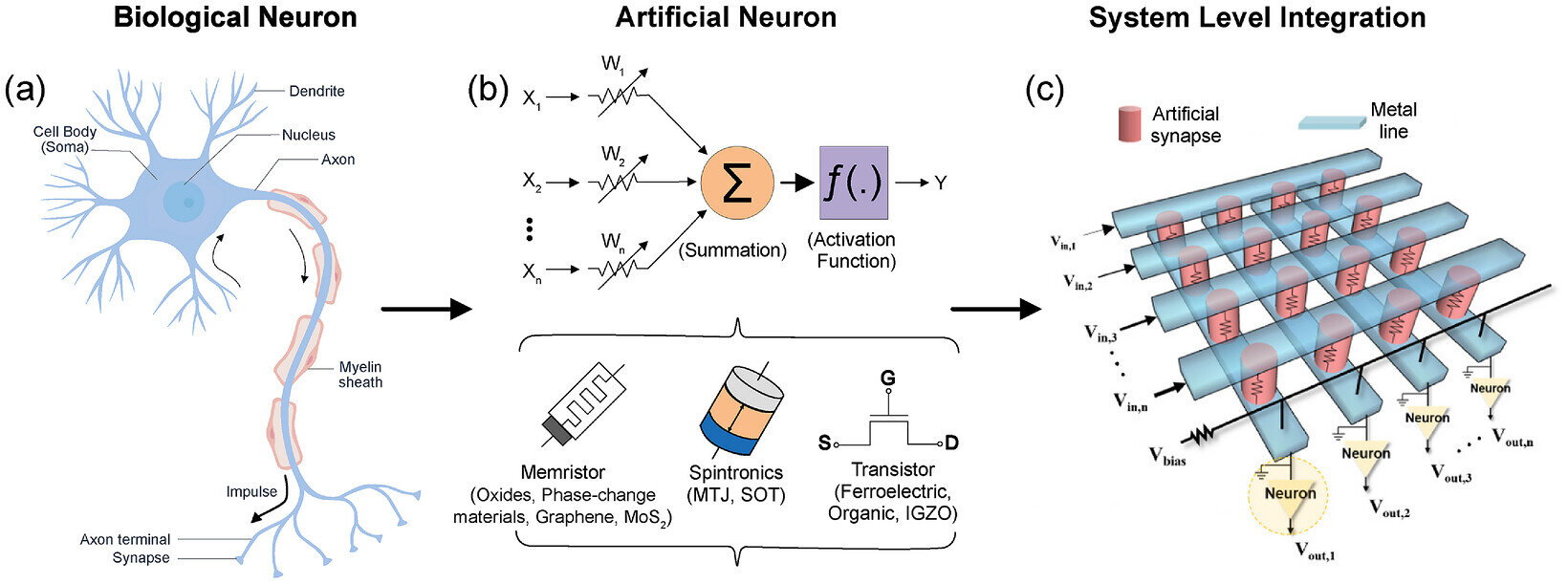
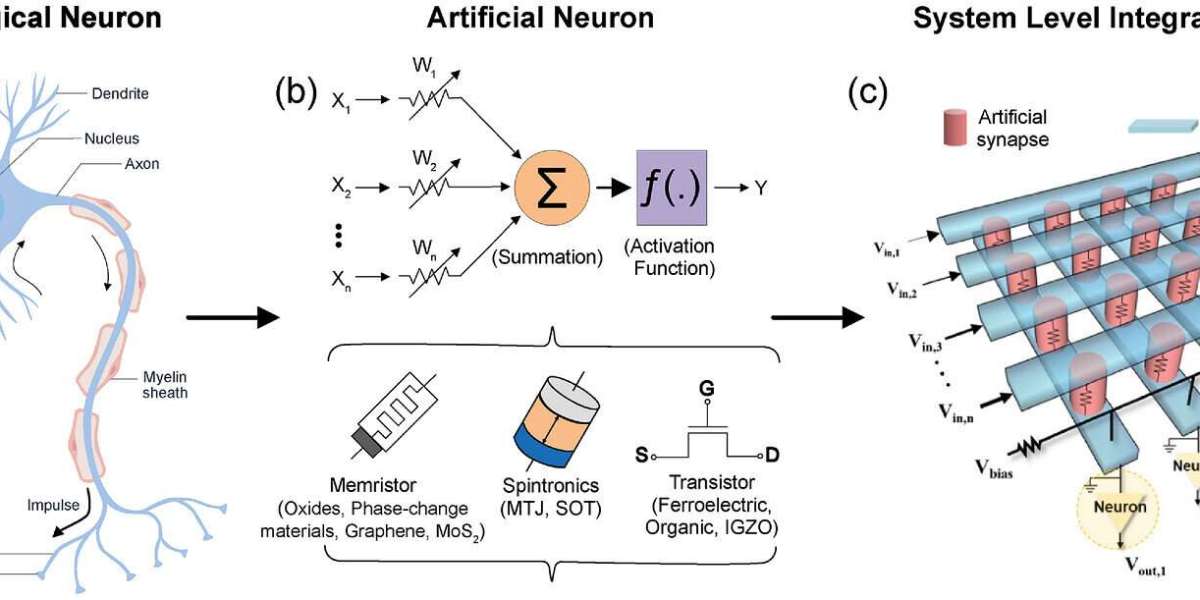
Schematics showing (a) biological neuron and (b) summation and non-linear activation function computed inside a neuron. The emerging device candidates for post-CMOS neuron implementations are also shown. (c) Schematic of a crossbar array showing the typical arrangement of synapses and neurons in a system-level architecture. Reproduced with permission. Copyright 2020, Frontiers.
image source: onlinelibrary.wiley.com
video here-loading
Key Points
Neuromorphic computing aims to reproduce important features of the brain’s information processing, including event-driven activity, parallel processing and close integration of memory and computation.
A new review in Advanced Functional Materials, published September 7, 2026 and accepted on August 13, 2026, examines emerging post-CMOS artificial neurons that could address some of the area and energy limitations of conventional CMOS neuron circuits.
Researchers examined technologies including memristors, phase-change materials, spintronic devices, ferroelectric field-effect transistors, organic devices and photonic systems.
Some experimental artificial-neuron devices have demonstrated energy-per-spike values ranging from femtojoules to nanojoules, although the measurements come from different device architectures and are not directly comparable.
The researchers say practical neuromorphic systems will require progress not only in devices, but also in circuits, architectures, manufacturing, reliability and application-specific design.
advertisement
A Different Approach to AI Hardware

As artificial intelligence workloads grow, conventional computing architectures face increasing pressure from the amount of data that must move between memory and processors. A review in Advanced Functional Materials, published September 7, 2026 and accepted on August 13, 2026, examines whether hardware inspired by the way biological neurons process information could provide another route for building more energy-efficient and scalable computing systems. The work was conducted by researchers affiliated with the University of Ottawa, Columbia University and Hanyang University. Rather than describing a single new chip, the review surveys research into artificial neurons and emerging device technologies, outlining how these components could eventually form larger neuromorphic computing systems.
Why Conventional CMOS Neurons Face a Scaling Problem
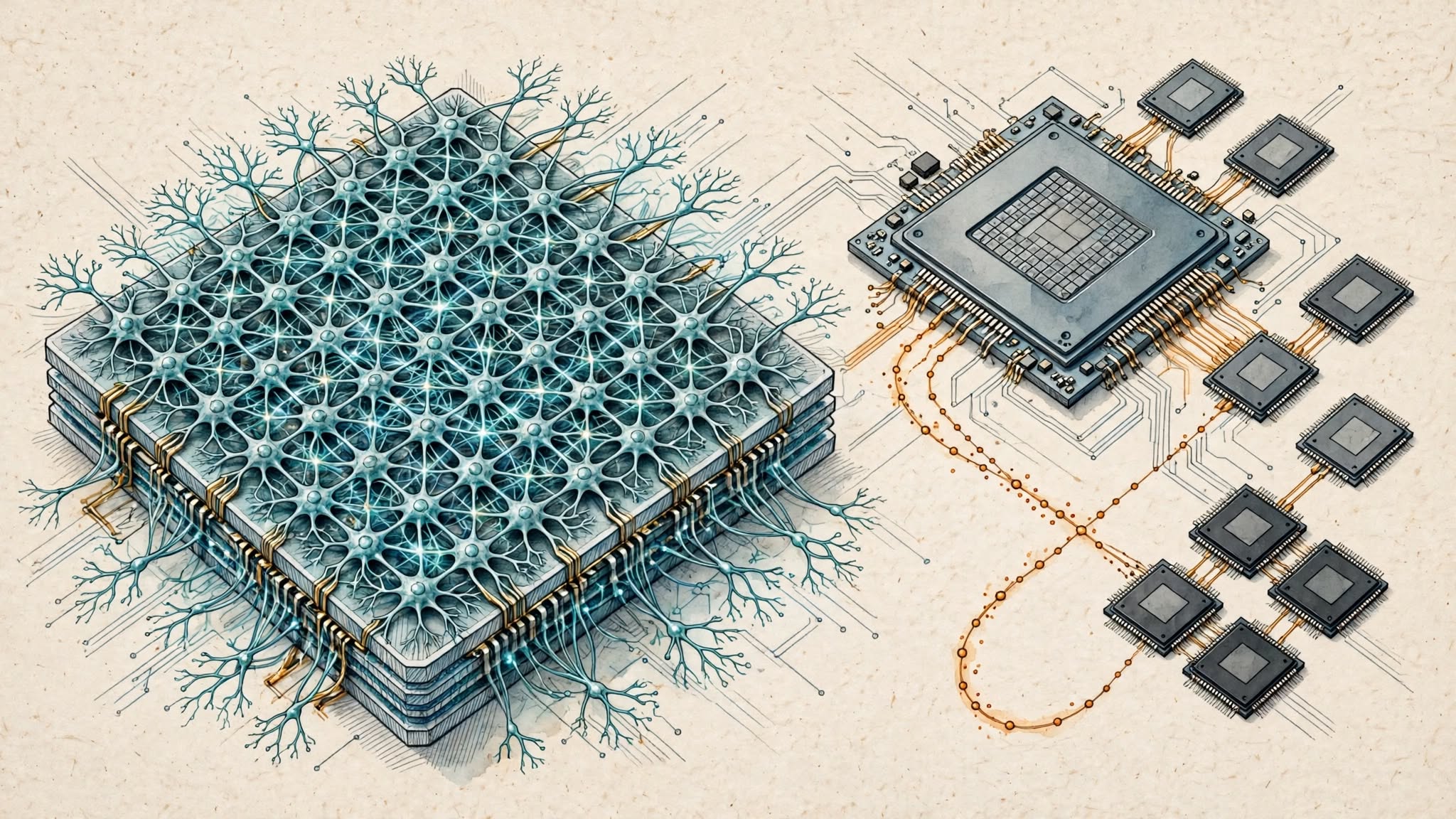
Modern processors such as GPUs, TPUs and NPUs have helped drive advances in deep neural networks, but conventional computing generally separates processing from memory. Moving information between those locations can create what researchers call the “memory wall,” adding latency and energy costs as data volumes and computational requirements increase. Neuromorphic computing takes a different approach by drawing on the brain’s highly parallel and event-driven operation, where memory and computation are more closely colocated. In a neuromorphic system, synapses primarily store connection weights, while neurons integrate incoming signals and apply nonlinear thresholding before producing an output. Conventional CMOS circuits can reproduce these behaviors, but detailed neuronal dynamics may require numerous transistors, capacitors and resistors. The review identifies the membrane capacitor used to achieve biological time constants as a particularly important scaling limitation: in dense arrays, the capacitor can occupy too much physical area, while static current during integration can also consume significant energy.
How Brain-Inspired Artificial Neurons Work
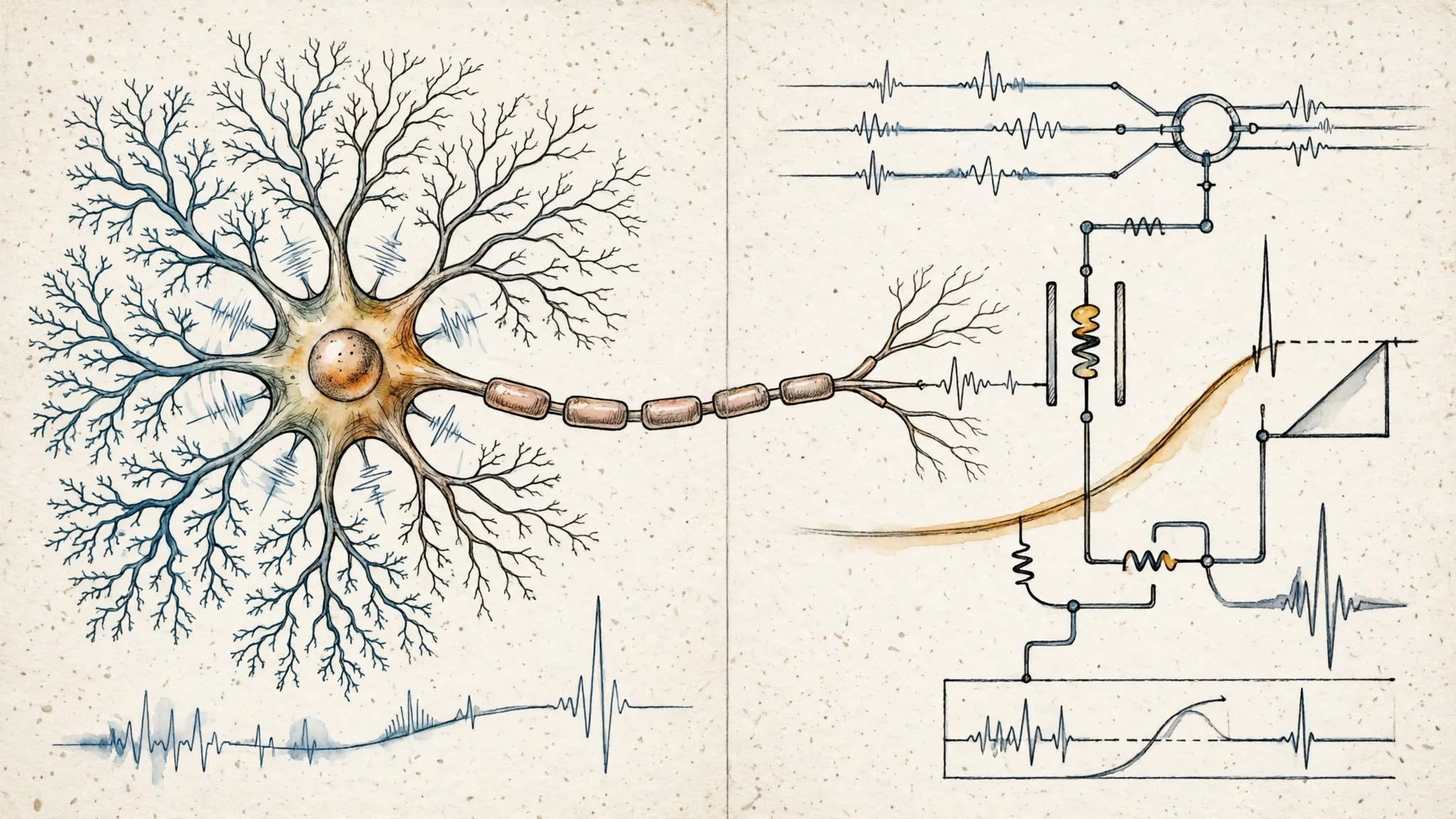
The biological neuron provides the basic model for many neuromorphic circuits. Signals arrive through dendrites, are integrated in the cell body, and can trigger an electrical spike when the membrane potential reaches a threshold. Researchers translate these principles into mathematical neuron models with different levels of biological detail. The Hodgkin-Huxley model, for example, represents complex ion-channel dynamics but is computationally demanding, while the simpler leaky integrate-and-fire (LIF) model captures the essential process of integrating inputs, reaching a threshold and generating a spike before resetting. The review identifies LIF as the most widely adopted abstraction for neuromorphic hardware because of its relative simplicity, while more complex models can reproduce behaviors such as bursting, adaptation and different firing patterns. This distinction matters because hardware designers must balance biological realism, energy consumption, speed and scalability rather than attempting to reproduce every feature of a biological neuron.
Post-CMOS Devices Put Neuron-Like Behavior Into the Hardware
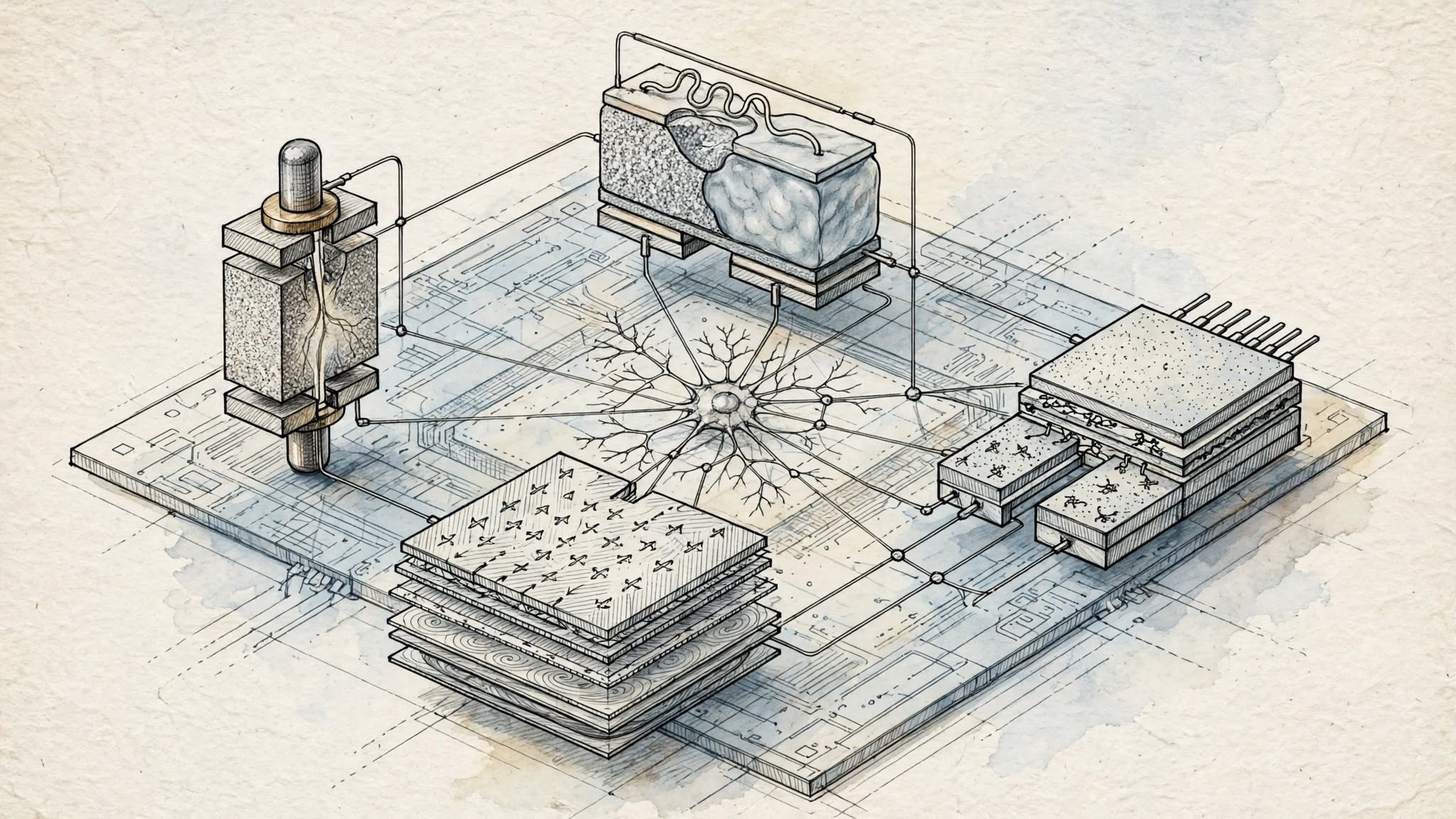
The central focus of the review is the move toward post-CMOS artificial neurons. These devices exploit physical properties that can naturally reproduce aspects of neuronal behavior, potentially reducing the number of conventional circuit components required. The technologies examined include resistive random-access memory (RRAM) and memristors, phase-change memory, spintronic devices, ferroelectric field-effect transistors (FeFETs), organic electrochemical transistors and other emerging semiconductor structures. Their physical characteristics can provide functions such as integration, threshold switching, memory retention, recovery and adaptation. The review reports examples across a wide performance range. For instance, an anti-ferroelectric FET neuron was reported at 37 femtojoules per spike, while an NbO₂ memristor example was reported at 29 picojoules per spike. An exchange-bias magnetic tunnel junction was reported at 190 femtojoules, and a synthetic antiferromagnetic device at 486 femtojoules. Across the devices summarized in the review, reported energy figures extend from 37 femtojoules to hundreds of nanojoules (up to 520 nanojoules), depending on the device technology and operating conditions. These figures should not be interpreted as a single benchmark for the entire field because the devices, operating conditions and measurement configurations differ.
More Complex Neurons Are Also Being Built
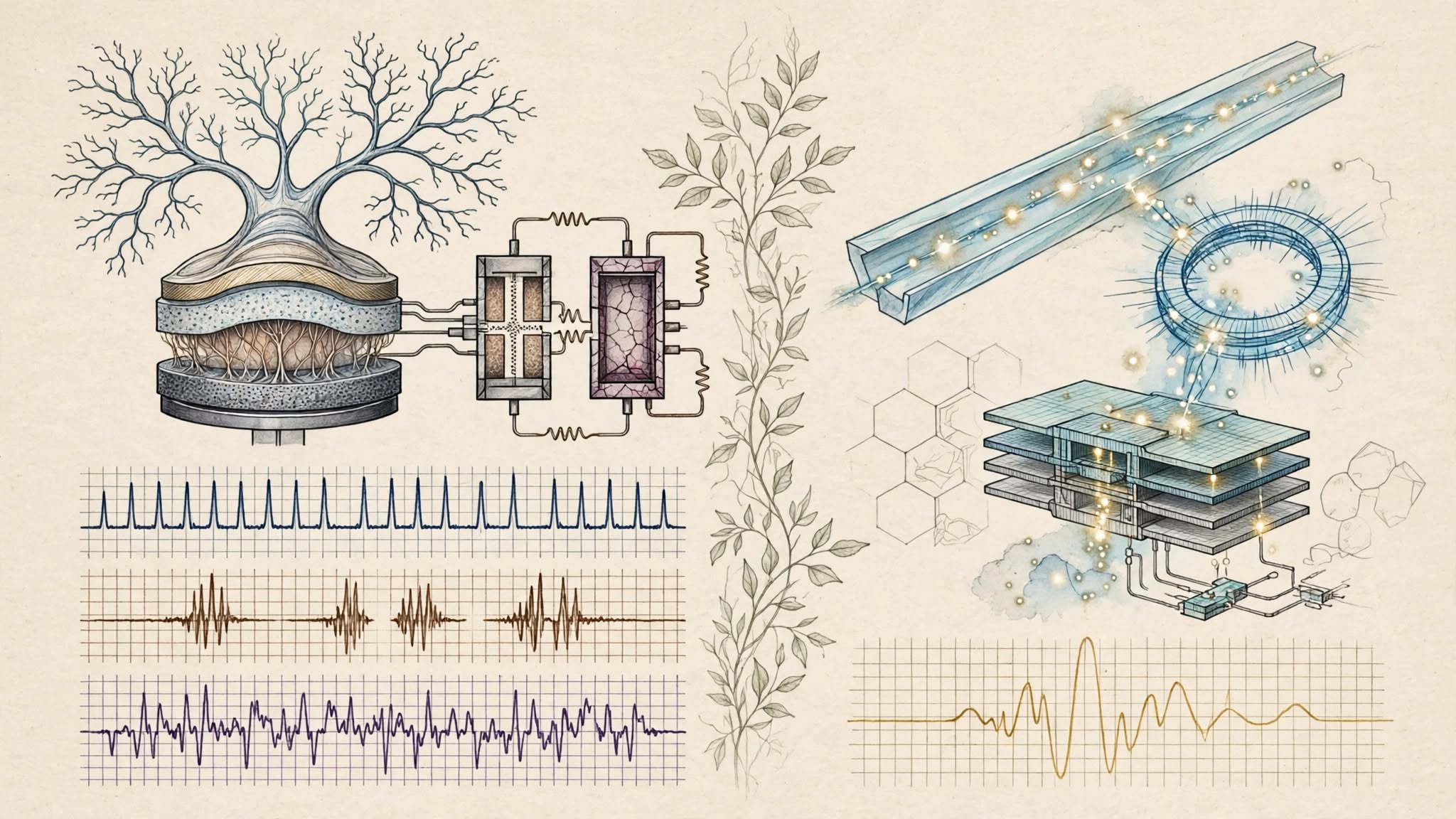
The emerging devices are not limited to simple integrate-and-fire behavior. The review describes hardware implementations designed to reproduce more complicated neuronal dynamics, including stochastic firing, bursting, phasic spiking, mixed-mode firing, spike-frequency adaptation and oscillatory behavior. One example uses NbOₓ threshold-switching devices to emulate aspects of ion-channel kinetics in a compact Hodgkin-Huxley neuron. Researchers subsequently demonstrated a fully integrated memristive Hodgkin-Huxley neuron using HfOₓ-based RRAM and NbOₓ-based threshold-switching memristors, with behaviors including all-or-nothing firing, tonic spiking and bursting, subthreshold oscillation and mixed-mode firing. The review also discusses stochastic neurons that deliberately exploit physical fluctuations in nanoscale devices. Such systems can produce probabilistic firing useful for certain forms of neuromorphic and probabilistic computing. Other approaches use optical or photonic signals, potentially allowing high-bandwidth communication and wavelength-division multiplexing, although optical losses, thermal drift, crosstalk and electro-optic conversion remain challenges.
From Individual Devices to Large Neuromorphic Systems
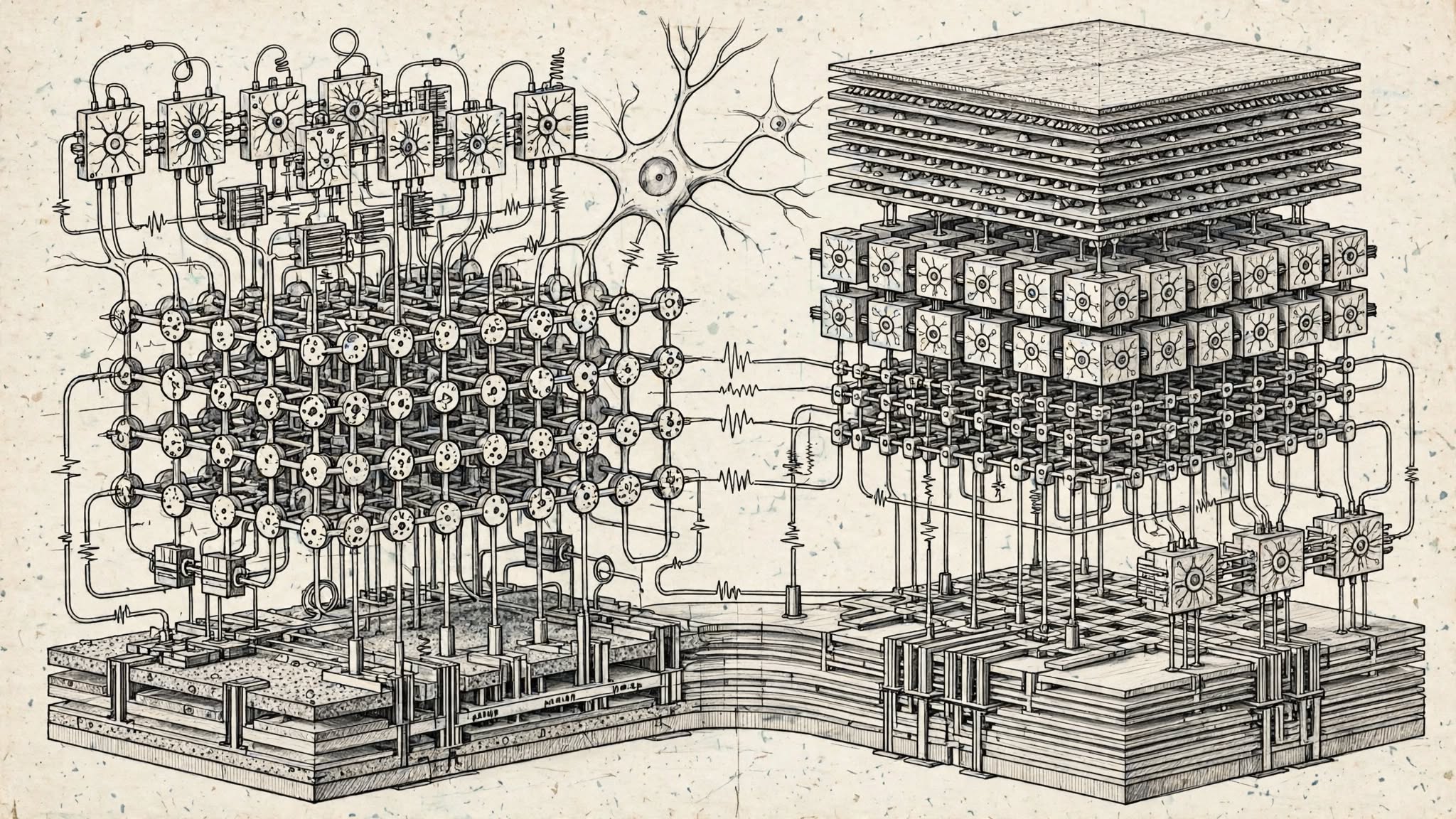
Building a useful neuromorphic processor requires more than creating a neuron that works in a laboratory. The artificial neurons must be integrated with synaptic arrays, communication networks and peripheral electronics while maintaining reliable timing and manageable energy consumption. The review emphasizes the importance of system-level approaches such as high-density synaptic crossbars, event-driven communication, local in-memory routing and potentially three-dimensional integration. Device variability is another major issue because differences in threshold voltage, conductance, leakage and temporal behavior can change how individual neurons fire. Proposed approaches include calibration, adaptive biasing, redundancy, fault-aware mapping and device-aware training. The researchers also emphasize that neuron and synapse timing must be jointly considered when implementing learning mechanisms such as spike-timing-dependent plasticity (STDP). In other words, a scalable neuromorphic system requires coordinated design across the device, circuit and architecture levels rather than simply replacing a conventional transistor with a new material.
Potential Applications Beyond Data Centers
The review identifies several application areas in which different types of artificial neurons may be appropriate. Inorganic solid-state devices, including NbOₓ-based Mott devices, are discussed in connection with high-speed edge-processing applications, while organic electrochemical neurons (OECNs) can provide low-frequency operation more closely aligned with biological signals and are therefore relevant to bio-interfacing applications. Other potential applications discussed in the review include edge AI, autonomous drones, smart sensors, electronic skin, prosthetics and brain-machine interfaces. Photonic and optoelectronic neurons offer another route for applications requiring high-bandwidth optical communication and processing. These should be understood as potential applications described by the sources, not as technologies already deployed at commercial scale.
The Remaining Path to Practical Chips
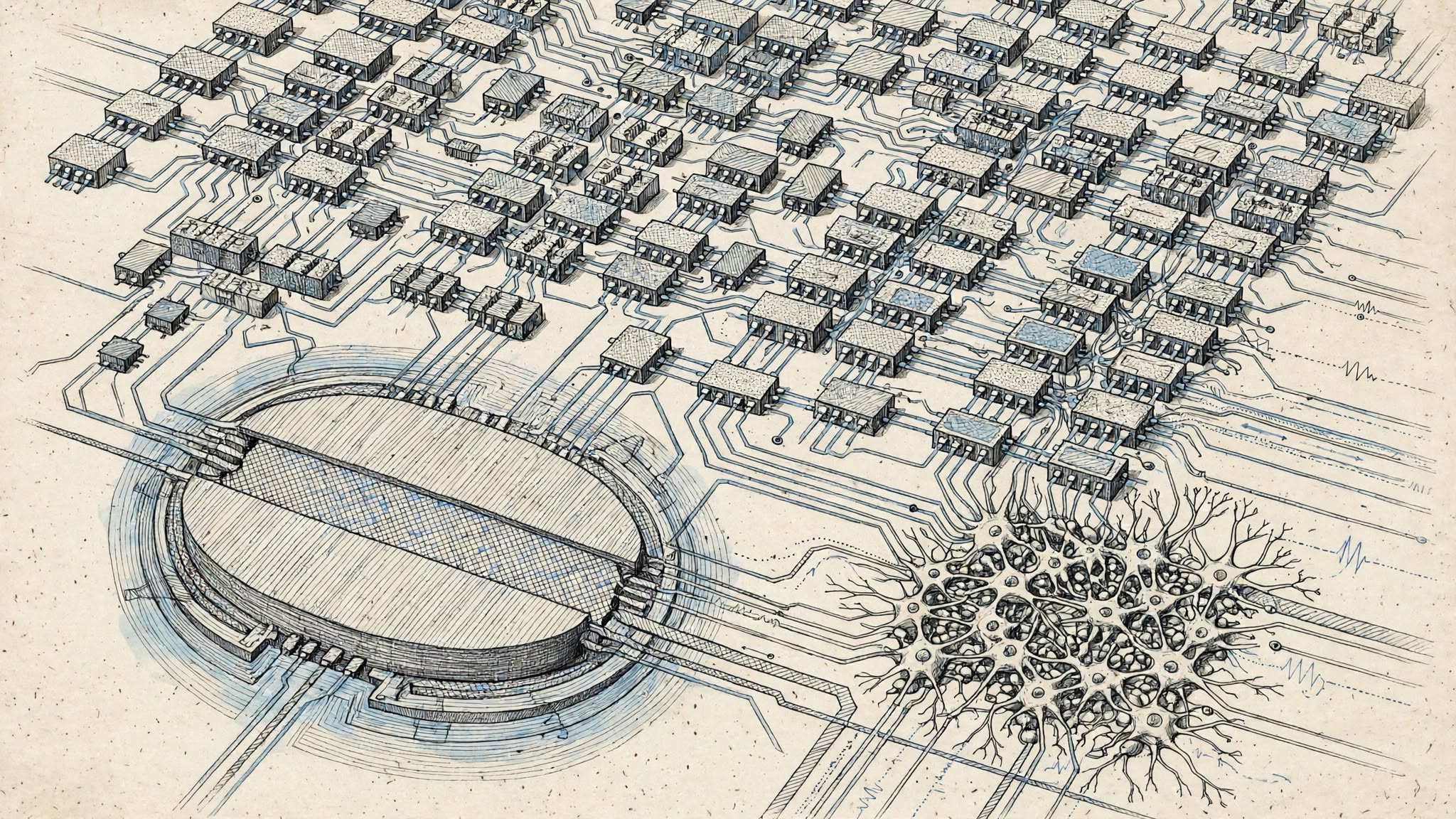
The researchers conclude that moving from laboratory demonstrations toward commercially viable artificial-neuron hardware will require progress across several areas. Device reliability and variability must be controlled, while future systems should support greater reconfigurability, allowing neuron behavior to be adapted to different computational tasks. The review also calls for better multimodal integration, including optical, tactile and chemical sensing, as well as improvements in system-level scalability. Manufacturing presents another hurdle: practical technologies must address CMOS compatibility, thermal budgets, contamination control, wafer-scale uniformity, fabrication yield and cost. Long-term operation will also need to be evaluated through standardized reliability and qualification procedures, including measurements of endurance, retention, threshold drift and stability under prolonged use. The authors therefore describe brain-inspired post-CMOS hardware as a developing research field whose eventual impact depends on coordinated advances in materials science, device physics, circuit design, semiconductor manufacturing and computational neuroscience.
Key Points Summary
Neuromorphic computing seeks to process information using principles inspired by biological neural systems.
The memory wall is a major limitation of conventional architectures because data must repeatedly move between memory and processing units.
CMOS artificial neurons can reproduce neuronal behavior but may require large circuits and capacitors, limiting density and increasing energy use.
Post-CMOS technologies such as memristors, spintronic devices, FeFETs, phase-change materials and organic devices can exploit their physical properties to implement neuron-like functions.
Experimental devices have demonstrated very low reported energy-per-spike values, but performance figures cannot be directly compared without considering their different designs and measurement conditions.
More advanced hardware can reproduce behaviors beyond simple integrate-and-fire neurons, including bursting, adaptation, stochastic firing and Hodgkin-Huxley-like dynamics.
The major remaining challenge is turning individual demonstrations into reliable, scalable and manufacturable neuromorphic systems.
What This Means
The research points toward a possible change in how specialized AI hardware could be designed. Instead of relying entirely on conventional digital circuits to reproduce neural-network operations, future neuromorphic processors could use the physical behavior of emerging devices to perform some neuron-like functions directly in hardware.
For data-center operators and AI hardware designers, the attraction is the possibility of reducing energy and data-movement overhead. For researchers, the more immediate challenge is proving that the benefits demonstrated by individual devices can survive when thousands or millions of components are integrated into reliable systems.
Readers should watch for progress in large-scale integration, device reliability, CMOS-compatible manufacturing, 3D architectures and hardware-software co-design. The review makes clear that these developments are still necessary before post-CMOS artificial neurons can become broadly commercial computing technology.
advertisement
Frequently Asked Questions (FAQ)
What is neuromorphic computing?
Neuromorphic computing is an approach to computer hardware inspired by the architecture and information-processing behavior of biological neural systems. It seeks to use features such as parallel processing, event-driven activity and closer integration of memory and computation.
What is a post-CMOS artificial neuron?
A post-CMOS artificial neuron is a hardware device or device-based circuit that reproduces neuronal functions using emerging materials or physical mechanisms beyond conventional CMOS circuitry. Examples discussed in the review include memristors, phase-change devices, spintronic devices and ferroelectric transistors.
Why is CMOS difficult to scale for artificial neurons?
Detailed CMOS neuron circuits can require multiple transistors and other components. The review highlights the physical size of the membrane capacitor needed to reproduce biological time constants, as well as energy consumed during subthreshold integration, as important limitations for dense neuron arrays.
What is a leaky integrate-and-fire neuron?
The LIF neuron is a simplified mathematical model in which incoming signals accumulate over time while the membrane potential gradually leaks toward a resting level. When a threshold is reached, the neuron produces a spike and resets. Its relative simplicity has made it a common model for neuromorphic hardware.
Can artificial neurons reproduce more complex brain-like behavior?
Yes. The review describes hardware implementations capable of reproducing behaviors including bursting, stochastic firing, phasic spiking, adaptation, oscillations and Hodgkin-Huxley-like dynamics.
Are brain-inspired chips already replacing conventional data-center processors?
The supplied sources do not establish that such chips are currently replacing conventional data-center processors. The Wiley paper is a review of emerging technologies and explicitly identifies further work needed in device, circuit, architecture, manufacturing and application development.
Could this technology be used outside data centers?
Potential applications discussed in the sources include edge AI, smart sensors, autonomous drones, electronic skin, prosthetics, brain-machine interfaces, wearable technology and human-machine interfaces.
Sources
Advanced Functional Materials — “Emerging Post-CMOS Hardware Neurons for Brain-Inspired Computing: Devices, Circuits, and System Integration” — Primary scientific review; accepted on August 13, 2026, and first published online on September 7, 2026.
Tech Xplore — “Building brain-inspired semiconductor chips for smarter, greener data centers”
Additional Verified Sources
No additional sources were used.
Thank you !