
article image source: news.berkeley.edu (Link)
UC Berkeley Student Identifies Three Rare Dwarf Galaxy Candidates Near M101

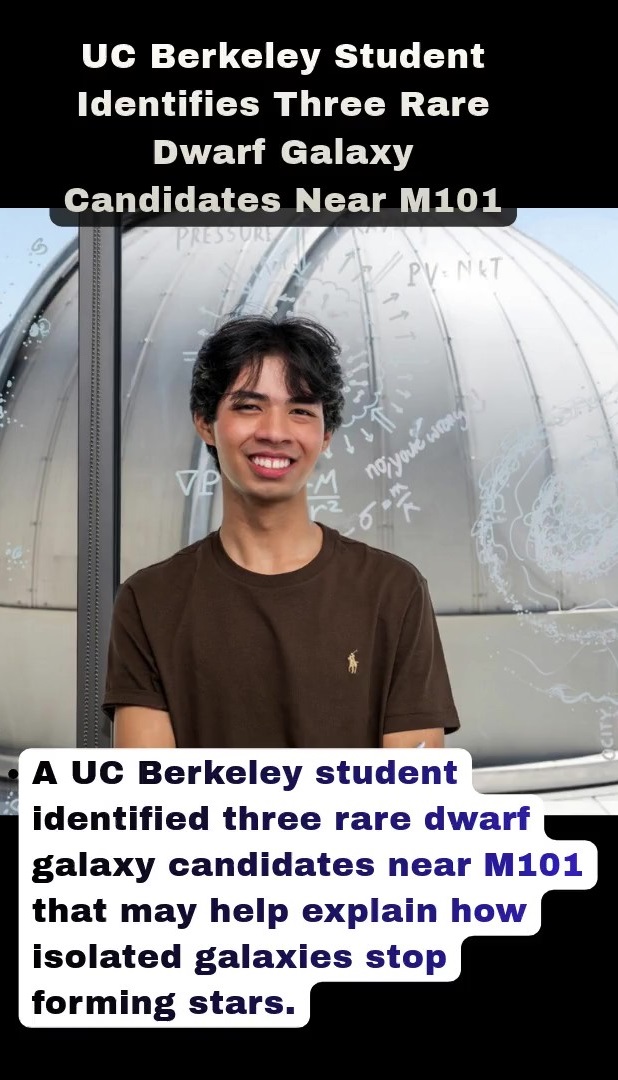
Julian Shapiro (right) poses with Alex Filippenko, a mentor and Berkeley astronomy professor.
Photo courtesy of Shannon Kelli, image source: news.berkeley.edu
Key Points
Julian Shapiro, a first-year UC Berkeley astrophysics student, identified three unusual dwarf galaxy candidates that appear to have stopped forming stars despite being relatively isolated.
The objects, named Shapiro Dwarf Galaxies I, II and III, could help astronomers investigate the origins of isolated, quiescent dwarf galaxies.
The research proposes that the galaxies may be backsplash galaxies—objects that passed close to a larger galaxy, lost their star-forming gas and subsequently moved back into more isolated regions.
Initial distance estimates place the candidates approximately 4–8 megaparsecs away, but more precise measurements are needed to establish their locations and histories.
Follow-up observations with the Hubble Space Telescope or James Webb Space Telescope could help determine whether the candidates are backsplash galaxies or have other explanations for their lack of star formation.
advertisement
A Young Researcher Finds Three Unusual Galaxies
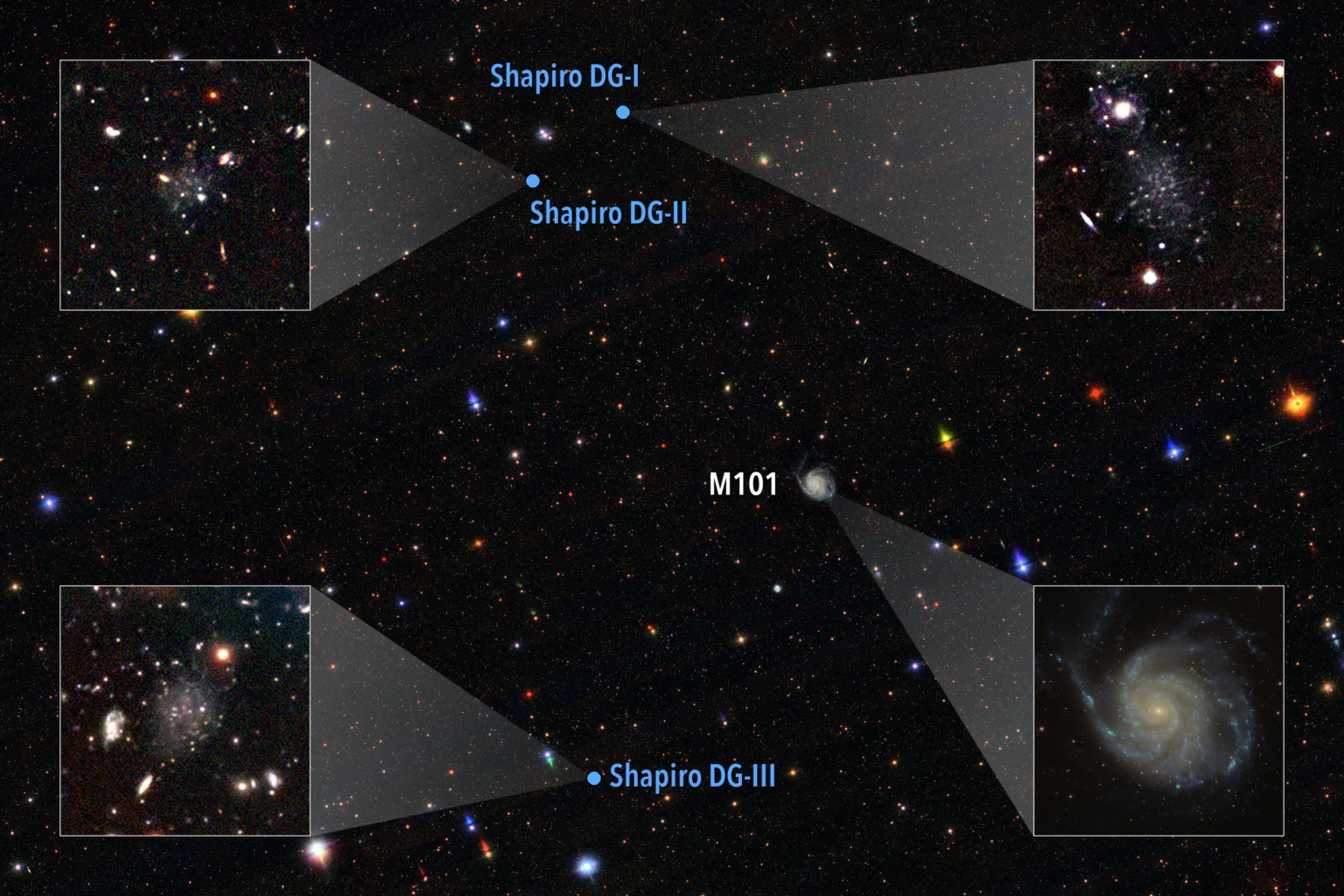
A composite image created by Julian Shapiro using images from the Sloan Digital Sky Survey, Hyper Suprime-Cam Legacy Archive / National Astronomical Observatory of Japan, and Canada-France-Hawaii Telescope / Coelum.
Courtesy of Julian Shapiro, image source: news.berkeley.edu
A first-year student at the University of California, Berkeley, has identified three unusual dwarf galaxy candidates that could help astronomers investigate a longstanding question about how small galaxies evolve. The objects appear to have stopped forming stars even though they are located outside the immediate environments where this condition is usually observed.
The candidates were identified by Julian Shapiro, an undergraduate astrophysics student who conducted the research while still in high school. His study, published in The Astrophysical Journal on October 6, 2026, catalogs the objects as Shapiro Dwarf Galaxy I, Shapiro Dwarf Galaxy II and Shapiro Dwarf Galaxy III.
The discovery is significant because the candidates combine two characteristics that astronomers do not commonly find together: relative isolation and an apparent lack of ongoing star formation. Their unusual properties may offer clues about the forces that can transform dwarf galaxies, even after they move away from larger galactic systems.
However, the research does not establish that the objects are definitively backsplash galaxies. Their distances and histories remain uncertain, and additional observations will be necessary to determine their nature.
Why Isolated Dwarf Galaxies That Stop Forming Stars Are Unusual
Dwarf galaxies are relatively small and faint compared with larger systems such as the Milky Way. They are found in different environments, including as satellites orbiting larger galaxies and as more isolated objects in lower-density regions of the universe.
Their surroundings can influence whether they continue producing stars. Dwarf galaxies in relatively isolated environments are generally expected to retain cold gas, an essential ingredient for star formation. By contrast, dwarf galaxies near massive neighbors can lose some of this gas through environmental processes and eventually become quiescent, meaning their star formation has largely or entirely ceased.
This creates an astronomical puzzle when a dwarf galaxy appears both isolated and quiescent. If it is far from a massive neighbor, what caused it to lose the material needed to form new stars?
Shapiro’s three candidates may help researchers investigate that question. If their apparent isolation and lack of recent star formation are confirmed, they could provide evidence that environmental interactions can affect a galaxy long after it has moved away from its original host.
What Are Backsplash Galaxies?
One possible explanation is that the candidates are backsplash galaxies. In this scenario, a small galaxy once passed relatively close to a much larger galaxy before moving outward again into a more isolated region.
During its close encounter, the smaller galaxy could have experienced environmental forces capable of removing or reducing its gas supply. Without enough cold gas, it would have difficulty sustaining star formation. After moving away from its host, it could therefore remain quiescent despite appearing isolated today.
This possibility is particularly interesting because cosmological simulations predict that backsplash galaxies should exist. Nevertheless, identifying convincing examples in the nearby universe has been difficult.
Shapiro’s study presents three candidates whose estimated distances and apparent quiescence are consistent with this explanation. The findings provide potential observational support for the theory, rather than definitive proof that the proposed process occurred in these particular objects.
The distinction matters: astronomers must establish both where these galaxies are and whether their histories fit the backsplash scenario before drawing firm conclusions.
Why M101 Is a Leading Suspect
The nearby spiral galaxy Messier 101, commonly known as the Pinwheel Galaxy, is the primary proposed host associated with the candidates. M101 lies approximately 6.7 megaparsecs from Earth, within the 4–8 megaparsec distance range estimated for the newly identified dwarf galaxy candidates.
The three candidates appear in the region beyond M101’s estimated virial radius, the area associated with the galaxy’s gravitationally bound system. Their projected separations from M101 are approximately 289–329 kiloparsecs. These measurements make their possible connection to the larger galaxy scientifically interesting, although projected positions alone cannot establish their complete three-dimensional locations or past trajectories.
The study also identifies an important alternative explanation for Shapiro Dwarf Galaxy II. Because it lies near the spiral galaxy NGC 5585, it could instead be a faint satellite of that galaxy.
Other environmental processes, including cosmic web stripping, could also potentially explain the loss of star-forming gas. Consequently, M101 is the leading proposed host in the study, but it is not a confirmed explanation for the origin of all three objects.
How the Research Team Identified the Candidates
Shapiro used archival astronomical observations from the Canada–France–Hawaii Telescope Legacy Survey and the Hyper Suprime-Cam survey. Rather than relying on a new observing campaign, the research extracted information from existing telescope data and used image analysis to investigate the faint objects.
One important challenge was estimating their distances. Establishing distance is essential because an apparently isolated galaxy might actually be associated with a larger system or lie much farther away than initially suspected.
The study used a technique called surface-brightness fluctuations. In simplified terms, this method examines variations in the light from unresolved stars within a galaxy to help estimate how far away the galaxy is.
The resulting initial distance estimates for the three candidates are approximately 4–8 megaparsecs. These estimates are provisional, however, and the paper emphasizes the need for deeper observations to obtain stronger constraints.
The candidates are also faint and compact. Their estimated absolute visual magnitudes range from approximately −7.3 to −8.1, while their estimated half-light radii—the radii enclosing half of their total light—range from about 110 to 140 parsecs.
These properties are consistent with small dwarf galaxies, but the measurements do not independently establish their evolutionary histories.
Evidence That Star Formation Has Stopped
The researchers also examined whether the candidates showed signs of recent star formation. The study reports no detections in observations from the Galaxy Evolution Explorer (GALEX), which observes ultraviolet light. It also reports no H-alpha detection for Shapiro Dwarf Galaxy I.
Ultraviolet emission and H-alpha emission can provide evidence of relatively recent star-forming activity. Their absence places constraints on the candidates’ recent star formation, supporting the interpretation that they are quiescent.
The study also examined available radio-survey data. It found no resolved, coincident neutral atomic hydrogen sources for Shapiro Dwarf Galaxies I and II in the Apertif survey data considered by the researchers.
These non-detections are important, but they should not be interpreted as complete proof that the galaxies contain no gas or that star formation ceased at a precisely established time. Observational limits restrict what researchers can conclude from signals that were not detected.
Taken together with the distance estimates, the available observations support the possibility that the candidates are isolated, quiescent dwarf galaxies. More sensitive observations are needed to strengthen that interpretation and distinguish between competing explanations.
What Astronomers Need to Confirm Next
The most important next step is to improve the distance measurements. Shapiro’s paper identifies follow-up observations with the Hubble Space Telescope or James Webb Space Telescope as a way to obtain stronger constraints on the candidates’ nature and help distinguish a backsplash origin from alternatives such as cosmic web stripping.
Additional observations could also clarify whether the three objects are genuinely isolated, how they relate to M101 and NGC 5585, and what processes might have caused their star formation to decline.
The Vera C. Rubin Observatory is another important part of the longer-term outlook. Its planned large-scale sky surveys are expected to identify many more faint astronomical objects, potentially expanding the sample of candidate backsplash galaxies available for study.
A larger sample would allow astronomers to compare observations with cosmological simulations and examine whether the predicted populations of dwarf galaxies match what telescopes actually reveal.
Why the Discovery Matters for Cosmology
The research has implications beyond the histories of three faint galaxies. Dwarf galaxies provide important tests of the standard cosmological framework known as Lambda cold dark matter, or ΛCDM.
This model describes the universe’s large-scale evolution and the role of dark matter in the formation of cosmic structures. Understanding how many dwarf galaxies exist, where they are found and how their properties change across different environments can help researchers evaluate models of galaxy formation.
Backsplash galaxies are particularly relevant because their histories can complicate the distinction between isolated galaxies and satellites of larger systems. A galaxy that appears isolated today may have experienced a significant interaction in the past.
Shapiro’s paper explores how models of galaxy populations could eventually be extended to test the abundance of backsplash systems. Future surveys, including those expected from the Vera C. Rubin Observatory, may provide the larger observational samples needed for such comparisons.
The three candidates are not enough to settle broader questions about cosmology. Their potential value lies in offering targets for follow-up observations and helping researchers develop better ways to identify similar objects.
A Notable Achievement for an Undergraduate Researcher
The discovery is also notable because Shapiro conducted the work while still in high school before beginning his first semester at UC Berkeley. His research resulted in a sole-authored paper in The Astrophysical Journal, a scientific journal that publishes astronomical research.
The Davidson Institute recognized his research by naming him a 2026 Davidson Fellow. He also received the Astronomical League’s National Young Astronomer Award in 2025.
Berkeley astronomy professor Alex Filippenko praised the sophistication of Shapiro’s research and analysis. Shapiro is set to join Filippenko’s research group, where he will work on the Hubble tension, a disagreement among measurements of the universe’s expansion rate. He also hopes to carry out follow-up observations of the dwarf galaxy candidates.
The project highlights how publicly available archival telescope data can support original research. Existing observations can be revisited with new questions and analytical methods, potentially revealing objects or patterns that were not the original focus of the data collection.
Key Points Summary
Julian Shapiro, a first-year UC Berkeley astrophysics student, identified three faint, quiescent dwarf galaxy candidates near the region of the Pinwheel Galaxy, M101. Their apparent combination of isolation and halted star formation is unusual because isolated dwarf galaxies are generally expected to retain the gas needed to form stars.
The study proposes that the candidates could be backsplash galaxies: dwarf galaxies that lost gas during an earlier encounter with a larger galaxy and later moved outward. Archival telescope observations and surface-brightness fluctuation measurements provide provisional distance estimates of approximately 4–8 megaparsecs. However, the candidates’ exact distances and origins remain uncertain, and other explanations cannot be ruled out.
Follow-up observations with Hubble or JWST could help determine their nature. The discovery may eventually contribute to research on dwarf-galaxy evolution and tests of the standard ΛCDM cosmological model.
What This Means
Shapiro’s discovery offers astronomers three promising targets for investigating why some dwarf galaxies stop forming stars despite appearing isolated. The objects may represent backsplash galaxies, which would help researchers study the lasting effects of interactions with larger galaxies.
But the evidence remains preliminary. Better distance measurements and further observations are needed to establish whether the candidates share the proposed history, whether alternative environmental processes are responsible, or whether some of the objects have different origins.
If future observations confirm their nature, the candidates could become useful additions to the study of dwarf-galaxy evolution and tests of the ΛCDM cosmological model. For now, the study provides a carefully qualified step toward resolving an astronomical puzzle—and an impressive research achievement by a young scientist.
advertisement
Frequently Asked Questions (FAQ)
What did Julian Shapiro discover?
He identified three unusual dwarf galaxy candidates, named Shapiro Dwarf Galaxies I, II and III. They appear to be quiescent despite being relatively isolated.
What is a backsplash galaxy?
A backsplash galaxy is a galaxy that may have passed close to a larger host galaxy, lost gas through environmental interactions and subsequently moved back into a more isolated region.
Have the three objects been confirmed as backsplash galaxies?
No. The research identifies them as candidates. Their provisional distances and apparent quiescence are consistent with the proposed explanation, but further observations are needed to establish their origins.
How far away are the candidates?
The study gives initial distance estimates of approximately 4–8 megaparsecs. These estimates need to be refined through follow-up observations.
Why is M101 important to the discovery?
M101, also known as the Pinwheel Galaxy, is the primary proposed host associated with the candidates. Their positions make a past connection plausible, but the study does not definitively establish that all three interacted with M101.
How did Shapiro find the galaxies?
He analyzed archival observations from the Canada–France–Hawaii Telescope Legacy Survey and the Hyper Suprime-Cam survey, using image analysis and surface-brightness fluctuations to investigate the objects and estimate their distances.
Why does the discovery matter to cosmology?
If confirmed, the candidates could help researchers understand how environmental interactions affect dwarf galaxies and test predictions about the abundance and distribution of galaxies in the ΛCDM cosmological model.
Sources
- UC Berkeley News -Alexander Rony, “A UC Berkeley undergraduate’s research leads to an astronomical first,” published October 6, 2026.
https://news.berkeley.edu/2026/10/06/a-uc-berkeley-undergraduates-research-leads-to-an-astronomical-first/ - The Astrophysical Journal -Julian Shapiro, “Discovery of Isolated, Quenched Candidate Backsplash Dwarf Galaxies near M101,” The Astrophysical Journal, 1010:27 (2026). DOI: 10.3847/1538-4357/ae99cb.
https://iopscience.iop.org/article/10.3847/1538-4357/ae99cb
Thank you !