
Helping Others Is Associated With a Younger-Appearing Brain in Adulthood

Key Points
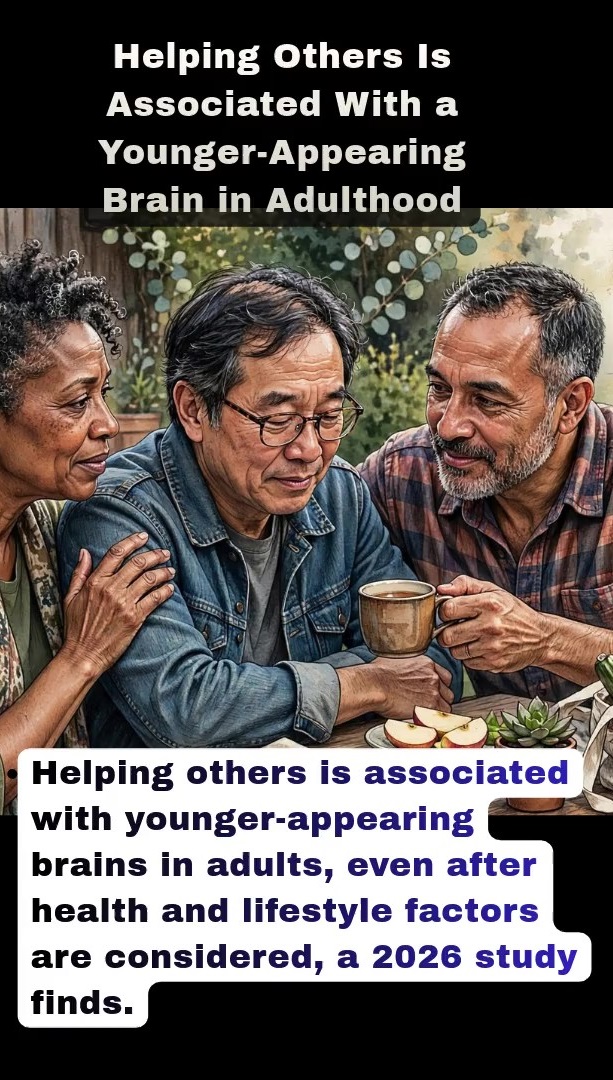
A 2026 study found that adults who reported providing more social support to others tended to have a younger-appearing brain relative to their chronological age.
The study analyzed 194 adults from the MIDUS 3 and MIDUS Refresher 1 datasets, with a mean age of 55.9 years and an age range of 27 to 95.
Participants reported providing an average of 69.73 hours of support per month, including unpaid practical assistance and emotional support.
The association between greater support provision and younger BrainAGE remained statistically significant after accounting for a broad range of health, demographic and lifestyle factors.
Participants providing a high level of support—one standard deviation above the average, or roughly 141 total hours per month—had BrainAGE values about 1.4 years lower than those at the average support level.
advertisement
Helping Others and Brain Age

Providing support to other people may be associated with a younger-appearing brain in adulthood, according to a study published in Nature. Researchers found that adults who reported providing more unpaid assistance and emotional support tended to have lower BrainAGE values, meaning their MRI-estimated brain age was younger relative to their chronological age.
The study examined 194 adults drawn from the MIDUS 3 and MIDUS Refresher 1 datasets. Participants had a mean chronological age of 55.9 years, with ages ranging from 27 to 95, and 105 were women.
The findings do not establish that helping others slows brain aging. Instead, they identify a statistical association between the amount of support people reported providing and a measure of brain age derived from structural MRI scans.
Measuring Brain Age With MRI
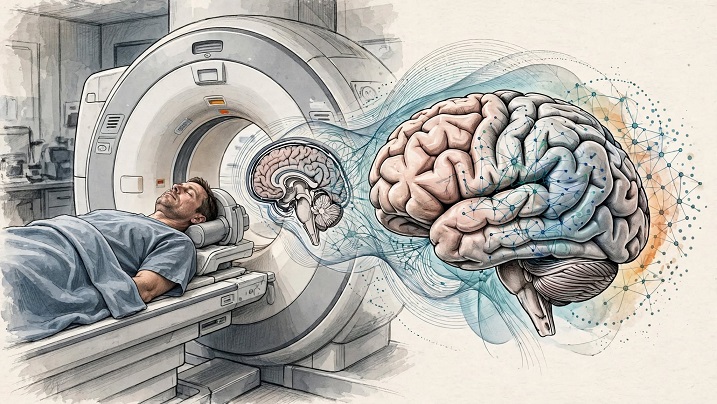
The researchers used structural magnetic resonance imaging (MRI) to estimate participants' brain ages. The analysis used BrainageR version 2.0, which applies a Gaussian Process Regression model trained on 3,337 healthy individuals to estimate brain age from brain structure.
The researchers then calculated BrainAGE, defined as estimated brain age minus chronological age. A negative BrainAGE value indicates that a person's estimated brain age is younger than their chronological age.
Across the study sample, the mean chronological age was 55.91 years, while the mean predicted brain age was 51.67 years. This produced an average BrainAGE of −4.24 years.
BrainAGE is therefore a statistical estimate based on brain imaging, rather than a direct measurement of a person's overall biological age or a diagnosis of brain health.
What Counts as Helping Others?

The researchers measured participants' provision of social support by asking about the total amount of unpaid assistance and emotional support they provided to spouses, children, relatives, friends and other people.
Practical or instrumental assistance included activities such as helping with household tasks, transportation and childcare. Emotional support included comforting others, listening to their problems and offering advice.
Participants reported providing an average of 69.73 hours of support per month, with individual reports ranging from 0 to 311 hours.
The researchers also considered different types of support separately in an exploratory analysis. Emotional support showed a statistically significant association with lower BrainAGE, while unpaid instrumental assistance did not reach statistical significance in that analysis.
The Association Remained After Health and Lifestyle Adjustments
The researchers tested whether the relationship between support provision and BrainAGE remained after accounting for a range of potentially relevant factors.
In the fully adjusted model, greater support provision was significantly associated with lower BrainAGE, with a standardized coefficient of β = −0.198 and p = 0.023.
The complete model explained approximately 25.1% of the variance in BrainAGE, while support provision accounted for approximately 2.2% of the unique variance.
The researchers also translated the statistical relationship into a more understandable comparison. A level of support provision one standard deviation above the average corresponds to approximately 141 hours of support per month, given the study's mean of 69.73 hours and standard deviation of 71.09 hours.
At that modeled level, BrainAGE was approximately 1.4 years lower than at the average support level.
This is a statistical model comparison, however, and does not mean that providing 141 hours of support causes a person's brain to become 1.4 years younger.
Helping Mattered Beyond Family and Caregiving Roles
The researchers also examined whether broader role-based measures could explain the association.
Measures including caregiving status, grandparenthood, number of living children and retirement status did not explain additional variation in BrainAGE once the researchers accounted for the amount of support participants reported providing.
This suggests that the measured quantity of support provision itself captured information that was not fully explained by simply identifying whether someone occupied a particular family or caregiving role.
However, because the study was observational, these findings cannot determine why the association exists.
Emotional Support Showed a Stronger Association

An exploratory analysis examined emotional support and instrumental assistance separately.
Emotional support was significantly associated with lower BrainAGE, with β = −0.26 and p = 0.007. By contrast, unpaid instrumental assistance had a smaller and statistically nonsignificant association, with β = −0.09 and p = 0.167.
These results suggest that the emotional component of supporting others may be particularly relevant to the relationship observed in this dataset.
However, this was an exploratory analysis, and the researchers did not establish that emotional support itself produces changes in brain aging.
Why Might Helping Be Connected to Brain Aging?
The researchers discussed several possible explanations for the observed relationship.
Providing support to others may be connected with psychological well-being, social connection, a sense of purpose, self-worth and stress regulation. The study also discusses biological possibilities involving social interaction, bonding and processes such as oxytocin-related signaling.
These mechanisms remain hypotheses rather than demonstrated explanations. The study did not directly test whether any of these pathways caused the relationship between support provision and BrainAGE.
It is also possible that the relationship works in the opposite direction or through other factors. For example, people with greater underlying neurobiological health may be more capable of providing support to others.
The Findings Do Not Prove That Helping Slows Brain Aging

Despite the striking BrainAGE association, the findings should not be interpreted as evidence that helping other people reverses or slows brain aging.
The study used observational data, meaning participants were not randomly assigned to provide different amounts of social support. Consequently, the researchers could identify relationships between variables but could not establish cause and effect.
BrainAGE itself is also a statistical estimate derived from MRI measurements. It is not equivalent to a complete biological-age measurement and should not be interpreted as a direct prediction of future neurological health or disease.
The researchers emphasize the need for additional validation before brain-age measures can be applied clinically.
Important Limitations of the Study

Several limitations affect how broadly the findings can be interpreted.
The final sample was relatively small, with 194 participants, and approximately 76% were White. The participants retained for the analysis also tended to be younger and have a lower health burden than some eligible participants who were not included in the final sample.
The researchers noted that people experiencing particularly intense caregiving or chronic stress may be underrepresented. The measurement of support provision also relied on retrospective self-report, which can introduce recall limitations.
In addition, the study focused on specific forms of support and did not capture every possible type of prosocial behavior, such as charitable giving.
These limitations mean that the findings should not automatically be generalized to every population or interpreted as demonstrating a universal relationship between helping others and brain aging.
What Researchers Want to Study Next

The researchers call for larger and longitudinal studies that can follow people over time and examine whether changes in prosocial behavior are associated with subsequent changes in BrainAGE.
Future research could also examine different forms of prosocial activity, including volunteering and other structured opportunities to support people in the community.
Longitudinal studies may be particularly important because they could help distinguish between competing explanations: whether providing support contributes to healthier brain aging, whether people with healthier brains are more likely to provide support, or whether both are influenced by other factors.
For now, the study provides evidence of an association between greater reported social support provision and a younger-appearing brain in mid-to-late adulthood, while leaving the underlying causes unresolved.
Key Points Summary
A study published in Translational Psychiatry found that adults who reported providing more social support tended to have lower BrainAGE values, meaning their MRI-estimated brain age was younger relative to their chronological age.
The analysis included 194 adults, with a mean age of 55.9 years. Participants reported an average of 69.73 hours of support per month.
The fully adjusted statistical model found a significant association between greater support provision and lower BrainAGE (β = −0.198, p = 0.023). A support level one standard deviation above the average—roughly 141 total hours per month—was associated with BrainAGE approximately 1.4 years lower than at the average support level.
An exploratory analysis found a significant association between emotional support and lower BrainAGE, while instrumental assistance was not statistically significant.
The study does not prove that helping others slows brain aging or causes the brain to become younger. The results are observational and require confirmation through larger and longitudinal research.
What This Means
The findings add to research exploring how social behavior may relate to brain health during adulthood. They suggest that providing support to other people may be associated with differences in MRI-estimated brain age even after researchers account for multiple demographic, health and lifestyle factors.
But the study should be viewed as an association rather than a prescription or proof of causation. It does not show that increasing the amount of help someone provides will make their brain younger.
Instead, the results point toward a potentially important relationship between social support, emotional interaction and brain aging that future longitudinal research can investigate more directly.
advertisement
Frequently Asked Questions [FAQ]
Does helping others actually make the brain younger?
The study does not prove that helping others makes the brain younger. It found an association between greater support provision and lower BrainAGE, but the observational design cannot establish causation.
What is BrainAGE?
BrainAGE is the difference between a person's MRI-estimated brain age and chronological age. A negative value means the estimated brain age is younger than the person's chronological age.
How many people participated in the study?
The final analysis included 194 adults from the MIDUS 3 and MIDUS Refresher 1 datasets.
How much support did participants provide?
Participants reported an average of 69.73 hours of support per month, with reported values ranging from 0 to 311 hours.
What does 1.4 years lower BrainAGE mean?
The study's statistical model estimated that participants at a support level one standard deviation above the average—roughly 141 total hours of support per month—had BrainAGE values about 1.4 years lower than participants at the average support level. This does not mean that their brains were literally made 1.4 years younger by helping others.
Was emotional support linked to brain age?
Yes. In an exploratory analysis, emotional support was significantly associated with lower BrainAGE (β = −0.26, p = 0.007). Instrumental assistance was not statistically significant (β = −0.09, p = 0.167).
Can BrainAGE be used as a medical diagnosis?
No. BrainAGE is a statistical estimate derived from MRI data and should not be treated as a diagnosis or as a complete measurement of biological aging. The researchers note that additional validation is needed before clinical application.
What are the main limitations?
The study had a relatively small sample, approximately 76% of participants were White, support provision was based on retrospective self-report, and the final participants tended to be younger and have lower health burdens than some eligible participants who were not retained. The observational design also prevents causal conclusions.
Sources
- Nature — “Providing social support to others is associated with younger brain age in mid-to-late adulthood.”
(downloadable pdf: https://www.nature.com/articles/s41398-026-04459-8_reference.pdf - Medical Xpress — “Helping others linked to younger adult brains, even after accounting for health and lifestyle.”
Additional Verified Sources
None. This article uses only the two sources in main sources section.
Thank you !