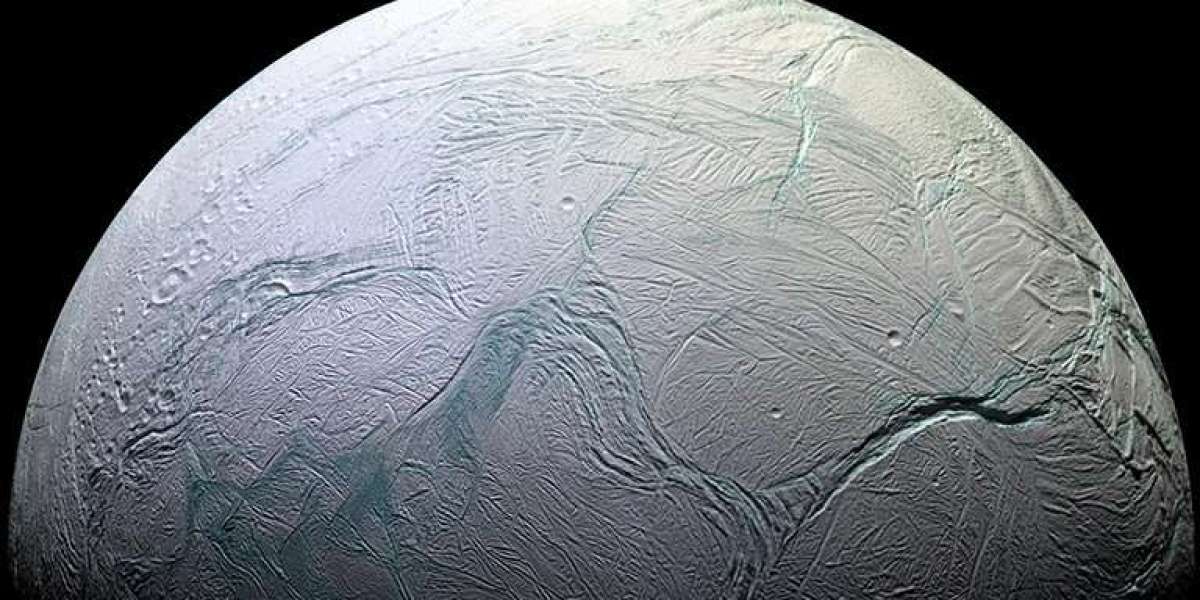

Enceladus Ice Grains Could Make Signs of Life Easier to Detect
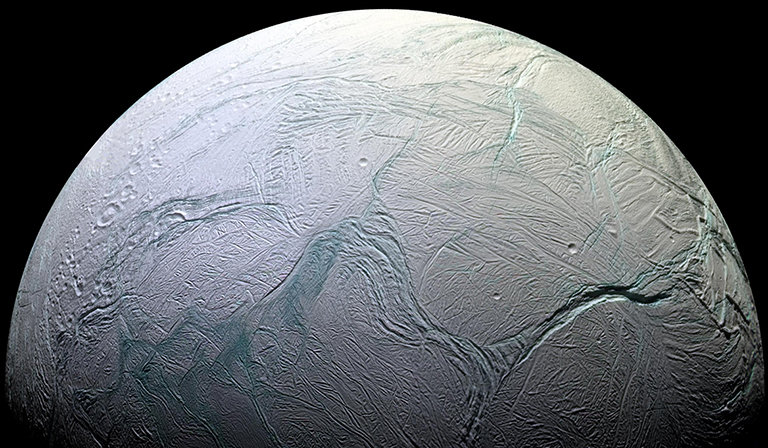
Saturn's moon Enceladus. Image Credit: NASA
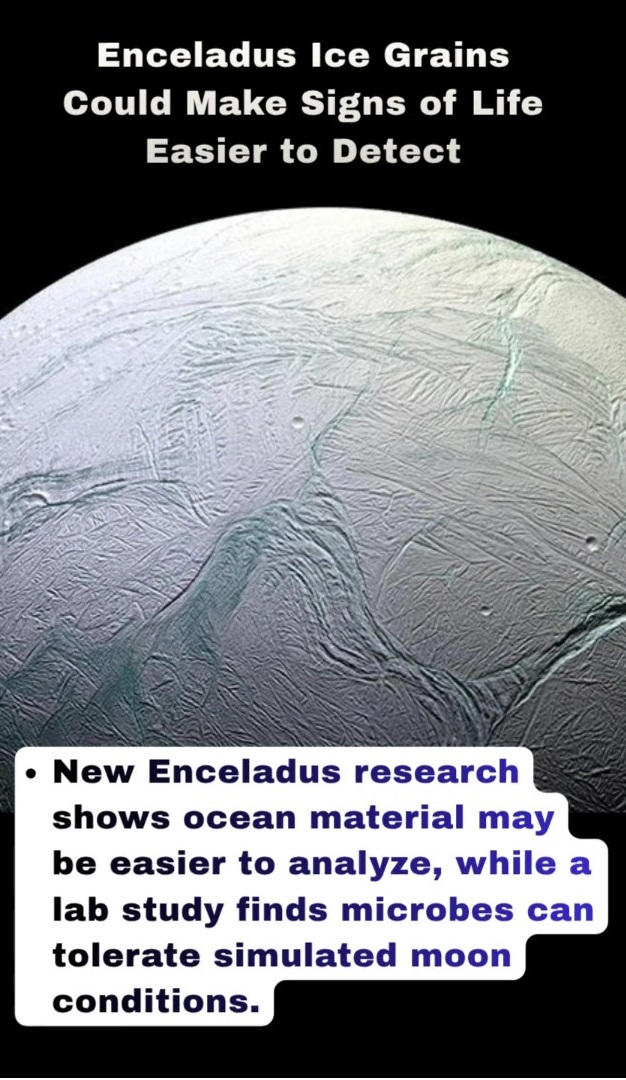
Key Points
New analysis of NASA’s Cassini data suggests Enceladus’ ocean material undergoes chemical separation as it freezes and is expelled through the moon’s icy crust.
Salts and organic compounds can become separated and concentrated into individual ice particles, potentially making them easier to analyze.
The researchers found that droplets do not necessarily freeze instantaneously; instead, slow freezing and later fragmentation help produce chemically distinct ice grains.
A separate Science Advances study found that an Earth microorganism can grow under laboratory conditions designed to resemble Enceladus’ alkaline, carbon-dioxide-limited ocean environment.
The findings do not demonstrate that life exists on Enceladus, but they strengthen the scientific case for examining individual plume particles for possible biosignatures.
advertisement
A new analysis of Saturn’s icy moon Enceladus may make one of the most difficult tasks in the search for extraterrestrial life somewhat easier: sampling and identifying material from its hidden ocean.
Two studies published in Science Advances on September 25, 2026, provide new insights into both the chemistry of Enceladus’ ocean and the ability of microorganisms to tolerate conditions thought to exist there.
One study, led by planetary scientist Frank Postberg of Freie Universität Berlin, examined how material from Enceladus’ subsurface ocean becomes transformed into the tiny ice grains that escape into space.
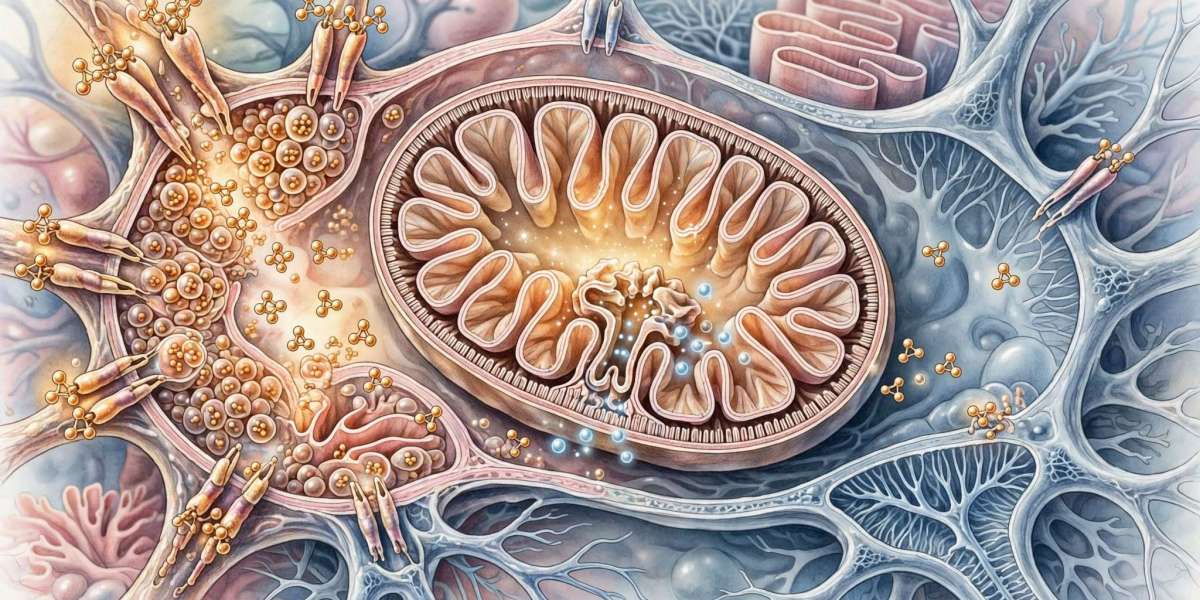
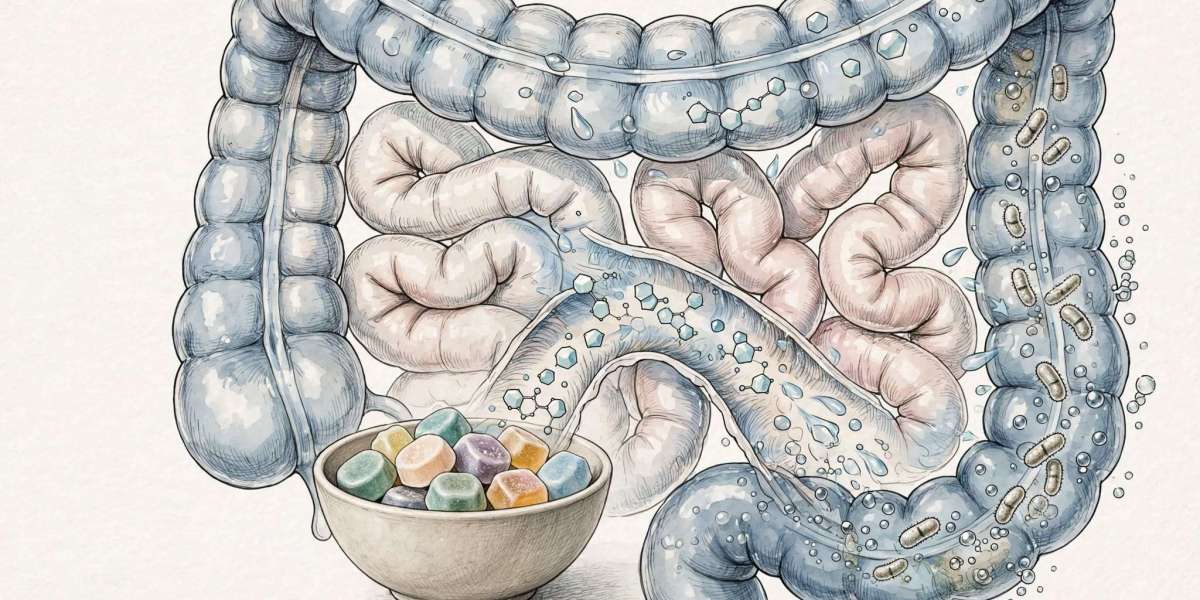
The researchers found that ocean droplets can freeze slowly as they travel through the moon’s icy fractures. During this process, dissolved substances can separate from one another rather than remaining evenly distributed throughout the ice.
That means salts, organic compounds and other ocean constituents can become concentrated in different particles.
For scientists searching for evidence of life, that separation could be important.
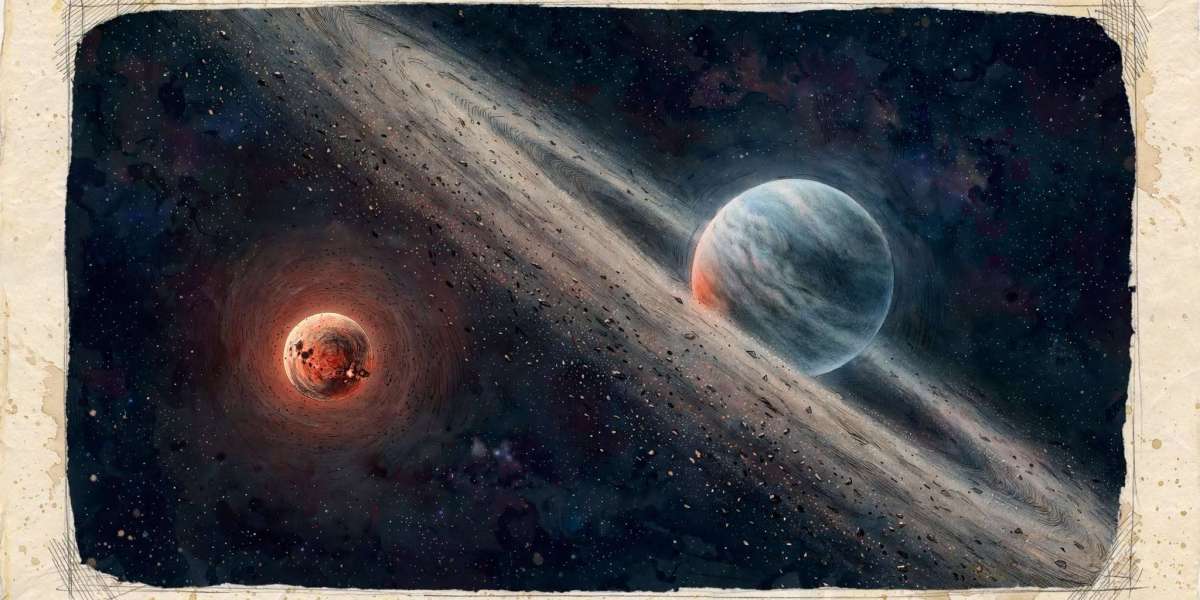
Enceladus is already considered one of the most promising places in the solar system to investigate whether environments suitable for life exist beyond Earth. Beneath its icy exterior lies a global ocean of liquid water, while enormous plumes erupt from fractures near its south pole and send water vapor and ice particles into space.
Those plumes provide a rare opportunity: spacecraft can sample material originating from an ocean that is otherwise hidden beneath an icy crust.
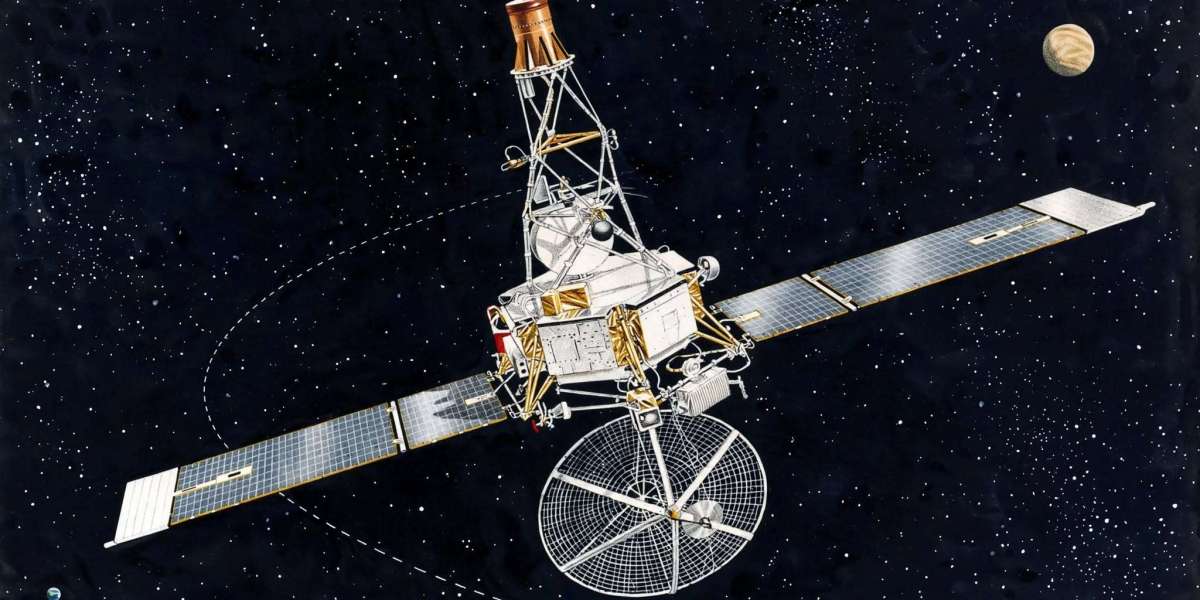
NASA’s Cassini spacecraft repeatedly passed through Enceladus’ plume during its mission to the Saturn system. Its instruments detected salts, organic compounds and other materials in the ejected particles, while earlier observations provided evidence consistent with interactions between water and rock on the ocean floor.
The new study focuses on what happens to ocean droplets between their formation and their eventual escape into space.
According to the researchers, gas-filled bubbles can rise through the ocean and burst at its surface, producing droplets that become incorporated into water vapor moving through cracks in the ice shell.
Scientists had previously considered the possibility that these droplets would freeze almost immediately. The new work instead indicates that freezing can occur slowly enough for dissolved materials to separate within the droplets.
Laboratory experiments and theoretical calculations, combined with measurements from Cassini’s Cosmic Dust Analyzer, were used to reconstruct this process.
The researchers analyzed approximately 1,000 mass spectra of individual salt-rich ice grains recorded by Cassini. Their analysis identified several compositional groups dominated by different salts, including sodium chloride, sodium carbonate or bicarbonate, phosphate compounds, sodium or potassium hydroxide, and potassium chloride.
The results indicate that the chemical diversity of the particles can be explained by a sequence involving slow freezing followed by fragmentation.
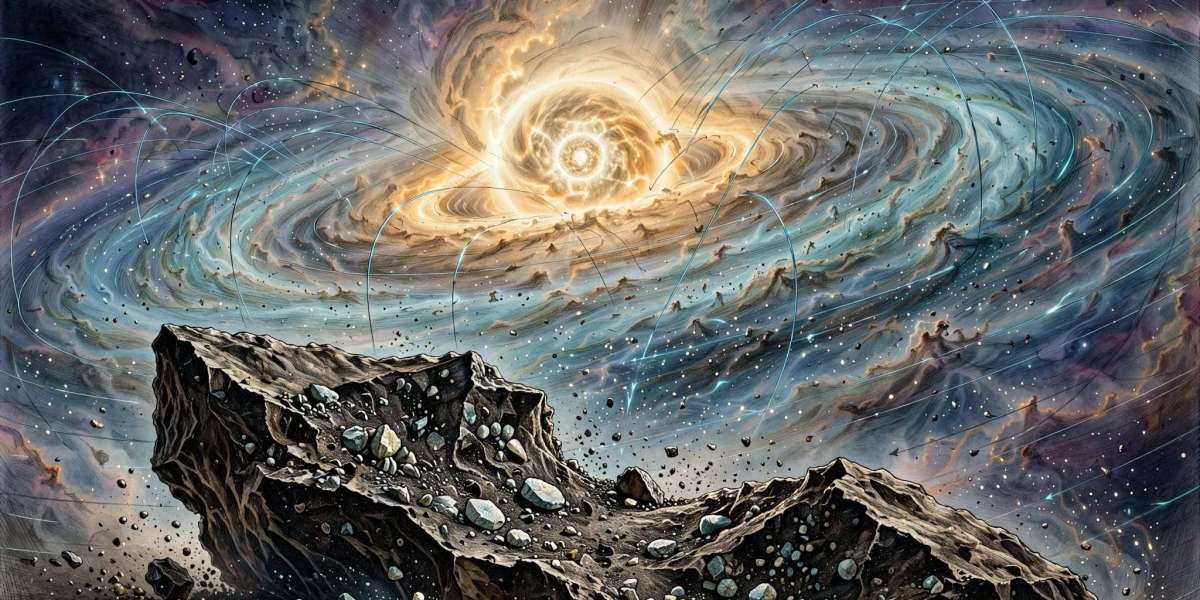
As droplets move through the moon’s narrow ice vents, they can be accelerated to speeds of up to about 1,000 kilometers per hour (620 miles per hour). Collisions with the walls of those fractures can break the larger frozen droplets into much smaller particles.
The resulting ice grains can therefore contain highly concentrated portions of material that had previously been dissolved in the ocean.
This process effectively performs a form of natural chemical separation before the material even reaches space.
For researchers, that could have major practical value. If biological material were present in an ocean droplet, the freezing and fragmentation process could potentially concentrate some of that material into a relatively small number of individual ice grains.
That does not mean scientists have detected extraterrestrial life.
Instead, it changes how future spacecraft might search for it.
Rather than treating the plume simply as a mixture of material from the ocean, researchers may need to examine many individual ice particles. A particle containing concentrated biological material could potentially provide a clearer chemical signal than a larger sample in which biological compounds are diluted among many other substances.
The implications become more interesting when combined with the second Science Advances study published at the same time.
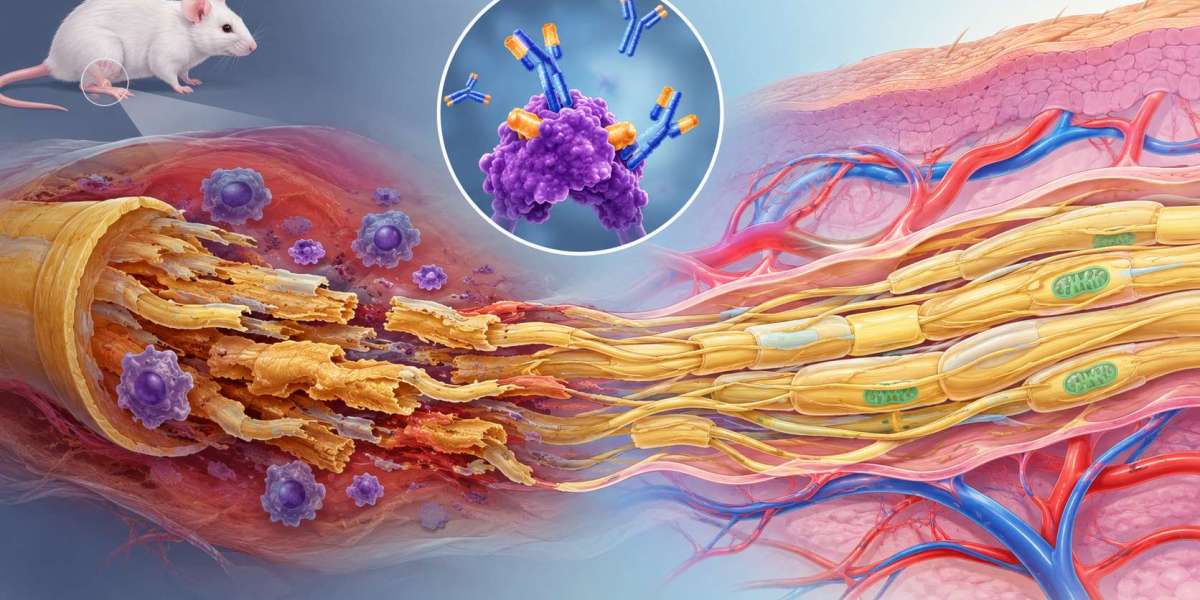
That research investigated whether a microorganism from Earth could function under laboratory conditions designed to resemble the geochemical environment believed to exist within Enceladus.
The microorganism was Methanothermococcus okinawensis, a methane-producing archaeon associated with deep-sea hydrothermal environments on Earth.
Researchers created a simulated Enceladus environment characterized by very low oxygen, high carbonate concentrations and strongly alkaline conditions, with pH values around 10 to 11. They also incorporated conditions associated with interactions between water and the moon’s rocky interior.
The experiment tested whether the microorganism could continue its metabolism under those conditions.
The organism did not grow in an otherwise optimal laboratory medium when the environment became highly alkaline and lacked sufficient dissolved carbon dioxide. But under the simulated Enceladus conditions, it continued growing and produced methane.
The researchers also found that the microorganism was able to adapt its metabolism to the limited availability of carbon dioxide in the simulated environment.
The result does not establish that organisms on Earth—or organisms with similar biology—actually live beneath Enceladus’ ice.
Instead, it demonstrates that at least one terrestrial microorganism can tolerate and metabolically function under a combination of environmental conditions that researchers consider relevant to Enceladus.
That distinction is important in interpreting the findings.
There is still no confirmed evidence of life on Enceladus. The studies address two separate questions that are important to the search: whether the moon’s ocean environment could support certain forms of metabolism, and whether material potentially containing biological traces could become concentrated into particles that spacecraft could detect.
Enceladus is particularly valuable because its ocean is effectively exposed to space through the south-polar plume.
The moon's icy crust does not need to be drilled through before scientists can obtain samples of ocean-derived material. Instead, material from the hidden environment is naturally transported outward, where a spacecraft can potentially pass through it.
The new findings suggest that this natural sampling system may be more useful than previously appreciated.
The first study indicates that Enceladus itself may separate and concentrate different chemical components as ocean droplets freeze and fragment. The second provides experimental evidence that a methane-producing microorganism can function under simulated conditions resembling the moon’s alkaline, carbon-dioxide-limited environment.
Together, the studies provide additional information for scientists planning how future missions could investigate the moon.
For future spacecraft, the implication is not simply to collect as much plume material as possible. Researchers may need to analyze large numbers of individual particles because potentially important compounds could be concentrated in only a small fraction of them.
That approach could make the search for biosignatures more targeted.
The findings also illustrate why Enceladus remains an important destination in planetary science. Its combination of liquid water, organic chemistry, internal energy and water-rock interactions provides several of the ingredients scientists consider relevant when assessing whether an environment could support life.
But habitability and life are not the same thing.
A world can possess conditions that appear suitable for life without actually containing living organisms. Confirming life would require evidence that cannot be explained adequately by non-biological processes.
For now, the new research provides a more detailed understanding of how Enceladus’ ocean material reaches space and how certain Earth microorganisms respond to an environment resembling the moon’s subsurface chemistry.
The next major step will be obtaining new measurements directly from Enceladus’ plume.
Future missions could search individual ice grains for organic molecules, cellular material or other potential biosignatures. The challenge will be distinguishing genuine biological evidence from chemistry that can arise through geological or other non-biological processes.
For the moment, the message from the two studies is therefore more measured than the prospect of discovering alien life itself: Enceladus may be easier to investigate than scientists once thought, and some of the chemical evidence needed for that investigation could already be concentrated inside the tiny ice particles naturally escaping from its hidden ocean.
Key Points Summary
Enceladus contains a subsurface ocean beneath its icy crust.
Its south-polar plumes send ocean-derived ice particles into space.
Cassini data show that salts and other materials can become separated during freezing and fragmentation.
Individual ice grains may therefore contain highly concentrated chemical components.
Laboratory experiments show that Methanothermococcus okinawensis can grow under simulated Enceladus-like conditions.
The findings improve our understanding of how future missions could search for biosignatures, but they are not evidence that life has been discovered.
advertisement
Frequently Asked Questions [FAQ]
Is there life on Enceladus?
No. Scientists have not confirmed life on Enceladus. The studies instead provide new information about the moon’s chemistry and show that at least one Earth microorganism can grow under simulated Enceladus-like conditions.
Why is Enceladus important in the search for life?
Enceladus is believed to have a global subsurface ocean, and material from that ocean is naturally expelled into space through plumes near the south pole. This allows spacecraft to sample ocean-derived material without drilling through the moon's ice.
What did the new Cassini analysis discover?
The study found evidence that ocean droplets can freeze slowly enough for dissolved substances to separate. Subsequent fragmentation can produce tiny ice grains containing concentrated and chemically distinct components.
What spacecraft collected the original data?
The observations were made by NASA's Cassini spacecraft, including its Cosmic Dust Analyzer, during its exploration of the Saturn system.
Could an ice grain contain evidence of life?
Potentially, if biological material exists in the ocean and becomes incorporated into plume material. The researchers suggest that freezing and fragmentation could concentrate such material into individual particles, potentially making it easier to detect.
What microorganism was tested in the second study?
Researchers tested Methanothermococcus okinawensis, a methane-producing archaeon associated with hydrothermal environments on Earth.
Did the microorganism actually come from Enceladus?
No. It is an Earth microorganism used in laboratory experiments to test whether an organism could function under simulated Enceladus-like conditions.
What does a pH of 10–11 mean?
It describes a strongly alkaline environment. The second study investigated whether a microorganism could maintain its metabolism under such conditions while also coping with limited carbon dioxide.
Does producing methane prove there is life on Enceladus?
No. The methane production occurred in a laboratory experiment using an Earth microorganism. It demonstrates that a biological metabolism can operate under simulated conditions; it does not show that the same process is occurring naturally on Enceladus.
What could future missions look for?
Future spacecraft could examine individual ice grains for organic compounds, cellular material and other potential biosignatures that could help determine whether biological activity has occurred in Enceladus' ocean.
Sources
Phys.org — Great News from Saturn’s Moon Enceladus in the Search for Life in Space
Science Advances — Cassini CDA Observes Compositional Segregation of Enceladus' Ice Grains
Additional Verified Sources
Thank you !