
Emotional Intelligence Differences Between Men and Women Are More Complex Than Assumed, Study Finds
Key Points
A meta-analysis covering 1,279 academic papers and 609,278 people in 76 countries examined gender differences in emotional intelligence.
Women scored higher on average in recognizing and understanding emotions, particularly on performance-based tests.
Men and boys tended to score higher when regulating their own emotions, while women scored higher when regulating other people's emotions.
The differences became smaller in recent years, with the narrowing particularly pronounced among children.
Researchers say emotional intelligence should be treated as a set of different skills, rather than a single ability associated with one gender.
advertisement
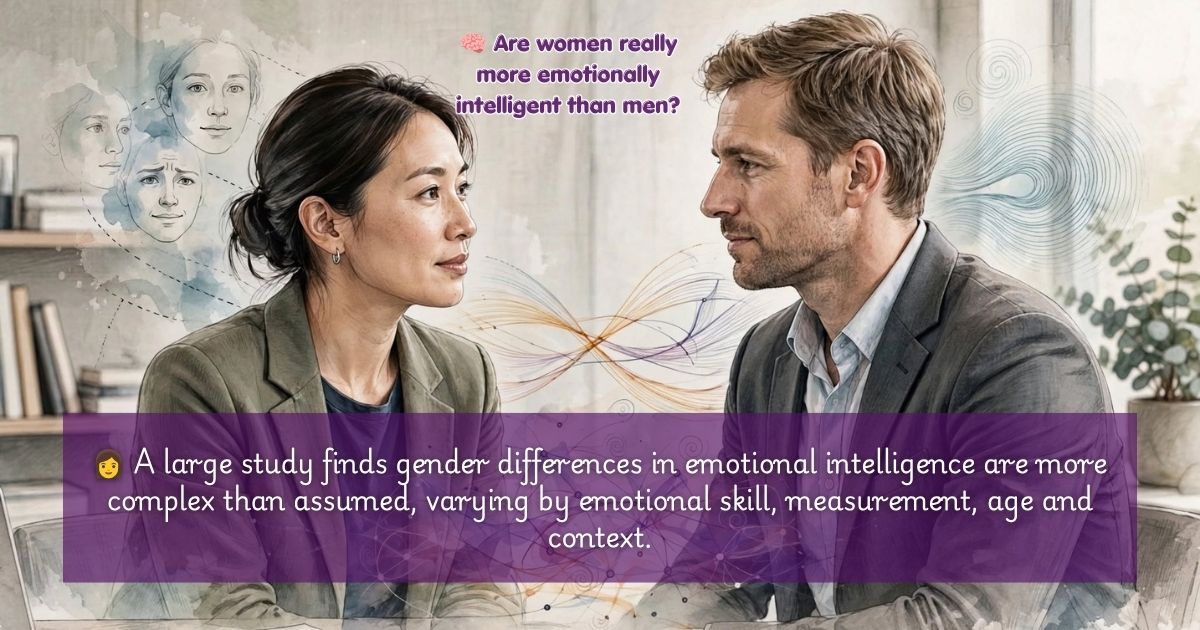
A large analysis of research spanning nearly three decades suggests that the familiar idea that women simply have greater emotional intelligence than men is too broad to capture what the evidence actually shows.
The study, led by researchers from the University of Limerick, the University of Zurich and Cambridge Judge Business School, examined 1,279 academic papers, covering 1,428 samples and 609,278 participants across 76 countries. The findings were published in the journal Emotion.
Rather than finding one consistent gender advantage across every aspect of emotional intelligence, the researchers found a more complicated pattern. Women scored higher, on average, in recognizing and understanding emotions, while the pattern changed when researchers examined emotional regulation.
For tasks involving the management of one's own emotions, men and boys tended to score higher. When the task involved managing other people's emotions, women tended to score higher.
The distinction matters because emotional intelligence is often discussed as though it were one general personal characteristic. The researchers instead divided emotional abilities into separate areas, including recognizing, understanding and regulating emotions, with each ability considered in relation to either oneself or other people.
That approach challenges the usefulness of a simple question such as whether women or men are "more emotionally intelligent."
"Women are emotionally intelligent. Men think they are," said Jochen Menges, a professor of leadership at Cambridge Judge Business School and the University of Zurich, according to the study's accompanying report. He emphasized that performance-based testing showed a substantial advantage for women, while the difference nearly disappeared when people simply assessed their own abilities.
This difference between demonstrated ability and self-perception was one of the study's notable findings.
The researchers found that the gender gap was larger when emotional intelligence was assessed using performance-based tests, in which participants complete tasks that are scored for accuracy. The difference was smaller when researchers used self-report questionnaires, where participants rate their own abilities.
That finding suggests that people's confidence in their emotional abilities should not automatically be treated as evidence of how well they actually perform on emotional tasks.
The researchers said they could not determine why the difference between self-perception and measured performance exists. Possible explanations include men overestimating their abilities, women underestimating theirs, or both occurring at the same time. The study therefore does not establish a single explanation for the pattern.
The findings become even more nuanced when considering changes over time.
Because the research included data covering almost 30 years, the researchers were able to examine whether gender differences in emotional intelligence had changed. They found that differences in overall emotional intelligence had narrowed in recent years, with the change particularly pronounced among children.
The researchers noted that this pattern is consistent with changes in socialization and gender norms, but the data do not establish that these changes caused the narrowing. They also cautioned that age, generation and the historical period in which data were collected cannot be completely separated in the analysis. Biological explanations also could not be ruled out.
The analysis also found that context influenced the size and direction of some gender differences.
For example, differences in emotion recognition were larger among leaders than among nonleaders. The researchers also found, contrary to their expectations, that differences were smaller in male-dominated industries than in other sectors.
Geography mattered as well. Differences were reported as larger in North and Central America and Europe than in other parts of the world.
The study's findings have potential relevance for workplaces because emotional intelligence has been associated with areas such as job performance, stress management, communication and conflict management, according to research included in the analysis.
The researchers argued that treating emotional intelligence as an inherently feminine characteristic can create problems in organizations.
One concern is that women could be expected to take on a disproportionate amount of emotional labor simply because of assumptions about their natural abilities. At the same time, broad claims about gender differences can make genuine differences in particular emotional skills harder to discuss scientifically.
Menges said organizations should therefore avoid treating emotional intelligence as a feminine trait and instead approach it as a collection of skills that can be developed across the workforce.
The researchers also recommended using validated performance-based measures where available, rather than relying solely on people's assessments of their own abilities. They argued that emotional skills should be developed in everyone rather than assigned according to gender expectations.
The distinction between managing one's own emotions and managing other people's emotions is particularly important.
According to the study's findings, women showed an advantage in recognizing and understanding emotions and in regulating other people's emotions. For managing their own emotions, however, the pattern shifted, with men scoring higher.
This means that saying simply that "women have higher emotional intelligence" leaves out important information. A person may perform particularly well in one emotional ability while showing no advantage, or even a different pattern, in another.
The study therefore does not eliminate gender differences in emotional abilities. Instead, it shows why those differences need to be examined more precisely.
The researchers concluded that asking whether women or men have more emotional intelligence is too simple a question. A more useful approach is to ask which emotional ability is being measured, how it is being measured, whether it concerns oneself or another person, and what context the ability is being assessed in.
For organizations, that distinction could affect how employees are assessed and how responsibilities are assigned. Rather than assuming that women should naturally handle interpersonal or emotional work, the researchers argue that these abilities should be viewed as skills that can be measured and developed among everyone.
The broader message from the analysis is not that one gender is emotionally superior to the other. Instead, the evidence points toward different patterns across different emotional abilities, with those patterns influenced by measurement method, context, age and other factors.
As research continues to examine emotional intelligence, the study suggests that broad gender stereotypes are less informative than looking closely at the particular skill being tested and the circumstances in which it is used.
Key Points Summary
The study analyzed 1,279 papers and 609,278 participants from 76 countries.
Women generally performed better at recognizing and understanding emotions.
Men and boys tended to perform better at regulating their own emotions.
Women tended to perform better at regulating other people's emotions.
Gender differences were smaller in self-report assessments than in performance-based tests.
Differences in overall emotional intelligence have narrowed in recent years, particularly among children.
The researchers found that gender differences varied according to age, leadership position, industry, geography, measurement method and the emotional ability being assessed.
The findings argue against treating emotional intelligence as a single inherently feminine or masculine characteristic.
What This Means
The study suggests that emotional intelligence is better understood as a collection of distinct abilities rather than one broad characteristic.
For workplaces, the findings are relevant because assumptions about gender and emotional ability could influence who is expected to handle interpersonal problems, communication and other forms of emotional work.
The researchers' recommendation is to assess and develop emotional skills across employees rather than assuming that women or men naturally possess particular abilities.
For future research, an important issue is understanding why the differences vary across abilities, populations, time periods and contexts. The current analysis identifies these patterns but does not establish a single cause for them.
advertisement
Frequently Asked Questions [FAQ]
Does the study show that women have higher emotional intelligence than men?
Not in a simple, across-the-board sense. Women scored higher on average in general emotional intelligence and showed advantages in several emotional abilities, particularly recognizing and understanding emotions. However, the results varied depending on the specific ability being tested and the context.
Which emotional abilities did women score higher in?
Women showed higher scores in recognizing and understanding emotions and in regulating other people's emotions.
Which emotional ability did men score higher in?
Men and boys tended to score higher on tasks involving regulation of their own emotions.
How large was the study?
The analysis covered 1,279 academic papers, 1,428 samples and 609,278 participants across 76 countries.
Does the study say men overestimate their emotional intelligence?
The researchers found that women's advantage was substantially larger on performance-based tests than on self-report assessments. Menges suggested that men overestimating their abilities, women underestimating theirs, or both could potentially contribute to the difference, but the study does not establish which explanation is responsible.
Did the gender gap change over time?
Yes. The researchers found that gender differences in overall emotional intelligence narrowed in recent years, with the change particularly pronounced among children. The study does not establish exactly why this happened.
Did the results differ between countries and regions?
Yes. The study found larger differences in North and Central America and Europe than in other parts of the world.
Did leadership status affect the results?
Yes. Gender differences in emotion recognition were larger among leaders than nonleaders, according to the study's analysis.
What is the main message of the research?
The researchers argue that asking whether women or men are more emotionally intelligent is too broad. Emotional intelligence should instead be examined according to which skill is involved, how it is measured, who the emotional ability is directed toward and the context in which it is used.
Sources
Additional Verified Sources
None. This article uses only the two sources provided.
Thank you !