
NASA’s Artemis III Lander Test Sets Stage for Future Moon Landings With SpaceX and Blue Origin
Key Points
NASA plans to use the 2027 Artemis III demonstration mission to practice critical rendezvous and docking operations between Orion and commercial human landing system test vehicles in low Earth orbit.
SpaceX and Blue Origin are preparing different test articles for the mission, allowing NASA to evaluate technologies and procedures intended to support future crewed lunar landings.
The Blue Origin Blue Moon test lander will include major systems designed to reflect its future crewed architecture, while SpaceX's Starship Version 3 test article will feature a new docking system.
Artemis III astronauts will not enter the Starship test vehicle, while up to two astronauts are expected to enter the Blue Origin test lander during the demonstration.
NASA says data from the demonstration, combined with future uncrewed lunar landing demonstrations, will help improve confidence in the systems needed to safely return astronauts to the Moon.
advertisement
NASA is preparing a complex demonstration mission designed to test the technology, procedures and coordination needed for future crewed Moon landings, with the agency planning to bring together its Orion spacecraft, Space Launch System rocket and commercial human landing systems developed by SpaceX and Blue Origin.
The planned Artemis III demonstration mission in 2027 is intended to serve as an important operational test before astronauts eventually land on the lunar surface. Rather than sending the crew directly to the Moon for this demonstration, NASA plans to conduct key rendezvous and docking activities in low Earth orbit, allowing astronauts and mission teams to practice procedures that will be required during future lunar missions. (NASA)
The test is part of NASA's broader Artemis campaign, which is designed to establish a sustained human presence around and on the Moon while developing capabilities that can eventually support missions farther into the solar system. The agency's current plan calls for the Artemis III demonstration mission in 2027, while the first Artemis crewed lunar landing is planned for Artemis IV in 2028. (NASA)
At the center of the demonstration will be two commercial human landing system test articles. SpaceX and Blue Origin are working with NASA to develop landing systems intended to transport astronauts between lunar orbit and the Moon's surface on future Artemis missions. For Artemis III, each company will fly a test version of its planned crewed landing system, giving NASA an opportunity to evaluate how the spacecraft interact with Orion and how mission teams manage the complex sequence of launches, rendezvous and docking operations. (NASA)
The Artemis III crew will launch aboard NASA's Orion spacecraft, which will be carried into low Earth orbit by the agency's Space Launch System, or SLS rocket. The commercial lander test articles, meanwhile, will be launched separately using commercial rockets. This arrangement is designed to replicate an important element of NASA's future lunar mission architecture: launching a lander separately, positioning it in orbit, and then sending astronauts aboard Orion to rendezvous and dock with it. (NASA)
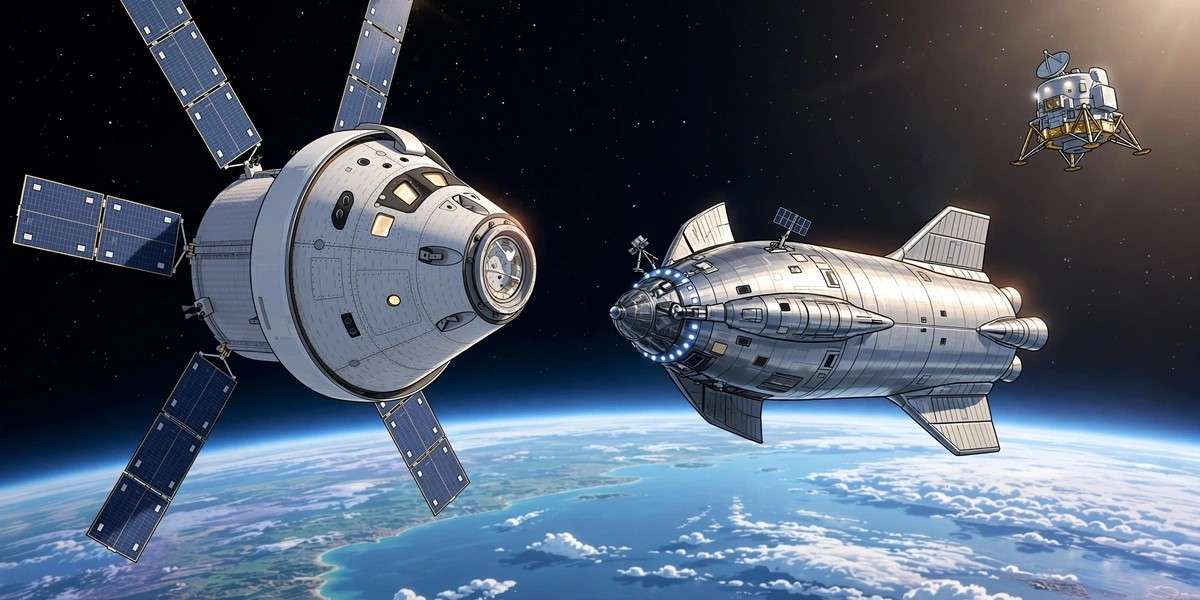
NASA describes the demonstration as an opportunity to practice the same basic rendezvous-and-docking configuration that will be needed for future crewed lunar landing missions. During the operation, Orion will act as the chaser spacecraft, while the lander test articles serve as the targets. Astronauts and ground teams will work through the procedures for approaching, docking and undocking from the vehicles before the crew eventually returns to Earth aboard Orion. (NASA)
The two companies, however, are taking different approaches.
For Blue Origin, the Artemis III test vehicle will be based on the company's Blue Moon Mark 2 human landing system architecture. NASA says the test article will incorporate major avionics, flight software and control systems intended to make the demonstration relevant to future crewed lunar operations. The production system is also expected to include important elements such as an Environmental Control and Life Support System, a crew cabin and avionics. (NASA)
Up to two Artemis III crew members are expected to enter the Blue Origin test lander after Orion docks with it. The astronauts will wear their Orion Crew Survival System suits as they open the hatch and enter the vehicle. The test lander will also carry an instrumented spacesuit mass simulator designed to provide real-time information about the environment inside the cabin. NASA compares the device to the suited "Moonikin" manikin that flew aboard the uncrewed Artemis I mission. (NASA)
The SpaceX test is structured differently. NASA says the company plans to use Starship Version 3, described as the basis for the future Starship Human Landing System, or HLS. The test article will be equipped with an additional docking system mounted on the nose of the spacecraft, allowing NASA and SpaceX to examine how Orion and the Starship test vehicle operate together as an integrated system. (NASA)
However, the Artemis III astronauts will not enter the Starship test vehicle during this demonstration. NASA and SpaceX instead plan to focus on areas including docking, communications and controllability, using the mission to gather information that can contribute to future development. (NASA)
The mission will also test something that is less visible to the public but essential to the success of future lunar flights: the ability of multiple organizations and launch sites to coordinate a tightly timed sequence of operations.
NASA, SpaceX and Blue Origin are expected to conduct launches within a relatively short timeframe, exercising ground processing, launch operations, mission control, communications networks and data exchange. The campaign will involve three major rockets — NASA's SLS, SpaceX's Starship/Super Heavy system and Blue Origin's New Glenn — as part of a demanding series of operations. (NASA)
According to NASA's plan, Blue Origin's lander test article is expected to launch first and can remain in a designated "parking" orbit for up to 30 days. This buffer will allow teams to conduct orbital system checks before the Artemis III crew launches aboard NASA's SLS rocket and Orion spacecraft from Launch Complex 39B at NASA's Kennedy Space Center in Florida. (NASA)
Once in orbit, Orion will rendezvous and dock with the Blue Origin lander, allowing the astronauts to carry out the planned demonstration activities. After the Blue Origin phase is completed, the crew will remain in orbit aboard Orion while SpaceX launches its Starship Version 3 test article for the next phase of the demonstration. Starship will then rendezvous and dock with Orion for its own set of tests. Throughout the mission, Orion will operate in a circular orbit, an arrangement NASA says provides more launch opportunities and allows the vehicles to reach their designated mission altitude in a single launch. (NASA)
The unusual structure of Artemis III reflects the complexity of future lunar landing missions. A crewed flight to the Moon requires more than a successful rocket launch. NASA must coordinate multiple spacecraft, launch vehicles, mission-control teams and commercial partners while ensuring that the systems needed to carry astronauts between lunar orbit and the surface operate together safely.
NASA's Steve Creech, program manager for the Human Landing System Program at the agency's Marshall Space Flight Center, said the two landing-system providers have taken different approaches to the Artemis III mission. He described their objectives as complementary to upcoming uncrewed demonstrations at the Moon, with the overall goal of building greater understanding and confidence in the spacecraft and launch vehicles before crewed lunar landings. (NASA)
The Artemis III demonstration is therefore not a substitute for actual lunar landing tests. Instead, it is one part of a broader sequence of demonstrations and development activities. NASA says information from the low-Earth-orbit mission, together with data from future uncrewed demonstrations at the Moon, will help support astronaut safety and mission success during future crewed lunar landings. (NASA)
The mission will also provide an opportunity to mature the designs of the landing systems before astronauts depend on them during lunar operations. NASA says the prototype designs will inform future development efforts and continue to mature over the following year. This approach reflects the agency's effort to identify technical and operational challenges before committing astronauts to the more demanding environment of lunar orbit and the Moon's surface. (NASA)
The importance of the demonstration extends beyond the individual spacecraft. NASA's future lunar architecture depends on the ability to coordinate commercial landing systems with government-developed transportation and crew vehicles. Orion, SLS, commercial rockets and human landing systems must work together as parts of one integrated mission.
For NASA, that makes Artemis III an important systems-engineering exercise. The agency's Artemis program manager, Jeremy Parsons, described the mission as a highly coordinated operation involving demanding launch sequences, multiple launch pads and complex mission operations. NASA says its experience in systems engineering, integration and low-Earth-orbit mission operations will be central to bringing the different parts of the demonstration together. (NASA)
The broader objective is to build a repeatable pathway toward lunar exploration. NASA's future architecture envisions commercial human landing systems being positioned in orbit before a crewed Orion spacecraft arrives. The Artemis III demonstration will allow NASA and its commercial partners to practice that sequence under controlled conditions before applying the lessons to missions involving the Moon. (NASA)
For readers watching NASA's return-to-the-Moon effort, the key development is therefore not simply the testing of a particular spacecraft. It is the integration of several complex systems into a coordinated mission architecture. Artemis III is planned to test that integration in 2027, while NASA's current plan calls for Artemis IV to carry astronauts to the lunar surface in 2028. (Universe Today)
The next milestones to watch will include the continued development and testing of the Blue Moon and Starship systems, preparations for their respective uncrewed lunar demonstrations, and the readiness of NASA's Orion and SLS systems for the Artemis III demonstration campaign. The results of those activities will help determine how confidently NASA can move toward future crewed lunar landings.
In that sense, the Artemis III demonstration is designed to make the eventual lunar landing less of a first-time experiment and more of a carefully rehearsed operation. By testing rendezvous, docking, communications, spacecraft interaction and mission coordination before astronauts are sent to the Moon's surface, NASA is attempting to reduce uncertainty and build operational experience ahead of the next phase of human lunar exploration. (NASA)
Key Points Summary
Artemis III is planned as a 2027 low-Earth-orbit demonstration mission, not the first crewed Artemis lunar landing.
NASA's Artemis IV mission is currently planned to carry astronauts to the lunar surface in 2028.
SpaceX and Blue Origin will provide test articles for their future human landing systems.
The mission will practice rendezvous and docking between Orion and commercial lander test vehicles.
Astronauts are expected to enter the Blue Moon test lander, while they will not enter the Starship test article.
The mission will test not only spacecraft but also launch operations, mission control, communications and coordination.
Data from Artemis III and future uncrewed lunar demonstrations will help NASA prepare for future crewed Moon landings.
What This Means
Why it matters:
Artemis III is intended to give NASA and its commercial partners practical experience with the complex sequence required to connect a crewed spacecraft with a commercial human landing system. The mission could identify technical and operational issues before astronauts rely on these systems during lunar missions.
Who may be affected:
The effort directly involves NASA, SpaceX, Blue Origin, their engineering and mission teams, and the astronauts participating in Artemis missions. It also has broader implications for the future architecture of human lunar exploration.
What readers should watch next:
The key developments will be the continued testing and maturation of Blue Origin's Blue Moon and SpaceX's Starship systems, upcoming uncrewed lunar demonstrations, and preparations for the 2027 Artemis III demonstration mission. The progress of those activities will help shape NASA's path toward the planned 2028 Artemis IV lunar landing.
advertisement
Frequently Asked Questions (FAQ)
What is the Artemis III lander test?
It is a planned 2027 NASA demonstration mission in low Earth orbit designed to practice rendezvous and docking between NASA's Orion spacecraft and commercial human landing system test articles developed by SpaceX and Blue Origin.
Will Artemis III astronauts land on the Moon?
No. Based on NASA's current plan described in the provided sources, Artemis III is a demonstration mission in low Earth orbit. NASA currently plans the first Artemis crewed lunar landing for Artemis IV in 2028.
Which companies are developing Artemis human landing systems?
SpaceX and Blue Origin are developing human landing systems for NASA's Artemis missions.
Will astronauts enter both lander test vehicles?
No. NASA says up to two astronauts are expected to enter the Blue Origin Blue Moon test lander. Astronauts will not enter the SpaceX Starship test article during Artemis III.
What rocket will launch the Artemis III astronauts?
The Artemis III crew is planned to launch aboard NASA's Orion spacecraft, carried by the Space Launch System (SLS) rocket.
Why is the mission being conducted in low Earth orbit?
Testing the systems in low Earth orbit allows NASA and its partners to practice important operations — including rendezvous and docking — under conditions that provide more launch opportunities and are less demanding than conducting the same demonstration during a lunar mission.
What is Blue Origin's role in Artemis III?
Blue Origin is developing a Blue Moon Mark 2-based test lander that will demonstrate major elements of the company's future human landing system architecture.
What is SpaceX's role in Artemis III?
SpaceX plans to provide a Starship Version 3 test article with an added docking system so NASA and SpaceX can evaluate how the Starship test vehicle interacts with Orion.
How will Artemis III help future Moon landings?
NASA expects data from Artemis III, together with future uncrewed demonstrations at the Moon, to improve understanding and confidence in the spacecraft, launch vehicles and operational procedures needed for future crewed lunar landings.
Sources