
U.S. Energy Department Sets 2028 Target for Fault-Tolerant Quantum Computing
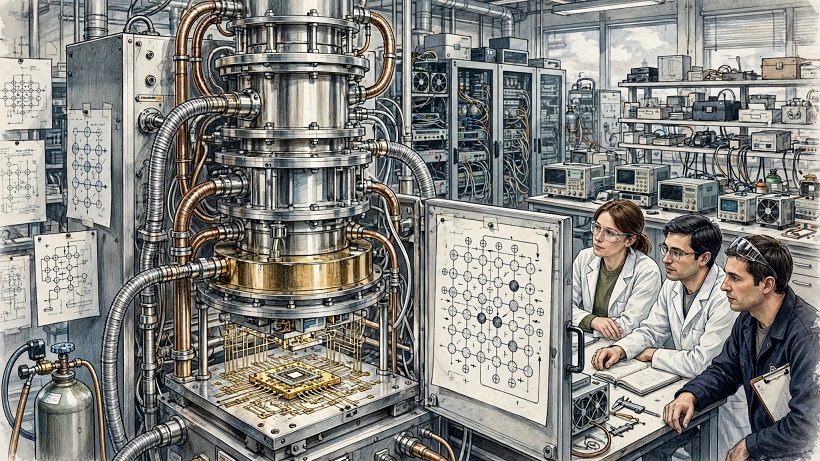
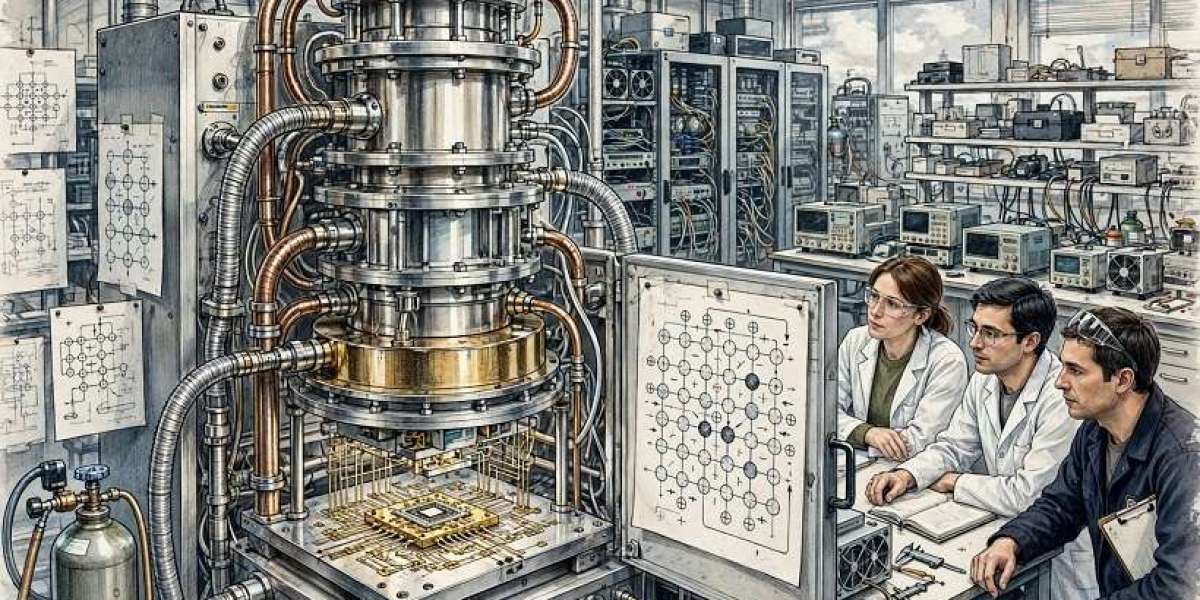
Photo by AI (Credits: saraapp.net)
Key Points
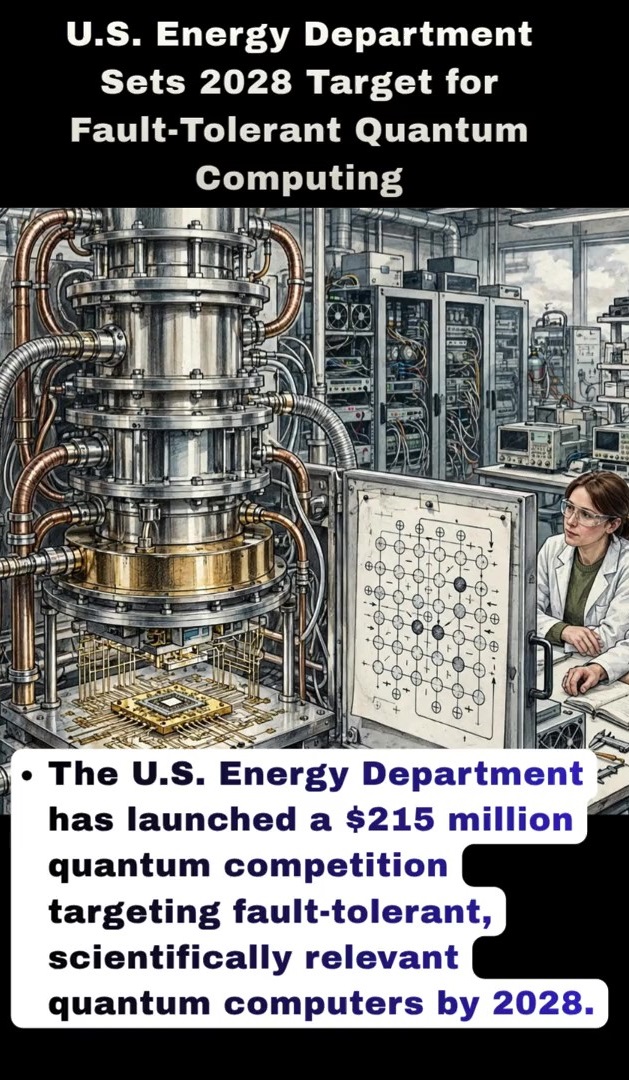
The U.S. Department of Energy (DOE) has launched the Quantum Genesis Q Competition, with up to $215 million in planned funding.
The initiative aims to accelerate development of fault-tolerant, scientifically relevant quantum computers by 2028.
Participating private-sector companies will be asked to demonstrate systems with at least 100 logical qubits capable of performing hundreds of millions of fault-tolerant operations.
The competition will include a $100 million incentive pool, plus two additional $50 million pools tied to demonstrations involving 150 and 200 logical qubits.
DOE is also planning $45 million for a national-laboratory testbed to validate quantum hardware, software, algorithms and other parts of the computing stack.
advertisement
The U.S. Department of Energy (DOE) has launched a new competition designed to accelerate the development of fault-tolerant quantum computers, setting 2028 as the target year for demonstrating systems capable of performing scientifically meaningful computations.
Announced on September 17, 2026, the Quantum Genesis Q Competition offers up to $215 million in planned funding to private-sector companies developing what DOE calls scientifically relevant quantum computers.
The initiative is aimed at moving quantum computing beyond demonstrations based primarily on the number of physical qubits toward machines capable of carrying out reliable, error-corrected calculations that can address difficult scientific problems.
Under the competition, applicants will be asked to propose systems containing at least 100 logical qubits and capable of performing hundreds of millions of fault-tolerant operations.
A logical qubit is different from a physical qubit. Physical qubits are the underlying quantum components used to build a quantum computer, but they are vulnerable to errors caused by noise and other imperfections. Fault-tolerant quantum computing uses error-correction techniques to protect information and make reliable computation possible despite those errors.
The DOE's objective is therefore not simply to encourage companies to build machines with larger raw qubit counts. The competition is structured around demonstrating that quantum systems can perform useful scientific work while maintaining the reliability required for extended computations.
The department says the systems will be aimed at problems in areas including chemistry, materials, physics and applied mathematics.
That focus on scientific applications is an important part of the program. Rather than measuring progress only through hardware specifications, the initiative seeks demonstrations showing that quantum computers can be integrated into meaningful scientific workflows.
The funding structure is also designed to reward measurable progress.
Phase I will provide fixed awards for early milestones, with payments of up to $1.5 million per awardee.
Phase II will introduce a $100 million general incentive pool for companies that demonstrate a first-generation scientifically relevant quantum computer meeting the program's requirements, including at least 100 logical qubits.
Two additional incentive pools will provide another $50 million each for systems demonstrating 150 logical qubits and 200 logical qubits, respectively.
That means the planned incentive structure totals $200 million, in addition to the early milestone funding that brings the competition's overall planned funding to as much as $215 million.
However, the full $215 million is not money already appropriated and available immediately. DOE says the competition has $2.5 million in fiscal year 2026 dollars, while funding for later years is contingent on congressional appropriations.
The distinction is important because the competition's headline figure represents planned funding rather than a single currently available government payment.
The initiative also includes a separate effort to establish the infrastructure needed to determine whether competing systems actually meet the required standards.
DOE has announced a Quantum High-Performance Computing Validation and Verification Testbed Lab Call, with up to $45 million in planned funding for the department's national laboratories.
The testbed effort is intended to provide tools for examining and validating different layers of a quantum computing system, from physical hardware and quantum gates to logical architectures, algorithms, applications and classical control systems.
This verification component is important because quantum-computing performance cannot necessarily be judged by one simple number.
A machine may have a large number of physical qubits but still struggle to preserve quantum information accurately enough to perform long calculations. Logical qubit counts and the ability to execute reliable operations therefore provide a different measure of progress toward fault-tolerant computing.
The DOE competition is designed to make those capabilities central to the evaluation process.
According to the department, the program will support public-private collaboration while drawing on expertise from the U.S. national laboratories.
The competition is part of the U.S. Department of Energy's broader effort to advance quantum computing, building on work outlined in the department's Blueprint for DOE Quantum Supercomputing and a recent advisory committee report.
The latest competition represents a more immediate effort to encourage private-sector companies to demonstrate practical progress toward fault-tolerant quantum computing.
The timing reflects the technical challenge facing the quantum industry. Researchers have made progress in quantum error correction and logical qubits, but building a system capable of maintaining reliable computation over hundreds of millions of operations remains a significant engineering challenge.
The DOE's approach is to use competitive funding and milestone-based evaluations to encourage companies to demonstrate concrete capabilities rather than simply make long-term technology projections.
The Science report on the announcement said DOE expects to support between three and 10 teams, with funding tied to performance milestones. That structure would allow multiple technical approaches to be pursued rather than requiring the department to select a single quantum-computing architecture in advance.
The competition is not restricted in the DOE announcement to one particular type of quantum hardware. Companies developing different approaches can therefore compete if their systems can meet the required performance and scientific-use criteria.
The department's emphasis on scientific relevance is significant because quantum computers are being developed for applications that could eventually involve highly complex simulations and calculations.
Potential areas identified by DOE include chemistry, materials science, physics and applied mathematics. The department describes these as areas where future quantum systems could tackle computational problems that are currently extremely difficult for conventional computing approaches.
For now, however, the 2028 objective remains a development target rather than a guarantee that a broadly useful quantum computer will be available by that date.
The program itself is structured as a competition because significant technical work remains. Companies will need to meet specified milestones and demonstrate their systems under the program's evaluation framework.
The next steps are already scheduled.
DOE says it will hold a virtual informational webinar on September 25, 2026, at 1 p.m. Eastern Time for potential applicants. Final applications for the Quantum Genesis Q Competition are due on October 19, 2026.
The department's separate validation and verification effort will involve DOE National Laboratories, while the Quantum Genesis Q Competition is aimed at private-sector companies.
The initiative therefore creates two connected tracks: companies will compete to develop and demonstrate quantum systems, while the national laboratories will provide capabilities needed to characterize and validate those systems.
The central question now is whether the combination of targeted funding, competitive milestones and validation can accelerate the transition from today's quantum processors toward machines capable of sustained fault-tolerant computation.
For the quantum-computing industry, 2028 has consequently become a clearly defined technical target within the DOE program. The outcome will depend not only on increasing qubit numbers, but on demonstrating that those qubits can be protected from errors and used to perform meaningful scientific calculations.
The next milestones to watch are the September 25 informational webinar, October 19 application deadline, selection of participating teams, early performance milestones and the planned 2028 evaluation of whether competing systems can meet the required logical-qubit and fault-tolerant-operation targets.
Key Points Summary
DOE has launched the Quantum Genesis Q Competition.
The program has up to $215 million in planned funding.
The target is a scientifically relevant, fault-tolerant quantum computer by 2028.
Systems must demonstrate at least 100 logical qubits and hundreds of millions of fault-tolerant operations.
Additional incentives are tied to 150- and 200-logical-qubit demonstrations.
DOE is separately planning $45 million for quantum validation and verification infrastructure.
Applications are due October 19, 2026.
What This Means
Why it matters: The DOE initiative puts government funding behind specific technical and scientific performance targets for fault-tolerant quantum computing rather than focusing solely on raw physical-qubit counts.
Who may be affected: Private-sector quantum-computing companies are eligible to compete for the Quantum Genesis Q funding, while DOE National Laboratories will participate in the separate validation and verification effort.
What to watch next: The September 25 applicant webinar, October 19 application deadline, selection of participating teams, early milestones and the planned 2028 performance evaluation will provide the next major indicators of progress.
advertisement
Frequently Asked Questions [FAQ]
What is the DOE Quantum Genesis Q Competition?
It is a U.S. Department of Energy competition intended to accelerate development of scientifically relevant, fault-tolerant quantum computers.
How much money is involved?
DOE says the competition has up to $215 million in planned funding. The department says $2.5 million is provided in fiscal year 2026 dollars, with later funding dependent on congressional appropriations.
What must participating companies build?
The competition seeks systems with at least 100 logical qubits capable of performing hundreds of millions of fault-tolerant operations, along with scientific demonstration programs.
What are the additional $50 million incentive pools for?
DOE has established two additional incentive pools of $50 million each for qualifying demonstrations involving 150 and 200 logical qubits.
What is a logical qubit?
A logical qubit is an error-corrected quantum-information unit formed using physical quantum hardware and error-correction techniques. Logical qubits are intended to provide greater reliability for extended computations.
When are applications due?
Final applications for the Quantum Genesis Q Competition are due October 19, 2026.
Is the $215 million already fully funded?
No. DOE describes the amount as planned funding. The department says funding beyond the fiscal year 2026 allocation is contingent on congressional appropriations.
Is DOE funding only the competing companies?
No. DOE is also planning a separate $45 million effort for National Laboratories to develop validation and verification capabilities supporting the competition.
Sources
Additional Verified Sources
No additional sources were needed for the core article. The DOE announcement was used as the official primary source for the funding structure, eligibility, technical requirements and deadlines.
Thank you !