
NASA Artemis II Crew Returns to Kennedy Space Center After Record-Setting Moon Mission
Passing the Baton: Artemis Astronauts and the Race to Artemis 3 - Spaceflight Now
Key Points
NASA's Artemis II astronauts reunited with their Orion spacecraft at Kennedy Space Center three months after completing their mission around the Moon.
The Artemis II crew reached approximately 252,756 miles (406,640 kilometers) from Earth, surpassing the previous human spaceflight distance record set during Apollo 13, according to NASA.
The mission marked humanity's first crewed journey to the Moon in more than five decades and served as the first crewed test flight of NASA's Artemis program.
Engineers have begun detailed post-flight inspections of the Orion spacecraft to prepare for future Artemis missions.
NASA is now shifting its focus toward the next phases of the Artemis program, including future lunar landing missions designed to establish a sustained human presence near the Moon.
advertisement
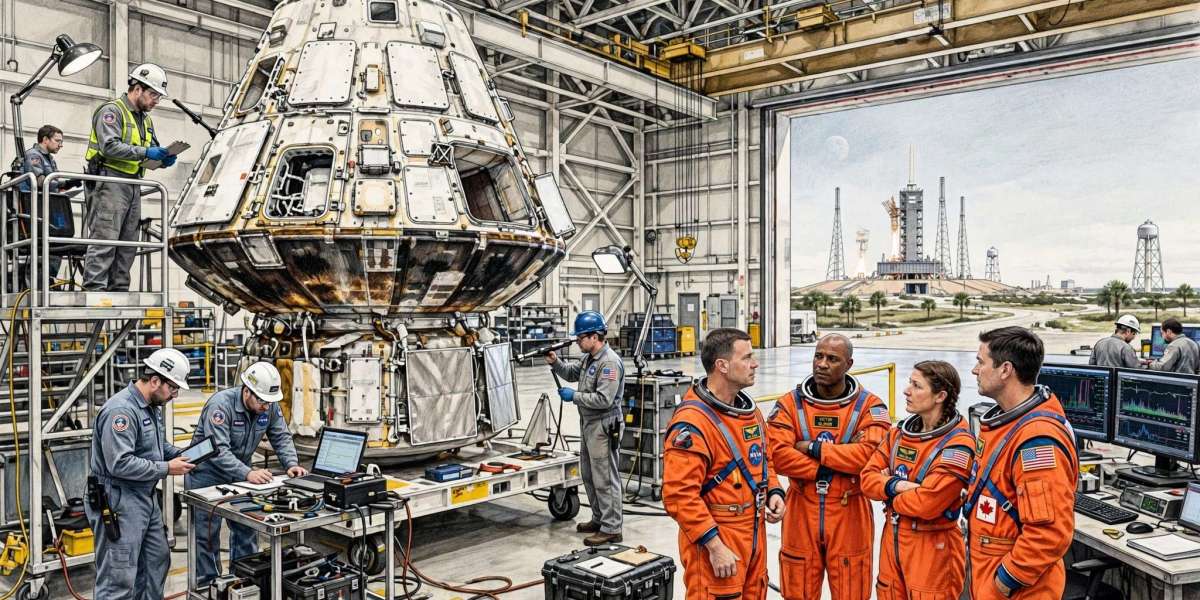
Three months after completing NASA's Artemis II mission around the Moon, the four astronauts who carried out humanity's first crewed lunar voyage in more than half a century returned to Kennedy Space Center in Florida, where they reunited with the Orion spacecraft that safely brought them home. The visit marked the astronauts' first opportunity to see the capsule since splashing down in the Pacific Ocean following their successful 10-day mission in April 2026. (AP News)
The reunion offered both engineers and astronauts an opportunity to reflect on one of the most significant milestones in NASA's current deep-space exploration program. While the spacecraft now sits inside a processing facility undergoing extensive inspections and analysis, the crew used the visit to thank the thousands of engineers, technicians, scientists, contractors, and support personnel whose work made the mission possible. Commander Reid Wiseman noted that returning to Launch Complex 39B without seeing the towering Space Launch System (SLS) rocket created a striking contrast with launch day only months earlier. (AP News)
The Artemis II crew consisted of NASA astronauts Reid Wiseman, Victor Glover, and Christina Koch, along with Canadian Space Agency astronaut Jeremy Hansen. Together, they became the first humans to travel beyond low-Earth orbit since the final Apollo mission in 1972, completing the first crewed flight of NASA's Orion spacecraft and Space Launch System. During the mission, the astronauts orbited the Moon before safely returning to Earth, testing systems that will support future lunar expeditions. (NASA)
According to NASA, the Artemis II crew reached a maximum distance of approximately 252,756 miles (406,640 kilometers) from Earth, surpassing the previous human spaceflight distance record set by the Apollo 13 astronauts in 1970. The spacecraft also passed roughly 4,067 miles (6,546 kilometers) above the lunar surface during its closest approach, allowing engineers to evaluate Orion's performance in the deep-space environment while astronauts conducted operational demonstrations and scientific observations. (NASA)
Unlike the Apollo lunar landings, Artemis II was designed primarily as a comprehensive flight test rather than a landing mission. Throughout the nearly ten-day journey, the astronauts evaluated Orion's life-support systems, communications equipment, navigation capabilities, manual flight operations, and numerous other systems required for long-duration missions beyond Earth's orbit. The successful completion of these objectives provided NASA with valuable engineering and operational data that will help shape upcoming Artemis flights. (NASA)
Following splashdown off the coast of California on April 10, 2026, recovery teams transported Orion aboard the USS John P. Murtha, where engineers began initial post-flight inspections before the spacecraft was returned to Kennedy Space Center for more extensive analysis. Since arriving in Florida, technicians have been removing reusable hardware, collecting onboard scientific and engineering data, inspecting heat-shield components exposed during atmospheric re-entry, and preparing the spacecraft for future evaluations. (NASA)
The astronauts themselves have also continued post-mission activities since returning home. After completing medical evaluations immediately following recovery, the crew reunited with their families at NASA's Johnson Space Center in Houston before beginning physical rehabilitation, scientific debriefings, and detailed reviews of the mission with engineers and flight planners. These discussions are expected to help refine operational procedures for future crews traveling farther into deep space. (NASA)
For Christina Koch, the mission represented another milestone in her distinguished NASA career. She became the first woman to travel to the vicinity of the Moon as part of the Artemis program. During recent public appearances, Koch emphasized that NASA selected astronauts based on qualifications, experience, and mission requirements, highlighting the agency's commitment to assembling the strongest possible crew for challenging exploration missions. (AP News)
Mission specialist Jeremy Hansen, representing the Canadian Space Agency (CSA), also announced that he plans to conclude his active service with the Canadian Space Agency later this year while continuing to support Canada's space efforts through the Royal Canadian Air Force Reserve. Hansen has indicated he intends to remain involved with future Artemis activities despite stepping away from his current CSA role. (AP News)
The successful completion of Artemis II is widely viewed as an essential step toward NASA's long-term objective of establishing a sustained human presence near the Moon. Rather than focusing solely on short exploration visits, the Artemis program aims to develop technologies, operational experience, and international partnerships that can support repeated lunar missions while also preparing astronauts for future expeditions to Mars. (NASA)
The Artemis program differs significantly from the Apollo era in both scale and international cooperation. Alongside NASA, partners including the Canadian Space Agency, the European Space Agency (ESA), the Japan Aerospace Exploration Agency (JAXA), and numerous commercial aerospace companies are contributing spacecraft, technologies, scientific instruments, and future lunar infrastructure. This collaborative approach reflects NASA's broader strategy of building a sustainable exploration architecture rather than conducting isolated missions. (NASA)
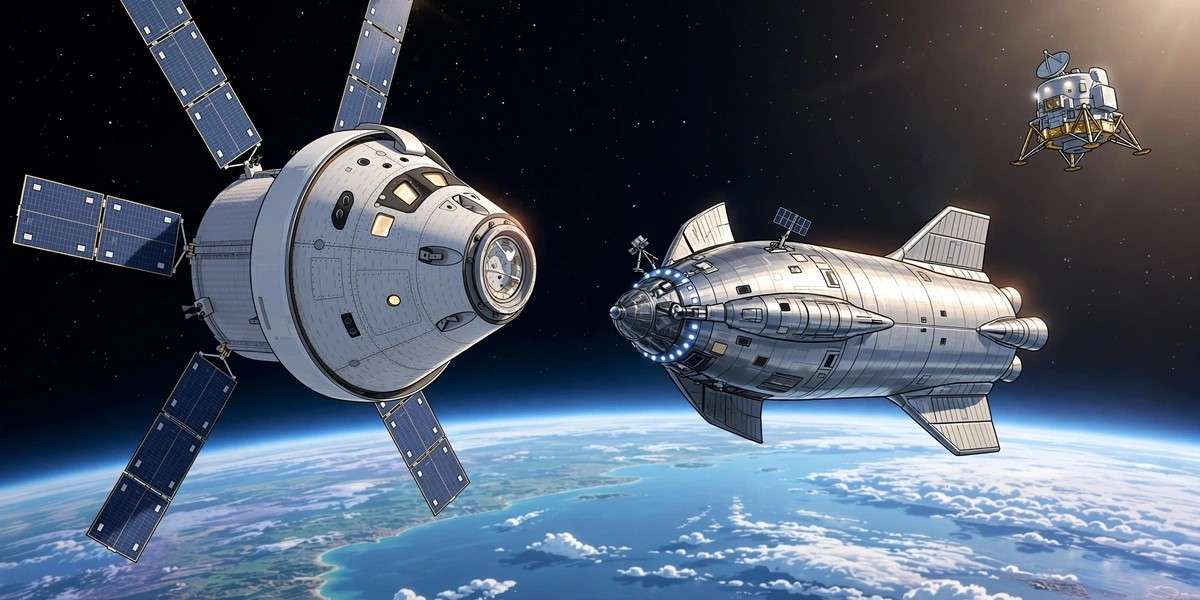
Future Artemis missions will gradually expand mission complexity. NASA has stated that upcoming flights are expected to test docking operations with lunar landing systems developed by SpaceX and Blue Origin, along with additional technologies needed to support astronauts on and around the Moon. These capabilities are considered essential before astronauts can begin longer-duration surface expeditions and eventually establish permanent infrastructure supporting scientific research and future exploration. (AP News)
The return of the Artemis II astronauts to Kennedy Space Center therefore represented more than a ceremonial reunion with their spacecraft. It symbolized the transition from a successful test mission to the next phase of NASA's exploration strategy, as engineers continue analyzing every aspect of Orion's performance while mission planners prepare for increasingly ambitious journeys beyond Earth orbit. The data collected from Artemis II will help reduce risks for future crews and shape the technologies that NASA and its international partners hope will eventually carry humans deeper into the solar system. (AP News)
Key Points Summary
NASA's Artemis II astronauts returned to Kennedy Space Center three months after completing their lunar mission.
The four-person crew traveled approximately 252,756 miles (406,640 kilometers) from Earth, setting a new human distance record.
Artemis II became the first crewed mission beyond low-Earth orbit since Apollo 17 in 1972.
Engineers are conducting extensive post-flight analysis of the Orion spacecraft.
The mission provided critical data for future Artemis flights aimed at returning astronauts to the Moon and preparing for eventual Mars exploration.
What This Means
The success of Artemis II is a major step in NASA's Artemis program, which seeks to establish a long-term human presence near the Moon and develop technologies for future deep-space exploration.
The mission's successful testing of the Orion spacecraft, Space Launch System (SLS) rocket, communications systems, navigation systems, and crew operations helps reduce risks for future astronauts.
The results are important for:
NASA and its international partners
Future lunar exploration missions
Scientific research conducted around and on the Moon
Commercial aerospace companies involved in lunar transportation systems
Long-term plans for human missions to Mars
Readers should watch for updates on upcoming Artemis missions, including future lunar landing efforts and continued analysis of data collected during Artemis II.
advertisement
Frequently Asked Questions (FAQ)
What was Artemis II?
Artemis II was NASA's first crewed Artemis mission and the first human mission to travel around the Moon since the Apollo era. The mission tested spacecraft systems needed for future deep-space exploration.
Who were the Artemis II astronauts?
The crew consisted of:
Reid Wiseman (NASA)
Victor Glover (NASA)
Christina Koch (NASA)
Jeremy Hansen (Canadian Space Agency)
Did Artemis II land on the Moon?
No. Artemis II was a lunar flyby mission designed to test spacecraft systems and crew operations. The mission orbited the Moon and returned safely to Earth without landing.
How far did the Artemis II crew travel?
According to NASA, the astronauts reached approximately 252,756 miles (406,640 kilometers) from Earth, setting a new record for the farthest humans have traveled from the planet.
Why is Artemis II important?
The mission tested critical systems needed for future lunar missions, helping NASA prepare for later Artemis flights that are expected to include lunar landings.
What spacecraft was used for Artemis II?
The mission used NASA's Orion spacecraft, launched aboard the Space Launch System (SLS) rocket.
What is the goal of the Artemis program?
NASA's Artemis program aims to return astronauts to the Moon, develop a sustained human presence in lunar space, support scientific research, and prepare for future missions to Mars.
Sources
Associated Press (AP News)
https://apnews.com/article/artemis-ii-astronauts-moon-nasa-c2000e3659f02138511f5542bbf40309
Additional Verified Sources
NASA Artemis II Mission
https://www.nasa.gov/mission/artemis-ii/NASA Mission Updates and Post-Flight Coverage
https://www.nasa.gov/