
NASA Reveals Groundbreaking Insights Into Dark Matter’s Role in Shaping the Universe
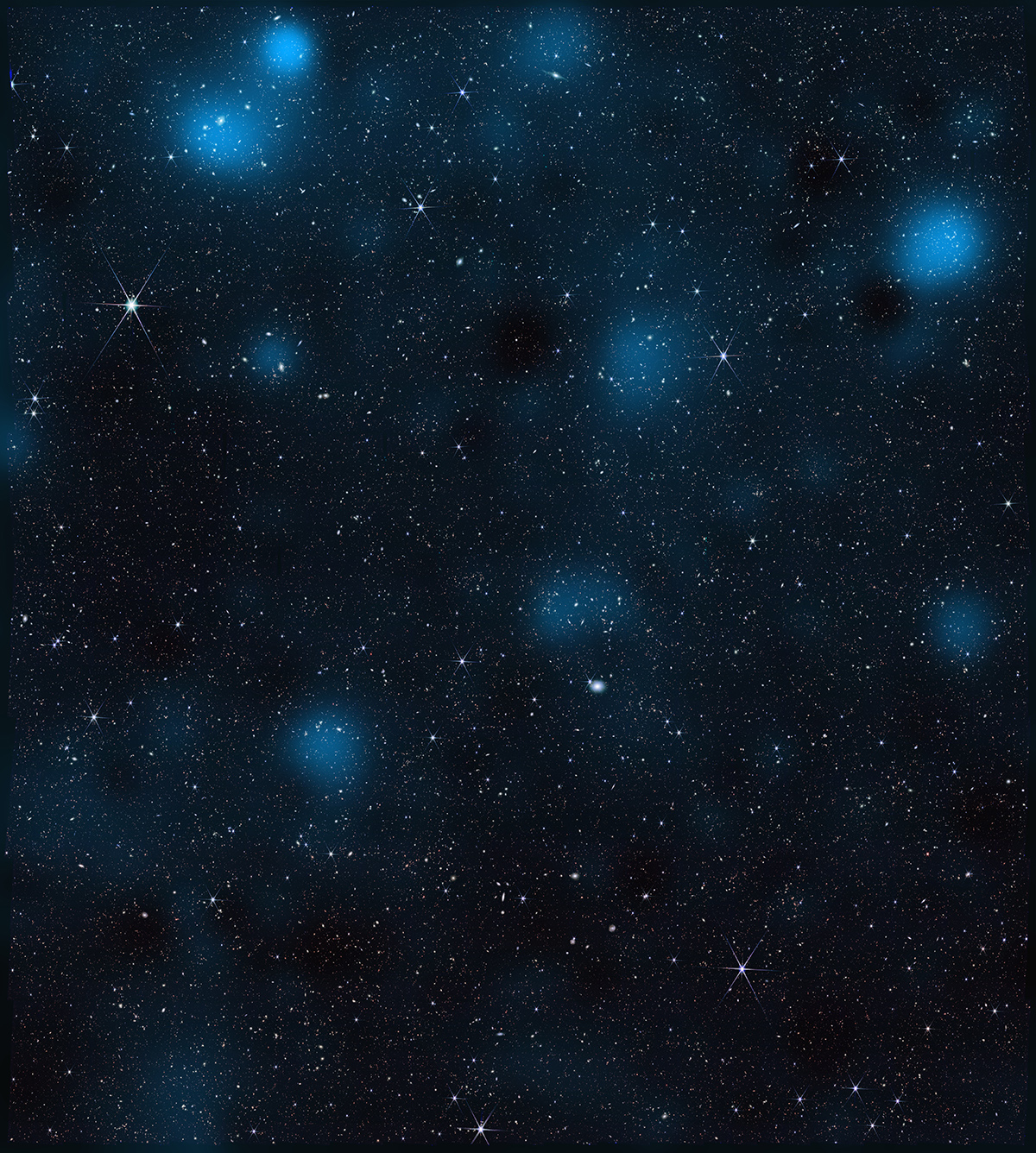
Image by the James Webb Space Telescope overlaid with a map of dark matter, represented in blue. Brighter blue areas indicate a higher density of dark matter. Credit: NASA/STScI/J. DePasquale/A. Pagan
Key Points:
Webb’s dark matter map shows the universe’s “invisible scaffolding.”
Dark matter guides galaxy and planet formation through gravity.
Webb’s high-resolution data reveals nearly 800,000 galaxies in unprecedented detail.
advertisement
Introduction
NASA’s James Webb Space Telescope is giving humanity the clearest view yet of dark matter, the invisible substance that shapes the cosmos. While dark matter cannot be seen directly, its gravitational influence governs the formation and structure of galaxies, stars, and even planets, including Earth. Using Webb’s unprecedented sensitivity, scientists have now created the most detailed dark matter map ever, revealing how this mysterious material interweaves with the “regular” matter that makes up everything we can observe.
Mapping the Invisible: Webb’s Landmark Achievement
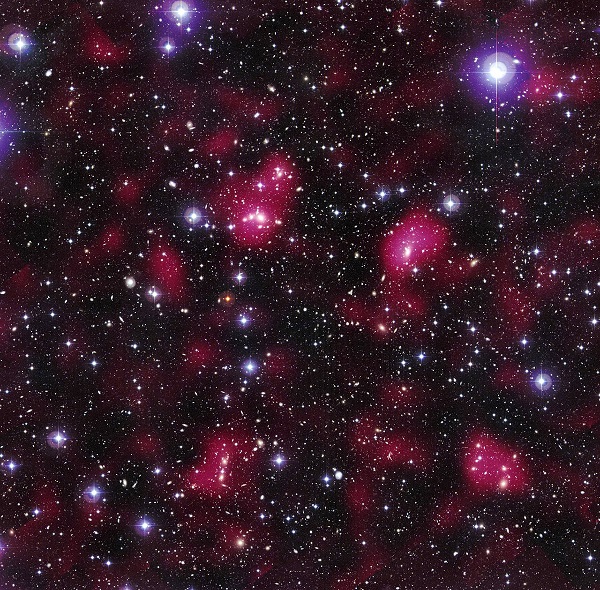
A dark matter map produced by the Hubble Space Telescope in 2008, showing the distribution of dark matter in the supercluster Abell 901/902. Credit: NASA, ESA, C. Heymans (University of British Columbia, Vancouver), M. Gray (University of Nottingham, U.K.), M. Barden (Innsbruck), and the STAGES collaboration
Webb’s Unmatched Resolution
Webb has produced the largest and sharpest dark matter map to date.
The telescope observed the COSMOS field for 255 hours.
Nearly 800,000 galaxies were identified, some for the first time.
The new map, focusing on the COSMOS region in the constellation Sextans, is 2.5 times the size of the full Moon in the sky. It builds on previous efforts, including Hubble’s first map of the area in 2007, and surpasses prior data by capturing about twice as many galaxies and revealing previously unseen clumps of dark matter. Scientists identify dark matter indirectly by observing how its gravity bends light from distant galaxies—a phenomenon known as gravitational lensing. By analyzing these subtle distortions, researchers can determine where dark matter resides and how it interacts with ordinary matter.
The Cosmic Role of Dark Matter
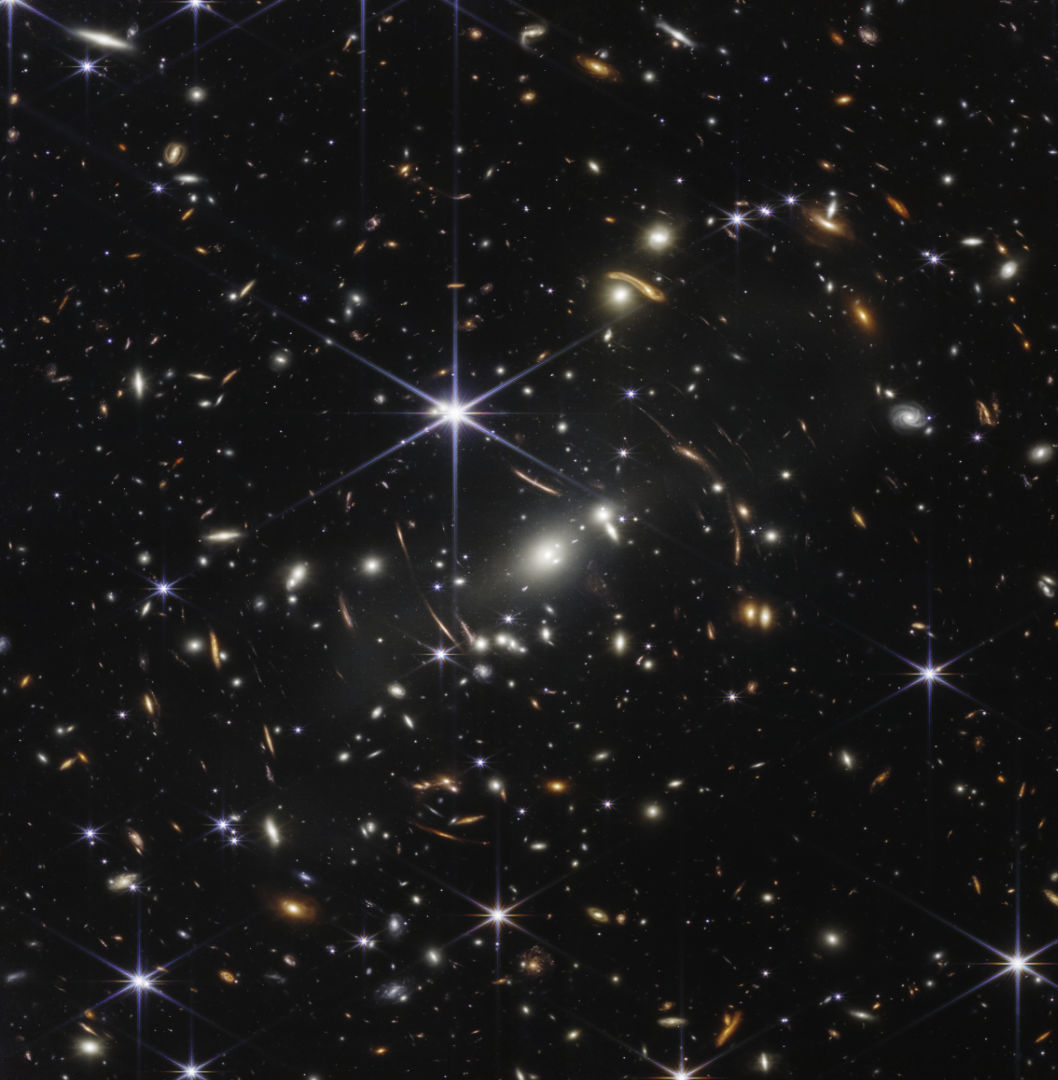
A deep view of the Universe, captured by the James Webb Space Telescope, showing a vast collection of distant galaxies. Dark matter is thought to be responsible for influencing the formation and distribution of galaxies we see in the Universe today. Credit: NASA, ESA, CSA, STScI
Gravity’s Hidden Hand
Dark matter makes up about 27% of the universe.
It pulls ordinary matter into dense regions where stars and galaxies form.
Its influence shaped the distribution of galaxies and the eventual formation of planets.
Dark matter does not emit, reflect, or absorb light, but it exerts gravity, acting as a scaffolding around which the universe forms. Where dark matter accumulates, ordinary matter follows, creating galaxy clusters millions of light-years across and forming the building blocks for stars and planets. According to Richard Massey of Durham University, “It’s the gravitational scaffolding into which everything else falls and is built into galaxies.” Diana Scognamiglio from NASA’s Jet Propulsion Laboratory adds that “previously, we were looking at a blurry picture of dark matter. Now we’re seeing the invisible scaffolding of the universe in stunning detail.”
Unlocking the Universe’s Early History
Clues from the Cosmic Past
Dark matter clumps likely formed first in the early universe.
Regular matter gathered around these clumps to form the first stars and galaxies.
This process provided the elements necessary for planets and life to exist.
By mapping dark matter in exquisite detail, scientists are gaining insight into how galaxies and stars formed earlier than previously thought. Dark matter’s gravitational pull helped gather ordinary matter, allowing hydrogen and helium to transform into heavier elements essential for planets like Earth. As Jason Rhodes, a coauthor from NASA JPL, explains, “This map provides stronger evidence that without dark matter, we might not have the elements in our galaxy that allowed life to appear.”
Future Prospects and Expanding Knowledge
The Road Ahead
Upcoming telescopes like NASA’s Nancy Grace Roman Space Telescope will expand dark matter maps.
Webb’s resolution remains unmatched, but larger surveys will explore bigger cosmic regions.
Scientists are working on 3D mapping to understand dark matter properties.
While Webb has provided unparalleled detail, future missions will broaden our view. The Nancy Grace Roman Space Telescope, launching soon, will survey areas 4,400 times larger than COSMOS, offering complementary insights. ESA’s Euclid telescope and the Vera C. Rubin Observatory will also contribute to mapping dark matter, helping scientists answer lingering questions about its composition, whether it consists of slow-moving “cold” particles or faster “warm” ones.
Conclusion
NASA’s James Webb Space Telescope has not only given us the sharpest map of dark matter ever produced but also reinforced the understanding that this invisible material is essential for the formation of the universe as we know it. By tracing the cosmic scaffolding on which galaxies, stars, and planets depend, Webb allows humanity to see the hidden forces that have shaped our very existence. As future observatories expand on these findings, we may finally uncover the true nature of dark matter—a discovery that could revolutionize our understanding of the cosmos and our place within it.
Key Points Summary:
Webb created the largest, most detailed dark matter map ever.
Dark matter guides the formation of galaxies, stars, and planets.
COSMOS field observations identified nearly 800,000 galaxies.
Gravitational lensing reveals dark matter’s location and influence.
Future telescopes will expand and complement Webb’s findings.
advertisement
Frequently Asked Questions (FAQ):
Q: What is dark matter?
A: Dark matter is an invisible substance that makes up about 27% of the universe and influences the formation and motion of galaxies through gravity.
Q: How does Webb map dark matter if it’s invisible?
A: Scientists use gravitational lensing, observing how dark matter bends the light from distant galaxies, allowing them to map its distribution indirectly.
Q: Why is dark matter important for planets like Earth?
A: Dark matter’s gravitational pull helped gather ordinary matter into regions dense enough to form stars and galaxies, providing the elements needed for planets and life.
Q: How does Webb’s map compare to Hubble’s?
A: Webb’s map shows twice the number of galaxies as Hubble’s map and reveals new clumps of dark matter at higher resolution.
Q: What comes after Webb for dark matter studies?
A: NASA’s Nancy Grace Roman Space Telescope, ESA’s Euclid telescope, and the Vera C. Rubin Observatory will expand dark matter mapping and help study its fundamental properties.
Sources
NASA – Detailed overview of Webb’s dark matter mapping and findings
https://www.nasa.gov/missions/webb/nasa-reveals-new-details-about-dark-matters-influence-on-universe/Sky at Night Magazine – Summary of Webb’s high-resolution dark matter map and its cosmic significance
https://www.skyatnightmagazine.com/news/james-webb-space-telescope-dark-matter-mapNational Geographic – In-depth explanation of dark matter, Webb’s mapping techniques, and future research
https://www.nationalgeographic.com/science/article/dark-matter-map-james-webb-space-telescope
Thank you !