
Tree Rings Uncovered: How Tree Growth Rings Reveal Age, Climate History, and Human Stories
Tree rings are living history books, showing age and environmental conditions year by year.
Dendrochronology links tree ring patterns across centuries, helping date buildings, climate events, and ancient civilizations.
Tree rings reveal climate change, fires, pests, and even human land use, making forests essential archives for science and history.
advertisement
Introduction: The Silent Record Keepers in Our Forests
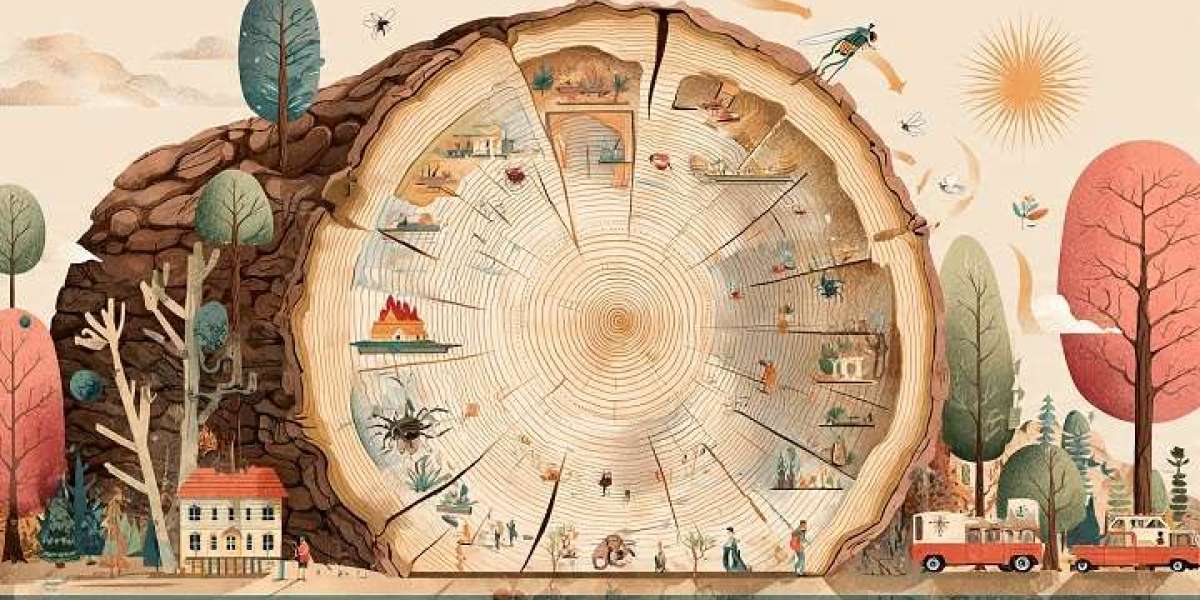
If you’ve ever looked at a tree stump, you’ve probably seen the concentric rings and guessed they tell a tree’s age. But tree rings do far more than count years. They are living archives, recording climate, forest health, fire history, and even human activity.
From the eastern forests of the United States to ancient archaeological sites, tree rings have helped scientists uncover stories about the past. This field of study—dendrochronology—uses ring patterns to date events and reconstruct environmental conditions, sometimes stretching back thousands of years.
How Tree Rings Form: The Science Beneath the Bark
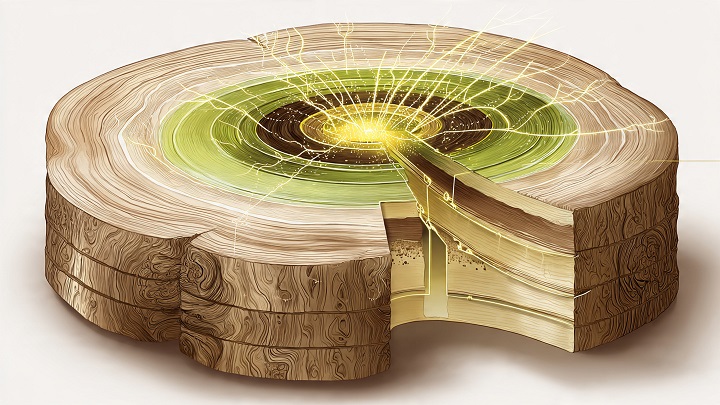
Trees grow by adding new wood each year between the bark and the trunk. This growth happens in two distinct phases:
Spring growth: rapid, producing lighter wood with larger cells
Late summer/fall growth: slower, producing darker, denser wood
One light ring plus one dark ring equals one full year of growth. Over time, these layers build a unique timeline that reflects the tree’s life.
The cambium layer is responsible for this growth. It produces new wood and bark as hormones like auxins and cytokinins move through the tree. This biological process is the reason rings are formed and why they vary in thickness from year to year.
advertisement
What Tree Rings Reveal About the Environment
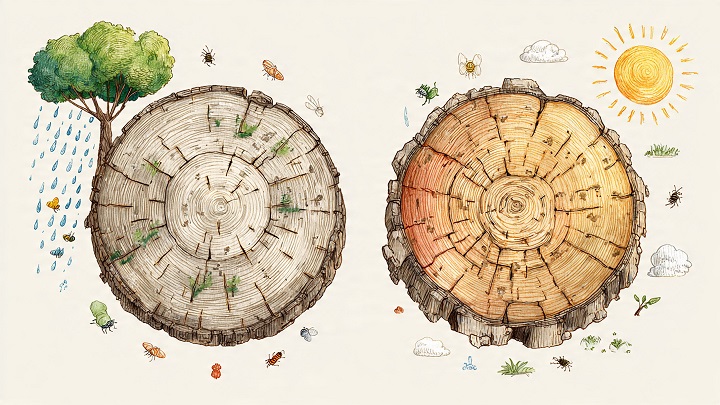
Tree ring width and color vary based on environmental conditions. In general:
Wide rings indicate favorable growth conditions such as warm, wet years.
Narrow rings can indicate drought, cold weather, disease, fire, or pest outbreaks.
The ring patterns also reflect how mature the tree is—young trees often grow faster, producing wider rings, while older trees grow more slowly, producing narrower rings over time.
Tree Rings as Climate and Ecological Evidence
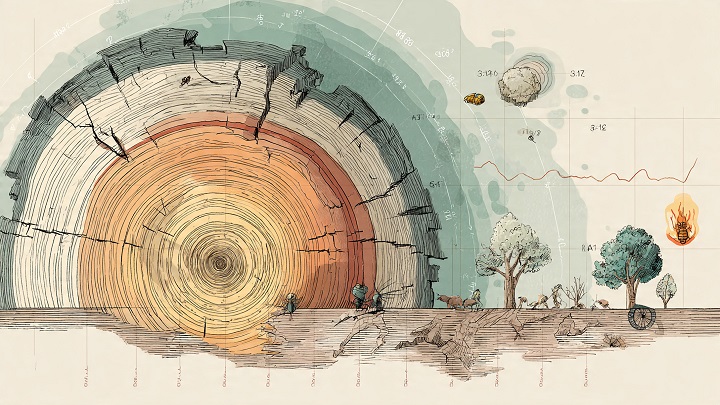
Tree rings are more than an age marker. They act as ecological weather records, showing how forests respond to long-term climate changes. By analyzing ring patterns, scientists can reconstruct:
Drought cycles
Flood history
Fire frequency and intensity
Insect outbreaks
Changes in atmospheric carbon levels
For example, recent studies show that carbon isotope ratios in tree rings have shifted over the past few decades, mirroring the rise in atmospheric CO₂—offering direct evidence of human-driven climate change.
advertisement
Dendrochronology: The Science of Dating the Past
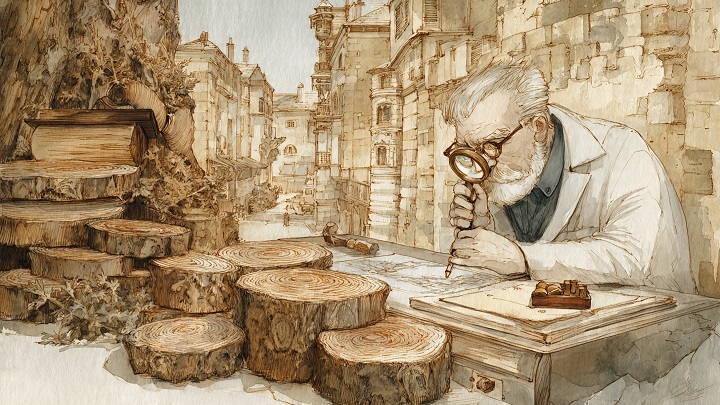
Dendrochronology was pioneered by Andrew E. Douglass in the early 1900s. It involves matching ring patterns from multiple trees to create long timelines. When rings align across trees in the same region, scientists can build an accurate chronology of environmental history.
This method is used in archaeology as well. Researchers can date timber from ancient buildings, ships, or structures by comparing ring patterns to known timelines. For example, tree rings helped date a Neolithic wooden well in the Czech Republic to 5256 BCE, making it over 7,000 years old.
How Tree Ring Sampling Works
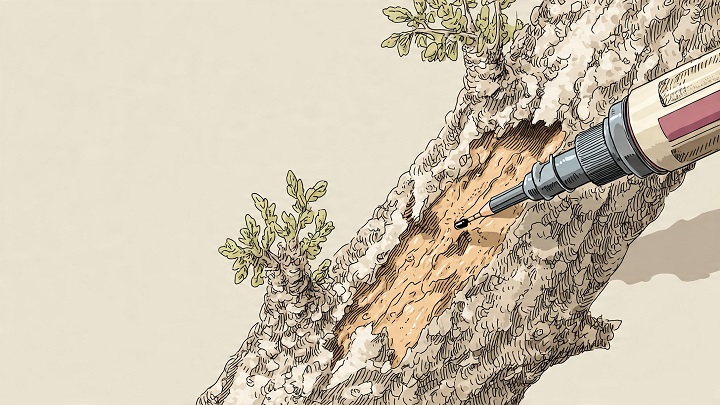
Scientists can study tree rings without cutting down the tree using an increment borer—a hollow steel tool that extracts a small core from the trunk. This core is about the size of a pencil and shows the full ring pattern, allowing researchers to study a tree’s life while leaving it alive.
Tree Rings and Human History
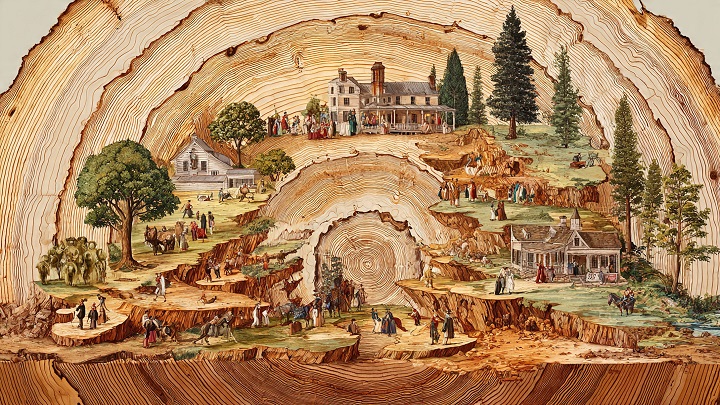
Tree rings can also reveal how humans interacted with forests over time. In the U.S. National Capital Region, ecologists studied rings from 1,518 trees to determine forest age and land-use history. They found that some trees were much older than their neighbors, suggesting past disturbances like agriculture or logging.
Some notable examples include:
A white oak tree aged 239 years, living through events such as early tobacco farming and the construction of Prince William Forest Park.
A tulip poplar tree aged 192 years, witnessing Civil War deforestation and the creation of Rock Creek Park.
A chestnut oak tree aged 158 years, growing during the Civil War and observing historical travel routes along the Shenandoah and Potomac rivers.
These trees are like living witnesses, carrying the story of human land use and environmental change in their rings.
Tree Rings and Fire History
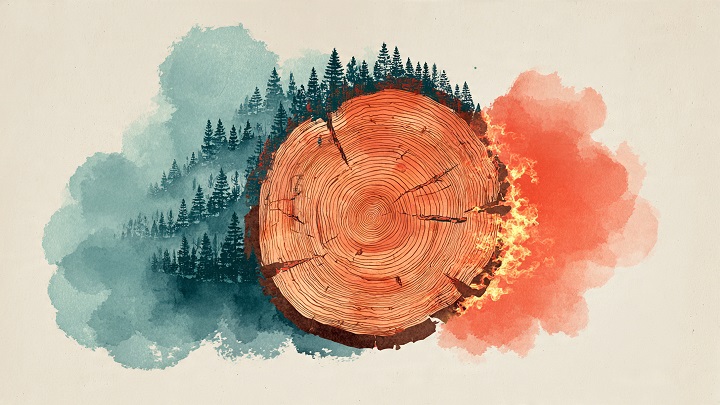
When a tree survives a fire, it often carries a fire scar in its rings. This scar becomes a permanent record of wildfire history. In 2022, researchers studied a tree sample dated from 1370 to 1710, revealing scars from 19 separate fires, helping scientists reconstruct wildfire patterns over centuries.
Tree Rings and Solar Activity
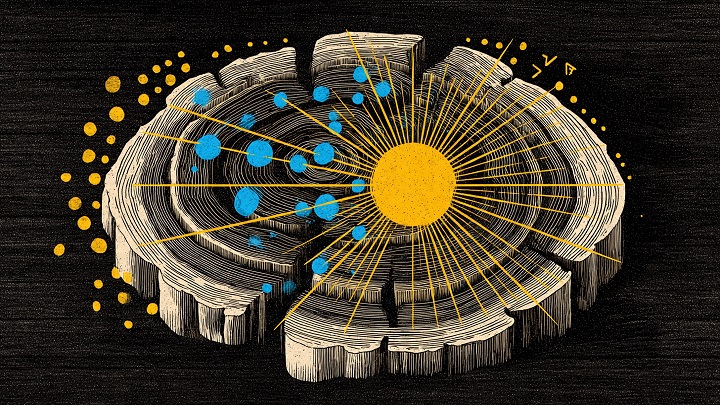
Tree rings can even reveal solar activity. Scientists from the University of Arizona and ETH Zurich used tree rings to reconstruct solar flare history from 1000 BCE to 2 BCE. When solar flares erupt, carbon-14 spikes in the atmosphere and is absorbed by trees, leaving a measurable record in the rings.
Conclusion: The Living Memory of Trees
Tree rings are more than lines on a stump—they are nature’s archive, recording the story of life, climate, and human history. From ancient wells to modern forests, rings reveal how ecosystems have responded to droughts, fires, insects, and changing climates. They show us that the past is not lost—it is still alive in the wood around us.
When we understand tree rings, we gain a deeper appreciation for forests not just as landscapes, but as living libraries that store centuries of environmental memory. In a world facing rapid climate change, these silent witnesses remind us that the future depends on protecting the forests that hold our past.
Key Points Summary
Tree rings record yearly growth, climate conditions, and environmental stress.
Ring patterns vary by species, location, and age, with wider rings indicating favorable growth.
Dendrochronology matches ring patterns across trees to build historical timelines.
Tree rings reveal fires, droughts, insect outbreaks, and human land use.
Ring data can date ancient structures and track climate change through carbon isotopes.
advertisement
Frequently Asked Questions (FAQ)
Q1: What is a tree ring?
A tree ring is a concentric layer of wood added annually by a tree’s growth, consisting of a light spring band and a darker late-season band.
Q2: How do tree rings show climate history?
Ring width and density change based on rainfall, temperature, and environmental stress. Wider rings usually mean better growth conditions, while narrower rings may indicate drought or stress.
Q3: What is dendrochronology?
Dendrochronology is the scientific method of dating events and environmental changes by analyzing tree ring patterns.
Q4: Can scientists study tree rings without cutting trees down?
Yes, scientists use an increment borer to extract a small core sample, allowing the tree to remain alive.
Q5: How far back can tree rings reveal climate history?
Tree rings can reveal climate conditions up to thousands of years, depending on the species and available samples. Some studies extend back over 7,000 years through preserved wood.
Sources
National Park Service – “Tree Rings and the Tales They Tell”
https://www.nps.gov/articles/000/tree-rings.htm
Arbor Day Foundation – “The Living Forest: What Tree Rings Tell Us About the Life of a Tree”
https://www.arborday.org/perspectives/living-forest-what-tree-rings-tell-us-about-life-tree
EarthDay.org – “The Real Lord of the Rings: Tales Beneath the Bark”
https://www.earthday.org/the-real-lord-of-the-rings-tales-beneath-the-bark/
Thank you !