
article image source: earthsky.org (Link)
Lunar X and Lunar V: How to Spot the Moon’s Most Fascinating Optical Features
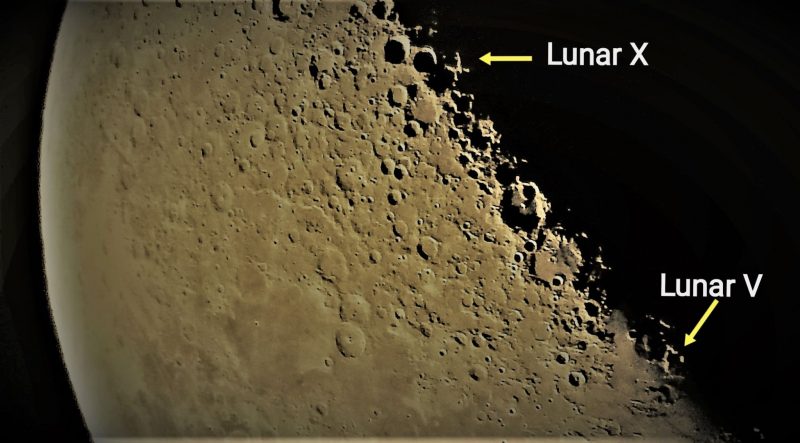
Kannan A in Singapore wrote on April 19, 2021:
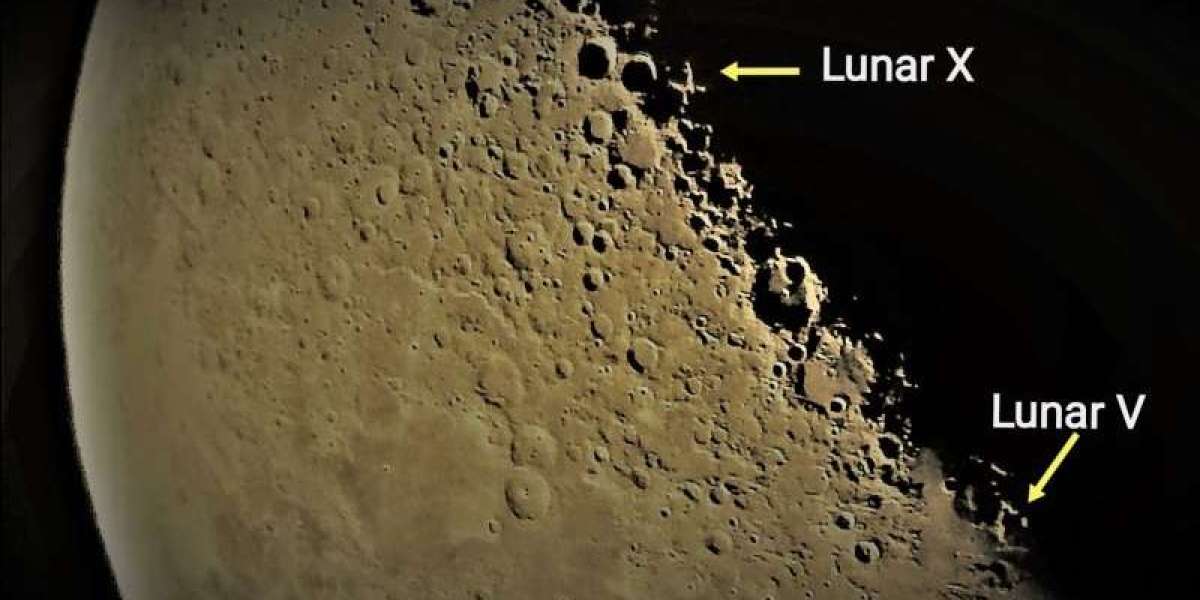
“Upon a close look at the moon tonight, I realized that the Lunar X and Lunar V were clearly visible. These are transient lunar features visible on the lunar surface for about 4 hours once a month. They are most striking when they are visible on the shadow side of the terminator. But they will remain visible against the lunar surface even after the terminator has moved because they are brighter than the surrounding area.”
image source: earthsky.org (Link)
Key Points:
Lunar X & V appear only for a few hours around the first-quarter moon.
These optical features are caused by sunlight illuminating crater rims and ridges.
Best observed with binoculars or a telescope at around 50x magnification or higher.
advertisement
The Moon has captivated humanity for millennia, but few know about two of its most intriguing optical phenomena: the Lunar X and Lunar V. These temporary patterns appear along the moon’s terminator—the line dividing lunar day and night—and reveal themselves as striking letters formed by sunlight casting shadows across the lunar surface. While they may look like cryptic symbols, they are entirely natural illusions caused by the interplay of light and topography.
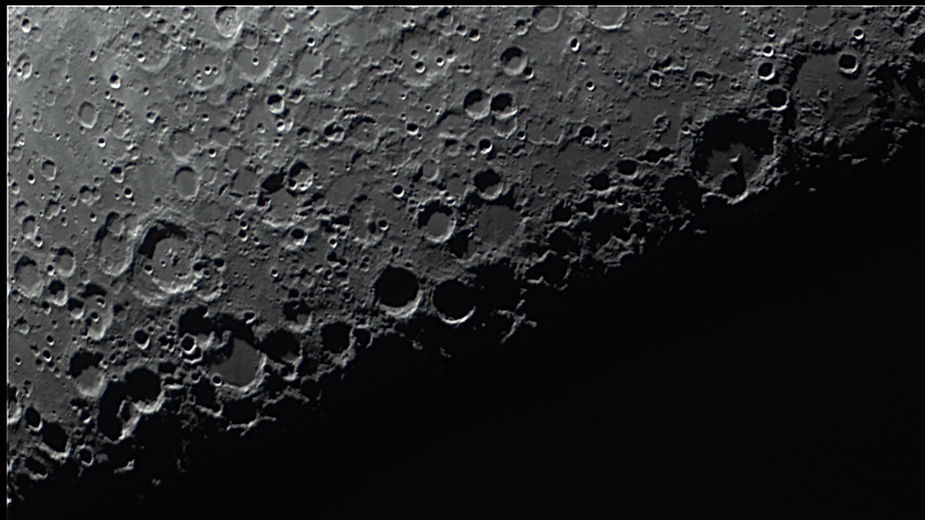
Lunar X
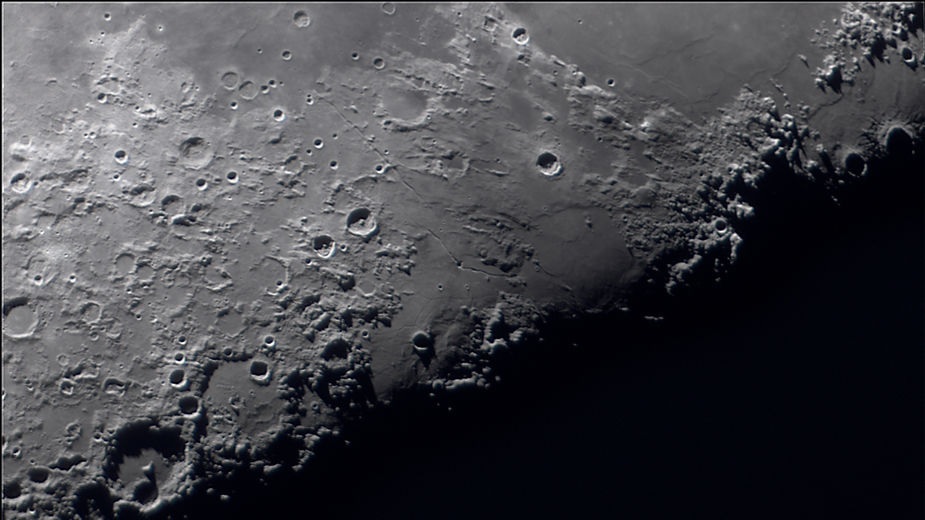
Lunar Y
The Lunar X, sometimes called Werner X, emerges when sunlight illuminates the rims of the craters Blanchinus, La Caille, and Purbach. The result is a sharply defined ‘X’ that seems to float on the Moon’s surface. Similarly, the Lunar V forms along ridges east of the crater Ukert, producing a visible ‘V’ shape. Each arm of both the X and V spans roughly 65 kilometers, making them impressively large when observed through a telescope.
These features are highly time-sensitive. They are most visible for about four hours around the first-quarter moon, when the angle of sunlight hits the lunar surface just right. Observers have noted that the X may take a few hours to fully form, while the V appears more consistently, creating a dynamic viewing experience where patterns seem to emerge in real time. Because their visibility depends on precise lighting, weather, and geographic location, Lunar X and V are not guaranteed to be seen everywhere simultaneously, but they occur monthly and predictably for those who know when to look.
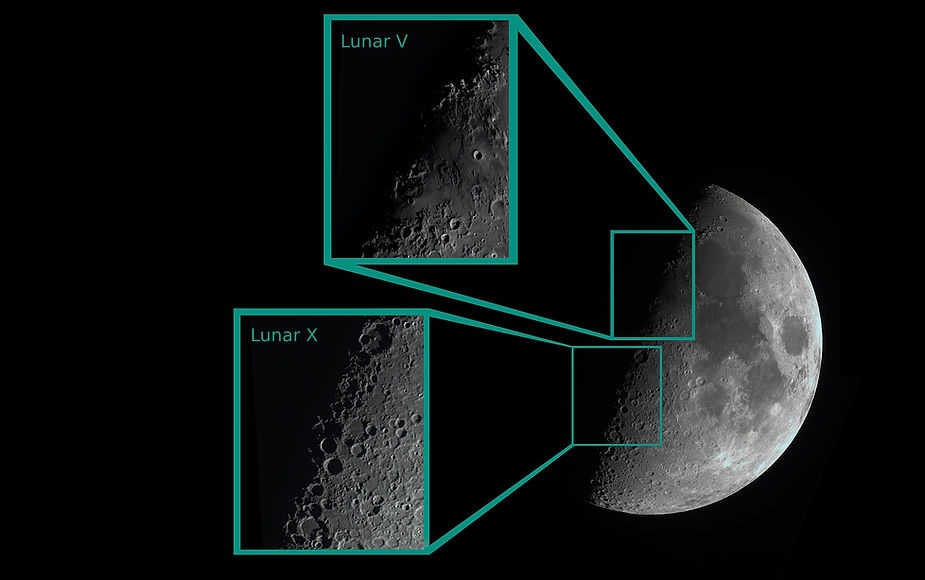
Full lunar image
For amateur astronomers aiming to catch these phenomena, careful planning is key. Websites like WinJupos can convert Universal Time to local time, ensuring observers know exactly when the Lunar X and V will be visible in their area. Viewing can be accomplished with binoculars, but telescopes with at least 50x magnification provide the clearest view. Using a barlow lens or lunar imaging cameras can further enhance the experience, as demonstrated by enthusiasts who have captured detailed mosaics of these features.
In addition to their visual appeal, the Lunar X and V offer a fascinating lesson in lunar geology and optical effects. They highlight how sunlight interacts with crater topography to create shapes that seem familiar to the human eye—a combination of natural physics and visual perception. Beyond just astronomy enthusiasts, these features remind us of the subtle and ever-changing beauty of our nearest celestial neighbor.
Conclusion:
The Lunar X and Lunar V are not just optical curiosities; they are an invitation to engage with the Moon in a deeper, more observant way. Whether you are a seasoned astronomer or a curious beginner, these features illustrate how precise conditions of light and shadow can transform ordinary lunar terrain into a breathtaking spectacle. By planning your observation around the first-quarter moon, converting Universal Time to your local time, and using even basic viewing equipment, you can witness this rare lunar artwork. The Moon constantly offers surprises to those who look closely, and Lunar X and V are perfect examples of its hidden wonders—proof that the cosmos is full of fleeting beauty waiting to be discovered.
Key Points Summary
Lunar X & V appear briefly around the first-quarter moon.
X is formed by craters Blanchinus, La Caille, and Purbach; V is near crater Ukert.
Visibility depends on light angle, weather, and location.
Best seen with 50x magnification or higher.
Phenomenon occurs predictably every lunar month.
advertisement
Frequently Asked Questions (FAQ)
Q1: What causes the Lunar X and Lunar V?
A: They are optical illusions created by sunlight illuminating crater rims and ridges along the moon’s terminator.
Q2: When can I see Lunar X and V?
A: They are visible for about four hours around the first-quarter moon phase.
Q3: Do I need a telescope to see them?
A: Binoculars can show the features, but a telescope at 50x magnification or higher provides the best view.
Q4: Are Lunar X and V visible worldwide at the same time?
A: No, visibility depends on your location, weather, and the timing of the moon’s phase.
Q5: Is there any special software to help plan viewing?
A: Yes, programs like WinJupos can convert Universal Time to your local time for precise observation.
Sources
GeekPants Media – Personal lunar observations with images and equipment details
https://www.geekpantsmedia.com/post/the-lunar-x-and-lunar-vThe Sky Scrapers – Monthly prediction of Lunar X & V visibility and observation tips
http://www.theskyscrapers.org/lunar-x-v---2025EarthSky – Explanation of Lunar X & V optical phenomena and viewing guidance
https://earthsky.org/astronomy-essentials/what-is-lunar-x/
Thank you !