
article image source: thebrighterside.news (Link)
New Gold Nanospheres Capture Nearly the Full Solar Spectrum, Doubling Solar Energy Absorption
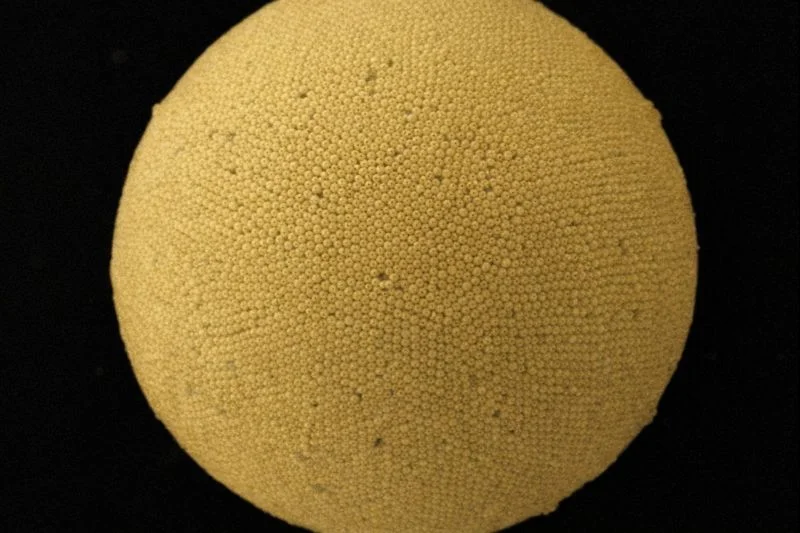
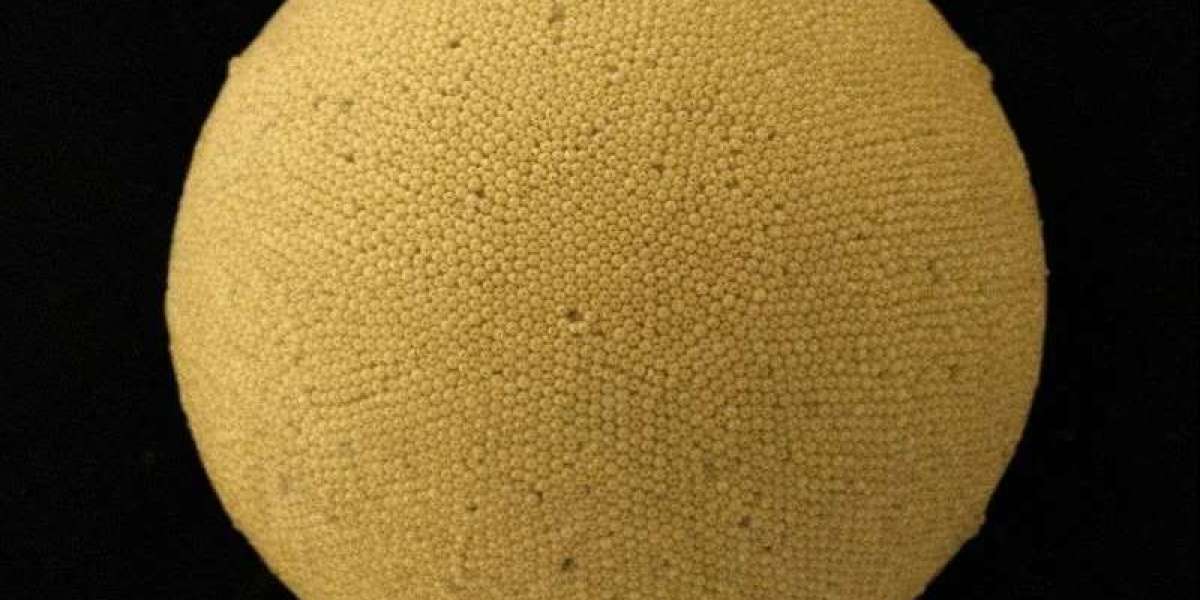
Gold supraballs absorb most sunlight, boosting thermoelectric output and pointing to simpler, high-efficiency solar coatings.
(CREDIT: ACS Applied Materials & Interfaces / color modification from grey scale to gold scale)
image source: thebrighterside.news
• Gold “supraballs” absorb over 90% of sunlight wavelengths, including near-infrared.
• Coated thermoelectric devices nearly doubled energy absorption in lab tests.
• Simple, room-temperature fabrication could lower the cost of high-efficiency solar-thermal systems.
advertisement
Harnessing the full power of the sun has long been a challenge for modern renewable energy technology. While traditional photovoltaic systems capture visible light effectively, they miss a significant portion of the solar spectrum — especially near-infrared wavelengths that carry substantial energy.
Now, researchers reporting in ACS Applied Materials & Interfaces have developed gold nanospheres, known as “supraballs,” that absorb nearly the entire range of sunlight. In laboratory and outdoor tests, these supraballs dramatically increased the performance of a thermoelectric generator, marking a promising advance in next-generation solar energy harvesting.
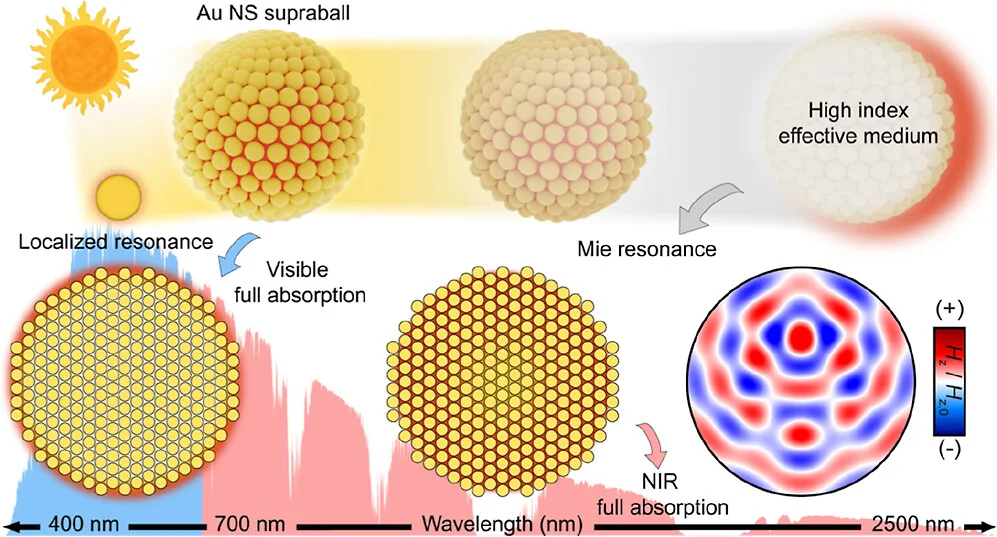
Practical solar energy harvesting demands absorbers that combine large-area scalability with strong light–matter interactions spanning the visible to near-infrared (NIR) spectrum.
(CREDIT: ACS Applied Materials & Interfaces)
image source: thebrighterside.news
Unlike single gold nanoparticles, which absorb only a narrow band of visible light, supraballs are formed when many nanoscale gold particles self-assemble into tightly packed microspheres. This structural shift changes how the material interacts with light. When the nanoparticles sit just nanometers apart, they “couple” together, strengthening visible-light absorption and enabling broader near-infrared capture through complex internal resonances.
Before fabricating the material, the team ran computer simulations comparing different nanostructures — including single nanospheres, clusters, hollow shells and fully packed supraballs. According to the study, the fully filled supraballs performed best, with predicted absorption exceeding 90% across sunlight wavelengths.
Design optimization proved critical. Researchers tested supraballs constructed from 30, 50 and 70 nanometer gold nanoparticles. Larger particles improved near-infrared absorption but increased visible-light scattering losses. The 50 nanometer configuration delivered the best overall balance, maximizing broadband solar absorption. Simulations also revealed that films composed of many supraballs could smooth out absorption fluctuations by allowing neighboring spheres to reabsorb scattered light.
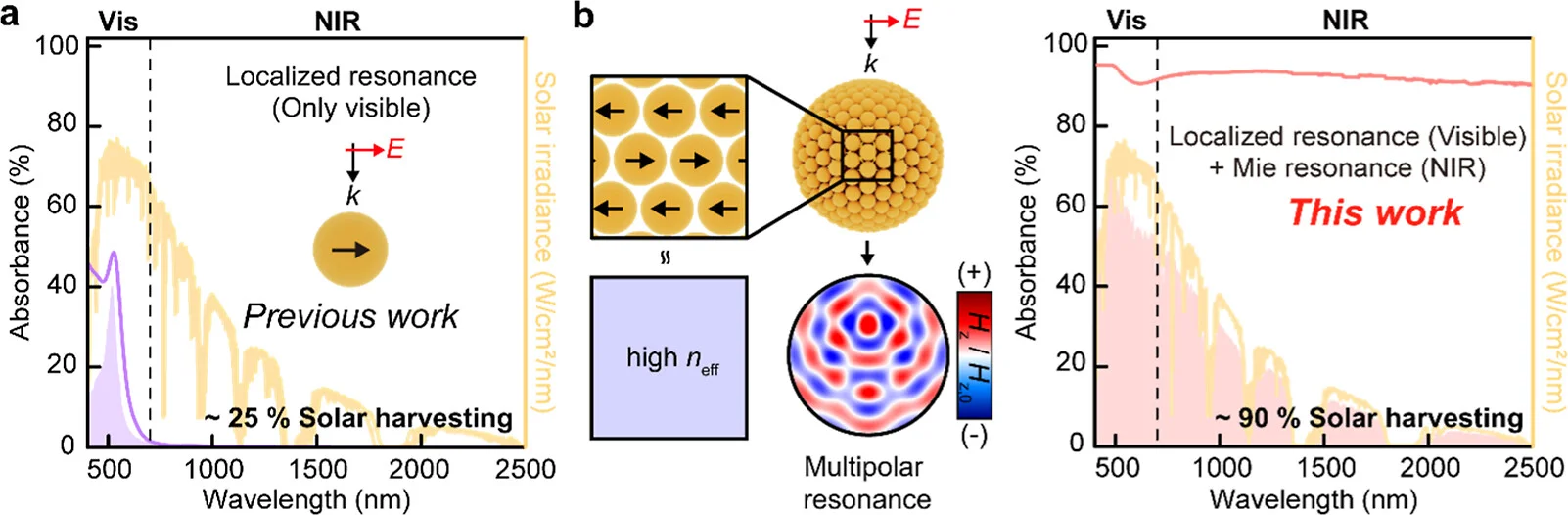
Single Au NS versus Au NS supraballs: importance of multiscale plasmonics for resonant and nonresonant engineering of solar energy harvesting.
(CREDIT: ACS Applied Materials & Interfaces)
image source: thebrighterside.news
To create the supraballs, scientists used a seeded-growth method to synthesize gold nanospheres, then employed a flow-focusing microfluidic system to form droplets containing the particles. As the droplets dried, the particles packed tightly into solid microspheres about 3 micrometers wide. Surface chemistry played a key role: thiolated polyethylene glycol (PEG) above 2 kDa enabled uniform, ordered structures, while shorter PEG chains led to irregular clumps. Notably, the fabrication process required only ambient room conditions — no clean rooms or extreme temperatures.
In testing, a supraball film dried onto glass appeared dark compared to the gold-toned film made from individual nanoparticles. Spectroscopy measurements showed that the supraball coating maintained more than 90% absorption across the measured solar spectrum. Under standard AM 1.5 G illumination, the supraball film averaged 88.84% absorption, compared to 45.20% for a film made from conventional single gold nanoparticles.
The team then applied the supraball coating to a commercially available thermoelectric generator (TEG), a device that converts heat differences into electricity. Under an LED solar simulator, the supraball-coated TEG achieved roughly 89% solar absorption, nearly double that of a nanoparticle-coated control device (45%). Electrical output reflected this gain: indoor one-sun testing showed 11.8 mA of current from the supraball device versus 5.1 mA from the control.
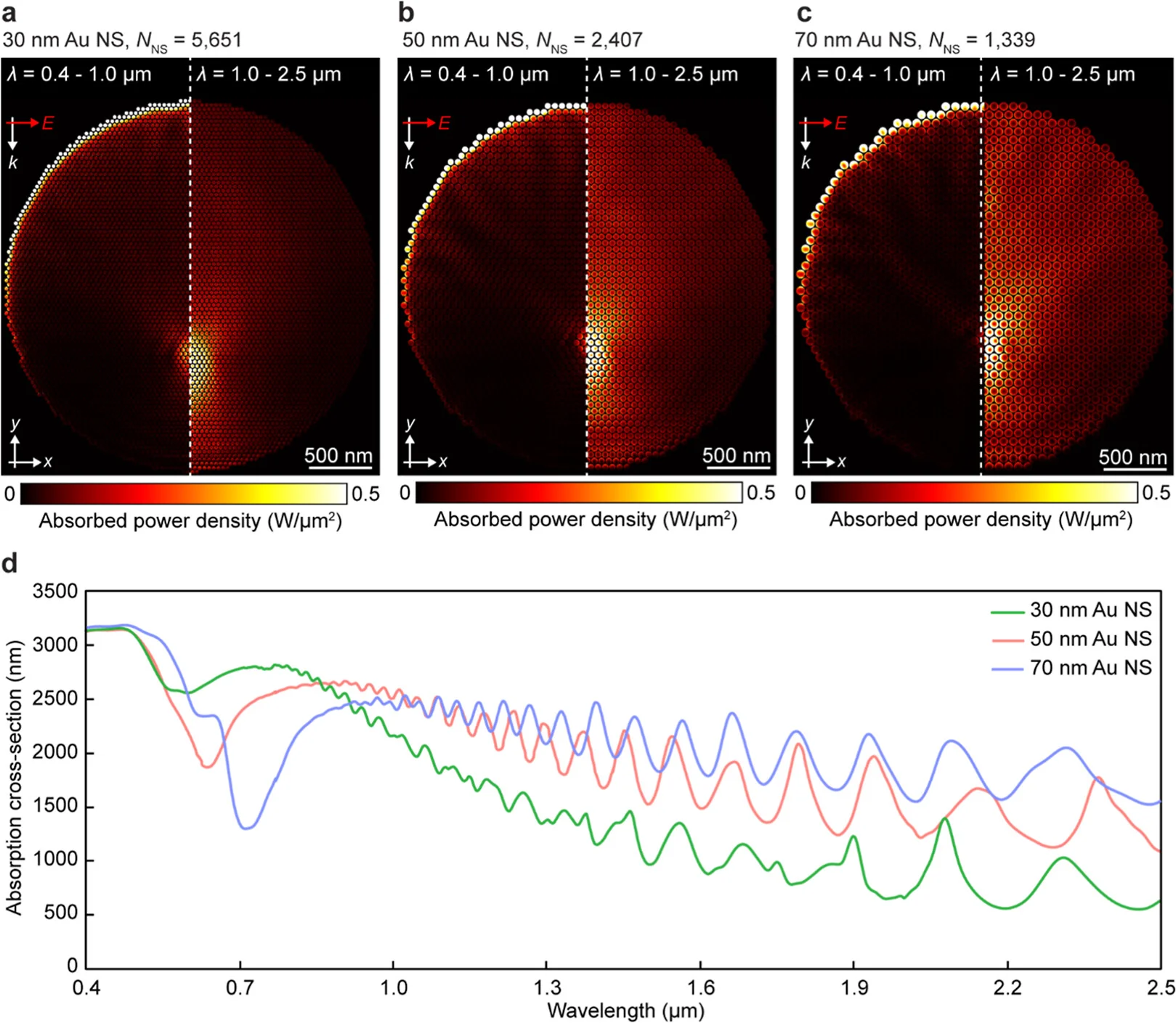
Effect of constituent Au NS size on the solar absorption of supraballs.
(CREDIT: ACS Applied Materials & Interfaces)
image source: thebrighterside.news
Outdoor tests conducted on June 18, 2025, at the KU R&D Center at Korea University confirmed the trend. Thermal imaging showed higher surface temperatures on the supraball-coated device, and current output remained consistently stronger under changing sunlight conditions.
“Our plasmonic supraballs offer a simple route to harvesting the full solar spectrum,” said researcher Seungwoo Lee. “Ultimately, this coating technology could significantly lower the barrier for high-efficiency solar-thermal and photothermal systems in real-world energy applications.”
Why This Matters for Renewable Energy
Current solar technologies often leave usable energy untapped. By capturing visible and near-infrared wavelengths more efficiently, supraball coatings could enhance solar-thermal systems used in industrial heating, building energy management, photothermal water treatment, and heat-driven chemical processes.
Equally important is manufacturability. The room-temperature, low-infrastructure fabrication process suggests scalability without expensive facilities. If successfully commercialized, this approach could provide a cost-effective path to higher solar conversion efficiency at a time when climate pressures and rising grid demand intensify the need for innovation.
advertisement
Conclusion
The development of gold supraballs represents more than a laboratory curiosity — it demonstrates how nanoscale engineering can unlock hidden potential in sunlight itself. By redesigning how gold nanoparticles interact with light, researchers have pushed solar absorption close to its practical limits across the full spectrum.
If these coatings scale successfully, they could reshape solar-thermal energy systems, making them more powerful, accessible and adaptable to real-world conditions. In a world urgently seeking cleaner and more efficient energy solutions, tiny spheres of gold may help capture nearly every ray the sun has to offer.
Key Points
Gold supraballs absorb more than 90% of sunlight wavelengths.
Coated thermoelectric generators nearly doubled absorption and current output.
Fabrication requires no clean rooms or extreme temperatures.
Optimized 50 nm nanoparticles balance visible and near-infrared absorption.
Technology shows promise for scalable solar-thermal and photothermal applications.
advertisement
Frequently Asked Questions (FAQ)
What are gold supraballs?
Gold supraballs are microscale spheres formed by tightly packing many gold nanoparticles together, enhancing broadband solar absorption.
How do supraballs improve solar energy harvesting?
They capture both visible and near-infrared light, allowing devices to absorb nearly the full solar spectrum instead of just a narrow band.
What device was tested with the coating?
A commercially available thermoelectric generator (TEG) was coated with supraballs and showed nearly double solar absorption compared to traditional coatings.
Why is near-infrared absorption important?
Near-infrared light represents a significant portion of sunlight energy that many conventional materials fail to efficiently capture.
Is the manufacturing process scalable?
The researchers report that the films form under ambient room conditions without clean rooms, suggesting potential for cost-effective scaling.
Sources
- American Chemical Society – Research press release on gold supraballs improving solar harvesting
https://www.acs.org/pressroom/presspacs/2026/january/tiny-gold-spheres-could-improve-solar-energy-harvesting.html - The Brighter Side – News coverage of supraball breakthrough and performance testing
https://www.thebrighterside.news/post/new-gold-nanospheres-capture-nearly-the-full-spectrum-of-solar-energy/ - ACS Applied Materials & Interfaces – Original peer-reviewed research article
https://pubs.acs.org/doi/10.1021/acsami.5c23149
Thank you !