
article image source: phys.org (Link)
New Lithium-Based Green Phosphors Could Redefine Commercial LED Efficiency
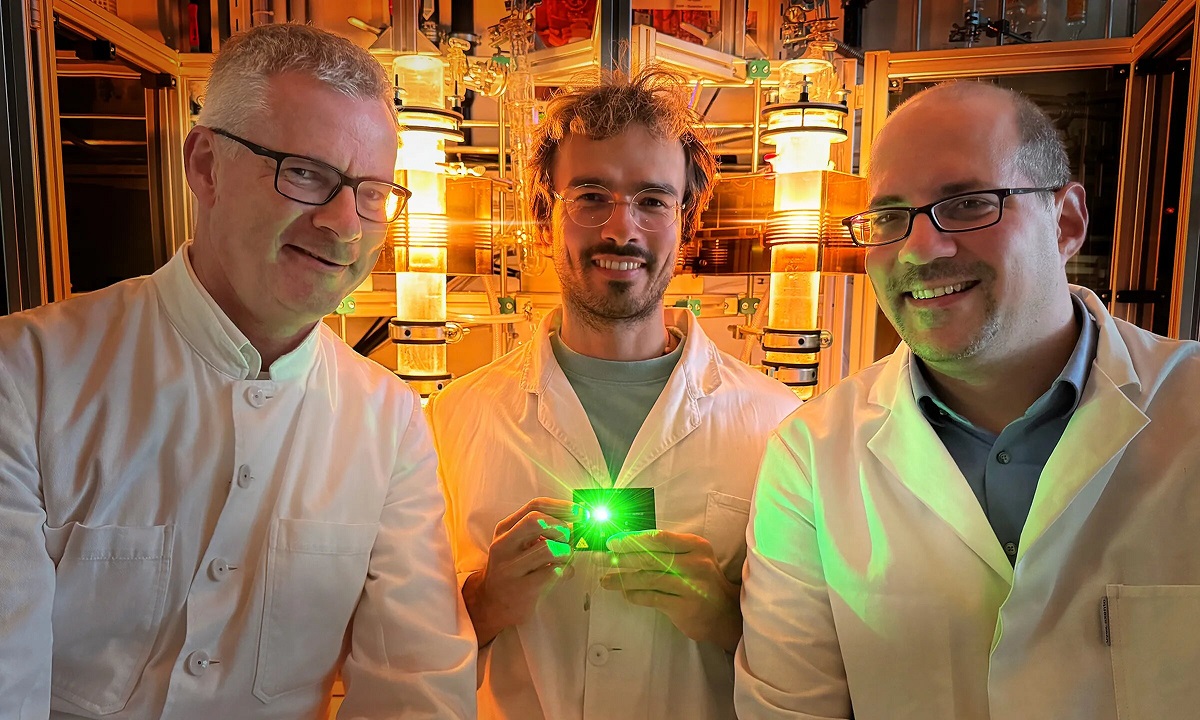
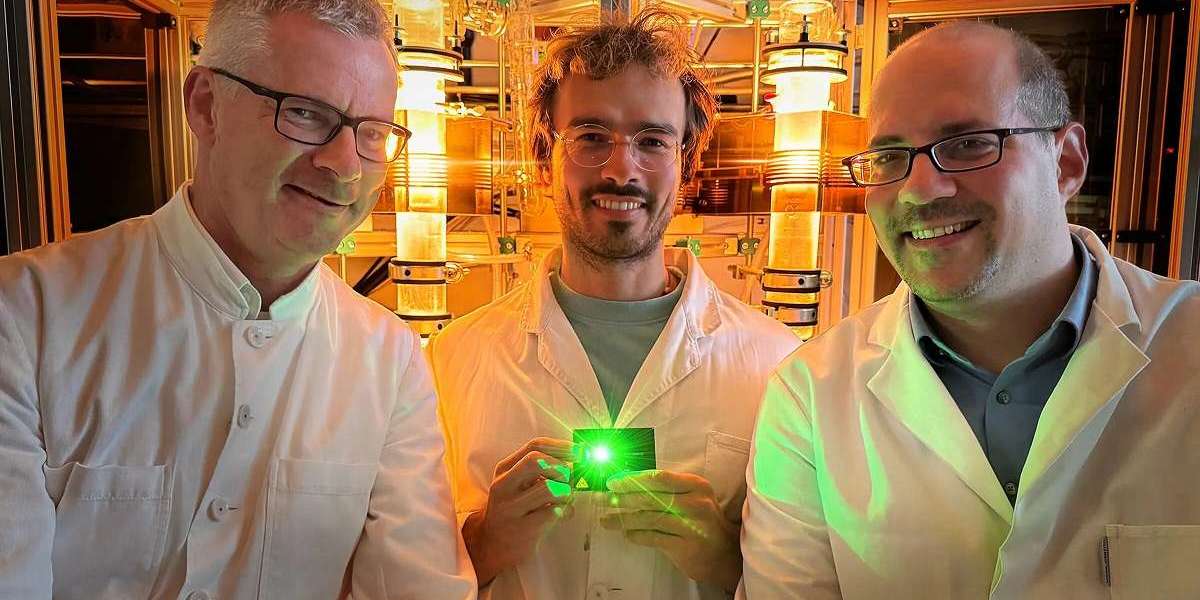
Research group leader Hubert Huppertz, first author Kilian Rießbeck, and Markus Suta are delighted about the newly discovered class of substances with green luminescent compounds. Credit: University of Innsbruck
image source: phys.org
Key Highlights:
Innovative lithium rare-earth oxonitridolithosilicates match industrial LED green phosphors.
Lower synthesis temperatures and diverse chemical compositions offer sustainable alternatives.
Prototype LEDs demonstrate market-ready potential alongside garnet standards.
advertisement
Green phosphors are essential for producing bright, energy-efficient white-light LEDs, powering everything from smartphones to streetlights. Traditionally, these phosphors rely on garnet structures, but researchers in Austria and Germany have discovered a new class of lithium-based green phosphors that could rival—and potentially replace—today’s commercial standard.
The breakthrough comes from lithium rare-earth oxonitridolithosilicates, compounds that crystallize in a completely new structure and integrate nitrogen alongside oxygen. This allows for flexible activator ion substitution, resulting in exceptional green luminescence even at lower synthesis temperatures—a critical advantage amid rising energy costs and potential raw material shortages.
Revolutionary Structure and Synthesis
Kilian Rießbeck and the team led by Hubert Huppertz at the University of Innsbruck developed these new phosphors by building on alkali lithosilicate chemistry. The addition of nitrogen anions creates a unique coordination environment for rare-earth activator ions, organized in a square-antiprismatic geometry. This design not only supports high luminescent efficiency but also tolerates a wide range of substitutions, resulting in 13 synthesized compounds with the same structural motif.
The compounds feature layered tetrahedra arrangements where four-membered silicate rings are linked by lithium tetrahedra. High-resolution, temperature-dependent photoluminescence spectroscopy, performed in collaboration with Markus Suta from Heinrich Heine University Düsseldorf, confirmed the mechanisms behind the green emission and suggested promising industrial efficiency.
Industrial Relevance and Prototype LEDs
In partnership with ams OSRAM, the researchers fabricated prototype LEDs using these new phosphors. Tests confirmed that the materials can compete with traditional garnet-based phosphors, demonstrating real-world applicability. Beyond just matching performance, the lower synthesis temperatures and alternative chemical composition offer a pathway toward more sustainable and geopolitically resilient LED manufacturing.
Conclusion
This development represents a significant step toward greener, more efficient, and adaptable LED technology. Lithium-based green phosphors not only provide a potential replacement for garnet phosphors but also open the door to more sustainable and versatile lighting solutions. As research continues, these compounds may reshape the future of LED illumination, offering brighter, energy-saving, and environmentally conscious lighting options worldwide.
Key Points Summary
Lithium rare-earth oxonitridolithosilicates offer a new green phosphor class.
Compatible with commercial LEDs, with prototype LEDs already tested.
Lower synthesis temperatures reduce energy use and raw material dependency.
Flexible lattice structure allows multiple compound variations.
Potential to revolutionize sustainable lighting and LED efficiency.
advertisement
Frequently Asked Questions (FAQ)
Q1: What makes lithium-based green phosphors different from traditional garnet LEDs?
A1: They feature a completely new crystal structure with nitrogen and oxygen integration, allowing for flexible activator substitution and high luminescence efficiency at lower synthesis temperatures.
Q2: Are these new phosphors ready for industrial use?
A2: Prototype LEDs have been successfully fabricated and tested with ams OSRAM, showing comparable performance to current garnet-based LEDs.
Q3: Why is this important for sustainability?
A3: Lower synthesis temperatures reduce energy consumption, and diverse chemical compositions reduce reliance on potentially scarce raw materials.
Q4: How many compounds have been synthesized so far?
A4: Researchers successfully synthesized 13 different compounds within this new structural motif.
Q5: Where was this research published?
A5: The study appeared in Advanced Functional Materials in 2025.
Sources
University of Innsbruck – Research breakthrough on lithium-based green phosphors for LEDs
https://phys.org/news/2026-02-lithium-based-green-phosphors-rival.html
Thank you !