
article image source: bbc.co.uk (Link)
The Oldest Evidence of Human Fire-Making: A Landmark Discovery
The Oldest Evidence of Human Fire Making: A Landmark Discovery
The ability to control fire is one of humanity’s most defining traits. It allowed our ancestors to cook, stay warm, and protect themselves from predators, but it also fueled an extraordinary leap in our cognitive and social evolution. A groundbreaking discovery in Suffolk, England, has just pushed back the timeline of fire-making by humans by an astonishing 350,000 years, revealing the earliest known evidence of deliberate fire-making. This revelation has not only changed our understanding of early human behavior but also highlighted the ingenious ways in which our Neanderthal relatives may have paved the way for us.
advertisement
A Revolutionary Discovery at Barnham
In December 2025, researchers announced the discovery of a 400,000-year-old hearth in Barnham, Suffolk. This site, long hidden beneath the surface of a disused clay pit, is now known to have hosted some of the earliest fire-makers in history—most likely Neanderthals. The hearth was identified by a combination of heat-shattered flint axes, baked earth, and two pieces of iron pyrite, a mineral that creates sparks when struck against flint. This discovery pushes back the earliest evidence of fire-making by humans by more than 350,000 years, far earlier than previous records from northern France.
The hearth was part of a campsite, situated near a watering hole, which would have provided early humans with a place to gather. Scientists believe that the pyrite, which is not naturally found in the immediate vicinity of Barnham, was deliberately transported to the site by the Neanderthals. This suggests that these early humans were not only capable of making fire but were also proficient in harnessing it for regular use, such as cooking and staying warm.

British Museum
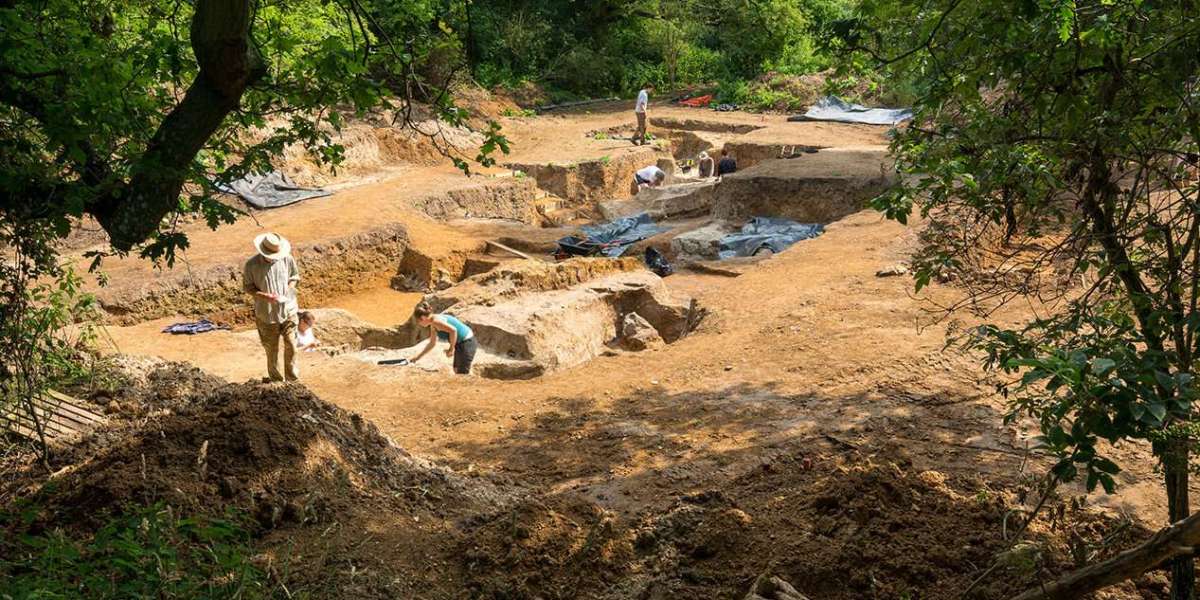
The layers of earth are slowly uncovered with hand tools
image source: bbc.co.uk
A Transformative Moment in Human Evolution
The controlled use of fire represents a critical milestone in the story of human evolution. For early humans, fire wasn’t just a tool for warmth—it fundamentally altered the way they interacted with the world around them. It enabled our ancestors to cook food, making it more digestible and nutritious, and it likely had significant impacts on brain development. Archaeologists speculate that cooking allowed early humans to free up energy from their digestive systems, which could then be allocated to brain growth, fueling the cognitive advances that distinguish humans from other species.
Moreover, fire became an essential element in the social evolution of early humans. Imagine the warmth and light of a campfire providing a social hub where humans gathered, shared stories, and possibly even began to develop early language and belief systems. These early hearths may have served as the centers of both physical and social activity, much like the campfires that continue to unite people today.
The Role of Neanderthals
For many years, Neanderthals were seen as primitive, brutish creatures. However, this new discovery adds to a growing body of evidence suggesting that Neanderthals were far more advanced than we once believed. From the creation of tools to the use of fire, these humans were innovative and capable, characteristics often associated with our own species, Homo sapiens.
The Neanderthals of Barnham likely came from regions of Europe connected to Britain by a land bridge at the time. Their ability to make fire in such a consistently reliable manner would have been crucial for survival in the harsh, cold climates of northern Europe. The discovery at Barnham also suggests that fire-making technology may have been shared across Europe during this period, with similar technologies emerging in other parts of the continent.
While the fire itself was central to this discovery, the tools found at Barnham also offer a glimpse into the technological advancements of early humans. Heat-shattered flint handaxes, likely used in both tool-making and fire-making, underscore the resourcefulness of these early humans in their quest for survival.

British Museum
A piece of iron pyrite found at the site
image source: bbc.co.uk
How Did Researchers Know This Was Deliberate Fire?
Determining that fire was deliberately made at Barnham was no simple task. Evidence of fire, such as ash or charcoal, is often difficult to preserve. In the Barnham site, researchers relied on a combination of sophisticated scientific techniques to confirm that the fire had been created intentionally and repeatedly. Geochemical analysis showed that the sediments had been exposed to temperatures exceeding 700°C (1,290°F), consistent with controlled burning rather than natural wildfires.
Moreover, the presence of iron pyrite—an incredibly rare mineral at Barnham—was a key piece of evidence. This mineral could only have been brought to the site deliberately, suggesting that the Neanderthals were not simply waiting for lightning strikes or natural fires to provide them with heat. Instead, they were creating fire at will, using technology that would have been crucial for their survival.
Implications for Human Evolution
This discovery at Barnham has profound implications for our understanding of human evolution. Fire allowed early humans to expand their range, making it possible for them to survive in colder climates and more varied environments. It also accelerated social and cognitive developments, pushing humanity toward the complex societies we would later build.
As Prof. Chris Stringer of the Natural History Museum points out, the ability to control fire was a "key development" in the evolution of Neanderthals. It helped them thrive in the changing environments of Europe and was instrumental in their social, cultural, and technological innovations.
Today, this finding invites us to rethink the legacy of Neanderthals and consider them not as primitive beings, but as highly skilled and intelligent ancestors who laid the foundation for the human race.
Conclusion: The Fire of Our Ancestors
The discovery of the oldest evidence of human-made fire at Barnham is a reminder of the ingenuity of our ancestors and the profound impact that mastering fire had on human evolution. It shows that early humans were not simply surviving—they were shaping the world around them, inventing technologies, and building the foundations for social structures that would eventually lead to modern civilizations.
As we reflect on this remarkable achievement, we are reminded of the power of discovery and the ongoing exploration of our past. The ability to create fire not only marked a critical moment in the story of humanity—it ignited the spark of progress that continues to light the way for future generations.
Sources:
- Reuters: Oldest evidence of human fire-making discovered at site in England
- CNN: Archaeologists find earliest known fire made by humans
- BBC: The moment the earliest known man-made fire was uncovered
Thank you !