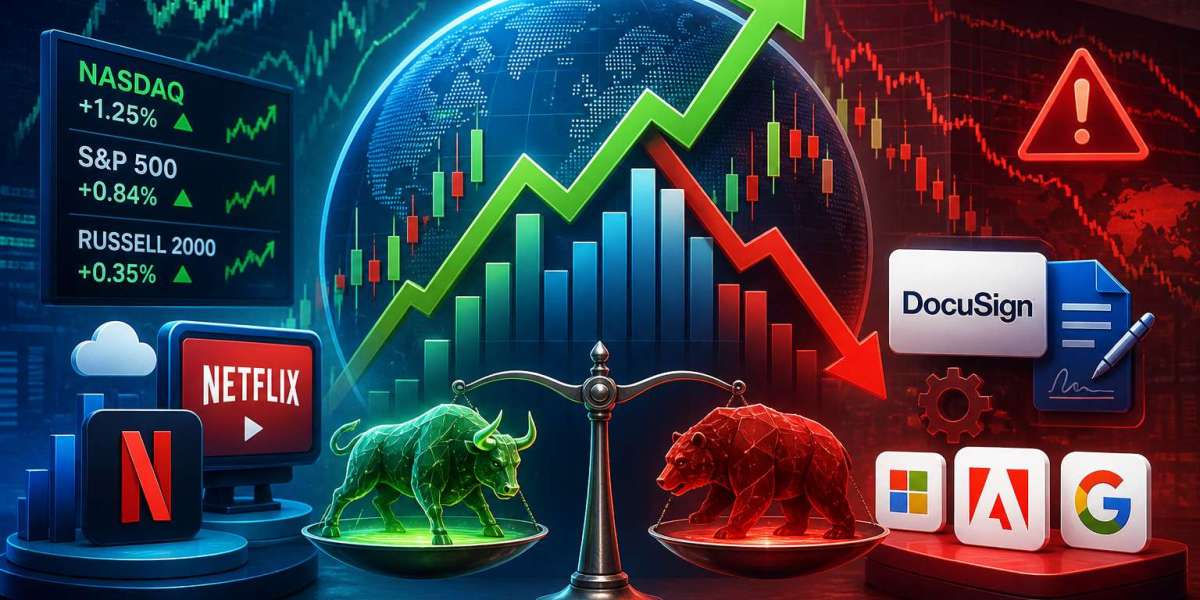

Stock Market Today: Record High Risks, Docusign Value Trap Warning, and Netflix Institutional Surge
Stock Market Today: Record High Risks, Docusign Value Trap Warning, and Netflix Institutional Surge
Key Highlights:
Record highs in tech and small-cap indexes may carry higher risks than broader markets
Docusign’s valuation concerns raise red flags despite solid financials
Netflix sees strong institutional buying but mixed signals from insiders and guidance
advertisement
The stock market today reflects a complex and evolving landscape where record highs, corporate fundamentals, and investor sentiment intersect in ways that challenge conventional wisdom, as recent analysis shows that while all-time highs in major indexes are often viewed with caution, their implications vary significantly depending on the segment of the market, with the S&P 500 historically demonstrating resilience and consistency even at peak levels, whereas indexes like the Nasdaq Composite and Russell 2000 reveal a more nuanced and sometimes riskier picture for investors, as data going back decades indicates that Nasdaq’s median one-year return after reaching record highs stands at approximately 14%, slightly below its performance following non-record days, and over a five-year horizon the gap widens further with returns of about 60% compared to 81% during non-peak entry points, highlighting that although gains remain substantial, the timing of entry can influence long-term outcomes, while volatility also tends to increase, with typical drawdowns reaching around 10% after record highs versus 8% otherwise and a higher probability of such declines occurring, and a similar pattern emerges in the Russell 2000, where small-cap stocks show weaker post-peak performance with median one-year gains of 6% compared to 11% during non-record periods and five-year returns of 34% versus 51%, reinforcing the idea that smaller and more growth-oriented segments of the market are inherently more sensitive to timing and economic cycles, which analysts attribute to structural differences such as the stability and profitability of large-cap companies in the S&P 500 compared to the volatility of tech-heavy and cyclical sectors, prompting many investors to consider strategies like dollar-cost averaging to mitigate the risks associated with entering the market at uncertain peaks,
At the individual stock level, this cautious tone is further underscored by concerns surrounding companies like Docusign, which, despite appearing attractively valued at first glance with earnings multiples near 10x and steady revenue growth of around 8% year-over-year, may in fact represent a potential value trap due to the significant impact of stock-based compensation on its true financial performance, as deeper analysis reveals that nearly 20% of the company’s revenue is allocated to stock-based compensation, effectively reducing its economic free cash flow from over $1 billion to approximately $378 million when adjusted, thereby pushing its actual valuation closer to 20x EV/FCF rather than the headline 8x figure, a discrepancy that highlights how reported metrics can sometimes obscure underlying realities, while operationally the company continues to deliver moderate growth with Q4 revenue reaching $836.9 million and annual revenue totaling $3.22 billion, yet its dollar net retention rate of 102% suggests limited expansion within its existing customer base, raising concerns about long-term growth sustainability, especially in an increasingly competitive environment where major technology players such as Microsoft, Adobe, and Google are integrating similar capabilities into their broader ecosystems, potentially commoditizing Docusign’s core offerings and challenging its ability to maintain pricing power, and although management is pursuing innovation through its Intelligent Agreement Management platform, the lack of strong upsell momentum combined with flat near-term guidance and ongoing dilution from stock-based compensation leads some analysts to adopt a bearish outlook, emphasizing the importance of evaluating not just growth but also the quality and sustainability of earnings,
Meanwhile, in another corner of the market, Netflix presents a contrasting narrative that combines strong institutional confidence with mixed short-term signals, as evidenced by PKO Investment Management’s dramatic increase in its holdings by over 1,250% during the fourth quarter to 190,000 shares valued at $17.81 million, contributing to the broader trend of institutional ownership which now accounts for more than 80% of the company’s stock, indicating significant long-term interest from large investors, and this confidence is partly supported by solid financial performance, with Netflix reporting first-quarter earnings per share of $1.23, significantly exceeding expectations of $0.76, alongside revenue growth of 16.2% year-over-year to $12.25 billion, yet despite these strong results, the company’s conservative guidance for the second quarter, projecting earnings of $0.78 per share, has introduced uncertainty and tempered market enthusiasm, leading to a mixed outlook among analysts who maintain a consensus rating of “Moderate Buy” with an average price target of $114.82, while additional factors such as insider selling activity totaling over 1.38 million shares worth approximately $127.5 million in recent months create further ambiguity regarding internal confidence, even as the company’s board has authorized a substantial $25 billion share repurchase program aimed at supporting the stock and enhancing shareholder value, illustrating the often contradictory signals that investors must navigate in today’s market, where strong fundamentals can coexist with cautious forward guidance and shifting sentiment,
Overall, the current stock market environment underscores the importance of nuanced analysis and disciplined investment strategies, as record highs do not necessarily signal imminent downturns but may carry different implications depending on the market segment, individual companies can appear undervalued while harboring hidden risks in their financial structures, and even industry leaders with strong growth trajectories can face mixed sentiment due to forward-looking uncertainties, ultimately reminding investors that successful decision-making requires a balance between optimism and caution, a deep understanding of underlying fundamentals, and a willingness to adapt to an ever-changing financial landscape where opportunities and risks are closely intertwined.
Conclusion
Today’s stock market highlights a powerful lesson: not all growth is equal, and not all opportunities are as straightforward as they seem.
From the hidden risks of buying at record highs in volatile indexes, to the importance of digging deeper into company fundamentals like Docusign, and the mixed yet promising signals surrounding Netflix, investors are reminded that knowledge is their greatest asset.
By staying informed, questioning surface-level data, and adopting disciplined strategies like diversification and dollar-cost averaging, investors can navigate uncertainty with confidence and position themselves for long-term success in an ever-evolving market.
Key Points Summary
Nasdaq and Russell 2000 record highs historically deliver weaker returns and higher volatility than non-peak entries
Docusign’s stock-based compensation significantly reduces its true profitability, raising valuation concerns
Netflix shows strong institutional interest and earnings growth but faces mixed sentiment due to guidance and insider selling
Market conditions highlight the importance of strategy, timing, and deeper financial analysis
Record highs don’t always mean strong future returns—especially in tech and small caps
Hidden costs like stock-based compensation can distort true valuations
Strong earnings don’t always guarantee bullish sentiment in today’s market
advertisement
Frequently Asked Questions (FAQ)
1. Is it risky to invest at stock market record highs?
Not always, but data suggests that in indexes like the Nasdaq and Russell 2000, returns may be lower and volatility higher compared to non-record entry points.
2. Why is Docusign considered a value trap?
Because its heavy stock-based compensation reduces real profitability, making the stock appear cheaper than it actually is.
3. What is stock-based compensation and why does it matter?
It is equity given to employees instead of cash, which can dilute shareholders and reduce true earnings.
4. Why is Netflix receiving mixed investor sentiment?
Despite strong earnings, conservative future guidance and insider selling create uncertainty.
5. What strategy can reduce risk when markets are at highs?
Dollar-cost averaging allows investors to spread investments over time rather than investing all at once.
Sources
- Yahoo Finance – Analysis of market performance at record highs
https://finance.yahoo.com/markets/article/buying-record-highs-looks-riskier-in-the-nasdaq-and-russell-2000-than-in-the-broader-market-chart-of-the-day-120000086.html - Seeking Alpha – Docusign valuation and stock-based compensation analysis
https://seekingalpha.com/article/4897847-docusign-beware-the-high-stock-based-compensation-that-makes-this-a-value-trap?source=feed_all_articles - MarketBeat – Netflix institutional investment and earnings update
https://www.marketbeat.com/instant-alerts/filing-pko-investment-management-joint-stock-co-has-1781-million-stock-holdings-in-netflix-inc-nflx-2026-05-03/
Disclaimer:
This material may contain third-party opinions, none of the data and information on this webpage constitutes investment advice
The content shared in economics articles is solely for research and informational purposes.
We are not a financial advisory service, and the information provided should not be considered investment or trading advice.
Thank you !