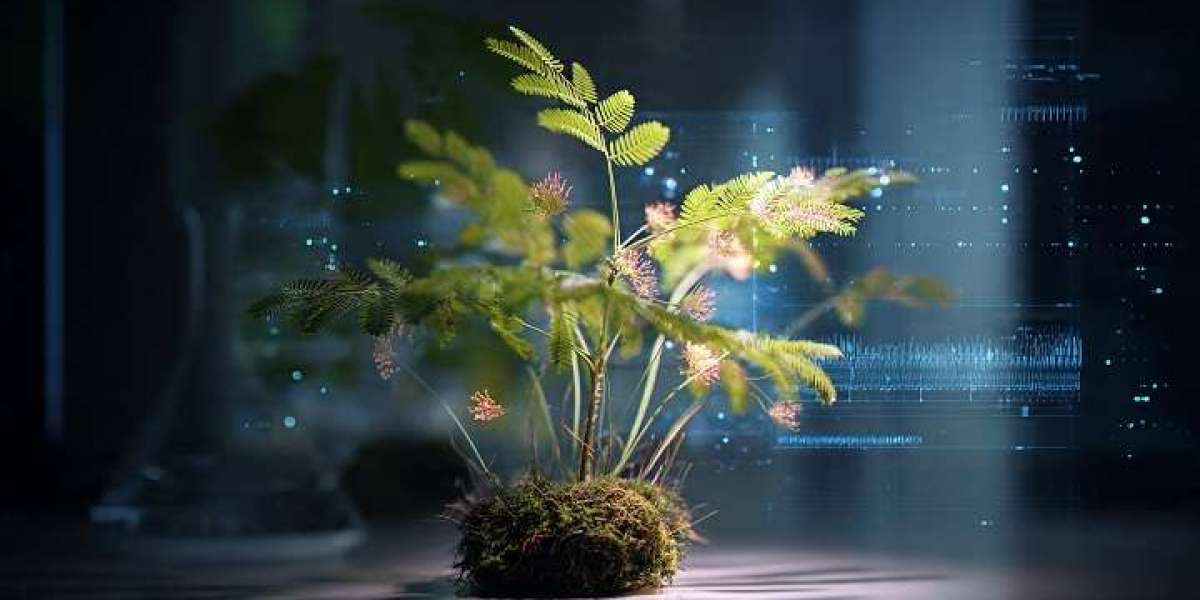

Scientists Discover Plants Can Count: New Study Reveals Hidden Plant Intelligence and Learning Abilities
Key Insights:
Plants like Mimosa pudica can track environmental events, suggesting a form of counting ability.
Research shows plant behavior follows learning patterns similar to animals—without neurons.
This discovery could redefine intelligence and open doors to biological computing and new scientific fields.
advertisement
Introduction: Can Plants Really Count?

Vishton’s work contributes to growing evidence that plants may be “smarter” than people may think.
Credit: Stephen Salpukas
image source: Scitechdaily.com
For decades, science has linked intelligence, memory, and decision-making to the presence of a brain.
But groundbreaking new research is challenging that assumption, revealing that plants may possess surprising cognitive-like abilities.
A recent study published in Cognitive Science suggests that plants—specifically Mimosa pudica—can “count” environmental events, raising profound questions about plant intelligence and non-neuronal learning.
Meet the “Counting” Plant: Mimosa pudica
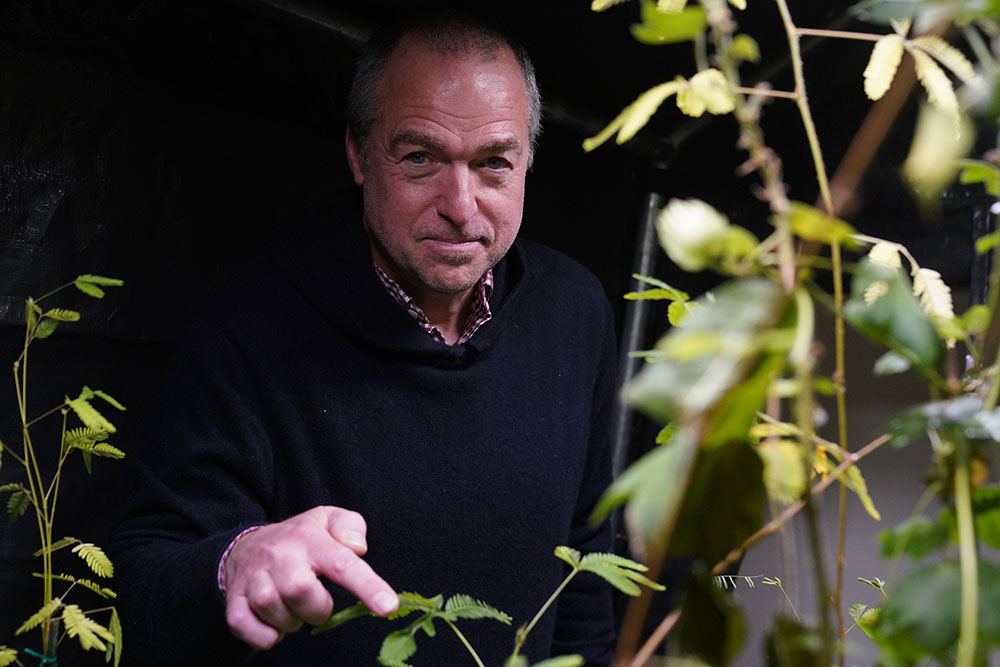
Vishton points to a Mimosa pudica plant inside his research tent.
Credit: Stephen Salpukas
image source: Scitechdaily.com
Mimosa pudica, often called the “touch-me-not” or shy plant, is famous for its rapid leaf-folding response when touched or shaken.
It also exhibits nyctinasty, a natural rhythm where leaves close at night and reopen during the day.
These visible movements made it an ideal subject for studying whether plants can process and respond to patterns in their environment.
The Experiment: Testing Plant Learning and Behavior
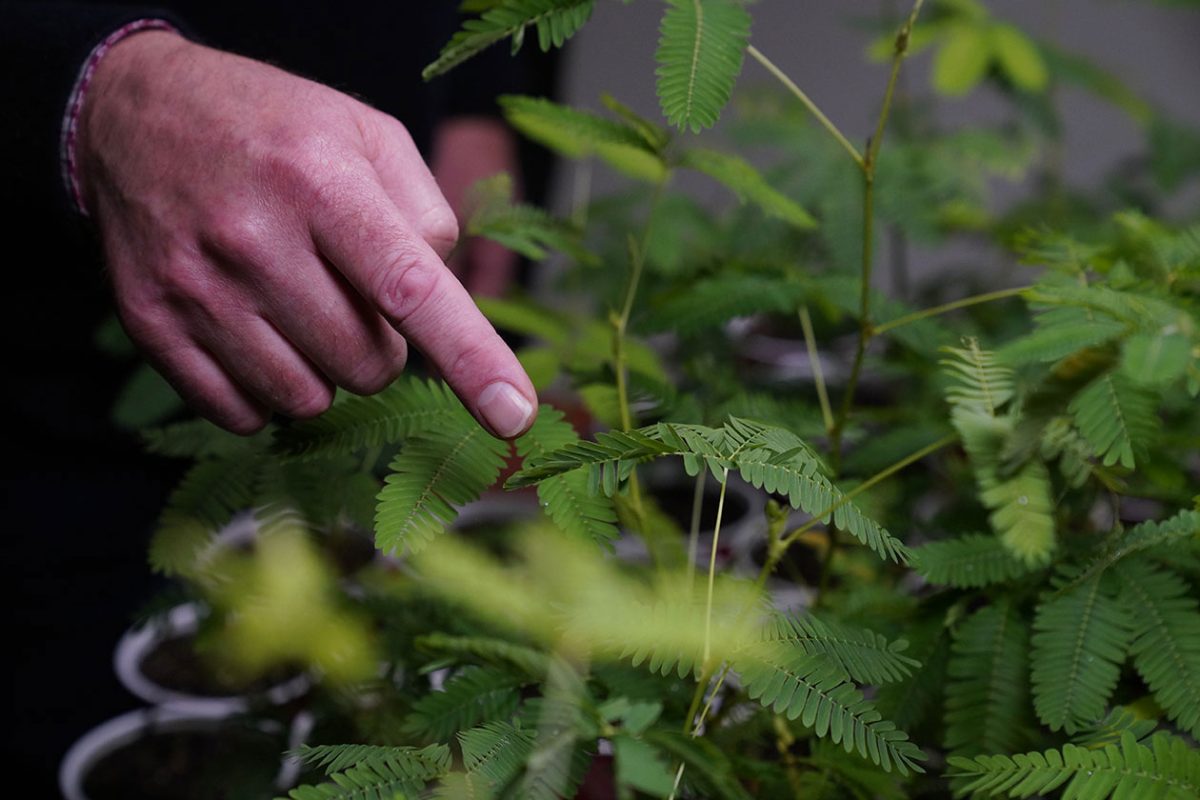
A developmental psychologist, Peter Vishton started his current project on Mimosa pudica plants during the COVID-19 pandemic.
Credit: Stephen Salpukas
image source: Scitechdaily.com
Researchers led by psychologist Peter Vishton at William & Mary conducted controlled experiments in a sealed, humid environment.
Phase 1: Establishing a Pattern
Plants were exposed to:
12 hours of light and 12 hours of darkness for two days
Followed by a third day of complete darkness
This three-day cycle was repeated multiple times.
What Happened?
After several repetitions:
The plants began moving before expected light periods
But showed no such anticipation on days of continuous darkness
This suggests the plants were not reacting passively—but anticipating future events.
Evidence of Learning: Patterns Like Animal Intelligence

The plants’ behavior followed a logarithmic learning curve:
Rapid initial adjustment
Gradual stabilization into a predictable pattern
This pattern is remarkably similar to how animals learn new behaviors.
According to the researchers, such curves are commonly seen when animals learn sequences—indicating that plants may be engaging in a comparable process of adaptation and prediction.
Counting vs. Time Tracking: What Are Plants Really Doing?

One key question:
Are plants tracking time—or counting events?
Testing Circadian Rhythm Theory
Plants naturally follow a 24-hour biological clock.
To rule this out, researchers:
Shortened the day to 20 hours (10 light / 10 dark)
Randomized cycles between 10 and 32 hours
Key Findings
Plants adapted quickly to new schedules
Predictive behavior persisted within 12–24 hour cycles
Behavior broke down outside this range
Conclusion
The simplest explanation, according to the researchers:
Plants are tracking the number of light-dark events, not just time.
Memory Limits and Information Processing in Plants

The experiments revealed two important constraints:
A minimum processing window (below 12 hours, patterns fail)
A maximum memory limit (beyond 24 hours, patterns fade)
This suggests plants can:
Store environmental information
Recall patterns
Adjust behavior accordingly
However, their “memory” operates within biological limits.
A New Kind of Intelligence Without a Brain

Perhaps the most revolutionary aspect of the study is this:
Plants appear to perform learning-like functions without neurons.
This challenges long-standing theories that:
Memory requires a brain
Learning depends on neural networks
Instead, the findings suggest that:
Information processing may occur at the cellular level
Non-neuronal cells could be capable of learning
As Vishton noted, this raises the possibility that learning might exist in all cells—not just neurons.
Scientific Debate and Interpretations
Both sources agree on the core findings but emphasize slightly different interpretations:
One perspective highlights this as the first evidence of plant enumeration, suggesting a breakthrough in understanding plant cognition.
Another frames it more cautiously, stating plants can “track the number of events”, which may resemble counting but is not identical to human numerical reasoning.
This distinction is important:
Plants are not doing arithmetic—but they may be processing sequences in a structured way.
Future Research and Potential Applications

Scientists still don’t fully understand how plants achieve this.
Future research will focus on:
Biological mechanisms behind plant memory
Cellular processes enabling pattern recognition
Cross-disciplinary insights from biology, chemistry, and psychology
Possible Applications
Biological or plant-based computing systems
Environmental sensing technologies
New approaches to studying learning at the cellular level
Even potential insights into breaking habits or addiction
Blurring the Line Between Plants and Animals

Traditionally, plants have been viewed as passive, reactive organisms.
But this research suggests something far more complex:
Plants may actively process information
They may anticipate environmental changes
They may exhibit a form of intelligence
This challenges the idea that intelligence is exclusive to animals—and suggests the boundary between life forms may be more fluid than we once believed.
Conclusion: Rethinking Intelligence in Nature

The discovery that plants like Mimosa pudica can track environmental events—and possibly “count”—marks a turning point in how we understand intelligence.
It suggests that learning is not confined to brains or neurons but may be a more universal property of life itself.
While plants are not thinking in the human sense, their ability to detect patterns, anticipate outcomes, and adapt behavior reveals a hidden layer of complexity in the natural world.
As research continues, we may find that intelligence is not something rare—but something deeply embedded in life at every level.
And perhaps the next time you water a plant, it might just be “remembering” more than you think.
Key Points Summary
Mimosa pudica can track environmental events, suggesting counting-like behavior.
Plant learning follows patterns similar to animal learning curves.
Behavior is based on event tracking, not just circadian rhythm.
Plants show memory limits between 12–24 hour cycles.
Intelligence may exist without neurons, at the cellular level.
This discovery challenges traditional definitions of intelligence.
advertisement
Frequently Asked Questions (FAQ) Section
Can plants really count?
Not in the human sense, but they can track and respond to repeated environmental events, which resembles counting.
What plant was used in the study?
Mimosa pudica, also known as the touch-me-not plant.
Do plants have memory?
The study suggests plants can store and recall information about environmental patterns within certain limits.
Is this proof that plants are intelligent?
It suggests plants have cognitive-like abilities, but scientists are still debating how to define plant intelligence.
Do plants have brains or neurons?
No, and that’s what makes this discovery so significant—learning may occur without them.
Why is this discovery important?
It could reshape our understanding of intelligence and lead to innovations in biology, computing, and environmental science.
Sources
SciTechDaily – Research overview on plant counting and intelligence
https://scitechdaily.com/scientists-discover-plants-can-count-and-may-be-smarter-than-we-thought/Nautilus – Explanation and interpretation of plant counting research
https://nautil.us/can-plants-count-1279432
Thank you !