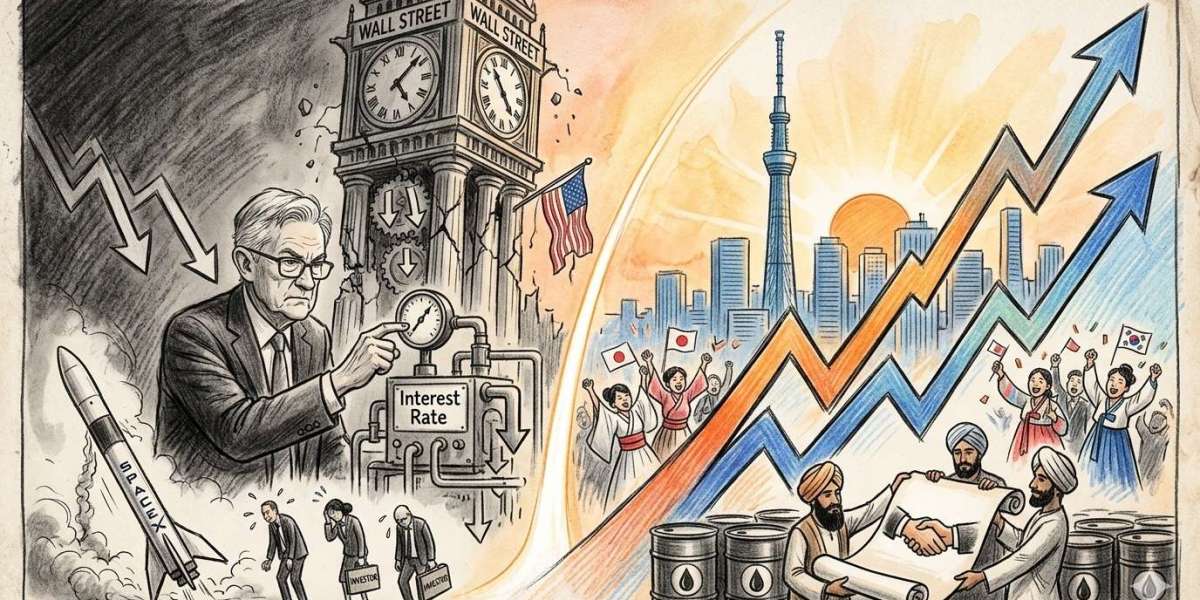

Stock Market Today: Dow, S&P 500, and Global Markets React to Fed Outlook, Trump Policies, and Oil Surge
♦ U.S. futures show mixed signals despite strong earnings momentum
♦ Global markets diverge as geopolitical tensions impact oil and equities
♦ Key stocks like Apple, Twilio, and Roblox drive market attention
advertisement
The stock market today presents a complex and dynamic picture shaped by strong corporate earnings, geopolitical tensions, and evolving monetary policy expectations, as U.S. stock futures showed mixed movement following record-setting gains in the previous session while global markets reacted differently to ongoing developments surrounding Iran and U.S. policy decisions.
Futures for the Dow Jones rose slightly by 0.09% and the S&P 500 gained 0.08%, while the Nasdaq 100 declined 0.11% and the Russell 2000 slipped 0.12%, reflecting cautious optimism among investors despite recent momentum.
At the same time, bond markets indicated stability with the 10-year Treasury yield at 4.39% and the two-year yield at 3.89%, while market expectations suggest a 94.8% probability that the Federal Reserve will maintain current interest rates in its upcoming June meeting, signaling confidence in a steady monetary policy outlook.
Exchange-traded funds tracking major indices showed mixed premarket performance, with the SPDR S&P 500 ETF Trust (SPY) dipping 0.19% to $720.05 and the Invesco QQQ Trust (QQQ) edging up 0.058% to $668.13, highlighting divergence within the broader market.
Individual stocks captured significant attention as Apple surged 3.11% after delivering better-than-expected quarterly results and strong forward guidance, Twilio jumped an impressive 20.69% following strong earnings and upgraded full-year sales projections, and Atlassian soared 24.26% after beating both earnings and revenue expectations by a wide margin.
This contrasted sharply with Roblox, which dropped 22.10% despite solid quarterly performance due to lowered revenue forecasts for fiscal 2026 that fell below analyst estimates, while Eli Lilly also posted gains of 0.58% driven by a remarkable 56% year-over-year revenue increase fueled by strong demand for its weight-management and metabolic treatments.
Looking back at the previous trading session, markets demonstrated broad strength as the Dow Jones climbed 1.62% to 49,652.14, the S&P 500 rose 1.02% to 7,209.01, the Nasdaq Composite gained 0.89% to 24,892.31, and the Russell 2000 outperformed with a 2.21% increase to 2,799.90.
Utilities, communication services, and industrial sectors led gains while technology stocks lagged behind the overall trend, underscoring sector rotation dynamics within the market.
Analysts provided additional context as Brian Rehling suggested that potential leadership changes at the Federal Reserve could result in gradual policy shifts, including a combination of lower short-term interest rates and a reduction in the Fed’s balance sheet.
This could in turn place upward pressure on long-term yields and introduce volatility in bond markets, although such changes are expected to unfold gradually rather than abruptly, and he also noted that advancements in artificial intelligence could support productivity growth and help contain inflation, potentially influencing future rate decisions.
Investors are also closely watching upcoming economic data releases, including the S&P U.S. manufacturing PMI and ISM manufacturing data, which are expected to provide further insight into the health of the economy.
Commodity markets reflected geopolitical tensions as crude oil prices rose 0.36% to around $105.45 per barrel amid ongoing concerns over supply disruptions linked to the Iran situation, whereas gold prices declined 1.11% to approximately $4,570.29 per ounce and the U.S. dollar index edged slightly lower.
In the cryptocurrency market, Bitcoin gained 1.72% to trade near $77,370.87, demonstrating continued investor interest in digital assets.
Globally, market sentiment diverged as British stocks, represented by the FTSE 100, fell 0.36% to 10,341.54 amid escalating geopolitical uncertainty, with President Donald Trump reaffirming a naval blockade of Iranian ports and expressing confidence that energy prices would eventually decline once the conflict is resolved.
Iran signaled resistance with officials warning against unrealistic expectations for rapid diplomatic progress and even hinting at potential retaliatory actions, adding to investor concerns about prolonged instability in the region.
The situation has already begun to impact economic indicators in the United Kingdom, where companies like NatWest reported strong profit growth and raised guidance, Bank of Ireland maintained a stable outlook with loan growth and reduced risk exposure, and Pearson benefited from increased demand for virtual learning.
However, broader economic data revealed challenges as retail sales declined by 1.6% in April due to rising fuel costs and weakening consumer confidence, while housing data showed a mixed picture with a 0.4% monthly increase in prices but signs of weakening demand and prior declines.
Overall, the stock market today reflects a delicate balance between optimism driven by strong corporate earnings and caution stemming from geopolitical risks and macroeconomic uncertainties, as investors navigate a landscape shaped by central bank expectations, global conflict developments, and sector-specific performance, emphasizing the importance of staying informed and adaptable in an ever-changing financial environment.
Conclusion
Today’s stock market underscores how interconnected global forces—from Federal Reserve expectations to geopolitical tensions—shape investor sentiment and market direction.
While strong earnings from major companies provide optimism and momentum, uncertainties around global conflicts, oil prices, and future monetary policy continue to introduce volatility.
The contrast between resilient U.S. markets and cautious global counterparts highlights the importance of diversification and awareness of macroeconomic signals.
For investors, this environment is not just about reacting to daily market swings but understanding the deeper trends that drive them, making informed decisions, and staying prepared for both opportunities and risks in a rapidly evolving financial world.
Key Points
U.S. futures show mixed movement despite strong earnings and previous record highs
Apple, Twilio, and Atlassian surge while Roblox drops sharply on weak outlook
Global markets decline as geopolitical tensions push oil prices higher
Markets rise—but uncertainty isn’t gone
Earnings impress while geopolitics worry investors
Oil surge and Fed outlook shape market direction
advertisement
Frequently Asked Questions (FAQ)
1. Why are stock market futures mixed today?
Futures reflect a balance between strong corporate earnings and concerns over geopolitical tensions and interest rate expectations.
2. What are the key stocks moving today?
Apple, Twilio, and Atlassian posted strong gains, while Roblox declined due to a weaker revenue outlook.
3. What is the Federal Reserve expected to do next?
Markets are pricing a high probability that the Fed will keep interest rates unchanged in its upcoming meeting.
4. How are global events affecting the stock market?
Tensions involving Iran and U.S. policy decisions are impacting oil prices and investor sentiment globally.
5. Why is the FTSE 100 down today?
The FTSE 100 declined due to geopolitical uncertainty, rising oil prices, and weaker retail data in the UK.
Sources
- Benzinga – U.S. stock market analysis, earnings, and economic outlook
https://www.benzinga.com/markets/equities/26/05/52205842/stock-market-today-dow-jones-sp-500-futures-gain-as-trump-administration-evades-war-powers-deadline-apple-twilio-roblox-in-focus - Investing.com – Global markets and FTSE 100 coverage amid geopolitical tensions
https://www.investing.com/news/stock-market-news/ftse-100-todaystocks-open-lower-as-iran-blockade-persists-trump-doubles-down-4652050
Disclaimer:
This material may contain third-party opinions, none of the data and information on this webpage constitutes investment advice
The content shared in economics articles is solely for research and informational purposes.
We are not a financial advisory service, and the information provided should not be considered investment or trading advice.
Thank you !