
article image source: iflscience.com (Link)
NASA’s MAVEN Discovers Possible Lightning on Mars: First Evidence of Electrical Storm Activity on the Red Planet
Perseverance Rover Captures Dust Devils Whirling Across Mars (Mars Report)
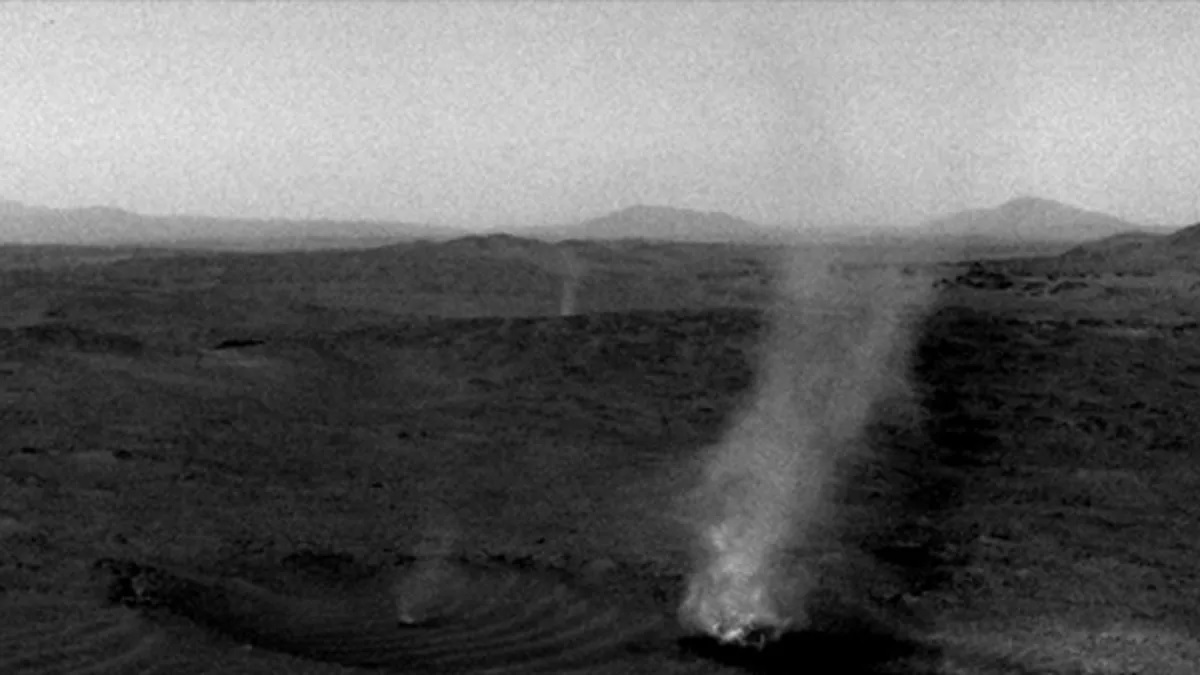
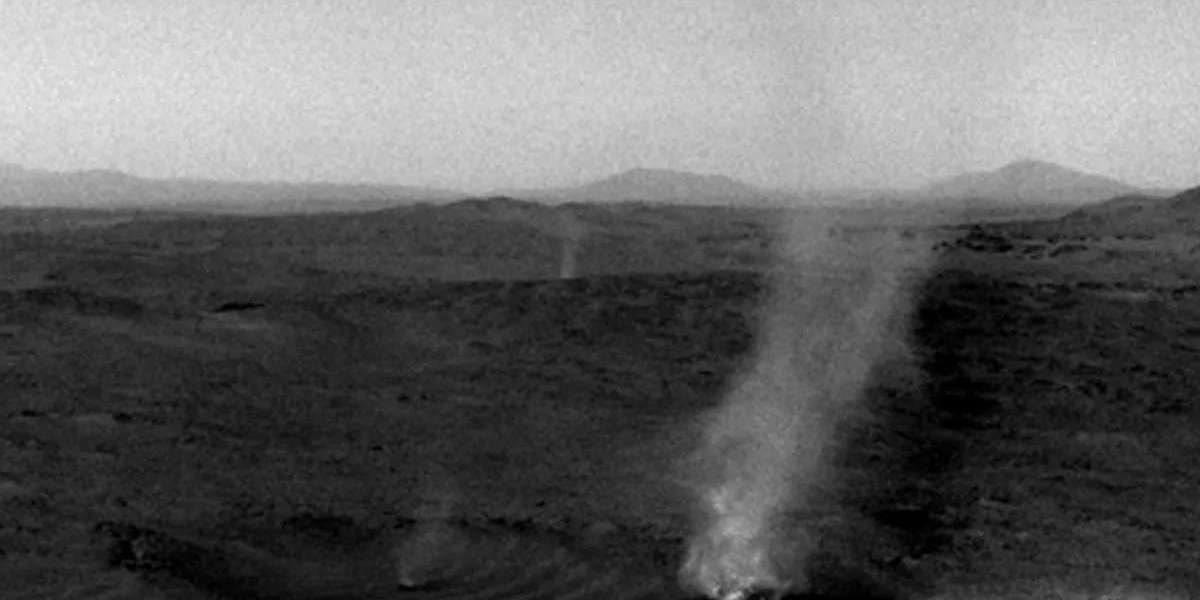
A dust devil on Mars, captured by NASA’s Perseverance Mars rover on January 25, 2025.
Image credit: NASA/JPL-Caltech /LANL/CNES/CNRS/INTA-CSIC/Space Science Institute/ISAE-Supaero/University of Arizona
image source: iflscience.com
Key Points (Quick Highlights)
Scientists using Mars Atmosphere and Volatile Evolution (MAVEN) detected a rare electromagnetic signal resembling lightning on Mars.
A single “whistler wave” lasting about 0.4 seconds may represent the first direct evidence of lightning-like activity in the Martian atmosphere.
The discovery suggests that dust storms and dust devils on Mars may generate electrical discharges, offering new insight into planetary atmospheres.
advertisement
Introduction: A Potential Breakthrough in Understanding Mars
Scientists working with data from NASA’s Mars Atmosphere and Volatile Evolution (MAVEN) mission may have discovered the first direct evidence of lightning-like activity on Mars, a finding that could reshape our understanding of the Red Planet’s atmosphere.
By analyzing years of orbital observations, researchers identified a rare electromagnetic signal known as a whistler wave—a type of radio emission typically produced by lightning. The discovery suggests that electrical discharges could occur within Martian dust storms or dust devils, hinting at dynamic atmospheric processes previously difficult to confirm.
How Scientists Detected Possible Lightning on Mars
The discovery came from an extensive review of more than 108,000 measurements collected by the MAVEN spacecraft while orbiting Mars. Researchers identified a single frequency-dispersed signal lasting approximately 0.4 seconds, with characteristics strikingly similar to lightning-generated whistler waves observed on Earth.
Whistler waves are low-frequency radio signals created when lightning produces an electromagnetic pulse that travels along magnetic field lines through a planet’s ionosphere and magnetosphere. These waves are well documented on Earth and have also been detected on planets such as Jupiter, Saturn, and Neptune.
Mars, however, presents a challenge. Unlike Earth, the planet does not have a strong global magnetic field. Instead, it possesses localized crustal magnetic fields, primarily concentrated in the southern hemisphere. These smaller magnetic regions can still guide electromagnetic waves, making it theoretically possible for lightning-generated signals to travel upward and be detected by orbiting spacecraft.
advertisement
Why Lightning on Mars Is Difficult to Detect
Detecting lightning on Mars is extremely challenging because several rare conditions must occur simultaneously.
First, the lightning-like discharge must happen in a region where localized magnetic fields are strong and nearly vertical. These conditions allow whistler waves to propagate upward toward the spacecraft.
Second, the atmospheric environment must support the wave’s passage through the ionosphere, the charged layer of the upper atmosphere.
Finally, the spacecraft must be positioned correctly at the exact moment the event occurs. In the detected case, the signal originated on the nightside of Mars, where ionospheric conditions were favorable for wave propagation.
Researchers noted that while nighttime ionospheric conditions appeared in roughly one-third of the observations, strong vertical magnetic fields occurred in less than 1 percent of them. This rarity explains why only one possible lightning event was found despite analyzing such a large dataset.
advertisement
Dust Storms and Dust Devils: A Likely Source of Martian Lightning
Scientists believe that Martian lightning may originate from dust storms or dust devils, which are common features of the planet’s atmosphere.
When dust particles collide and rub against each other during storms, they can exchange electrical charges—a process known as triboelectric charging. On Earth, this same mechanism occurs in volcanic plumes and dust storms, where large particles often become positively charged while smaller particles gain negative charges.
As turbulence lifts smaller particles upward and larger grains fall downward, a separation of charges can create strong electric fields. When the electric field becomes intense enough, it can trigger electrical discharges similar to lightning.
Supporting this idea, another study analyzing data from the Perseverance rover detected 55 possible electrical events over two Martian years, many occurring when the rover encountered dust devils. Researchers believe these swirling columns of dust could accumulate enough charge to produce lightning within them.
A Rare Signal in a Massive Dataset
Despite analyzing tens of thousands of observations, the research team discovered only one clear whistler event. This raises an important question:
Are lightning discharges rare on Mars, or are the conditions required to detect them simply uncommon?
According to researchers, both explanations may be possible. Electrical discharges might occur relatively frequently but remain undetectable because Mars’ ionospheric properties prevent the formation or propagation of observable whistler waves.
Another possibility is that Martian lightning exists but is weaker than Earth’s, making detection more difficult for instruments orbiting far above the planet.
advertisement
What This Discovery Means for Future Mars Missions
The potential detection of lightning on Mars has significant implications for future exploration.
Electrical discharges could pose risks to spacecraft electronics, rovers, and future human missions. Understanding how often these events occur—and under what conditions—will help engineers design more resilient equipment for long-term operations on the Martian surface.
Additionally, studying lightning-like activity provides valuable clues about atmospheric chemistry and plasma processes on other worlds. Comparing electrical phenomena across different planets helps scientists better understand the evolution of planetary atmospheres and magnetic environments.
Conclusion
The possible detection of lightning on Mars by NASA’s MAVEN mission represents an exciting step forward in planetary science. Even though researchers observed only a single whistler wave event, the signal strongly resembles the electromagnetic fingerprints of lightning seen on Earth and other planets.
This discovery suggests that electrical storms may occasionally flash within the dusty skies of Mars, likely generated by charged particles in dust storms or dust devils. While many questions remain—such as how common these events are and how powerful they might be—the finding opens a new window into the dynamic nature of the Martian atmosphere.
As scientists continue to analyze spacecraft data and plan future missions, each new clue helps humanity better understand our neighboring planet. One day, explorers on Mars may witness something once thought impossible: lightning illuminating the Red Planet’s dusty horizon.
Key Points Summary
NASA’s MAVEN spacecraft detected a possible lightning-generated whistler wave on Mars.
The signal lasted about 0.4 seconds and was found after analyzing over 108,000 observations.
Scientists believe dust storms or dust devils could generate electrical discharges in the Martian atmosphere.
Mars lacks a global magnetic field, making lightning detection extremely rare.
The discovery may help scientists better prepare future Mars missions and planetary research.
advertisement
Frequently Asked Questions (FAQ)
1. Did NASA really detect lightning on Mars?
Scientists detected a signal consistent with a whistler wave, which is commonly produced by lightning. While it strongly suggests lightning-like activity, the exact source cannot yet be confirmed.
2. What is a whistler wave?
A whistler wave is a low-frequency electromagnetic signal generated by lightning that travels along magnetic field lines through a planet’s ionosphere.
3. Why is lightning on Mars hard to detect?
Mars lacks a global magnetic field, and the conditions needed for whistler waves to travel through the atmosphere are extremely rare.
4. What could cause lightning on Mars?
Researchers believe dust storms and dust devils could generate electrical charges through particle collisions, eventually producing lightning-like discharges.
5. Why is this discovery important?
Understanding electrical activity on Mars could help scientists design safer spacecraft and improve knowledge of planetary atmospheres.
Sources
- Phys.org – Report on NASA MAVEN detecting lightning-like signals on Mars
https://phys.org/news/2026-03-nasa-maven-evidence-lightning-mars.html - IFLScience – Coverage of potential lightning detection by NASA’s MAVEN orbiter
https://www.iflscience.com/it-occurred-on-the-nightside-nasas-maven-orbiter-detects-potential-lightning-strike-on-mars-82734 - Science Advances – Scientific study on lightning-generated waves detected at Mars
https://www.science.org/doi/10.1126/sciadv.aeb4898
Thank you !