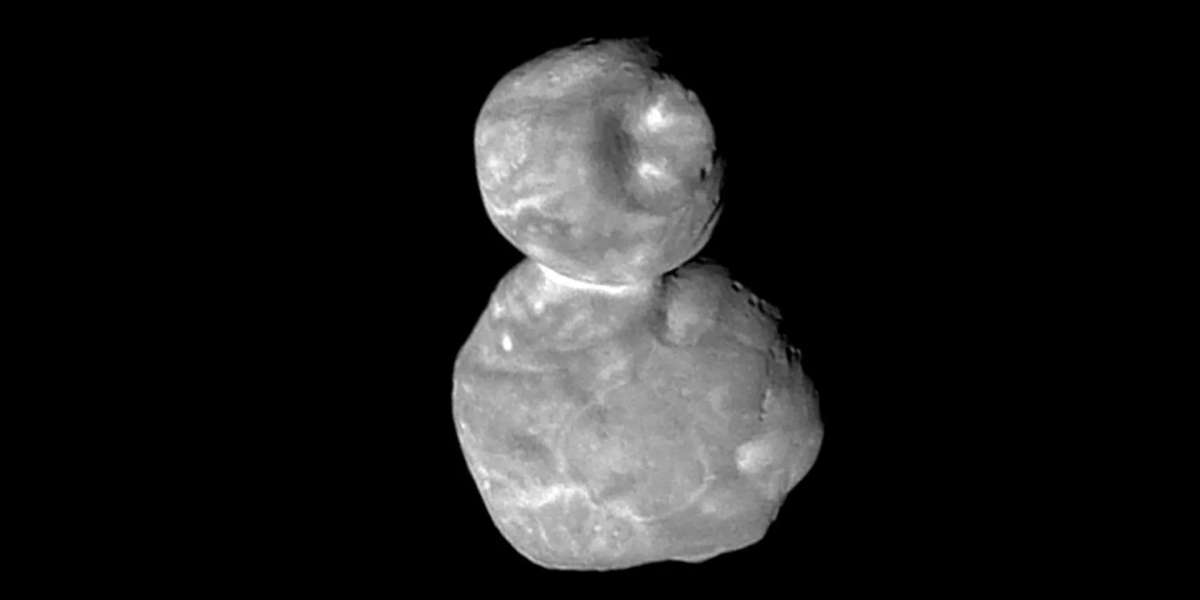

image source: sciencedaily.com
Why the Outer Solar System Is Filled with Giant Cosmic “Snowmen”: Unveiling the Mysteries of Contact Binaries
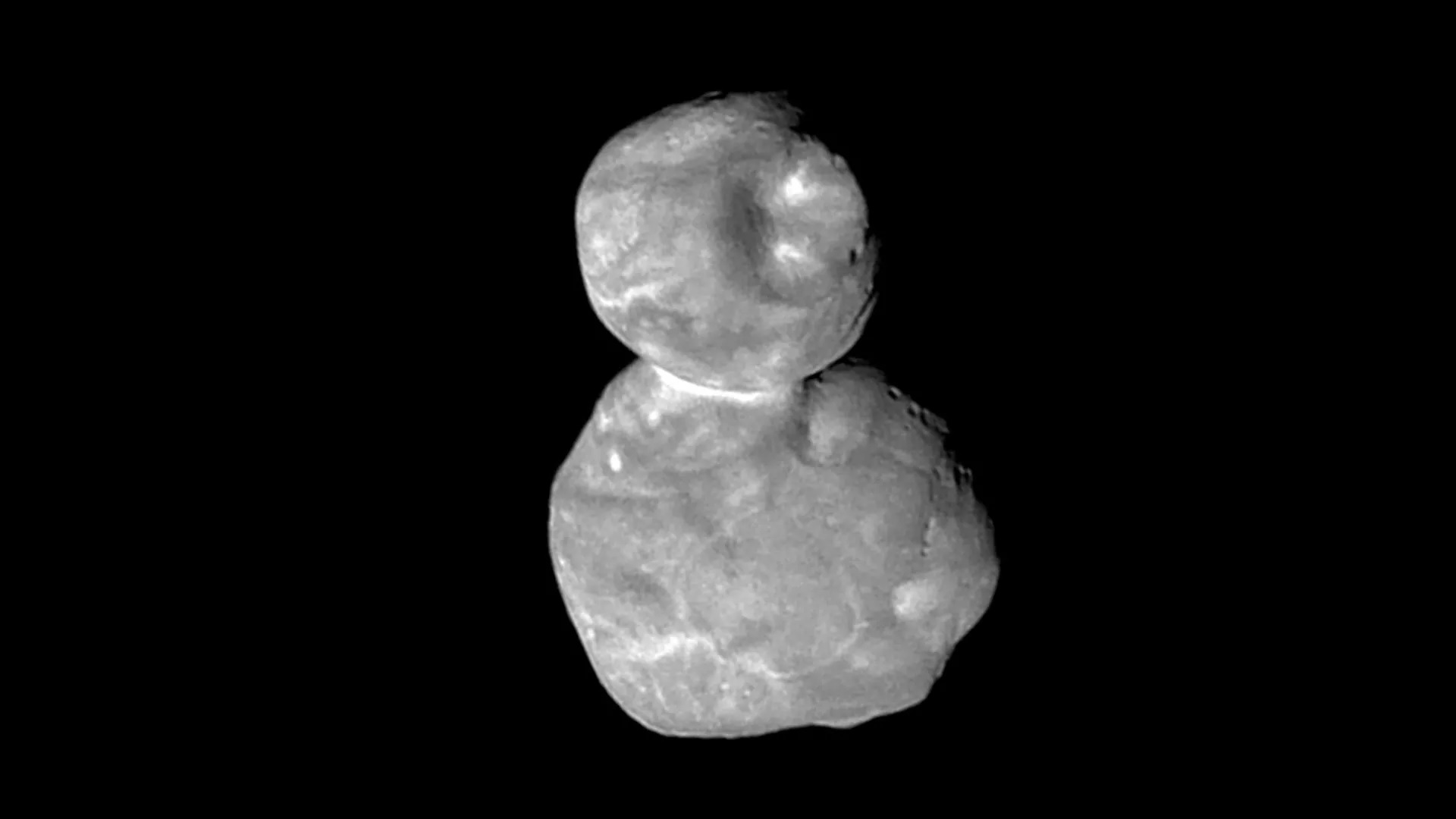
This image was taken by NASA's New Horizons spacecraft on January 1, 2019 during a flyby of Kuiper Belt object 2014 MU69, informally known as Ultima Thule. It is the clearest view yet of this remarkable, ancient object in the far reaches of the solar system – and the first small "KBO" ever explored by a spacecraft.
Credit: NASA/Johns Hopkins University Applied Physics Laboratory/Southwest Research Institute
image source: sciencedaily.com
Key Points:
About 10% of Kuiper Belt objects are two-lobed “snowmen” called contact binaries.
Gravitational collapse naturally explains their formation without violent collisions.
NASA’s New Horizons mission confirmed these unique shapes in distant objects.
advertisement
Far beyond Neptune, the outer solar system is a frozen frontier teeming with bizarre and fascinating objects. Among them are the giant cosmic “snowmen” — icy bodies with two distinct lobes connected together, scientifically known as contact binaries. For decades, astronomers have puzzled over how such fragile structures could form and survive in the harsh environment of space. Recent research from Michigan State University offers a groundbreaking answer: simple gravitational collapse.
The Kuiper Belt, a distant region past Neptune, is a relic of the early solar system. It contains planetesimals — leftover building blocks of planets — dwarf planets like Pluto, and comets. About one in ten planetesimals are contact binaries, showing a distinctive snowman-like shape. Unlike earlier models that assumed colliding bodies would merge into smooth spheres, new high-resolution simulations developed by Jackson Barnes at MSU reveal that these double-lobed objects form naturally when gravitational forces allow two bodies to gently come together without violent impacts.
advertisement
As tiny particles in the primordial solar nebula coalesced under gravity, some clusters split into pairs orbiting one another. Over time, these pairs spiraled inward and eventually touched, preserving their rounded shapes. Unlike the densely packed asteroid belt, the Kuiper Belt is sparsely populated, so these delicate structures rarely experience destructive collisions, enabling them to endure for billions of years.
NASA’s New Horizons mission provided the first close-up images of a contact binary in 2019, sparking renewed interest in these cosmic snowmen. Observations confirm that the formation process is common, reinforcing the idea that gravitational collapse is a straightforward and robust mechanism for creating these intriguing shapes. Barnes’ simulations also suggest the possibility of even more complex multi-lobed systems waiting to be discovered as exploration of the outer solar system continues.
The discovery of these snowman-shaped worlds is more than a curiosity; it offers insight into the early stages of planetary formation and the subtle forces shaping our solar system. Each contact binary serves as a frozen time capsule, preserving clues about the processes that built the planets and smaller bodies we see today. As technology advances and new missions venture into the Kuiper Belt, the universe may reveal even more astonishing shapes lurking in the cold reaches of space.
Conclusion
The outer solar system’s giant cosmic snowmen exemplify nature’s ability to create complex, enduring structures from simple forces. Through the lens of gravitational collapse, scientists now understand how these delicate two-lobed bodies could form without catastrophic collisions. They remind us that even in the remote, frozen corners of our solar system, beauty and science converge — frozen worlds quietly preserving the history of our cosmic neighborhood. Each discovery inspires us to keep exploring, revealing the subtle elegance of the universe’s most distant reaches.
Key Points Summary
Kuiper Belt objects can form two-lobed “snowmen” called contact binaries.
Gravitational collapse, not violent collisions, creates these structures.
Sparse collisions in the Kuiper Belt allow these delicate objects to survive billions of years.
NASA’s New Horizons confirmed contact binaries exist beyond Neptune.
Simulations suggest even more complex multi-lobed objects may exist.
advertisement
Frequently Asked Questions (FAQ)
Q: What is a cosmic “snowman”?
A: It is a two-lobed icy object, scientifically called a contact binary, found in the Kuiper Belt.
Q: How do contact binaries form?
A: They form when two objects orbit each other and gently merge under gravity, preserving their rounded shapes.
Q: Why do these objects survive so long?
A: The Kuiper Belt is sparsely populated, so collisions are rare, allowing delicate structures to last billions of years.
Q: Which missions have studied these objects?
A: NASA’s New Horizons mission provided the first close-up images of contact binaries in 2019.
Q: Can there be objects with more than two lobes?
A: Simulations suggest multi-lobed bodies could exist, formed through similar gravitational processes.
Sources
ScienceDaily – Michigan State University researchers explain how gravitational collapse forms snowman-shaped Kuiper Belt objects.
https://www.sciencedaily.com/releases/2026/02/260222085206.htmMonthly Notices of the Royal Astronomical Society – Original journal article on contact binary formation via gravitational collapse.
http://dx.doi.org/10.1093/mnras/stag002
Thank you !