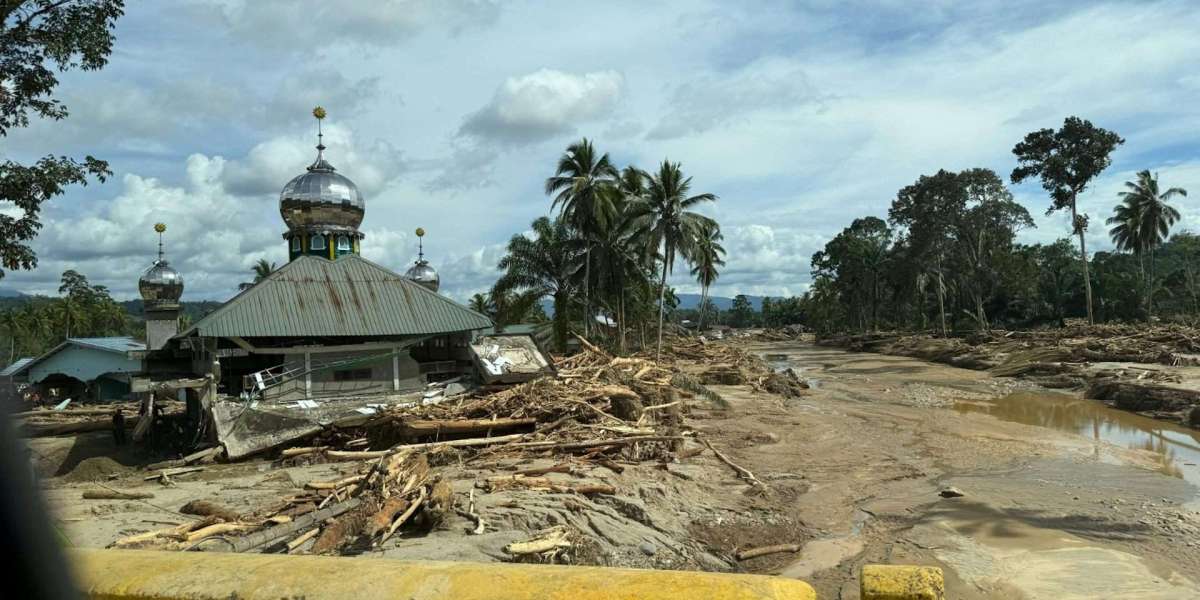

article image source: theconversation.com (Link)
Sumatra’s Flood Crisis: How Nature’s Breakdown Turned a Storm Into a Regional Tragedy
Sumatra’s Flood Crisis --- How Nature’s Breakdown Turned a Storm Into a Regional Tragedy
Introduction
In late November 2025, Cyclone Senyar swept across South and Southeast Asia, but nowhere felt its fury as intensely as Sumatra. Entire villages were swallowed by sudden floodwaters, homes were torn off their foundations, and families were forced to flee as rivers transformed into violent torrents. Although the storm brought extreme rainfall, environmental experts say weather alone does not explain the scale of destruction.
Across Sumatra — and much of Asia — deforestation, ecosystem degradation, and weakened watersheds allowed a natural storm to become a deadly disaster. Environmental organisations, scientists, and local communities point to one central truth: when forests disappear, so does nature’s ability to protect people.
advertisement
A Storm That Exposed a Fragile Landscape
Cyclone Senyar delivered intense rainfall that would challenge even resilient ecosystems. But in Sumatra, years of land clearing — for plantations, mining, and infrastructure — had already stripped forests of their natural ability to buffer water.
Healthy forests act as natural hydrological systems. Their soils, rich in organic matter, function like sponges: absorbing rainfall, slowing runoff, stabilizing slopes, and regulating river flow. When these systems are damaged, rainfall that once seeped quietly into the ground instead rushes downslope, turning into fast-moving floods and landslides.
According to environmental researchers, the result in Sumatra was a hydrometeorological event amplified by ecological collapse. Instead of being absorbed, extreme rainfall collided with bare soil, degraded slopes, and disrupted watersheds — producing destruction far beyond meteorological expectations.
Deforestation Across Sumatra: A Decade of Vulnerability
Two perspectives shed light on the scale of forest loss:
The Conversation’s analysis highlights severe degradation in the Batang Toru watershed, where around 1,550 hectares of forest have been lost since 2010, leaving slopes unstable and river systems overwhelmed.
Euronews, citing Indonesian NGO WALHI, reports an even broader regional picture: between 2016 and 2025, approximately 1.4 million hectares were deforested across Aceh, North Sumatra, and West Sumatra. This includes areas cleared for palm oil expansion, mining, geothermal development, and hydropower projects.
While the total figures differ in scope — one focusing on watershed-level environmental change and the other on regional-wide deforestation — both perspectives agree: forest loss has fundamentally weakened Sumatra's resilience to storms.
In areas such as Padang, relentless rainfall overwhelmed degraded mountain slopes. Rivers, choked with sediment, ran brownish-yellow days after the storm — a sign of massive soil erosion. Communities downstream faced destructive floods, while coastal ecosystems struggled under the weight of incoming sediment.
Human Impact and a Crisis Still Unfolding
Across North and West Sumatra, thousands of families have been displaced. Many villages are now isolated, grappling with food shortages and limited access to clean water. The wider Asian region saw more than 1,600 deaths due to overlapping storms — one of the deadliest weather events of 2025.
Residents such as Rangga Adiputra, a teacher whose home was swept away, say nearby hills had long been scarred by illegal logging — a claim echoed by environmental activists but rejected by officials. According to WALHI, multiple watersheds in Aceh and Sumatra are now classified as critical, with some having lost nearly half of their forest cover.
Although causes differ according to sources, the shared conclusion is clear: weakened ecosystems left millions vulnerable.
Why Forests Are Essential for Flood Protection
Scientists warn that when forests are clear-cut, flood risks skyrocket — sometimes for decades. Research referenced by Euronews indicates that in certain watersheds, floods can become up to 18 times more frequent after clear-cutting, and more than twice as severe.
The Conversation’s analysis aligns with this view, explaining that once forest roots decay and organic soil layers disappear, hillsides lose their ability to hold water. Rivers then receive massive surges in a short time, leading to catastrophic overflow.
Despite differences in data scale, both sources emphasise the same mechanism:
Deforestation transforms heavy rain into a destructive force.
Restoring Balance: A Path Toward Resilience
Experts argue that infrastructure alone — dams, levees, flood walls — cannot prevent future disasters. Instead, they call for ecosystem-based adaptation:
Protecting remaining primary forests and peatlands
Restoring degraded soils and increasing organic matter
Reforesting slopes and planting vegetation along riverbanks
Strengthening land-cover regulations and reevaluating mining and plantation permits
Integrating soil-health indicators into flood-risk planning
Environmental advocates stress that restoring nature must go hand in hand with holding responsible parties accountable. WALHI argues that companies profiting from deforestation should contribute to restoration efforts, while some government sectors deny involvement in illegal logging — a point of dispute among the sources.
Conclusion: Learning From the Floods
Sumatra’s flood crisis is not simply the story of a violent storm — it is a warning about what happens when ecosystems are pushed beyond their limits. Extreme weather, intensified by climate change, will continue. But whether future storms become recurring tragedies depends on the choices made today.
Rebuilding forests, restoring soils, and protecting watersheds are not just environmental goals — they are life-saving strategies. Nature has always been Sumatra’s greatest shield. Strengthening that shield is the only path toward a safer, more resilient future.
Sources
The Conversation — Sumatra’s flood crisis: How deforestation turned a cyclonic storm into a likely recurring tragedy
https://theconversation.com/sumatras-flood-crisis-how-deforestation-turned-a-cyclonic-storm-into-a-likely-recurring-tragedy-271302Euronews Green — How decades of deforestation turned Asia’s floods into one of the deadliest weather events of 2025
https://www.euronews.com/green/2025/12/05/how-decades-of-deforestation-turned-asias-floods-into-one-of-the-deadliest-weather-events-
Thank you !