
James Webb Space Telescope Discovers One of the Universe’s First Galaxies and Possible Signs of the First Stars
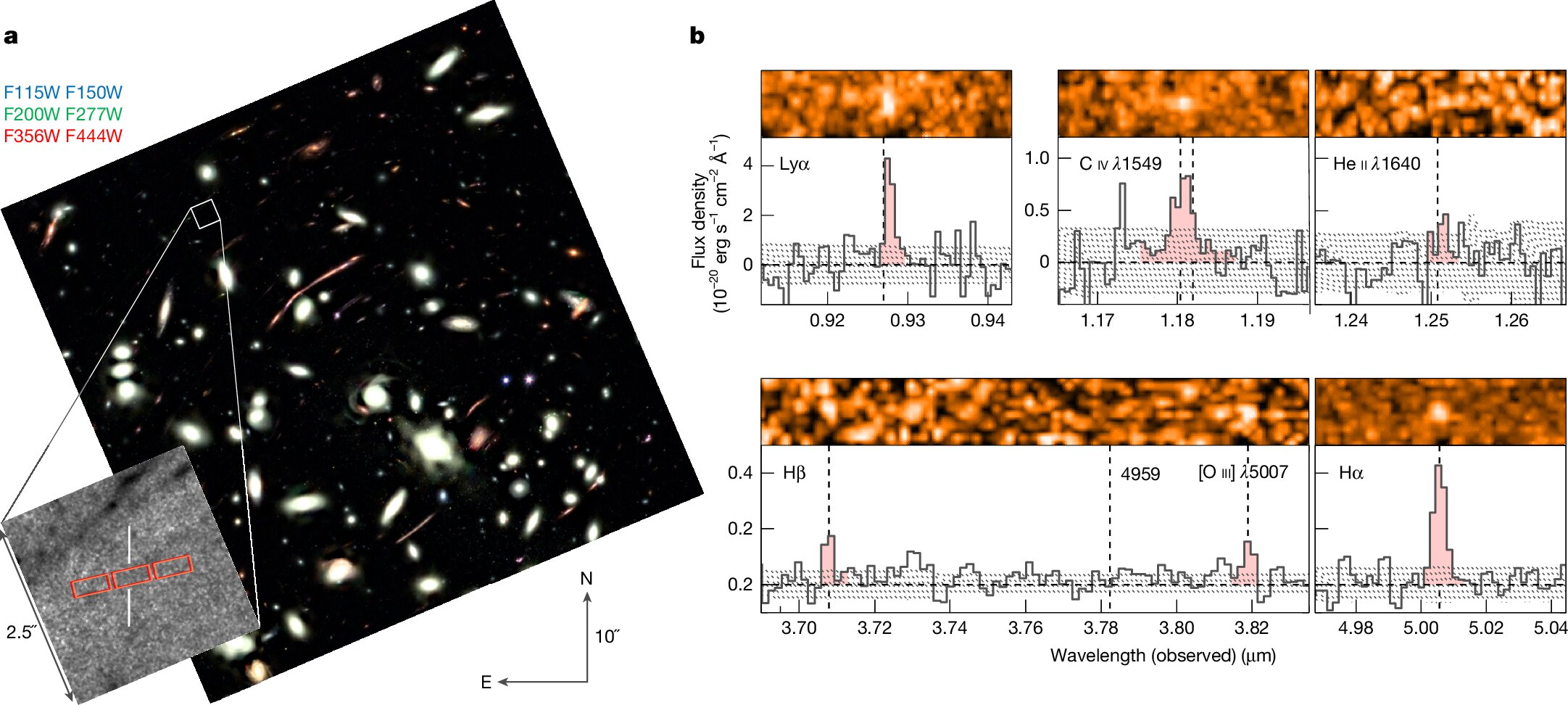
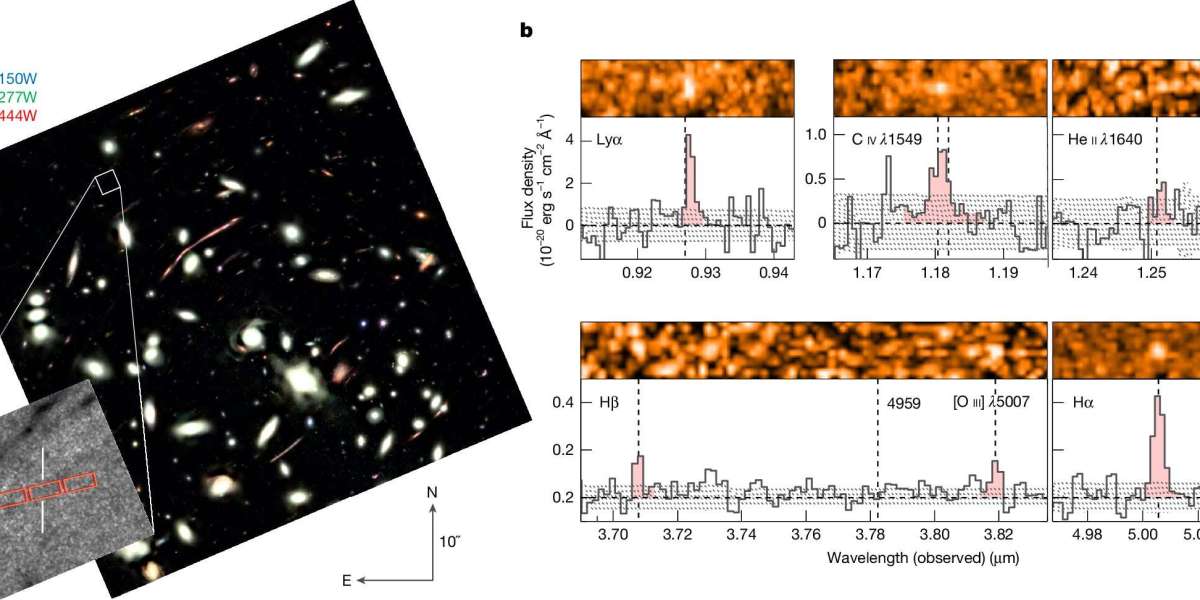
NIRCam image and NIRSpec spectra of LAP1-B.
Source and Credit: Nature (2026). https://dx.doi.org/10.1038/s41586-026-10374-1
James Webb Space Telescope Discovers One of the Universe’s First Galaxies and Possible Signs of the First Stars
Key Points Summary
Scientists discovered an ancient galaxy dating back nearly 13 billion years using the James Webb Space Telescope.
The galaxy may contain chemical evidence linked to the universe’s very first stars, known as Population III stars.
Researchers say the discovery offers a rare glimpse into how the earliest galaxies formed shortly after the Big Bang.
advertisement
Scientists using the James Webb Space Telescope have discovered one of the oldest and most primitive galaxies ever observed, providing what researchers believe could be one of the clearest glimpses into the universe’s earliest cosmic era. The galaxy, known as LAP1-B, appeared as it existed nearly 13 billion years ago, only around 800 million years after the Big Bang, making it one of the earliest galaxies ever studied in such detail. Researchers say the discovery may contain evidence connected to the universe’s first generation of stars, often referred to as Population III stars, which have long remained one of astronomy’s greatest mysteries.
The first stars and galaxies are incredibly difficult to observe because they are extremely distant and their light is faint after traveling across the universe for billions of years. However, the James Webb Space Telescope, launched in 2021 as a $10 billion observatory designed to study the early universe, has made it possible to look deeper into cosmic history than ever before. Using Webb’s advanced infrared capabilities, scientists led by astronomer Kimihiko Nakajima of Kanazawa University in Japan studied a remote region of deep space and identified LAP1-B as a possible “fossil in the making,” meaning it may resemble the ancient ultra-faint dwarf galaxies that still exist in the nearby universe today.
The galaxy itself is so tiny and distant that it would normally remain invisible even to powerful instruments. Researchers were only able to detect it thanks to a phenomenon known as gravitational lensing. In this effect, a massive cluster of galaxies located between Earth and the distant object bends and magnifies the incoming light, effectively acting like a giant cosmic magnifying glass. Scientists said this natural lens amplified the light from LAP1-B by approximately 100 times, allowing Webb to study it in unprecedented detail.
When researchers analyzed the galaxy’s light, they discovered that most of the brightness was not coming directly from stars but from glowing clouds of gas surrounding them. By splitting the light into a spectrum and studying the emission lines within it, scientists could determine the chemical composition of the galaxy. The results revealed that LAP1-B contains almost no heavy elements, making it one of the most chemically primitive star-forming galaxies ever observed. According to the research, the galaxy’s oxygen abundance is about 240 times lower than that of the sun, an indication that very few generations of stars had existed there before.
Scientists also detected intense ionizing radiation coming from the galaxy, a feature researchers expected to find in environments dominated by the earliest stars. One of the most important findings involved the galaxy’s elevated carbon-to-oxygen ratio. Researchers explained that this matches theoretical predictions for the chemical fingerprints left behind by Population III stars, the first stars believed to have formed in the universe. Unlike modern Population I stars, which contain heavier elements produced by earlier stellar generations, Population III stars were thought to consist almost entirely of hydrogen and helium formed shortly after the Big Bang. Their explosive deaths are believed to have seeded the universe with the first heavier elements needed to create planets, galaxies, and eventually life itself.
The study also uncovered evidence suggesting that LAP1-B is held together by a large halo of invisible dark matter. By measuring the motion and speed of gas within the galaxy, scientists concluded that ordinary matter alone could not explain the galaxy’s structure and stability. Dark matter, which cannot be directly seen but is believed to make up most of the universe’s matter, likely plays a major role in holding the galaxy together.
Researchers described the discovery as a rare snapshot of an early stage in galaxy evolution, when the first stars were beginning to transform the cosmos. The findings help scientists better understand how the earliest galaxies formed and evolved during the universe’s infancy. The team stated that their observations offer “a rare window into the earliest stages of galaxy formation,” potentially bringing humanity closer to understanding how the first cosmic structures emerged from the darkness following the Big Bang.
The discovery of LAP1-B highlights the revolutionary power of the James Webb Space Telescope and its ability to uncover hidden chapters of cosmic history that were previously beyond reach. As astronomers continue exploring the deep universe, discoveries like this may eventually reveal how the very first stars were born, how galaxies evolved over billions of years, and how the universe itself transformed into the rich and complex cosmos we observe today. The findings also remind humanity that every new observation of deep space is not only a scientific achievement, but a journey backward in time toward the origins of everything we know.
Key Points
Scientists observed a galaxy known as LAP1-B from around 800 million years after the Big Bang.
The discovery was made using the James Webb Space Telescope and gravitational lensing.
LAP1-B is one of the most chemically primitive galaxies ever detected.
Researchers found extremely low levels of oxygen and heavy elements.
The galaxy may preserve chemical signatures of the universe’s first stars, called Population III stars.
Scientists also found evidence suggesting the galaxy is surrounded by dark matter.
The discovery provides new insight into the earliest stages of galaxy formation.
advertisement
Frequently Asked Questions (FAQ)
What is LAP1-B?
LAP1-B is an extremely distant and ancient galaxy discovered by the James Webb Space Telescope. Scientists observed it as it existed about 800 million years after the Big Bang.
Why is this discovery important?
The galaxy may contain chemical evidence connected to Population III stars, the first stars believed to have formed in the universe.
What are Population III stars?
Population III stars are theorized to be the universe’s first generation of stars. They formed mainly from hydrogen and helium before heavier elements existed.
How did scientists detect such a distant galaxy?
Researchers used gravitational lensing, where a massive foreground galaxy cluster magnifies light from distant objects like a cosmic magnifying glass.
What makes LAP1-B unique?
It is one of the most chemically primitive galaxies ever observed, containing extremely low levels of heavy elements such as oxygen.
Did scientists find dark matter in the galaxy?
Researchers found evidence suggesting that LAP1-B is surrounded and stabilized by a large halo of invisible dark matter.
Sources
Phys.org – Report on the discovery of the ancient galaxy LAP1-B and possible evidence of the universe’s first stars
https://phys.org/news/2026-05-webb-universe-galaxies.htmlNature – Original article discussing relics of the first stars found in an ultra-faint distant galaxy
https://www.nature.com/articles/d41586-026-01151-1
Thank you !