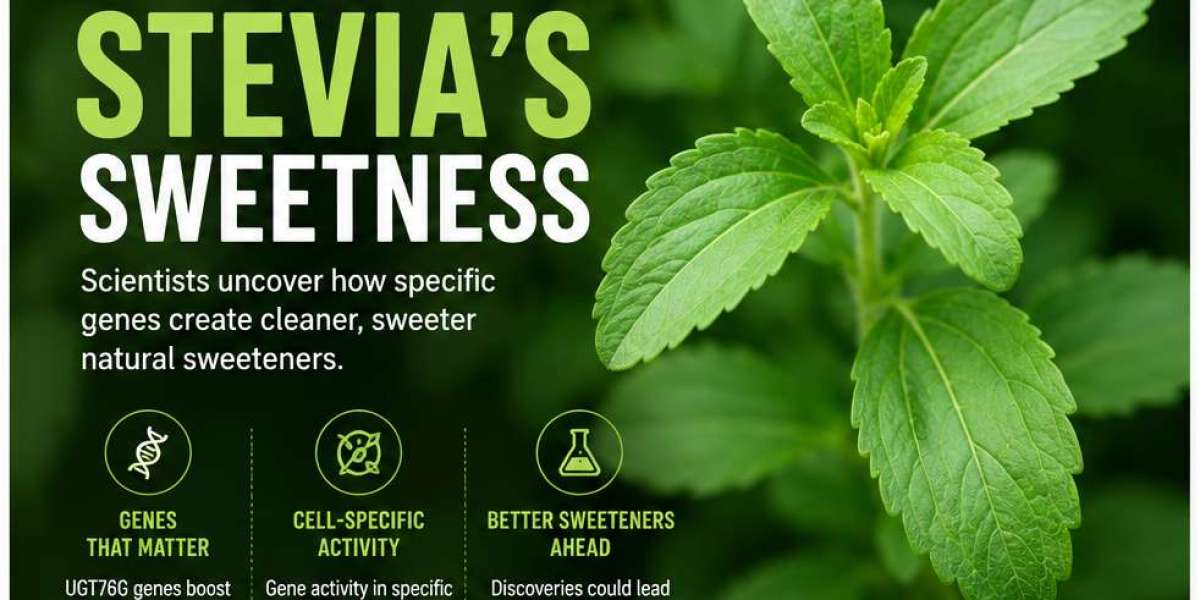

article image (Stevia) [Edited]: Stevia rebaudiana. Credit: public domain
Scientists Discover the Genetic Secret Behind Stevia’s Sweet Taste and Cleaner Flavor
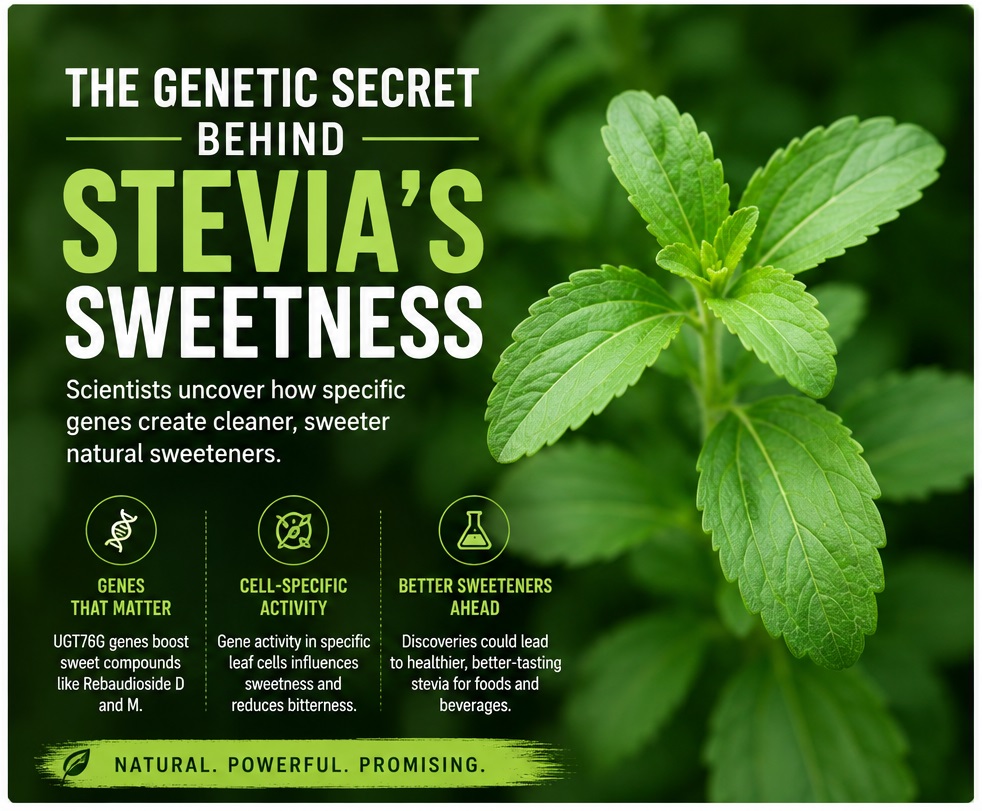
Scientists Discover the Genetic Secret Behind Stevia’s Sweet Taste and Cleaner Flavor
Key Points Summary
Researchers discovered that specific genes determine why some stevia tastes sweeter and less bitter than others.
Advanced genetic mapping revealed how stevia produces premium sweet compounds like Rebaudioside D and M.
The findings could lead to better natural sweeteners and healthier low-sugar foods worldwide.
advertisement
Stevia has become one of the world’s most popular natural sugar substitutes, widely used in beverages, desserts, and health-focused products because of its intense sweetness and low-calorie profile. Derived from the leaves of the plant Stevia rebaudiana, stevia contains natural compounds known as steviol glycosides, which can be up to 300 times sweeter than ordinary sugar. Yet not all stevia tastes the same. Some varieties deliver a clean and sugar-like sweetness, while others leave behind a noticeable bitter or lingering aftertaste. Scientists have long wondered what causes these major flavor differences, and now researchers from the University of Toyama in Japan believe they have uncovered the answer hidden deep within the plant’s genetics.
In a new study published in the journal New Phytologist, researchers led by Professor Tsubasa Shoji from the Institute of Natural Medicine at the University of Toyama discovered that stevia’s sweetness profile is strongly connected to variations in specific glycosyltransferase genes and to where those genes become active inside the plant’s leaves. According to the researchers, sweetness is not simply random or determined only by plant variety. Instead, it depends on precise genetic activity occurring within specialized leaf cells.
To better understand how stevia creates its sweet compounds, the research team first constructed a high-quality reference genome for the plant. This provided scientists with a detailed map of stevia’s DNA and helped them identify the genes involved in producing sweet-tasting molecules. The team then applied advanced scientific tools, including single-nucleus RNA sequencing, which allowed them to examine gene activity at the level of individual cells. They also used imaging mass spectrometry to observe how chemical compounds were distributed across different leaf tissues.
The study identified a group of genes called UGT76G glycosyltransferase genes as especially important in controlling sweetness quality. These genes produce enzymes that attach glucose molecules to steviol glycosides inside the leaves. This process directly affects the balance of compounds associated with smoother and more pleasant sweetness profiles. According to Professor Shoji, these enzymes play a critical role in increasing the concentration of desirable sweet compounds while influencing the overall taste experience.
Researchers focused particularly on premium sweet molecules known as Rebaudioside D and Rebaudioside M. These compounds are considered highly valuable because they provide a cleaner sweetness with significantly less bitterness compared to other stevia compounds. Scientists had previously known these molecules existed, but the biological mechanisms controlling their production were not fully understood. The new findings now suggest that the activity of sweetness-related genes in specific leaf cells may explain why these compounds appear only in limited quantities in many stevia varieties.
One especially important discovery involved a gene called UGT91D4. Researchers found that this gene was active only in certain specialized leaf cells, mainly in the mesophyll tissue, which is responsible for photosynthesis, and in epidermal cells that form the plant’s protective outer layer. Because the gene’s activity was limited to these particular cell types, the production of desirable sweet compounds such as Rebaudioside D and M also remained limited. This revealed that the exact location of gene activation inside the leaf plays a major role in shaping the plant’s final flavor profile.
The study also highlighted the importance of tiny genetic differences known as haplotypes. These small variations in DNA may explain why sweetness-related genes function differently among different stevia varieties. Some plants may naturally produce more pleasant sweet compounds because their genes are more effective or more active in key tissues. This helps explain why consumers often notice significant taste differences between various stevia-based sweeteners sold on the market today.
According to Professor Shoji, the research demonstrates that stevia’s flavor is determined not only by which genes are present, but also by exactly where those genes are switched on within the plant. This insight provides a far more detailed understanding of how natural sweetness is created at the cellular level.
The implications of the discovery could be significant for both consumers and the global food industry. By identifying the genes responsible for cleaner sweetness and reduced bitterness, researchers and agricultural breeders may eventually develop improved stevia varieties with superior flavor. Such advances could help manufacturers create healthier low-sugar foods and beverages that taste better and appeal to a wider range of consumers.
As governments and health organizations continue encouraging people to reduce sugar intake because of rising concerns about obesity, diabetes, and other health risks, better natural sweeteners are becoming increasingly important. Improved stevia products could provide food companies with a more appealing alternative to sugar while still satisfying consumer demand for natural ingredients.
The research may also support more efficient industrial-scale production of premium sweet compounds. If scientists can breed or engineer stevia plants that naturally produce larger amounts of desirable molecules like Rebaudioside D and M, manufacturers could potentially lower costs while improving product quality. This could accelerate the development of next-generation sweeteners that combine healthier nutrition with a more enjoyable taste experience.
The discovery represents another example of how modern genetic science is transforming agriculture and food technology. By understanding the microscopic biological processes that shape flavor, researchers are opening the door to natural products that are healthier, more sustainable, and better suited to consumer preferences. In the future, the humble stevia plant may become an even more powerful tool in the global effort to reduce sugar consumption without sacrificing sweetness and enjoyment.
Key Points
Scientists mapped stevia’s genome to uncover the genes responsible for sweetness quality.
UGT76G glycosyltransferase genes help produce sweeter and less bitter compounds.
Rebaudioside D and M are premium sweet molecules with cleaner flavor profiles.
Gene activity inside specific leaf cells influences taste and sweetness levels.
Small genetic differences called haplotypes may explain flavor variations between stevia varieties.
The findings could lead to healthier and better-tasting low-sugar food products.
Improved stevia breeding may support large-scale production of natural sweeteners.
advertisement
Frequently Asked Questions (FAQ)
What is stevia?
Stevia is a natural sweetener derived from the leaves of the plant Stevia rebaudiana. It is widely used as a sugar substitute because it contains very low calories while providing intense sweetness.
Why do some stevia products taste bitter?
Different stevia varieties produce different balances of sweet compounds. Some compounds create cleaner sweetness, while others contribute to bitterness or lingering aftertaste.
What did scientists discover in this study?
Researchers discovered that specific genes and their activity inside certain leaf cells control the production of desirable sweet compounds in stevia.
What are Rebaudioside D and M?
Rebaudioside D and M are premium sweet compounds found in stevia that are known for having a smoother and more sugar-like flavor with less bitterness.
How did scientists study stevia genetics?
The research team created a high-quality stevia genome map and used advanced tools such as single-nucleus RNA sequencing and imaging mass spectrometry.
Could this research improve food products?
Yes. The findings may help breeders develop better-tasting stevia varieties that can be used in healthier low-sugar foods and beverages.
Why is reducing sugar intake important?
Excessive sugar consumption is linked to obesity, diabetes, and other health problems, so natural sweeteners may help reduce these risks.
What journal published the study?
The study was published in the scientific journal New Phytologist in 2026.
Sources
- Phys.org Science news - What gives stevia its sweetness? Scientists uncover the genetic secret
https://phys.org/news/2026-05-stevia-sweetness-scientists-uncover-genetic.html - New Phytologist – Original study publication on stevia sweetness genetics
https://nph.onlinelibrary.wiley.com/doi/10.1111/nph.71191
Thank you !