
Why Your Eyes Never Truly Stay Still: Scientists Discover Tiny Eye Movements May Be Essential for Clear Vision
Why Your Eyes Never Truly Stay Still Scientists Discover Tiny Eye Movements May Be Essential for Clear Vision
Key Points Summary
Scientists discovered that tiny involuntary eye movements may actually improve how humans see the world.
Your eyes constantly “jitter” even when staring at a fixed object, helping prevent images from fading away.
Researchers say natural eye drift appears finely tuned to the limits of physics and biology for optimal vision.
advertisement
Most people believe their eyes remain perfectly steady when staring at an object, but science reveals something very different. Even when focusing intensely on a single point, human eyes continuously perform tiny involuntary motions known as fixational eye movements (FEMs). These microscopic drifts and jitters happen constantly, usually without us ever noticing them. For decades, scientists debated whether these subtle movements were simply flaws in the body’s motor system or whether they actually played an important role in helping us see clearly.
A new scientific study published in Physical Review Research now suggests these tiny eye movements are far from meaningless errors. Researchers developed an advanced mathematical model of the earliest stages of the human visual system, incorporating retinal responses, visual adaptation, optical blur, and neural noise. Their findings revealed a surprisingly delicate relationship between eye motion and perception, showing that these involuntary movements can either improve vision, interfere with it, or sometimes have little effect at all depending on the circumstances.
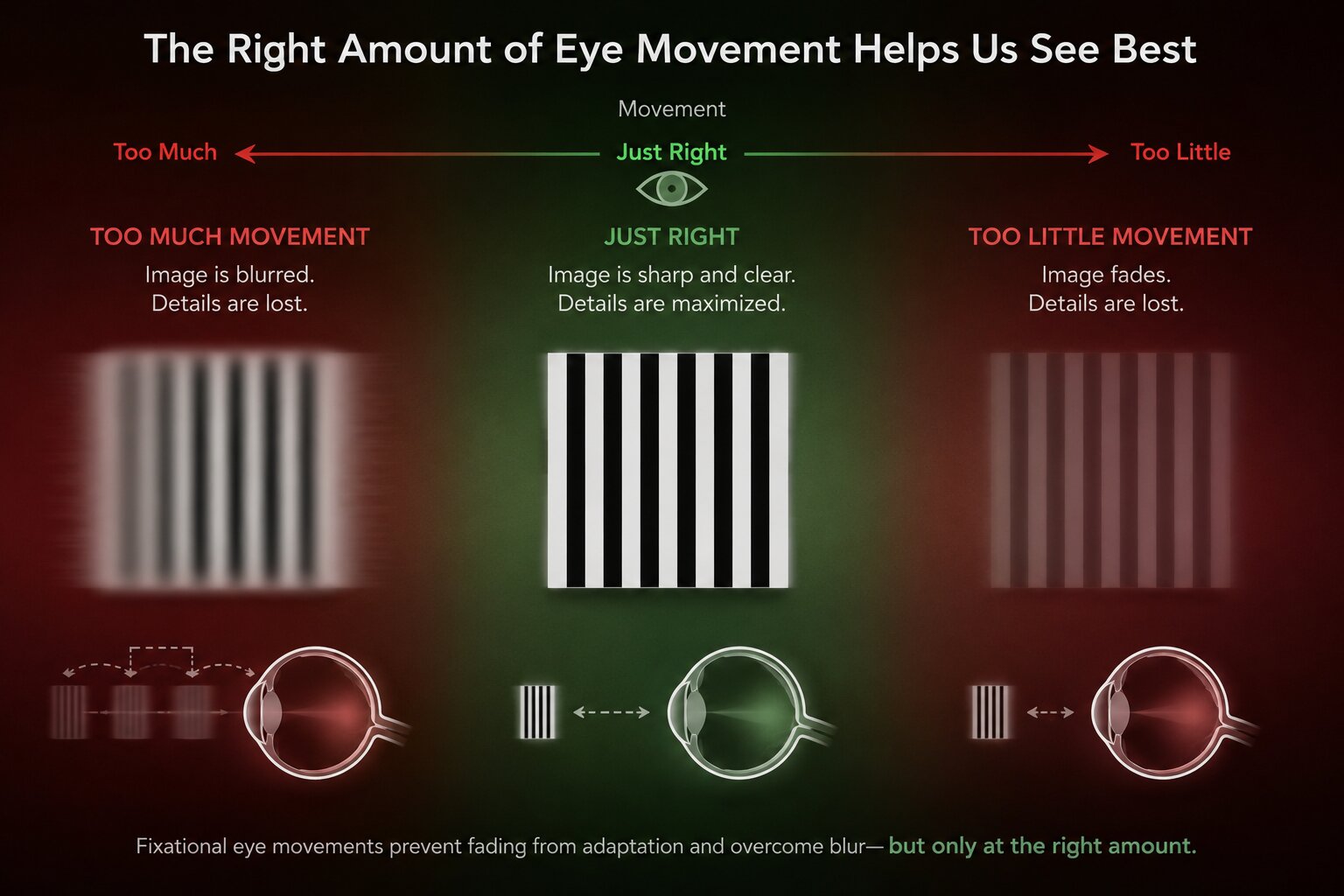
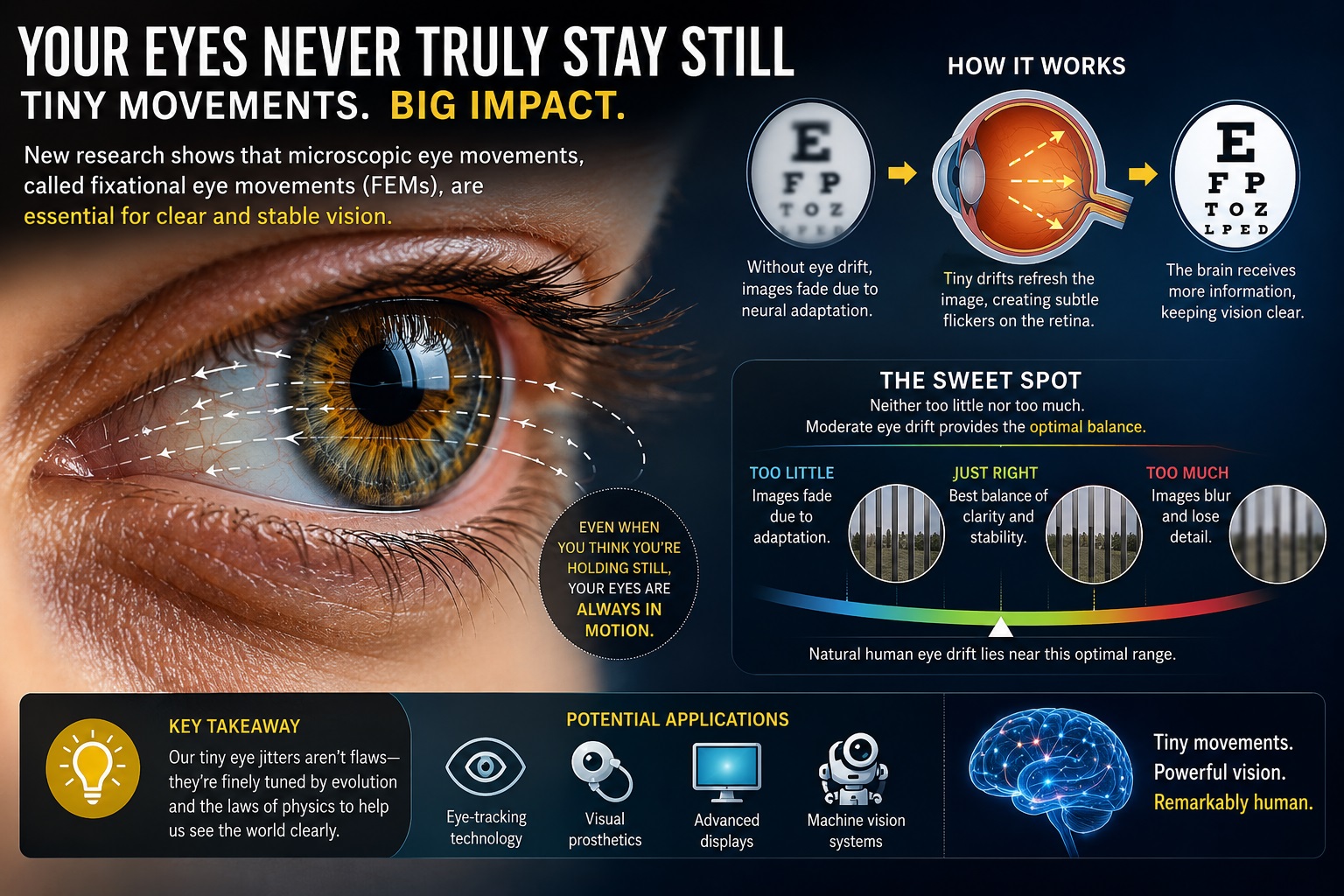
An illustration showing how tiny fixational eye movements affect vision. Too much motion blurs fine details, too little causes images to fade through neural adaptation, while a "just right" amount keeps patterns sharp and stable on the retina. Image generated with AI tools for illustrative purposes.
image source: sciencex.com
The study explains that fixational eye movements help convert spatial details into temporal signals — essentially transforming static visual information into tiny flickers that the retina can process more efficiently. The retina is highly sensitive to changes over time, but the optics of the human eye naturally blur extremely fine details. According to the researchers, moderate levels of eye drift appear to strike an ideal balance. They keep images from fading while preserving detail sharpness. Too little motion allows images to disappear through neural adaptation, while too much motion causes blur that reduces clarity.
Scientists discovered that the effects of these tiny eye movements depend heavily on exposure duration and the spatial properties of what a person is viewing. Certain patterns and stimuli become easier to detect when slight ocular drift is present, while others may become harder to perceive. This means the same eye movement can either enhance or impair vision depending on the visual environment.
The researchers also addressed several longstanding mysteries in vision science. Earlier retinal physiology studies showed that introducing small jittery movements improved scientists’ ability to decode retinal signals, leading some researchers to conclude that fixational eye drifts enhance the precision of retinal representation. The new model offers a potential explanation for this phenomenon by showing how motion spreads spatial detail across time, allowing neurons to process information more effectively.
However, the benefits are not unlimited. The research indicates that excessive drift or insufficient drift can both damage image quality. This creates what scientists describe as a “sweet spot” where eye movement is optimized for human vision. When researchers compared their calculations with actual measurements of natural human ocular drift, they found that the average drift speed in healthy human eyes lies remarkably close to this optimal range.
The findings led researchers to an intriguing conclusion: human eye movements may be naturally tuned to the physical limits of the visual system itself. The study notes that measured rates of fixational ocular drift appear optimized to provide maximum visual benefit while accounting for unavoidable optical blur. This suggests that the human visual system evolved in a way that balances motion, adaptation, and image clarity with extraordinary precision.
An easy way to imagine this effect is to picture staring at a striped pattern. Without any eye drift, the stripes might slowly fade from perception because the retina adapts to the unchanging image. Tiny natural movements create subtle shimmering on the retina, continuously refreshing the signal and keeping the pattern visible. But if the eyes moved too quickly, the stripes would smear together into a blurry gray image.
The study also helps explain why human contrast sensitivity — the ability to distinguish patterns of different fineness — follows a complex “band-pass” behavior that has puzzled scientists for years. Researchers suggest this pattern may emerge directly from the interaction between eye movement, adaptation, and optical blur. The model even revisits famous fixation experiments such as the stabilized-image studies conducted by neuroscientist Horace Barlow, showing that many earlier findings naturally align with this new explanation when these factors are considered together.
Beyond pure scientific curiosity, the research may eventually have practical applications. Understanding how microscopic eye movements interact with visual processing could influence the future design of visual prosthetics, eye-tracking technologies, advanced display systems, and machine-vision systems modeled after human sight. Since eye drift appears closely matched to the natural blur characteristics of human vision, changes in these movements could also affect visual sharpness and perception in important ways.
Perhaps the most fascinating takeaway is philosophical as much as scientific. The tiny motions we never notice — once thought to be flaws or biological imperfections — may actually represent an elegant solution shaped by evolution and constrained by physics itself. Human vision may depend not on perfect stillness, but on constant microscopic motion working silently in the background.
So the next time you stare at a completely still object, remember that your eyes are quietly moving all the time. Those tiny invisible jitters may be one of the main reasons the world around you remains vivid, stable, and clear.
Key Points
Human eyes constantly make tiny involuntary movements called fixational eye movements (FEMs).
Researchers developed a mathematical model explaining how these movements affect vision.
Moderate eye drift improves visual processing by preventing image fading.
Too much or too little eye movement can reduce image clarity.
Natural human eye drift appears remarkably optimized for the visual system.
The findings may influence future eye-tracking systems, prosthetics, and machine vision technology.
advertisement
Frequently Asked Questions (FAQ)
What are fixational eye movements (FEMs)?
Fixational eye movements are tiny involuntary eye motions that occur even when a person believes they are staring steadily at an object.
Why do our eyes move when focusing on something?
These small movements help prevent visual fading by constantly refreshing the image on the retina.
Can eye movements improve vision?
Yes. According to the study, moderate eye drift can enhance visual processing and improve how the brain interprets details.
What happens if eye drift is too strong?
Excessive eye movement can blur images and reduce visual clarity.
Why is this discovery important?
The findings could help improve visual prosthetics, eye-tracking systems, and artificial vision technologies inspired by human eyesight.
Which study discovered this?
The findings were published in Physical Review Research by Alexander J. H. Houston and colleagues in 2026.
Sources
Science X – Report on new research about fixational eye movements and human vision
https://sciencex.com/news/2026-05-steady-eyes-sight.htmlPhysical Review Research – Original scientific study by Alexander J. H. Houston et al.
https://doi.org/10.1103/l4qd-5s7d
Thank you !