
NASA’s Powerful New Ion Engine Could Revolutionize Human Missions to Mars
JPL Tests Next-Generation Electric Thruster - NASA Jet Propulsion Laboratory
Key Points Summary
NASA has successfully tested a next-generation lithium-powered ion engine capable of reaching unprecedented power levels for future Mars missions.
The experimental electromagnetic thruster achieved 120 kilowatts of power, making it 25 times stronger than current ion engines used in space.
Scientists believe the new propulsion system could dramatically reduce spacecraft mass and improve the feasibility of sending astronauts to Mars.
advertisement
NASA has taken a major step toward future human missions to Mars after successfully testing a powerful new electromagnetic ion engine at NASA Jet Propulsion Laboratory in Southern California.
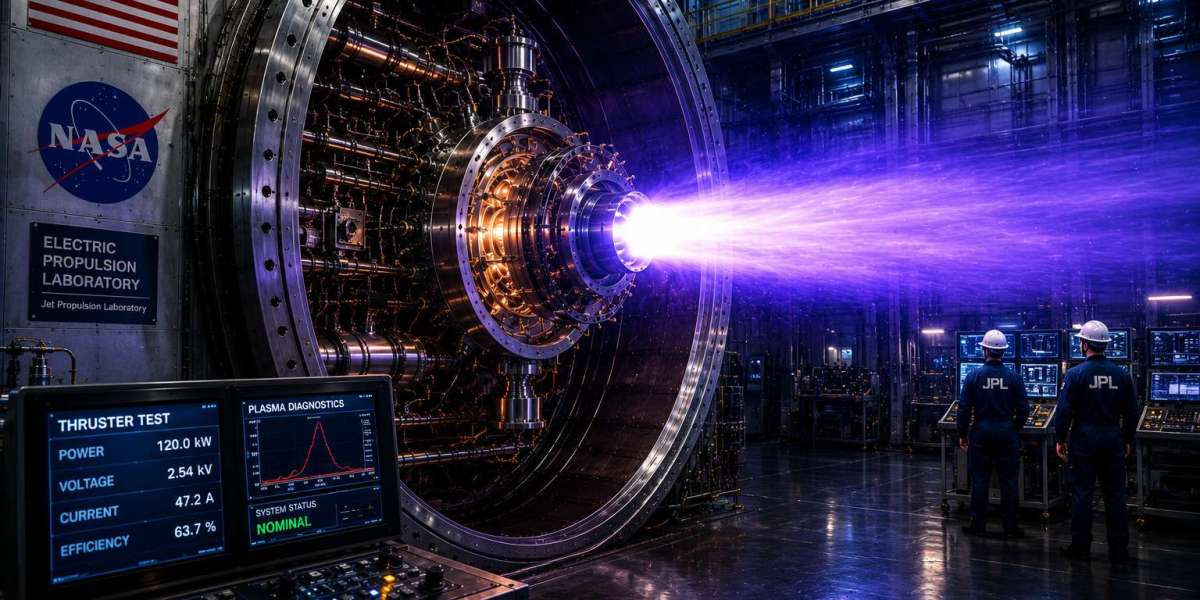
The experimental propulsion system, known as a lithium-fed magnetoplasmadynamic (MPD) thruster, recently completed its first high-energy tests and demonstrated performance levels never before achieved in the United States for this type of electric propulsion technology.
The successful trial is being viewed as an important milestone in NASA’s long-term plans for deep-space exploration and future crewed journeys to Mars. During testing on Feb. 24, engineers fired the thruster inside a specialized 26-foot-long vacuum chamber known as the Condensable Metal Propellant, or COMET, facility.
The engine completed five ignition cycles and reached power levels of up to 120 kilowatts, making it approximately 25 times more powerful than the ion propulsion system currently operating aboard NASA’s Psyche spacecraft.
According to NASA Administrator Jared Isaacman, this was the first time an electric propulsion system in the United States operated at such high power levels, marking what he described as real progress toward eventually placing astronauts on the Red Planet.
The new engine differs significantly from traditional chemical rocket systems. Conventional rockets rely on rapid combustion and massive bursts of thrust to launch spacecraft, but ion engines work using electric propulsion. Instead of burning large amounts of chemical fuel, they use electromagnetic fields to accelerate charged particles, or ions, through a nozzle at extremely high speeds.
Although ion engines generate less immediate thrust than chemical rockets, they can operate continuously over long periods, gradually accelerating spacecraft to tremendous velocities while consuming far less propellant. NASA says electric propulsion systems can use up to 90% less fuel than traditional rockets, reducing spacecraft mass and lowering launch costs.
The agency’s Psyche mission already demonstrates the advantages of electric propulsion, with its solar-powered thrusters eventually reaching speeds of roughly 124,000 miles per hour. The newly tested lithium-fed MPD thruster takes the concept even further by using lithium vapor as propellant instead of the more commonly used xenon gas. Researchers say lithium plasma can produce stronger thrust while maintaining high efficiency, making it especially attractive for large-scale deep-space missions. Inside the engine, powerful electrical currents interact with magnetic fields to accelerate lithium ions into an intensely hot plasma plume.
During testing, the central tungsten electrode glowed bright white at temperatures exceeding 5,000 degrees Fahrenheit, hotter than molten lava, while a vivid red stream of plasma emerged from the outer electrode. Scientists observed the test through viewing ports in the massive vacuum chamber at JPL’s Electric Propulsion Laboratory. Senior JPL research scientist James Polk described the successful experiment as the culmination of several years of engineering work.
He explained that researchers not only confirmed the thruster worked correctly but also achieved the exact power targets they had hoped for during the first major test campaign. Polk has spent decades studying electric propulsion systems and previously contributed to historic NASA missions including Deep Space 1 and Dawn, both of which helped pioneer ion propulsion beyond Earth orbit.
Ion propulsion technology itself has existed since the 1960s, but it only became operationally important after NASA launched Deep Space 1 in 1998, the first spacecraft to use ion propulsion beyond Earth orbit. Since then, multiple missions have relied on electric propulsion systems, including NASA’s Dawn mission to the asteroids Vesta and Ceres, NASA’s DART mission, European Space Agency missions such as SMART-1 and BepiColombo, as well as Hayabusa2 from Japan.
Despite these successes, most existing ion engines depend on solar arrays for electrical power, which creates major limitations for future deep-space missions. Solar-powered engines become less effective farther from the sun, and producing megawatt-scale electricity would require extremely large solar panels. To solve this challenge, NASA is simultaneously advancing nuclear-powered space propulsion systems.
One major initiative mentioned in reports is the Space Reactor-1 Freedom project, which aims to pair a compact nuclear fission reactor with advanced ion propulsion systems. According to Space.com, the project could launch before the end of 2028 carrying a group of miniature rotorcraft collectively known as Skyfall to Mars. While the early reactor mission is expected to use conventional xenon ion propulsion, researchers believe future nuclear-electric spacecraft combined with lithium-fed MPD thrusters could eventually transport astronauts to Mars more efficiently than ever before.
NASA’s long-term goals for the new propulsion system are extremely ambitious. Engineers hope to scale the current prototype from 120 kilowatts to between 500 kilowatts and one megawatt per thruster in the coming years. Eventually, human missions to Mars could require between two and four megawatts of total propulsion power, potentially involving several engines operating together continuously for more than 23,000 hours. Achieving that capability will require solving major engineering challenges related to heat management, durability, and long-term reliability under extreme conditions.
The development effort has been underway for approximately two and a half years and involves collaboration between NASA’s Jet Propulsion Laboratory, Princeton University, and NASA Glenn Research Center. Funding comes from NASA’s Space Nuclear Propulsion project, launched in 2020 under the agency’s Space Technology Mission Directorate and managed through Marshall Space Flight Center. Scientists believe the combination of nuclear power and high-performance electric propulsion may ultimately become one of the most practical methods for carrying humans deeper into the solar system.
The recent successful test demonstrates that technologies once considered experimental concepts may soon become essential tools for humanity’s expansion beyond Earth. If future testing continues to succeed, lithium-fed MPD thrusters could represent the beginning of a new era in space travel, bringing astronauts one step closer to walking on Mars and enabling robotic missions to explore distant regions of the solar system more efficiently than ever before.
Key Points
NASA tested a lithium-fed magnetoplasmadynamic thruster at JPL.
The engine achieved 120 kilowatts of power during testing.
The new system is about 25 times more powerful than Psyche’s ion engine.
Electric propulsion systems use significantly less propellant than chemical rockets.
Lithium plasma may provide stronger thrust and better efficiency than xenon gas.
The engine operates using electromagnetic fields and plasma acceleration.
Future Mars missions may require propulsion systems generating several megawatts of power.
NASA is also researching nuclear-powered propulsion systems for deep-space exploration.
The technology could support both robotic and human missions across the solar system.
Researchers aim to scale the thruster to 500 kilowatts and eventually several megawatts.
advertisement
Frequently Asked Questions (FAQ)
What is NASA’s new ion engine?
NASA’s new propulsion system is a lithium-fed magnetoplasmadynamic (MPD) thruster that uses electromagnetic fields to accelerate lithium plasma and generate thrust for spacecraft.
Why is the new thruster important?
The engine could make future human missions to Mars more efficient by reducing spacecraft mass and using far less propellant than chemical rockets.
How powerful is the new engine?
The prototype reached 120 kilowatts during testing, making it the highest-power electric propulsion system tested in the United States.
How do ion engines work?
Ion engines use electricity and magnetic fields to accelerate charged particles called ions, producing continuous thrust over long periods.
Why use lithium instead of xenon?
Researchers believe lithium plasma can provide stronger thrust and better efficiency at very high power levels compared to xenon gas.
Will this engine take astronauts to Mars soon?
Not immediately. NASA still needs to scale the technology to megawatt-class power levels and prove long-term reliability before it can support crewed Mars missions.
What role does nuclear power play in the project?
NASA is exploring nuclear-electric propulsion systems because solar power alone may not provide enough energy for future megawatt-scale ion engines.
Sources
- ScienceDaily – Report on NASA’s lithium-fed MPD thruster test and Mars mission ambitions
https://www.sciencedaily.com/releases/2026/05/260505234611.htm - Space.com – Coverage of NASA’s advanced ion engine testing and future nuclear propulsion plans
https://www.space.com/astronomy/mars/nasa-is-making-a-powerful-new-ion-engine-to-send-astronauts-to-mars-and-it-just-passed-its-1st-test
Thank you !