
article image source: sciencealert.com (Link)
500-Kilometer “Grand Canyon of the Atlantic”: Scientists Reveal the Hidden Forces That Tore a Giant Canyon Beneath the Ocean
A MASSIVE Undersea Canyon in The Middle of The Ocean - OzGeology
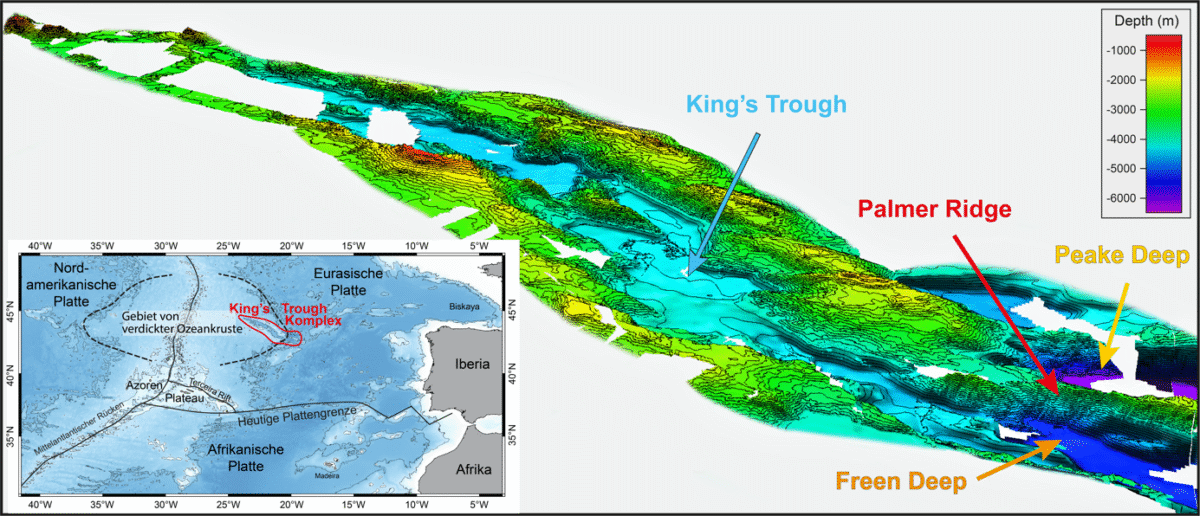
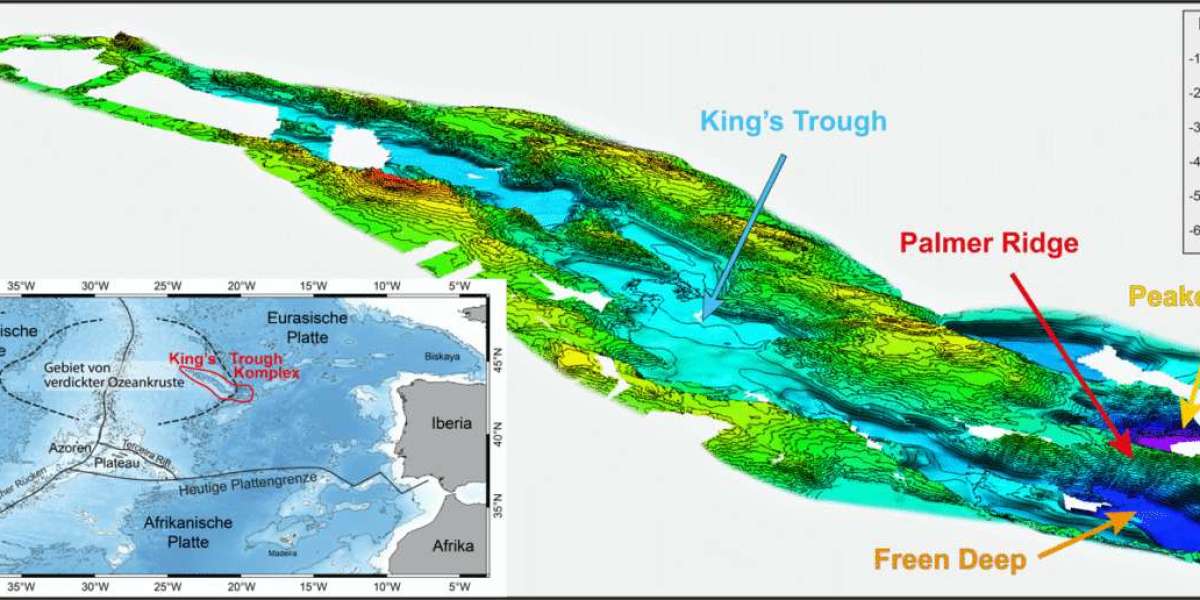
Bathymetric map of the King's Trough complex with deep basins at its eastern end (Peake and Freen Deeps). Inset shows an overview of the eastern North Atlantic based on www.gebco.net. (GEOMAR)
image source: sciencealert.com
3 Key Takeaways
A massive 500-kilometer underwater canyon system lies deep in the Atlantic Ocean, often called the “Grand Canyon of the Atlantic.”
Scientists now believe it formed 37–24 million years ago due to a rare combination of tectonic plate movement and mantle plume activity.
The discovery helps researchers better understand how powerful forces deep inside Earth shape the seafloor.
advertisement
Far beneath the waves of the Atlantic Ocean lies a geological structure so enormous that it rivals some of the most famous landscapes on Earth.
Known as the King’s Trough Complex, this immense network of trenches and basins stretches roughly 500 kilometers across the seafloor, about 1,000 kilometers off the coast of Portugal. Because of its vast scale, scientists often refer to it as the “Grand Canyon of the Atlantic.”
Unlike famous land canyons carved by rivers, this underwater formation was created by powerful geological forces deep within Earth. Recent scientific research is now revealing the dramatic processes that tore open this massive canyon system millions of years ago.
What Is the King’s Trough Complex?
The King’s Trough Complex (KTC) is a giant underwater landscape made up of parallel trenches, deep basins, ridges, and seamount-like structures on the North Atlantic seafloor.
The system extends for about 500 kilometers, making it larger than many well-known canyon systems on land.
Within this complex lies the King’s Trough basin, which scientists describe as one of the most prominent features of the region.
According to research data, the basin is roughly 350 kilometers long and up to 80 kilometers wide.
The surrounding topography is equally dramatic. Some areas show over 4,000 meters of vertical relief within only about 15 kilometers of horizontal distance, creating a striking canyon-like landscape beneath the ocean.
At the eastern edge of the complex lies Peake Deep, one of the deepest locations in the Atlantic Ocean.
advertisement
Why Underwater Canyons Are So Mysterious
On land, canyon formation is relatively easy to explain.
For example, the Grand Canyon in the United States was carved over millions of years by the Colorado River, which slowly eroded rock layers as the Colorado Plateau rose.
But underwater environments operate differently.
The ocean does not contain rivers capable of carving rock on such a massive scale. As a result, large submarine canyon-like structures remain poorly understood, and their origins have been debated by geologists for decades.
The King’s Trough Complex has been particularly puzzling. Scientists have discussed its origin for nearly 50 years, yet the area has been only sporadically studied, with limited rock samples collected until recently.
A New Study Brings Fresh Answers
A team of international researchers led by scientists from the GEOMAR Helmholtz Centre for Ocean Research Kiel set out to investigate the mysterious formation more thoroughly.
During a research expedition in 2020 aboard the research vessel METEOR, scientists conducted detailed mapping of the seafloor using high-resolution sonar technology.
They also collected volcanic rock samples from multiple locations in the trough using dredging equipment.
Back in the laboratory, the samples were analyzed to determine their chemical composition and geological age, helping researchers reconstruct the history of the region.
These investigations produced the first detailed and comprehensive map of the King’s Trough Complex, providing new clues about how it formed.
advertisement
When Did the Giant Canyon Form?
Based on geological evidence and rock dating, researchers estimate that the canyon system formed between 37 million and 24 million years ago.
During this period, a temporary plate boundary existed in this part of the North Atlantic.
At that boundary, the Earth’s crust was stretched and fractured, gradually opening up the large trough system.
Scientists describe the process as similar to a zipper slowly being pulled apart, with the seafloor splitting from east to west as tectonic forces pulled the crust in different directions.
The Hidden Role of a Mantle Plume
However, tectonic movement alone does not fully explain why the canyon formed precisely at this location.
Researchers believe another powerful force was involved: a mantle plume.
A mantle plume is a column of extremely hot material rising from deep within Earth’s mantle. When it reaches the base of the lithosphere, it can heat and weaken the crust above it.
Evidence suggests that before the plate boundary formed, the oceanic crust in this region had already become unusually thick and hot due to such mantle activity.
This likely made the area mechanically weaker, allowing the plate boundary to shift into the region and trigger the large-scale fracturing that formed the trough.
According to the research team, the plume responsible was probably an early branch of the Azores mantle plume, which remains active today roughly 700 kilometers to the south.
advertisement
Why the Canyon Stopped Growing
Despite the immense forces involved, the King’s Trough Complex did not evolve into a full seafloor-spreading ridge like the nearby Mid-Atlantic Ridge.
Researchers believe the process stopped when the plate boundary migrated further south toward the Azores region.
Once that shift occurred, the tectonic stress responsible for stretching the crust disappeared, and the formation of the trough system came to an end.
A Window Into Earth’s Deep Interior
Scientists emphasize that the King’s Trough Complex provides an important example of how processes deep inside Earth interact with tectonic plate movements at the surface.
Mantle plumes can weaken sections of the crust, influencing where fractures and rifts develop in the ocean floor.
This discovery also helps researchers understand similar geological features forming today.
One example is the Terceira Rift near the Azores, where scientists observe comparable trench systems developing in an area with unusually thick oceanic crust.
Studying the King’s Trough Complex could therefore offer insights into how similar structures may evolve in the future.
advertisement
Conclusion
The discovery of how the 500-kilometer “Grand Canyon of the Atlantic” formed reveals just how dynamic and powerful Earth’s interior truly is.
Far below the ocean surface, invisible forces — from rising mantle plumes to shifting tectonic plates — can reshape entire regions of the planet over millions of years.
The King’s Trough Complex stands as a reminder that Earth’s most dramatic landscapes are not limited to what we see on land. Some of the planet’s largest geological wonders lie hidden beneath the ocean, waiting to be mapped and understood.
As technology improves and exploration continues, scientists may uncover even more colossal structures on the seafloor — each one offering new clues about how our planet evolves from deep within.
Key Points
The King’s Trough Complex is a massive 500-kilometer underwater canyon system in the North Atlantic.
It formed between 37 and 24 million years ago due to tectonic plate stretching.
A mantle plume likely weakened the crust, guiding the plate boundary through the region.
The formation stopped when the plate boundary moved toward the Azores.
The discovery helps scientists understand how deep Earth processes shape the ocean floor.
advertisement
Frequently Asked Questions (FAQ)
What is the 500-kilometer canyon in the Atlantic Ocean?
It refers to the King’s Trough Complex, a vast underwater system of trenches and basins located about 1,000 kilometers off the coast of Portugal in the North Atlantic.
Why is it called the “Grand Canyon of the Atlantic”?
Because of its enormous size and dramatic topography, scientists compare it to the Grand Canyon on land.
How did the King’s Trough Complex form?
Researchers believe it formed when tectonic plates stretched and fractured the seafloor along a temporary plate boundary, assisted by heat from a mantle plume beneath the crust.
When did the canyon form?
Geological evidence suggests it formed between 37 million and 24 million years ago.
Why is this discovery important?
It helps scientists understand how deep mantle processes interact with tectonic plates, influencing where large geological structures form on the ocean floor.
Sources
- ScienceDaily – Research summary explaining the geological discovery of the King’s Trough Complex
https://www.sciencedaily.com/releases/2026/02/260222092327.htm - IFLScience – Overview of the “Grand Canyon of the Atlantic” and the new research findings
https://www.iflscience.com/the-500-kilometer-grand-canyon-of-the-atlantic-may-have-been-formed-by-forces-deep-within-our-planet-82752 - ScienceAlert – Detailed explanation of the tectonic and mantle forces behind the formation of the canyon
https://www.sciencealert.com/we-finally-know-what-tore-a-500-km-grand-canyon-into-the-atlantic-seafloor - Geochemistry, Geophysics, Geosystems – Original scientific study describing the research
https://agupubs.onlinelibrary.wiley.com/doi/10.1029/2025GC012616
Thank you !