
article image source and credits:
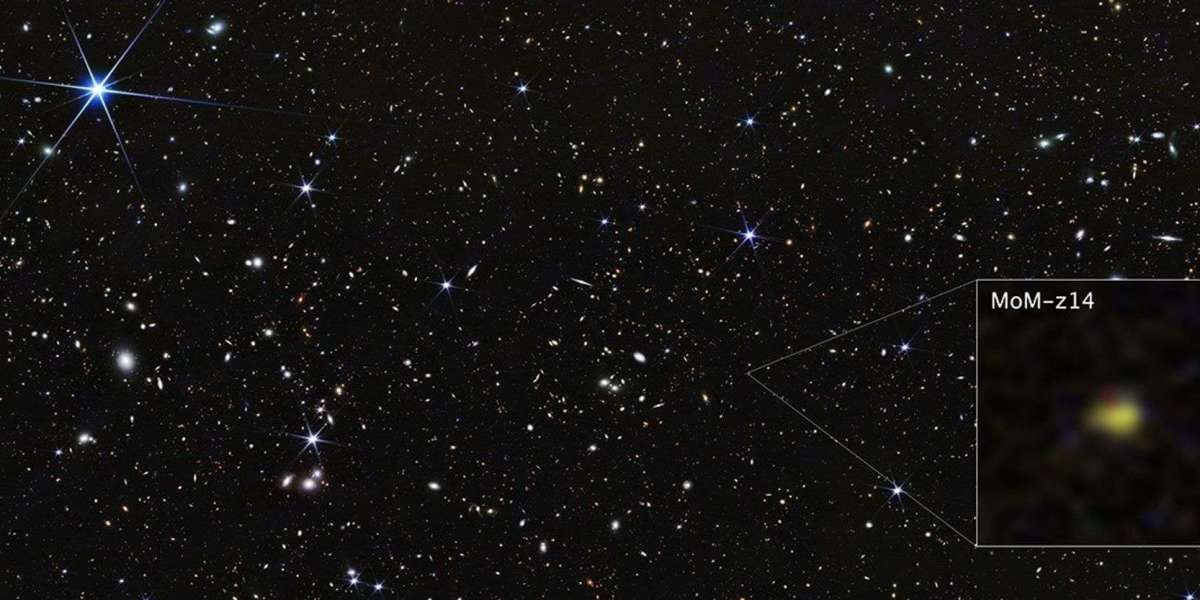
NASA’s James Webb Space Telescope shows galaxy MoM-z14 as it appeared in the distant past, only 280 million years after the universe began in the big bang.
Image: NASA, ESA, CSA, STScI, Rohan Naidu (MIT); Image Processing: Joseph DePasquale (STScI)
source: science.nasa.gov (Link)
NASA Webb Pushes Boundaries of Observable Universe Closer to the Big Bang: Discovering MoM-z14
Key Points:
James Webb Space Telescope observes galaxy MoM-z14 just 280 million years after the Big Bang.
Early galaxies are brighter and more chemically enriched than previously predicted.
Observations reshape understanding of the universe’s first billion years.
advertisement
NASA’s James Webb Space Telescope (JWST) has once again shattered expectations, revealing one of the earliest and brightest galaxies ever observed: MoM-z14. Existing only 280 million years after the Big Bang, this galaxy provides a remarkable glimpse into the universe’s formative years and challenges long-standing astronomical theories about early cosmic history.
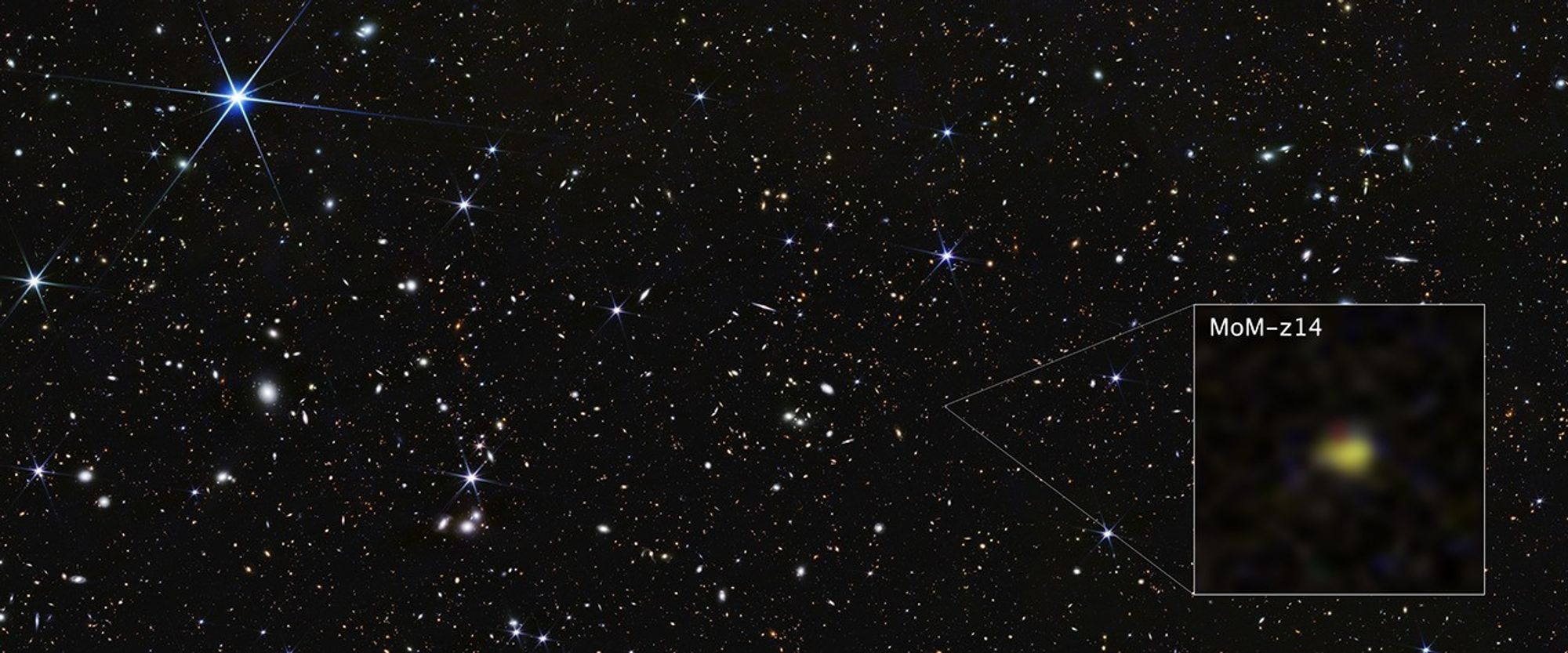
NASA’s James Webb Space Telescope shows galaxy MoM-z14 as it appeared in the distant past, only 280 million years after the universe began in the big bang.
Image: NASA, ESA, CSA, STScI, Rohan Naidu (MIT); Image Processing: Joseph DePasquale (STScI)
source: science.nasa.gov (Link)
Using JWST’s Near-Infrared Spectrograph (NIRSpec), astronomers confirmed MoM-z14’s extreme distance, measuring a cosmological redshift of 14.44. This means the galaxy’s light has traveled and stretched for approximately 13.5 billion years, allowing scientists to observe it as it existed in the universe’s infancy. Rohan Naidu of the Massachusetts Institute of Technology’s Kavli Institute for Astrophysics and Space Research, lead author of the study, emphasizes that Webb is showing a universe that “looks nothing like what we predicted,” opening the door to new questions and discoveries.
Intriguingly, MoM-z14 and other early galaxies are far brighter than theoretical models predicted—about 100 times more luminous than expected. Researchers, including Jacob Shen of MIT, point out that these observations reveal a growing gap between theory and reality, hinting at unknown physical processes in the early cosmos. One standout feature is the high nitrogen content in these galaxies, mirroring chemical signatures found in the oldest stars of the Milky Way. Astronomers theorize that supermassive stars in the dense early universe may have produced nitrogen far more efficiently than stars observed today.
advertisement
MoM-z14 also provides valuable insight into cosmic reionization, a critical period when the first stars cleared the thick hydrogen fog that dominated the early universe. Observing how MoM-z14 interacted with its surroundings helps astronomers map the timeline of reionization and understand how light began traveling freely through space, eventually reaching instruments like Webb.
This discovery follows the legacy of the Hubble Space Telescope, which first observed the bright galaxy GN-z11 approximately 400 million years after the Big Bang. Webb has since continued to push the observational frontier, identifying even earlier and more chemically complex galaxies. Looking forward, the upcoming Nancy Grace Roman Space Telescope is expected to expand this catalog dramatically, helping astronomers better understand common features of early galaxies and the processes that shaped the universe.
The James Webb Space Telescope stands as the premier observatory of our time, exploring the solar system, distant exoplanets, and the structure and origin of the universe itself. Webb’s discoveries are reshaping our understanding of cosmic history, offering both answers and new mysteries about the universe’s first billion years.
advertisement
Conclusion
The observation of MoM-z14 by the James Webb Space Telescope is more than a milestone; it is a window into a universe that defies our expectations. These early galaxies, brighter and more chemically rich than predicted, are teaching astronomers that the cosmos’ first billion years were dynamic, complex, and full of surprises. With Webb and future missions like the Roman Space Telescope, humanity is closer than ever to understanding our cosmic origins—illuminating not just distant galaxies, but our own place in the universe.
To learn more about Webb, visit: https://science.nasa.gov/webb
Key Points Summary
MoM-z14 observed just 280 million years after the Big Bang.
Early galaxies are far brighter and richer in elements like nitrogen than predicted.
Findings provide new insights into cosmic reionization and the universe’s early evolution.
Webb Telescope surpasses previous observational limits, opening a new era in astronomy.
advertisement
Frequently Asked Questions (FAQ)
Q: What is MoM-z14?
A: MoM-z14 is a galaxy observed by the James Webb Space Telescope, existing only 280 million years after the Big Bang.
Q: Why is this discovery significant?
A: MoM-z14 is much brighter and more chemically enriched than predicted, challenging our understanding of the early universe.
Q: How does this relate to cosmic reionization?
A: MoM-z14 provides evidence of early galaxies clearing hydrogen fog, helping astronomers map the timeline of reionization.
Q: What instruments on Webb detected MoM-z14?
A: Webb’s Near-Infrared Spectrograph (NIRSpec) confirmed MoM-z14’s redshift and analyzed its chemical composition.
Q: How does this discovery compare to Hubble’s findings?
A: Hubble observed GN-z11, 400 million years after the Big Bang, while Webb has pushed the frontier back to 280 million years.
Sources
- NASA – NASA Webb pushes boundaries of observable universe closer to Big Bang
https://science.nasa.gov/missions/webb/nasa-webb-pushes-boundaries-of-observable-universe-closer-to-big-bang/
Thank you !