
Scientists discover Queen Bees are Created by an entire Royal Support system, Not royal jelly alone
a video for this article is being created, stay tuned
Key Points
Scientists have discovered that royal jelly alone does not determine whether a honeybee becomes a queen.
Specialized "queen cells," or royal cribs, provide unique physical and chemical conditions essential for healthy queen development.
Researchers identified a previously unknown group of young worker bees called "queen cell builders" that construct and maintain these royal nurseries.
Experiments showed larvae raised in ordinary worker-bee wax developed into smaller queens and experienced significantly higher mortality despite receiving identical diets.
The findings, published in Nature, suggest that physical and social environments play a much larger role in development than previously understood.
advertisement
For decades, biology textbooks and bee researchers largely agreed on one explanation for how a honeybee queen is created: feed an ordinary female larva enough royal jelly and it develops into the colony's queen. New research now shows that this long-held view tells only part of the story.
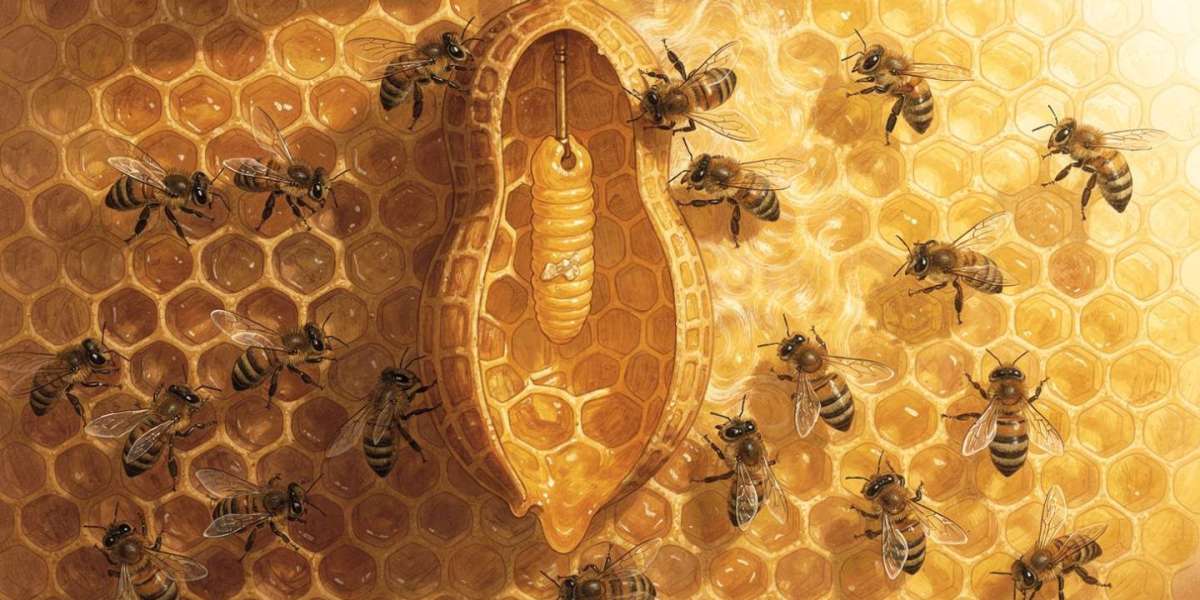
A study published in Nature reveals that a future queen is produced through an intricate combination of nutrition, specialized architecture, environmental conditions, and coordinated care from young worker bees. Rather than serving merely as protective containers, the peanut-shaped chambers known as queen cells act as carefully engineered developmental environments that help determine a larva's fate. (Nature)
The international research team found that colonies construct these royal nurseries using specially modified wax with unique physical and chemical properties. Young worker bees also regulate the temperature around developing queens and devote themselves to building and maintaining these chambers, demonstrating that the entire colony actively participates in producing its next reproductive leader. (Nature)
According to Boris Baer, an entomologist and director of the Center for Integrative Bee Research (CIBER) at the University of California, Riverside, the findings overturn an overly simplified view of queen development.
For years, researchers believed the process involved moving an egg into a queen cell and feeding the developing larva royal jelly. The new evidence instead points to an elaborate biological system in which multiple environmental factors work together to guide development. (ScienceDaily)
Honeybee queens and worker bees originate from nearly identical fertilized eggs, yet they mature into insects with dramatically different characteristics. Queens grow larger, develop faster, live substantially longer, and become the colony's only egg-laying females. While royal jelly remains an essential nutritional component, the researchers found it is not sufficient by itself to produce a healthy queen. (Nature)
To investigate the process, scientists combined thermal imaging, behavioral tracking, materials science, chemical analysis, transcriptomics, and experimental manipulation of wax materials. Their analysis showed that queen cells differ significantly from the familiar hexagonal worker brood cells found throughout a hive. (Nature)
The specialized queen-cell wax proved to be less dense, more flexible, and better able to retain heat and moisture than ordinary worker-cell wax. Researchers also detected differences in fatty acids and other chemical compounds, suggesting the wax itself creates a distinct developmental environment rather than serving simply as a physical enclosure. (Nature)
To determine whether these differences truly influenced development, the team raised queen larvae under identical feeding conditions while changing only the wax surrounding them. Larvae raised in worker-cell wax suffered higher mortality and developed into smaller queens than larvae reared in authentic queen-cell wax. These findings demonstrate that the physical and chemical properties of the royal chamber are critical alongside nutrition. (Nature)
The study also identified a previously unrecognized class of young worker bees that researchers named "queen cell builders." These bees differ from other workers because they temporarily undergo physiological and genetic changes while constructing royal chambers. They maintain elevated body temperatures and activate specialized biological pathways associated with wax production, allowing them to create the distinctive queen-cell material. (Nature)
Researchers observed that these workers do far more than recycle existing wax. By adding trace amounts of graphite to ordinary honeycomb, they demonstrated that the bees selectively collect wax from elsewhere in the hive before modifying and enriching it specifically for queen development. (Nature)
The elevated temperatures generated by queen cell builders may also help explain why queens complete development in approximately 16 days, compared with roughly 21 days for worker bees. Faster development enables colonies to replace queens more rapidly when necessary, improving the colony's chances of survival. (ScienceDaily)
The researchers compared both Asian and European honeybee species and found the same developmental strategy in each, suggesting the behavior evolved early in honeybee evolution and is likely widespread across honeybee species. (Nature Asia)
The work also reinforces the concept of a honeybee colony functioning as a "superorganism," in which thousands of individuals cooperate to create environmental conditions that shape the development of future generations. Rather than relying solely on genetics or nutrition, the colony collectively engineers the conditions required to produce a successful queen. (Reuters)
Beyond improving scientists' understanding of honeybee biology, the findings could have practical applications for modern beekeeping. Healthy queens are essential for maintaining productive colonies that pollinate more than 80 major agricultural crops worldwide. Better understanding how colonies naturally produce high-quality queens could eventually improve queen breeding and support healthier bee populations as beekeepers continue to report significant colony losses in many regions. (Reuters)
The researchers caution that one important question remains unanswered: exactly which physical or chemical properties of queen-cell wax trigger queen development at the molecular level. Future studies aim to identify those mechanisms and determine whether similar environmentally engineered developmental systems exist in other social insects such as termites, wasps, or stingless bees. (Reuters)
Taken together, the findings significantly expand scientists' understanding of how queen honeybees are produced. Instead of emerging simply because they consume royal jelly, queens appear to result from an integrated system in which specialized construction, engineered wax, carefully controlled environmental conditions, and coordinated care by young worker bees all contribute to shaping the colony's future leader. (Nature)
Key Points Summary
Royal jelly is necessary but not sufficient for queen development.
Queen cells act as engineered developmental environments.
Previously unknown queen cell builders construct and maintain royal chambers.
Specialized wax improves survival and queen development.
The discovery may improve beekeeping and broaden understanding of developmental biology.
What This Means
The findings reshape one of the best-known examples of developmental biology by showing that nutrition alone does not determine whether a honeybee becomes a queen. The research could influence future bee conservation efforts, commercial queen breeding, and studies of how physical environments affect biological development. Researchers will next investigate the molecular mechanisms within queen-cell wax that guide this process.
advertisement
Frequently Asked Questions (FAQ)
What was previously believed to create a queen bee?
Scientists long believed that feeding a larva large amounts of royal jelly was the primary factor responsible for producing a queen.
What did the new study discover?
The study found that specialized queen cells, unique wax composition, warmer temperatures, and dedicated worker bees are also essential for healthy queen development.
What are queen cell builders?
They are a newly identified group of young worker bees that build and maintain queen cells while temporarily undergoing physiological and genetic changes.
Why are queen cells different?
Their wax has distinct physical and chemical properties that help regulate heat, moisture, and developmental signals needed for queen larvae.
Why is this discovery important?
It provides a more complete understanding of honeybee biology and could improve queen breeding, pollinator health, and research into developmental biology.
Sources
ScienceDaily – Scientists just discovered how queen bees are really made
https://www.sciencedaily.com/releases/2026/06/260623083101.htmNature (Original Research Paper) – Queen cell architecture shapes honey bee queen development
https://www.nature.com/articles/s41586-026-10534-3Nature Portfolio (Press Release) – Biology: Newly identified 'queen cell builders' shape honeybee royalty
https://www.natureasia.com/en/info/press-releases/detail/9340Reuters – Worker bees build a 'royal palace' for the honeybee queen
https://www.reuters.com/science/worker-bees-build-royal-palace-honeybee-queen-2026-06-10/