
Global Markets Slip as Tech Sell-Off, Oil Dynamics and Long-Term Economic Pressures Shape Investor Sentiment
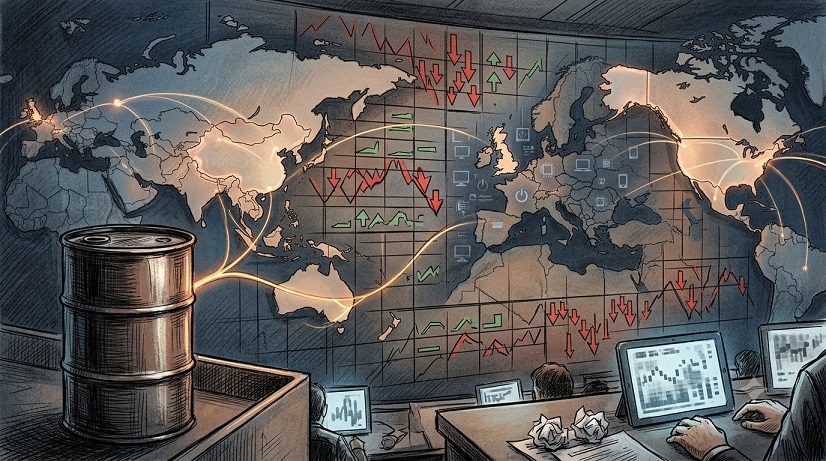
Key Points
S&P 500 futures and Nasdaq 100 futures fall as technology shares extend a broad sell-off.
South Korea’s Kospi drops more than 6%, leading losses across Asia-Pacific markets.
A decade after Brexit, the UK economy continues to face weaker growth, currency pressure, and political turnover.
Oil markets remain stable despite Middle East tensions, with China playing a key role in balancing global crude supply and demand.
Investors weigh mixed signals from equities, energy markets, and long-term structural economic shifts.
advertisement
Global financial markets came under renewed pressure on Tuesday as a combination of technology-sector weakness, regional equity declines in Asia, and evolving energy-market dynamics shaped investor sentiment across regions.
In early trading, S&P 500 futures fell 0.53%, while Nasdaq 100 futures dropped 0.99%, signaling continued caution after a technology-led sell-off in the previous session. Futures tied to the Dow Jones Industrial Average were comparatively steadier, slipping just 55 points, or 0.11%, as gains in industrial names helped offset weakness elsewhere.
During Monday’s regular trading session, the S&P 500 declined 0.37%, while the tech-heavy Nasdaq Composite fell 1.32%, weighed down by large-cap technology stocks. The downturn was driven in part by renewed selling pressure in the so-called “Magnificent Seven,” including declines in Amazon, Meta Platforms, and Alphabet, which each posted notable losses amid concerns about artificial intelligence talent competition and stretched valuations. In contrast, the Dow Jones Industrial Average rose 148.01 points, or 0.29%, supported by strength in Caterpillar shares.
The weakness in U.S. tech stocks rippled across global markets. In Asia-Pacific trading, South Korea’s Kospi fell more than 6%, while the Kosdaq dropped 6.27%, marking some of the steepest regional losses. Japan’s Nikkei 225 declined 1.5%, ending an eight-session winning streak, and the Topix slipped 0.79%. Broader regional benchmarks also weakened, including India’s Nifty 50, which lost 0.22%, Australia’s S&P/ASX 200, down 0.11%, and China’s CSI 300, which fell 1%, while Hong Kong’s Hang Seng Index eased 0.16%.
Investor caution has been amplified by ongoing rotation out of high-growth technology names, with market participants increasingly favoring diversified exposure through exchange-traded funds rather than concentrated individual stock positions. Analysts cited by CNBC noted that while interest in artificial intelligence remains strong, trading behavior has shifted toward broader index exposure as volatility in individual names increases.
At the same time, energy markets and geopolitical developments continue to influence broader risk sentiment. Oil prices have remained relatively contained despite months of disruption linked to conflict involving Iran and concerns over supply routes such as the Strait of Hormuz, which carries roughly one-fifth of global oil flows. Benchmark Brent crude recently traded below $78 per barrel, significantly lower than earlier spikes that reached around $114 per barrel at peak volatility.
A key factor behind the muted reaction in oil markets has been the role of China, the world’s second-largest crude consumer. According to analysts cited in energy market research, China has actively managed supply pressures by drawing on strategic reserves, adjusting import levels, and accelerating its transition toward electric vehicles and renewable energy. This has reduced oil consumption by an estimated 1 million barrels per day through EV adoption alone, helping stabilize global demand even during periods of geopolitical disruption.
China’s ability to absorb or release crude into the market through stockpiling has also been described by analysts as a “buffering mechanism,” reducing the severity of price spikes that would otherwise be expected during supply shocks. However, experts warn that this balancing role may be temporary, as sustained reliance on inventories cannot continue indefinitely without new production or demand shifts.
Looking ahead, the International Energy Agency (IEA) has suggested that a potential reopening of the Strait of Hormuz could quickly shift the market from supply constraints to oversupply conditions. The agency projects that global supply growth could exceed demand by 4.7 million barrels per day next year, driven by restored production in the Middle East and changing consumption patterns.
Beyond energy markets, longer-term structural economic developments continue to influence global sentiment. In the United Kingdom, a decade after the Brexit referendum of June 23, 2016, the economy has yet to regain pre-vote momentum. Academic estimates cited in economic analysis suggest that Brexit has reduced UK GDP by 6–8% by 2025, reflecting persistent uncertainty, reduced investment, and shifts in trade relationships.
Currency markets have also reflected this adjustment. Sterling has remained approximately 10% below pre-referendum levels, with the pound trading weaker against both the euro and the U.S. dollar. Analysts attribute this to reduced investor confidence, higher import costs, and structural changes in trade flows.
The divergence between UK equity indices further highlights the uneven economic impact. The internationally focused FTSE 100 has outperformed the domestically oriented FTSE 250, supported by multinational earnings and currency effects. However, both indices have lagged significantly behind U.S. equities, which have benefited from sustained growth in technology and AI-driven sectors.
Politically, the UK has experienced significant turnover since the referendum, with multiple prime ministers serving relatively short terms, reflecting continued instability in domestic governance and policy direction.
Across markets, the combination of short-term volatility in equities, longer-term currency and growth adjustments in developed economies, and structural shifts in global energy consumption underscores a broader theme: investors are navigating an environment shaped not only by earnings and interest rates, but also by geopolitical transitions and evolving consumption patterns.
Key Points Summary
Tech weakness pushes S&P 500 and Nasdaq futures lower.
Asia-Pacific markets fall sharply, led by South Korea’s Kospi (-6%+).
Oil markets remain stable as China offsets global supply shocks.
Brent crude stays well below prior crisis highs despite geopolitical tensions.
A decade after Brexit, the UK faces slower growth, weaker currency, and political instability.
What This Means
Recent market moves highlight a fragile balance between technology-driven equity leadership, geopolitical uncertainty in energy markets, and longer-term structural economic shifts in major economies.
Investors are watching whether continued weakness in large-cap technology stocks signals a broader correction or a rotation into more defensive sectors. At the same time, oil markets remain unusually stable given global tensions, largely due to shifting demand patterns in China and strategic inventory management.
In the UK, the long-term economic effects of Brexit continue to shape growth, currency strength, and market performance, reinforcing the importance of structural policy decisions on financial stability.
advertisement
Frequently Asked Questions (FAQ)
Why are global stock markets falling?
Markets are under pressure due to a sell-off in major technology stocks and weaker sentiment across Asia-Pacific equities.
What is driving weakness in tech stocks?
Investors are rotating out of large-cap tech names amid valuation concerns and shifting interest toward diversified index exposure.
Why is oil not rising sharply despite geopolitical tensions?
China’s demand management, stockpiling behavior, and EV adoption have helped offset supply shocks.
How has Brexit affected the UK economy?
Studies estimate Brexit has reduced UK GDP growth, weakened sterling, and contributed to long-term investment uncertainty.
What is the outlook for global markets?
Markets remain sensitive to tech earnings, geopolitical risks, and energy supply developments, with volatility expected to persist.
Sources
CNBC — https://www.cnbc.com/2026/06/22/stock-market-today-live-updates.html
CNBC — https://www.cnbc.com/2026/06/23/brexit-10-years-uk-economy-politics-charts.html
Yahoo Finance / CNN — https://finance.yahoo.com/energy/articles/future-oil-prices-may-depend-210026176.html
Disclaimer:
This material may contain third-party opinions, none of the data and information on this webpage constitutes investment advice
The content shared in economics articles is solely for research and informational purposes.
We are not a financial advisory service, and the information provided should not be considered investment or trading advice.
Thank you !