
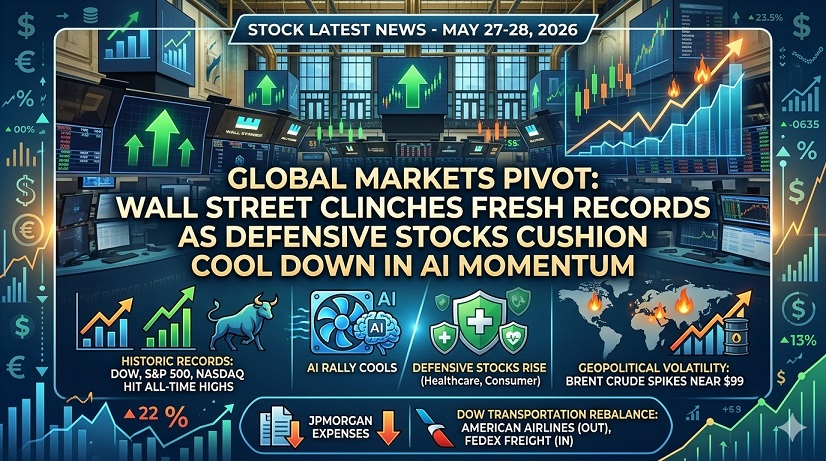
Global Markets Pivot: Wall Street Clinches Fresh Records as Defensive Stocks Cushion Cool Down in AI Momentum
Key Points
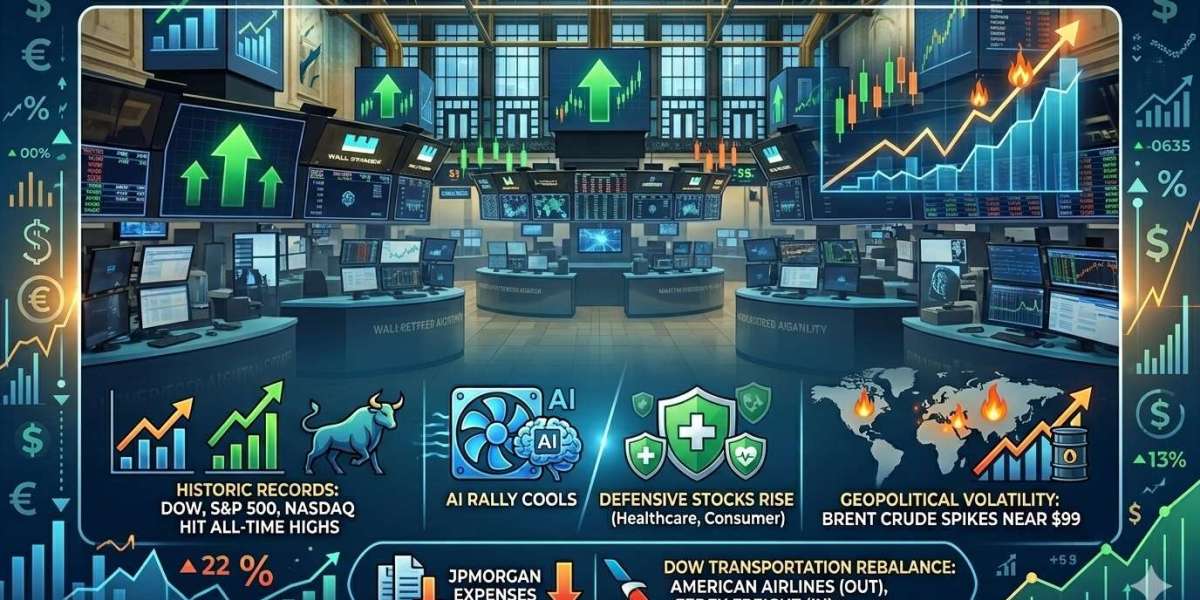
Record Closings: Major US stock indexes—the Dow Jones, S&P 500, and Nasdaq—all touched new historic all-time highs before closing mixed on Wednesday.
Sector Rotation: The heavily surging artificial intelligence (AI) and semiconductor rally took a temporary breather, shifting investor cash into defensive sectors like healthcare and consumer goods.
Geopolitical & Commodity Pressures: Renewed military friction between the US and Iran in the Strait of Hormuz caused oil markets to face extreme volatility, pushing Brent crude close to $99 a barrel.
Corporate Shakeups: Banking giant JPMorgan Chase faced headwinds over climbing expense projections, while structural changes hit the Dow Jones Transportation Average with FedEx Freight replacing American Airlines.
advertisement
Global stock markets witnessed a massive structural shift over the last 24 hours as Wall Street major benchmarks surged to fresh historic highs, proving resilient even as the red-hot artificial intelligence (AI) infrastructure rally began taking a much-needed breather.
In a classic display of market rotation, the Dow Jones Industrial Average rallied 182.60 points (0.36%) to a record close of 50,644.28, fueled significantly by defensive heavyweights such as Procter & Gamble climbing nearly 4% and UnitedHealth Group rising 1.9%.
Conversely, tech-heavy sectors cooled down as market participants actively questioned the near-term sustainability of the semiconductor boom; Nvidia slipped 1%, Qualcomm tumbled 6%, and Marvell Technology lost 4.6%, though chipmaker Micron managed to buck the trend by jumping 3.5% on the heels of a massive 19% surge earlier in the week following a UBS upgrade.
Outside of technology, the financial sector faced localized pressure after JPMorgan Chase stock dropped 2.4% following CEO Jamie Dimon's public caution that the bank's annual expenses could exceed previous targets by a staggering $1 billion, though broader equity sentiment remained supported by Goldman Sachs aggressively raising its year-end S&P 500 target to 8,000.
Beyond the shores of the US, global investors are moving with extreme caution as Asian shares declined early Thursday following defensive US military air strikes against Iranian drone positions near the vital Strait of Hormuz trading channel.
This escalating West Asian geopolitical tension sent energy markets into a tailspin, with Brent crude oil spiking near $99 a barrel and US West Texas Intermediate (WTI) crossing above $93 a barrel, which naturally heightens inflation anxieties just as international markets brace for the upcoming US Personal Consumption Expenditures (PCE) price index report.
Meanwhile, structural changes continue behind the scenes in major indices, highlighted by the announcement that FedEx Freight Holding Company will officially replace American Airlines Group in the prestigious Dow Jones Transportation Average effective June 1, 2026, marking an end to the airline's low-priced index weight and introducing a pure-play ground cargo player into the benchmark.
Collectively, Morgan Stanley analysts emphasize that while corporate earnings remain robust, global investors must carefully balance this equity triumph against weakening household balance sheets, rising long-term borrowing rates, and localized consumer credit defaults worldwide.
Key Points Summary
Wall Street Triumphs: The Dow Jones hit 50,644.28, the S&P 500 reached 7,520.36, and the Nasdaq pushed to 26,674.74, driven by defensive asset accumulation.
Tech Gives Ground: The dominant AI-driven rally eased up, dragging down major semiconductor stocks like Qualcomm and Nvidia as investors locked in profit.
Energy Shockwaves: Geopolitical conflicts in the Middle East disrupted global supply sentiment, sending Brent crude oil soaring toward the $99 threshold.
Index Rebalancing: American Airlines is officially being dropped from the Dow Jones Transportation Average to make room for the newly spun-off FedEx Freight.
advertisement
Frequently Asked Questions (FAQ)
Q1: Why did the stock market hit records if AI tech stocks were falling?
A: Investors practiced "sector rotation." When technology stocks began to cool off, large funds moved their money into safer, defensive sectors like healthcare (e.g., UnitedHealth) and consumer products (e.g., Procter & Gamble), keeping the broader market averages afloat.
Q2: How are the rising oil prices affecting international stock markets?
A: Rising energy costs increase expenses for manufacturing, shipping, and everyday consumers. This places upward pressure on global inflation, which often makes central banks hesitant to cut interest rates, slightly depressing Asian and European market openings.
Q3: Why is American Airlines being removed from the Dow Jones Transportation Average?
A: S&P Dow Jones Indices announced that American Airlines will be replaced by FedEx Freight Holding Co. on June 1, 2026. The airline was removed because its low share price gave it an insignificant weight (less than 0.5%) in measuring the transportation sector accurately.
Q4: What data point are global investors waiting for next?
A: The global financial community is closely watching for the release of the US Personal Consumption Expenditures (PCE) price index. This data is the Federal Reserve's preferred measure of inflation and will heavily influence whether global interest rates drop later this year.
Sources
Business Today Malaysia (Published May 28, 2026): Wall Street Hits Fresh Record Highs As AI Rally Takes A Breather
Morgan Stanley Research (Published May 27, 2026): Stock Market Rally 2026: Risks for Investors
Trading Economics (Published May 27, 2026): United States Stock Market Index Summary
S&P Dow Jones Indices Press Release (Published May 27, 2026): FedEx Freight Holding Set to Join Dow Jones Transportation Average
KSAT Business Bureau / AP (Published May 27/28, 2026): Asian Shares Decline and Oil Prices Up After US Strikes on Iran
Disclaimer:
This material may contain third-party opinions, none of the data and information on this webpage constitutes investment advice
The content shared in economics articles is solely for research and informational purposes.
We are not a financial advisory service, and the information provided should not be considered investment or trading advice.
Thank you !