
Bull Sharks Have Friends: New Research Reveals Surprising Social Lives of Apex Predators
Key Points:
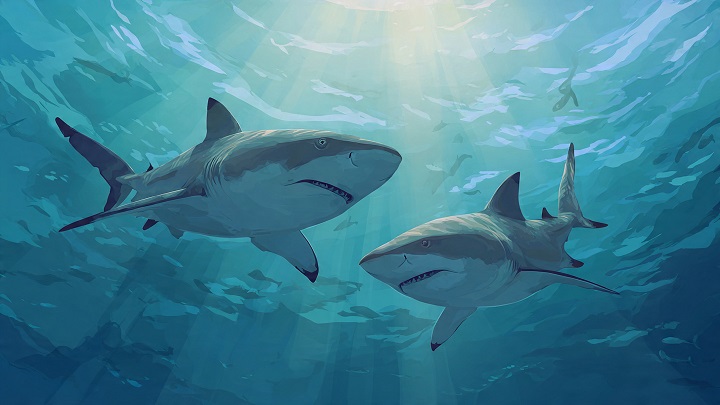
Bull sharks form selective friendships and social networks.
Adults lead social groups; older sharks are less social.
Male and female sharks show unique social preferences.
advertisement
Introduction
Bull sharks have long carried a fearsome reputation as solitary, aggressive predators. Yet, groundbreaking research now shows that these apex predators are far more social than once believed. In a six-year study of 184 bull sharks in Fiji, scientists observed that these sharks actively choose companions, swim together in synchronized patterns, and even follow one another in coordinated ways—forming a complex social network that challenges decades of assumptions about shark behavior.
Bull Sharks Are Social Animals
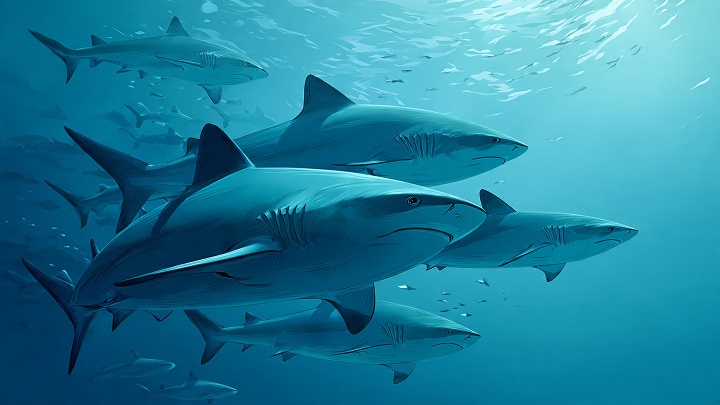
Contrary to popular belief, bull sharks do not simply mix randomly. Observations from the Shark Marine Reserve in Fiji reveal that sharks demonstrate active social preferences, forming bonds with certain individuals while avoiding others. Lead author Natasha D. Marosi, a PhD student at the University of Exeter and founder of Fiji Shark Lab, compared their behavior to human social relationships:
“As humans we cultivate a range of social relationships—from casual acquaintances to our best friends—but these bull sharks are doing similar things.”
Researchers defined social associations as sharks swimming within one body length of each other. They observed behaviors such as parallel swimming, where sharks align side by side, and lead-follow interactions, where one shark leads and another follows, moving in synchronized patterns.
Who Sharks Choose as Friends
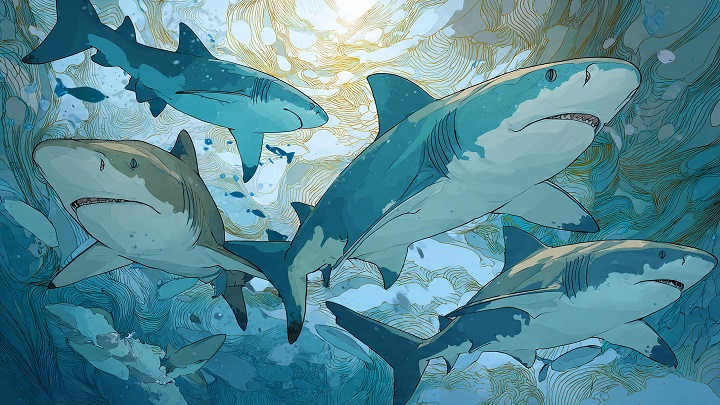
Both male and female bull sharks show preferences in their social interactions:
Sharks tend to associate more with females.
Males often maintain a larger number of social connections, possibly as protection from confrontations with larger individuals.
Sharks of similar size frequently form bonds, while age plays a role in social behavior.
Adults form the central core of the social network. Younger sharks, including sub-adults, often hang out with adults to gain information about feeding, mating, or navigating their environment. Advanced-adult sharks, on the other hand, are typically less social, having already mastered essential survival skills.
Toby Daly-Engel, director of the Shark Conservation Lab at the Florida Institute of Technology, noted:
“Older sharks don’t have as much need as younger sharks for socializing. They have fewer predators and already know where to feed or mate, so their advantage may be protection rather than social learning.”
How Social Behavior Supports Survival
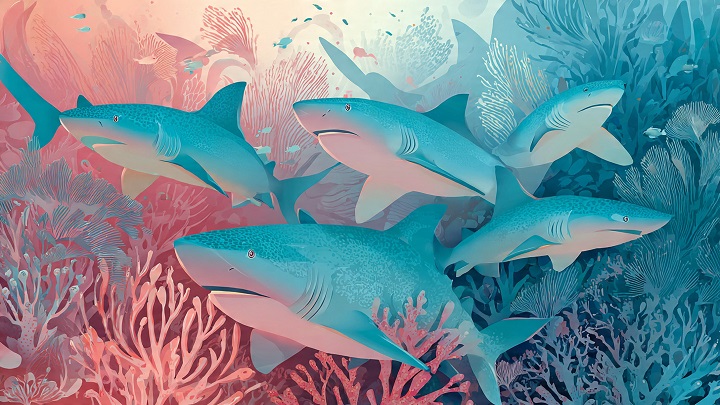
The study’s findings indicate that shark social behavior may play critical roles beyond companionship:
Learning from peers: Young sharks may learn optimal feeding strategies or mating behaviors by observing others.
Cooperation: Coordinated movement could enhance hunting efficiency or protection from threats.
Habitat navigation: Social connections help sharks move safely between habitats, including river systems, estuaries, and open ocean areas.
Marosi emphasized that understanding shark social networks is essential for conservation:
“How social the animal is will really affect its ability to survive and adapt to human impacts like overfishing, pollution, and habitat degradation.”
Observing Sharks in the Wild

Some skepticism has arisen because the study took place at a provision site—where sharks are fed during dives—but both Marosi and Daly-Engel affirm that the observed social behaviors are natural, not artificially induced by humans. Acoustic and satellite tracking studies corroborate the in-water observations, suggesting these friendships and social choices are consistent across different research methods.
Implications for Conservation
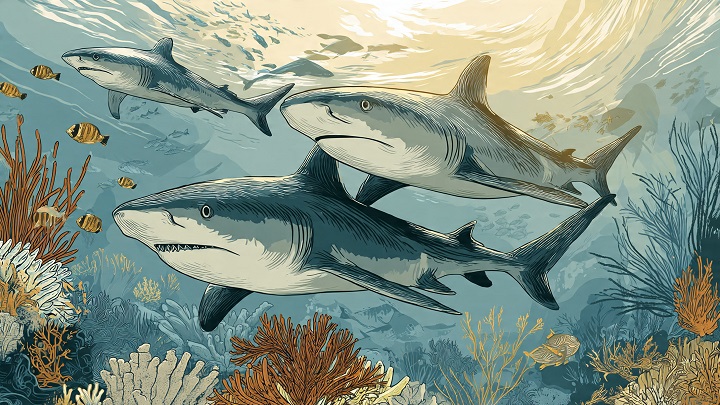
These discoveries are more than just fascinating facts—they have practical applications:
Improving conservation strategies: Knowing how sharks interact can guide the design of marine protected areas and shark management plans.
Changing perceptions: By framing sharks as social animals rather than mindless predators, public support for shark conservation may increase.
Protecting juvenile sharks: Understanding social networks helps identify critical habitats for younger sharks, enhancing survival rates.
The research also highlights the role of experienced adult sharks in facilitating social inclusion and possibly enabling social learning for younger sharks.
Conclusion

The revelation that bull sharks have friends transforms our understanding of these apex predators. They are not just solitary hunters but social beings capable of forming bonds, cooperating, and navigating complex social networks. This insight encourages us to rethink sharks not as ruthless predators but as sophisticated animals with behaviors that support survival, learning, and resilience.
By appreciating their social lives, we gain not only scientific knowledge but also a renewed sense of wonder—and a reminder that even the ocean’s most formidable creatures share one essential trait with us: the need for connection.
Key Points Summary
Bull sharks form selective friendships and social bonds.
Adults are the central core; older sharks socialize less.
Males and females have distinct social patterns.
Social behavior helps sharks learn, hunt, and navigate habitats.
Insights are crucial for conservation and changing public perception.
advertisement
Frequently Asked Questions (FAQ)
Q: Are bull sharks really social animals?
A: Yes! Studies show they form friendships, swim in sync, and follow chosen companions.
Q: Does the feeding site affect shark behavior?
A: While observations were at a provision site, researchers confirm that the social behavior is natural and consistent with tracking studies.
Q: Why are older sharks less social?
A: Older sharks already have survival skills and face fewer predators, reducing the need for social interactions.
Q: How can this research help conservation?
A: Understanding social networks aids in protecting habitats, managing populations, and educating the public about shark behavior.
Q: Do male and female sharks interact differently?
A: Yes, both sexes prefer females, but males often maintain more social connections, likely for protection and integration.
Sources
CBC – Coverage of bull shark social behavior and observational study in Fiji
https://www.cbc.ca/radio/asithappens/shark-friends-study-9.7138605ScienceDaily – Study on bull sharks’ social networks and conservation implications
https://www.sciencedaily.com/releases/2026/03/260317064436.htm
Thank you !