
Global Markets Strained: Dow Hits Record 52,000 as Tech Flees AI Bubble and Fed Chair Kevin Warsh Steers Monetary Policy
Key Points
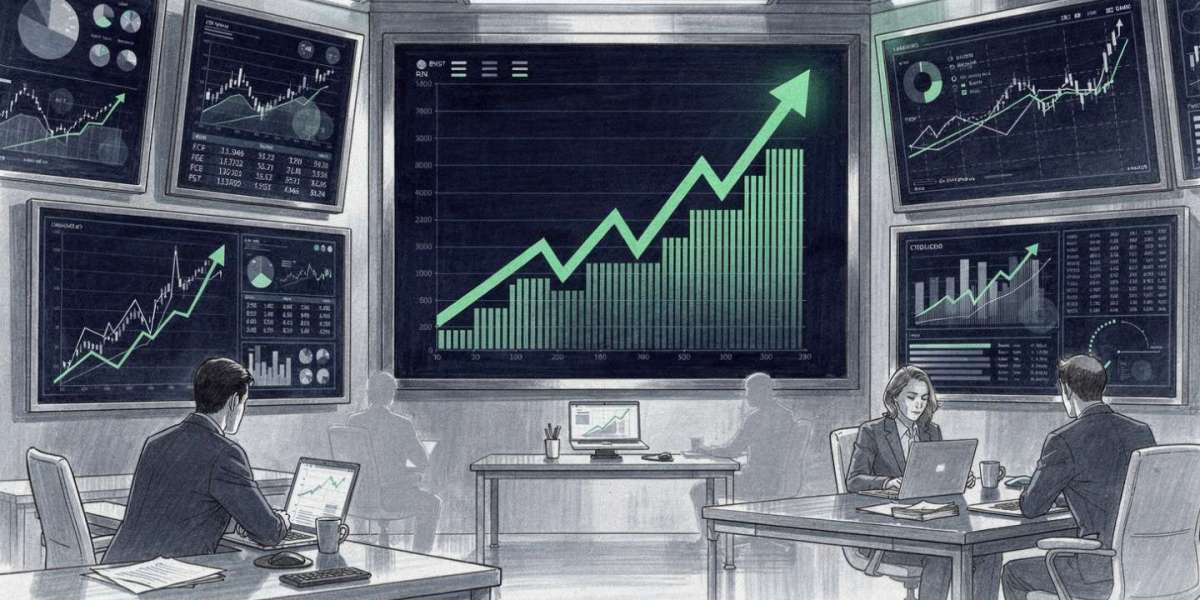
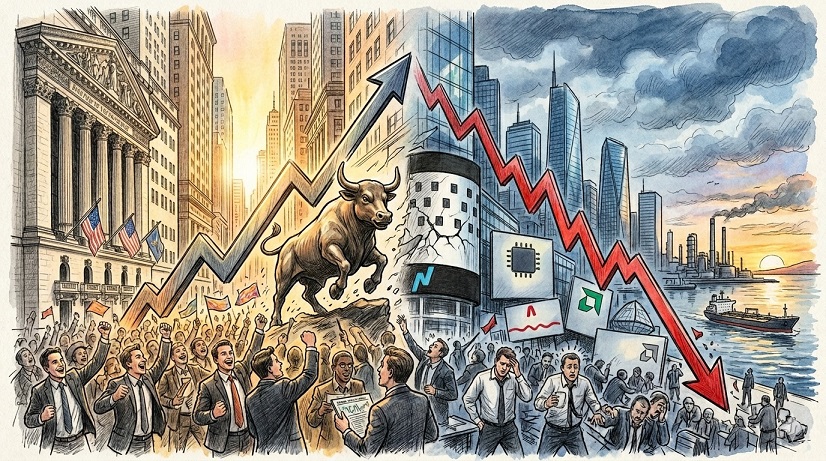
Historical Dow Milestones: The Dow Jones Industrial Average soared past the historic 52,000 mark for the first time before settling up 0.64% to a record high of 51,999.67.
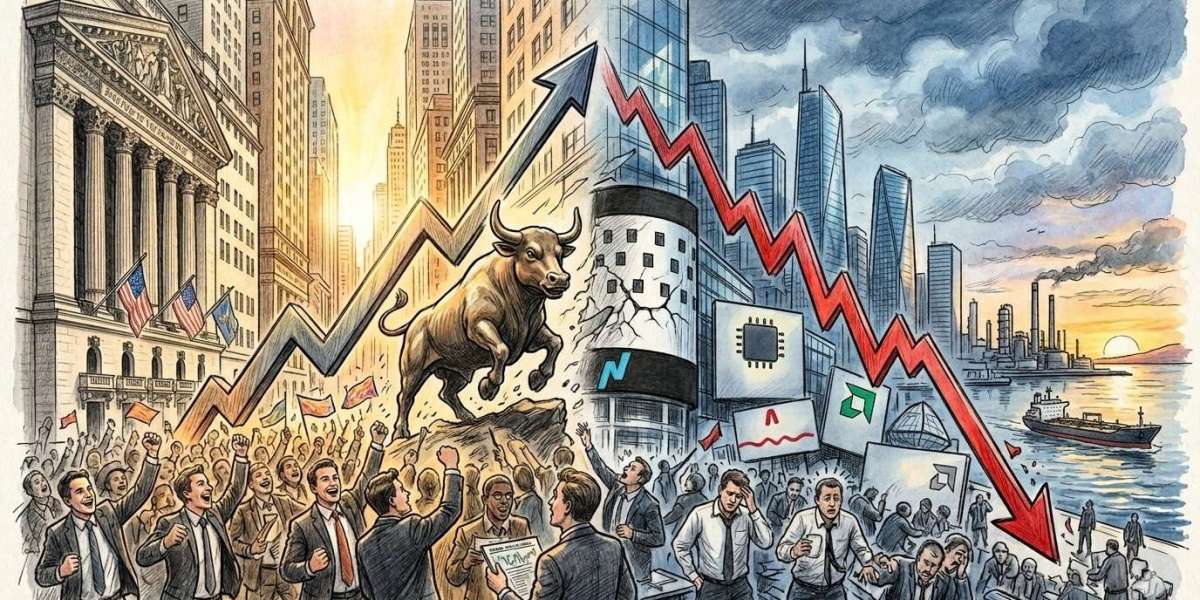
Tech Sell-Off & AI Bubble Fears: Sector rotation and renewed worries over an artificial intelligence bubble triggered a sharp retreat. The Nasdaq Composite dropped 1.15% to 26,376.34, dragged down by Nvidia (-2.4%), Broadcom (-4.4%), and Advanced Micro Devices (-7%).
First Fed Meeting for Chairman Warsh: Global investors are frozen ahead of the highly anticipated Federal Reserve policy meeting, the first chaired by the newly appointed head Kevin Warsh, where interest rates are expected to hold steady between 3.5% and 3.75%.
U.S.-Iran Ceasefire & Crude Collapse: Crude oil prices plummeted below $80 per barrel following a landmark tentative interim peace deal between Washington and Tehran that guarantees the unrestricted, toll-free reopening of the Strait of Hormuz by Friday.
SpaceX Continued Surge: Defying the tech sector slump, Elon Musk’s newly public SpaceX gained 4.83%, boosted by its announcement to acquire the AI coding startup Cursor from Anysphere for $60 billion.
Major Corporate Shifts: In a massive fast-food shakeup, Yum Brands surged 1.9% after announcing the sale of Pizza Hut to private equity firm LongRange Capital for $2.7 billion. Simultaneously, HSBC and Google Cloud announced a multi-year global partnership targeting over 200 generative AI banking use cases.
advertisement
The international financial ecosystem experienced a starkly divided session on this momentous Wednesday, June 17, 2026, as equity markets fragmented under the weight of geopolitical breakthroughs, shifting central bank leadership, and a severe structural rotation out of tech heavyweights. Wall Street logged a radically mixed day where traditional blue-chip stocks decoupled entirely from high-flying tech growth assets; the Dow Jones Industrial Average famously breached the psychological 52,000 threshold for the first time in human history, closing at an all-time record high of 51,999.67 behind massive surges in financials and utilities, which jumped 1.49% and 0.69% respectively.
Conversely, the tech-laden Nasdaq Composite Index bled heavily, shedding 1.15% to close at 26,376.34 alongside a 0.57% slide in the broader S&P 500 index to 7,511.35, a downturn directly caused by aggressive liquidations in the semiconductor and hardware spaces over resurfacing market panics regarding a structural AI bubble.
Cornerstone tech giants suffered immense damage, with market leader Nvidia falling over 2.4%, Broadcom plunging 4.4%, Micron Technology sliding 6.2%, and Advanced Micro Devices plummeting more than 7% as risk managers rushed to lock in profits. This tech migration occurred while the entire world shifted its focus to the afternoon's imminent Federal Reserve policy meeting, representing the highly critical, historic first session chaired by newly inaugurated Fed Chairman Kevin Warsh. While macroeconomic experts overwhelmingly forecast that the central bank will keep its benchmark interest rates unchanged at an elevated 3.5% to 3.75% band, global analysts are hyper-focused on the updated economic projections and Warsh’s debut press conference to decipher when the Fed might resume monetary easing, which Morningstar economists project may be delayed entirely until late next year.
Compounding this nervous anticipation is a seismic geopolitical shift in the Middle East, as global markets react to an extraordinary, tentative U.S.-Iran ceasefire agreement announced by President Trump and confirmed by international intermediaries, stating that formal peace military operations have ceased and the strategic Strait of Hormuz will reopen to toll-free commercial maritime traffic by Friday. This sudden de-escalation sent shockwaves through energy markets, forcing West Texas Intermediate (WTI) crude for July delivery to collapse by 5.82% down to $76.05 per barrel, while August Brent crude dumped 5.06% to settle at $78.96 per barrel.
Despite the sweeping tech bloodbath, Elon Musk's recently IPO'd aerospace titan SpaceX spectacularly bucked the trend, gaining 4.83% on its third trading day to hold its multi-trillion-dollar valuation after shaking up the software industry with a colossal $60 billion acquisition of AI coding startup Cursor from parent firm Anysphere. Corporate mergers and acquisitions further energized non-tech fields, notably with consumer giant Yum Brands gaining 1.9% following its blockbuster announcement that it is offloading Pizza Hut for $2.7 billion to private equity firm LongRange Capital. Meanwhile, a massive institutional push into financial technology surfaced out of London, where HSBC and Google Cloud officially launched a multi-year global generative AI banking partnership designed to deploy 200 distinct AI cases across global operations, prioritizing ultra-high-value projects expected to yield over $100 million in direct returns per initiative.
Asian markets traded with deep variance overnight as Tokyo’s Nikkei 225 index rallied 0.8% to 69,926.08 on the heels of a magnificent 17% export boom, while South Korea’s Kospi lost 0.2% as Samsung Electronics plummeted 1.9% in sympathy with Wall Street’s semiconductor corrections. Concurrently, public environmental watchdogs turned up the heat on western financial conglomerates, with the Center for International Environmental Law issuing an explosive global brief revealing that mega private asset managers like Vanguard, BlackRock, and State Street collectively hold over $53.4 billion in vulnerable petrochemical investments despite collapsing profit margins and intense structural global overcapacity. With the U.S. 10-year Treasury yield firmly anchored at 4.47%, individual retail investors and multi-national corporations alike find themselves navigating a complex financial landscape where inflation continues to recede, peace deals are re-routing global oil routes, and a new era of central banking under Chairman Warsh begins.
Key Points Summary
| Index / Asset | Closing Value / Price | Performance | Key Driver |
| Dow Jones (DJIA) | 51,999.67 | +0.64% ▲ | Defensive rotation into financials and utilities |
| S&P 500 | 7,511.35 | -0.57% ▼ | Dragged down by broader technology liquidations |
| Nasdaq Composite | 26,376.34 | -1.15% ▼ | Severe pullback in major semiconductor and AI stocks |
| WTI Crude Oil | $76.05 | -5.82% ▼ | Landslide drop following U.S.-Iran peace breakthrough |
| Brent Crude Oil | $78.96 | -5.06% ▼ | Opening of Strait of Hormuz lowers global supply risks |
| SpaceX Stock | Trading Up | +4.83% ▲ | Market responds to massive $60B Cursor acquisition |
| US 10-Year Bond | 4.47% Yield | Flat ▬ | Yields hold steady ahead of Chairman Warsh's speech |
advertisement
Frequently Asked Questions [FAQ]
Q1: Why did the Dow hit a record high while the Nasdaq fell today?
The market is experiencing sector rotation. Investors are taking profits out of expensive technology and AI stocks due to fears of an asset bubble and moving that money into safer, value-oriented sectors like financials, utilities, and consumer goods, which are heavily represented in the Dow.
Q2: What is the significance of Kevin Warsh's first Federal Reserve meeting?
This is the first meeting chaired by the new leader, Kevin Warsh. Wall Street is trying to gauge his monetary style. While interest rates are expected to hold steady at 3.5% to 3.75%, his press conference will reveal whether he plans to be more aggressive or cautious with future rate cuts.
Q3: How is the U.S.-Iran peace agreement affecting everyday consumers?
The interim deal stops military tensions and fully opens the Strait of Hormuz with no transit tolls. Because this ensures a smooth, vast supply of global oil, crude prices crashed by over 5%. For average citizens globally, this will directly translate to cheaper prices at the gas pump and lower transport costs for goods.
Q4: Why did chip stocks like Nvidia, AMD, and Broadcom crash?
Semiconductor companies have seen over-inflated prices due to the artificial intelligence boom. Today, a wave of caution swept Wall Street over whether AI infrastructure returns can justify these prices, prompting severe sell-offs in AMD (-7%), Broadcom (-4.4%), and Nvidia (-2.4%).
Sources
IC Markets Global Financial Updates (Published June 17, 2026)
Share-Talk Overnight Market & Geopolitical Review (Published June 17, 2026)
Pittsburgh Post-Gazette International Global Market Tracking (Published June 17, 2026)
China.org / Xinhua Wall Street Closing Summary (Published June 17, 2026)
Google Cloud Official Press Corner - HSBC AI Partnership (Published June 17, 2026)
Center for International Environmental Law Petrochemical Brief (Published June 17, 2026)
Disclaimer:
This material may contain third-party opinions, none of the data and information on this webpage constitutes investment advice
The content shared in economics articles is solely for research and informational purposes.
We are not a financial advisory service, and the information provided should not be considered investment or trading advice.
Thank you !