
Wall Street Explosive Relief Rally: Dow and Nasdaq Surge to Record Highs as Historic US-Iran Peace Deal Plummets Oil Prices
Key Points
Historic Peace Framework: The U.S. and Iran struck a game-changing preliminary agreement to end regional hostilities and reopen the economically crucial Strait of Hormuz.
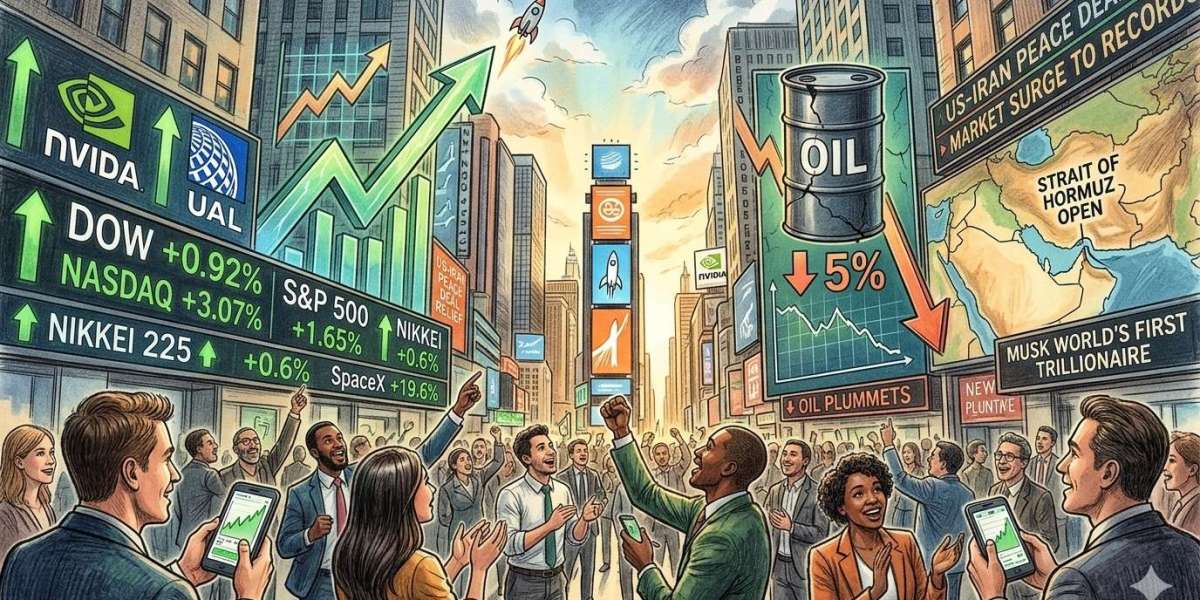
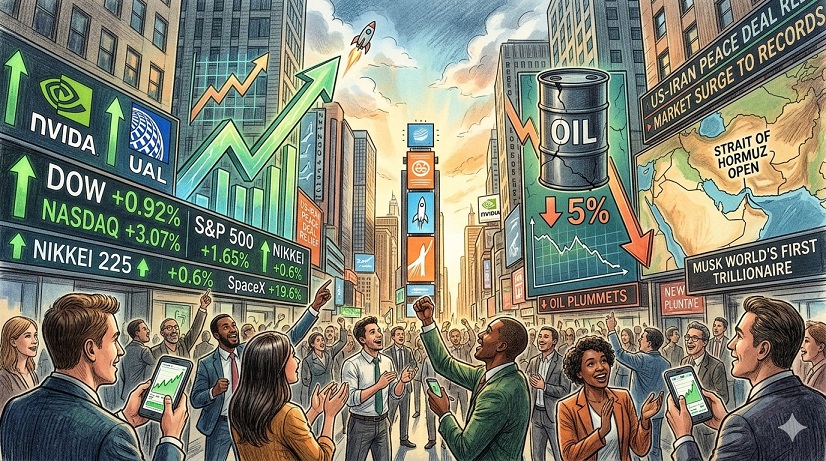
Stock Market Surge: The Dow Jones hit an all-time record closing high of 51,671.03 (+0.92%), the S&P 500 rose to 7,554.29 (+1.65%), and the tech-heavy Nasdaq skyrocketed by 795.10 points (+3.07%), marking its strongest one-day percentage gain since late March.
Crude Oil Plunges: U.S. crude futures and Brent crude plunged nearly 5% to just above $83 a barrel, hitting their lowest levels since March and heavily easing global inflation concerns.
SpaceX & Tech Lead Charge: SpaceX stock jumped an astonishing 19.6% to close at $192.46 on its second day of trading post-IPO, pushing its valuation past $2 trillion; meanwhile, the semiconductor index surged over 5% with Nvidia gaining 3.5% and Micron climbing 10.5%.
Global Market Reactions: Japan’s Nikkei 225 crossed the historic 70,000-point milestone for the first time ever before settling up 0.6%, while South Korea's Kospi jumped 2.1% to an all-time record.
Central Bank Spotlight: The Bank of Japan raised interest rates by 25 basis points to 1.0% (a 31-year high), while Australia’s RBA held rates steady at 4.35%. Investors now pivot to the upcoming U.S. Federal Reserve meeting under new, historically hawkish Chairman Kevin Warsh.
advertisement
Global financial markets are witnessing an absolute blockbuster relief rally today, June 16, 2026, following the monumental announcement of a tentative U.S.-Iran peace agreement designed to restore stability to vital energy supply chains and officially reopen the heavily disrupted Strait of Hormuz. This geopolitical breakthrough has fundamentally altered the near-term economic landscape, causing global benchmark crude prices to collapse by nearly 5% to just above $83 a barrel, their lowest point since March. This massive drop has rapidly drained the persistent inflation anxieties that have plagued Wall Street for months.
Investors reacted by aggressively dumping defensive positions and pouring capital back into high-growth risk assets, pushing the blue-chip Dow Jones Industrial Average up 468.77 points, or 0.92%, to a historic record close of 51,671.03, while the broader S&P 500 climbed a steep 1.65% to end at 7,554.29. The absolute star of the session was the Nasdaq Composite, which staged a breathtaking 3.07% surge (gaining 795.10 points) to finish at 26,683.94. This massive tech rally was propelled by an extraordinary technology rotation where the Philadelphia Semiconductor Index gained over 5%, highlighted by Nvidia's 3.5% rally and a massive 10.5% leap from Micron Technology after multiple major brokerage houses aggressively hiked their price targets on memory chips.
Adding immense fuel to the trading fire, SpaceX stock skyrocketed 19.6% to close at $192.46 in its second spectacular day of trading following the largest Initial Public Offering (IPO) in financial history. This move successfully pushed the space-exploration titan's valuation past the $2 trillion mark and officially cemented Elon Musk's status as the world's very first trillionaire. The immense relief felt by energy-sensitive sectors also triggered a massive surge in transport equities, causing fuel-dependent businesses like United Airlines to jump 3.9% and cruise giants like Carnival to surge 3.2%, effectively offsetting a sharp 3.6% retreat in the S&P 500 energy sector index as oil-and-gas producers pulled back alongside falling commodity prices.
This euphoria vibrated deeply across global borders, driving Japan's benchmark Nikkei 225 index briefly past the legendary 70,000-point threshold for the first time in history before it closed up 0.6% at 69,713.05. This was an incredibly resilient feat considering the Bank of Japan simultaneously hiked its short-term policy rate by 25 basis points to 1.0%, marking its highest borrowing cost in 31 years as the nation adjusts to structural inflation. Meanwhile, South Korea's high-tech Kospi index advanced an incredible 2.1% to a fresh record high of 8,721.64, while the Reserve Bank of Australia chose to keep its key interest rate locked at 4.35%, explicitly warning that local inflation remains uncomfortably high.
As the CBOE Volatility Index (VIX), Wall Street's primary fear gauge, slid for its third consecutive day, the entire global investing community shifted its collective gaze toward tomorrow’s high-stakes U.S. Federal Reserve monetary policy meeting. The event will be presided over by the newly appointed, historically hawkish Fed Chairman Kevin Warsh. While interest rates are universally expected to hold steady at this specific meeting, structural concerns regarding "Trumpflation" and Warsh's well-documented tendency to favor tighter monetary policies have led Wall Street analysts to aggressively price in a high probability of a definitive U.S. interest rate hike before the end of 2026.
Key Points Summary
Wall Street Records: Dow Jones hits historic 51,671.03; Nasdaq posts legendary 3.07% single-day gain.
Geopolitical Reset: Tentative U.S.-Iran framework to lift the blockade on the Strait of Hormuz.
Energy Relief: Oil plummets 5%, boosting airlines and cruise lines while dragging down energy companies.
Trillionaire Era: SpaceX spikes 19.6% on day two of trading, crossing a $2T valuation and crowning Elon Musk's status.
Global Milestones: Nikkei 225 breaks above 70k for the first time ever despite a rare Bank of Japan rate hike to 1.0%.
Fed Anxiety: Markets brace for Fed meeting tomorrow under new hawkish Chair Kevin Warsh, with late-2026 rate hikes looming.
advertisement
Frequently Asked Questions [FAQ]
Q: Why did the stock market rise so drastically today?
A: The main catalyst was a surprise preliminary peace agreement between the United States and Iran. This agreement aims to reopen the Strait of Hormuz, a critical maritime choke point for global oil supplies. The news caused oil prices to drop significantly, which directly reduces global inflation fears and encourages investors to buy riskier growth assets like technology stocks.
Q: What happened with SpaceX stock today?
A: Following its record-breaking Initial Public Offering (IPO) last week, SpaceX stock jumped an additional 19.6% on its second full day of trading, closing at $192.46 per share (well above its initial $135 IPO price). This surged the company’s valuation past $2 trillion and solidified CEO Elon Musk as the world's first trillionaire.
Q: How did international markets react to the U.S. news?
A: International markets exploded upward. Japan’s Nikkei 225 briefly hit an all-time historic high above 70,000 points. South Korea’s Kospi index surged 2.1% to hit its own record high, driven by heavy buying of semiconductor and tech stocks.
Q: Why are oil prices falling bad for energy stocks but good for the broader market?
A: Lower oil prices mean lower revenues for oil and gas extraction companies, which is why the S&P 500 energy sector fell 3.6%. However, cheaper fuel directly reduces operating costs for airlines, cruise lines, shipping companies, and everyday consumers. This eases overall inflation, making the broader economy much healthier.
Q: What is expected from the U.S. Federal Reserve meeting tomorrow?
A: The Federal Open Market Committee (FOMC) is widely expected to keep interest rates unchanged at this meeting. However, this is the first major meeting under the new, historically hawkish Fed Chairman Kevin Warsh. Because of his track record, economists are warning that the probability of a U.S. interest rate hike later in 2026 has risen dramatically.
Sources:
Saxo Bank Macro Report: Market Quick Take - 16 June 2026
Share Talk Financial Analysis: What happened overnight – Tuesday 16th June 2026
Kiplinger Market Watch: Nasdaq Jumps 795 Points, Dow Hits New High on Iran Deal: Stock Market Today
Commonwealth Bank of Australia Newsroom: Wall Street rallies on US-Iran deal and oil price slide
Al Jazeera Economy: US stock market jumps as US-Iran deal stirs hopes for end to energy turmoil
The Star Business News: Wall Street rallies, Dow ends with record on US-Iran deal, oil price slide
Business Today Markets: Wall Street Jumps After US-Iran Agreement Eases Inflation Fears
Disclaimer:
This material may contain third-party opinions, none of the data and information on this webpage constitutes investment advice
The content shared in economics articles is solely for research and informational purposes.
We are not a financial advisory service, and the information provided should not be considered investment or trading advice.
Thank you !