
Scientists Discover Parrots May Actually Use Names, New Study Finds
Key Points
Scientists have found evidence that parrots may use names to identify specific people, animals, and even other parrots.
The study analyzed recordings and reports from 884 companion parrots across dozens of species.
Nearly 47% of parrots in the dataset were reported using names in speech.
Researchers identified 88 parrots from 30 species that appeared to use names as individual labels.
Some parrots used names to greet others, seek attention, ask about absent individuals, or communicate socially.
The findings suggest parrots possess advanced cognitive and vocal abilities beyond simple mimicry.
Researchers caution that parrot name use is not identical to human language, and many questions remain unanswered.
advertisement
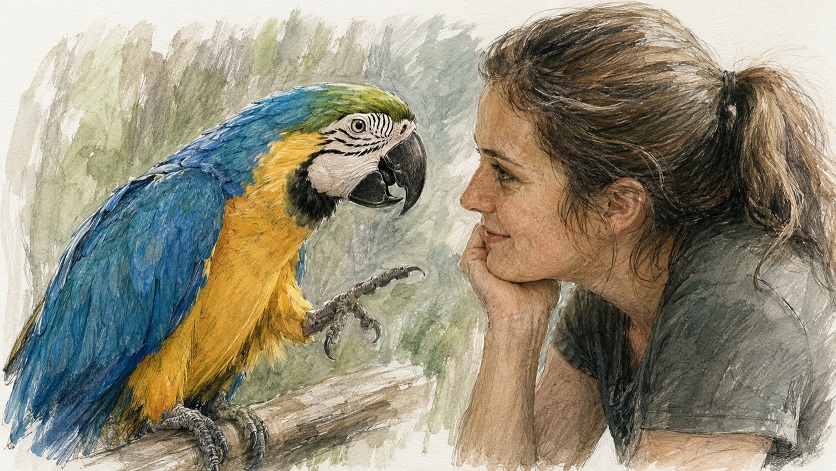
A fascinating new scientific study is challenging what we know about animal communication after researchers discovered that parrots may actually use names in ways surprisingly similar to humans. The findings, published in PLOS ONE and highlighted by researchers from the University of Pittsburgh, suggest that parrots are doing far more than merely repeating words they hear from people. Instead, many birds appear capable of learning, remembering, and appropriately using names to identify specific individuals.
The research team, led by scientists including Lauryn Benedict, Christine Dahlin, Marisa Hoeschele, Viktoria Groiss, and Eva Reinisch, examined data collected through the ManyParrots Project, an international collaboration studying parrot cognition, learning, and vocal communication. Rather than recording birds in the wild, researchers focused on companion parrots living with humans, where exposure to spoken names is common.
The study analyzed reports from 884 parrots and found that 413 birds—approximately 47% of the total—used names in their speech. These parrots produced more than 800 name-containing phrases, demonstrating that name use is widespread across many species of companion parrots. Researchers documented name use in 63 different species, representing more than 80% of the species included in the dataset.
What makes the discovery particularly significant is that scientists found evidence suggesting many parrots were not simply repeating names randomly. Researchers identified 131 examples of appropriate name use from 88 individual parrots belonging to 30 species. In these cases, birds appeared to use names correctly when referring to specific people, animals, or companions. Some parrots reportedly used the correct names for multiple household members, while others appeared to ask for individuals who were not present, indicating a possible understanding that a particular name corresponded to a specific individual.
One of the strongest findings involved what scientists call “individualized name use.” Researchers found 69 examples from 42 parrots where birds appeared to apply names only to particular individuals rather than using them as generic labels. For example, some parrots correctly used different names for different household members, pets, or birds. This behavior suggests the birds may recognize names as unique identifiers rather than simply memorized sounds.
The study also revealed that parrots use names in a variety of social situations. Birds were reported using names during greetings, farewells, attention-seeking behaviors, and interactions with humans and other animals. Some parrots appeared to refer to people who were not currently in the room, a behavior that resembles how humans talk about others even when they are absent. According to the researchers, this may indicate sophisticated social awareness and memory.
Interestingly, parrots did not always use names according to human linguistic rules. Some birds repeatedly vocalized their own names to attract attention, a behavior that researchers found particularly intriguing. While this differs from typical human name use, it may demonstrate that parrots adapt names for social purposes that make sense within their own communication systems. Scientists noted that many parrots appeared to use names creatively, highlighting the flexibility of their vocal behavior.
The findings also support previous research showing that parrots are among the most cognitively advanced birds on Earth. Earlier studies have documented parrots using signature contact calls, recognizing individual companions, and learning complex vocal patterns. The new study expands that knowledge by showing that companion parrots may learn names not only through direct interaction with humans but also by listening to conversations between people and other animals around them. In some cases, birds appeared to acquire names simply by observing social interactions occurring nearby.
However, researchers emphasize that the study does not prove parrots use names exactly as humans do. Christine Dahlin noted that scientists still do not fully understand the intentions behind animal vocalizations. While the evidence strongly suggests parrots can associate specific names with specific individuals, the cognitive processes behind that behavior remain an active area of research. Scientists say future studies will be needed to determine how parrots understand names, whether they create their own labels, and how widespread such abilities may be throughout the animal kingdom.
The discovery adds to a growing body of evidence suggesting that complex communication systems are more common in animals than previously believed. Researchers have previously identified name-like vocal signatures in dolphins, elephants, and certain wild bird species. The new parrot study provides some of the strongest evidence yet that a large and diverse group of animals can learn and use human-style names in meaningful social contexts. While many mysteries remain, the findings offer a remarkable glimpse into the intelligence and social sophistication of parrots, suggesting these colorful birds may understand far more about the world around them than once thought.
Key Points Summary
New research suggests parrots may use names rather than simply mimic them.
Scientists analyzed data from 884 companion parrots.
Nearly half of the parrots studied used names in their speech.
Evidence from 88 parrots showed names were used as labels for specific individuals.
Some parrots referred to absent individuals and used multiple names correctly.
Birds used names during greetings, attention-seeking, and social interactions.
Researchers say the findings reveal advanced cognitive and communication abilities.
More research is needed to understand how parrots process and use names.
advertisement
Frequently Asked Questions (FAQ)
Do parrots really understand names?
The study suggests many parrots can associate specific names with specific individuals, but scientists cannot yet confirm that parrots understand names exactly as humans do.
How many parrots were included in the research?
Researchers analyzed reports involving 884 companion parrots from numerous species.
What percentage of parrots used names?
Approximately 47% of parrots in the dataset were reported using names in their speech.
Did parrots use names correctly?
Many did. Researchers found numerous examples where parrots consistently used names for particular people, animals, or companions.
Can parrots talk about people who are not present?
Some parrots appeared to refer to absent individuals, which researchers consider one of the most intriguing findings of the study.
Are parrots simply copying sounds?
Not always. The study found evidence that some parrots use names in meaningful social contexts rather than merely repeating sounds.
Why is this discovery important?
It suggests parrots possess advanced social intelligence and communication abilities, potentially offering new insights into the evolution of language and cognition.
Sources
ScienceDaily (June 14, 2026)
https://www.sciencedaily.com/releases/2026/06/260613034232.htmPLOS ONE – Name Use by Companion Parrots (April 17, 2026)
https://journals.plos.org/plosone/article?id=10.1371/journal.pone.0346830
Thank you !