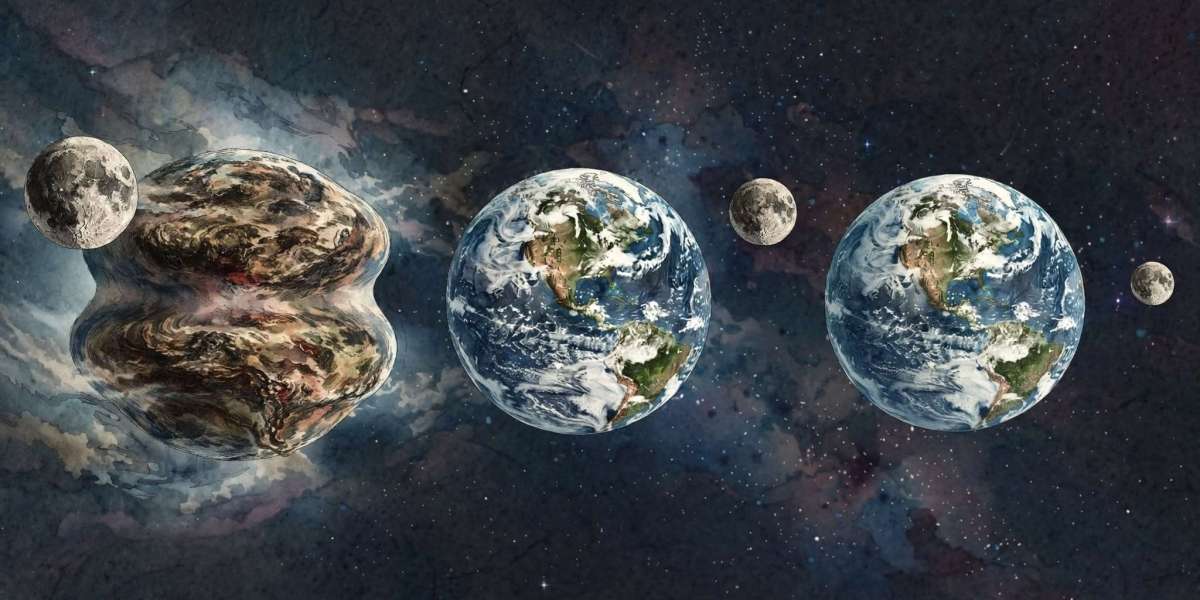
🌍 What if Earth's ancient rotation helped shape the planet we live on today?
A new scientific study reveals how Earth's extremely rapid spin following the Moon-forming impact may have influenced the formation of its first crust.
As the Moon gradually moved away, Earth slowed down and became rounder. This transformation may have compressed the crust around the equator, stretched it near the poles and triggered geological activity comparable in speed to some modern tectonic processes.
The findings could also help explain how Earth's earliest rocks became so diverse.
But how much did the Moon's retreat influence the geological evolution of our planet?
Discover the fascinating science behind Earth's ancient transformation! 🔬
---
A new study published on November 2, 2026, suggests that Earth's rapid early rotation may have produced substantial differences in the thickness of its first crust.
Following the Moon-forming impact, Earth's day may have lasted between approximately 2.3 and 5 hours, depending on the formation scenario.
As tidal interactions slowed Earth's rotation, the planet gradually became rounder, stretching its crust near the poles and compressing it around the equator.
In some high-angular-momentum models, the resulting crustal movements could have reached rates comparable to those associated with the formation of the modern Himalayas.
The proposed mechanism could help explain early volcanism, crustal recycling and the diversity of Earth's earliest rocks.