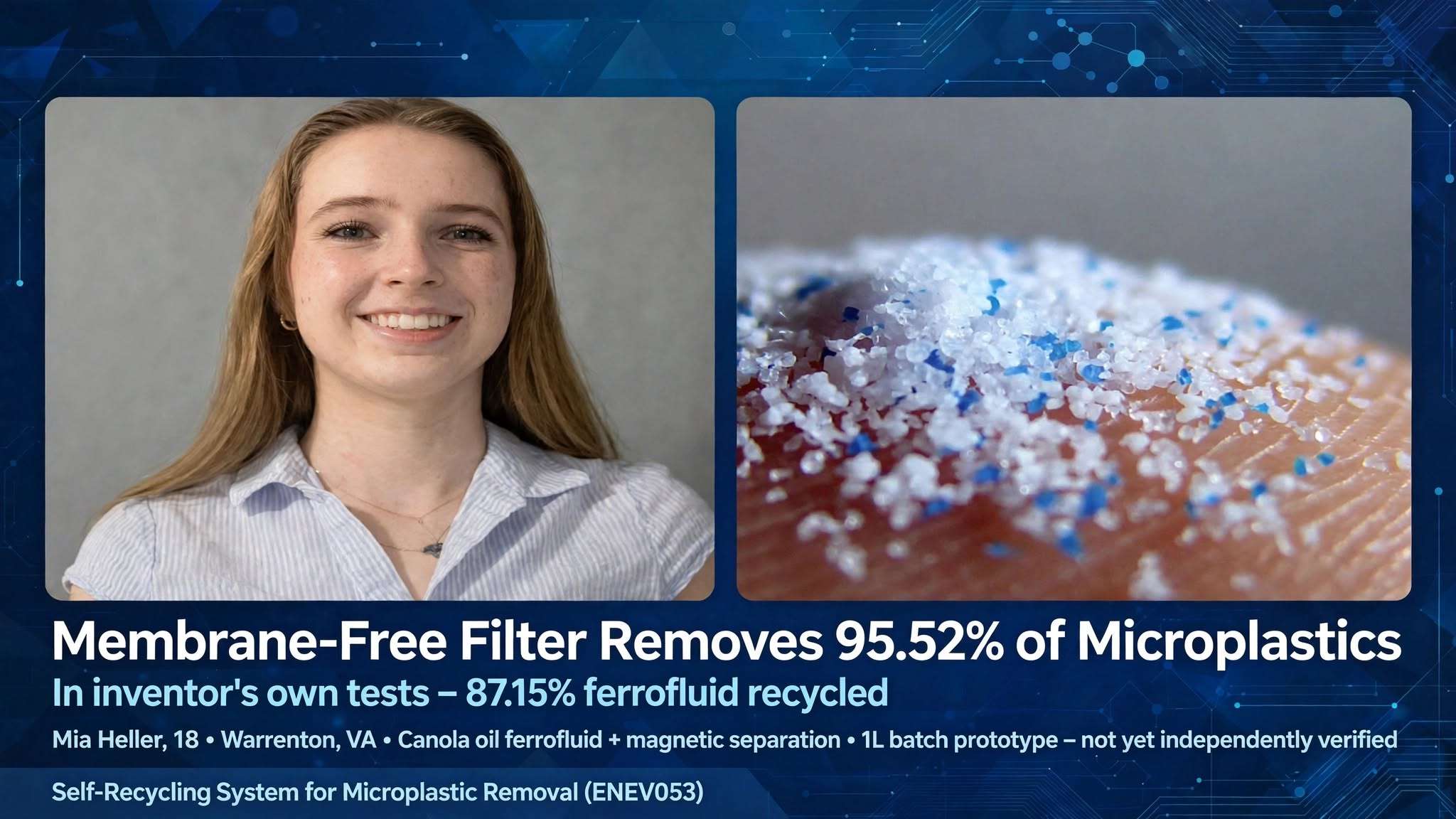
🎉 INNOVATION: Virginia Teen Builds Membrane-Free Filter That Removed 95.52% of Microplastics in Her Own Tests! 💧🔬
The future of clean water might have been prototyped in a family garage in Warrenton, Virginia!
Mia Heller, 18, a student at Kettle Run High School [and Mountain Vista Governor's School], who developed a low-cost, membrane-free water filtration system.
Her project, "ENEV053 – Self-Recycling System for Microplastic Removal," was a finalist at the 2025 Regeneron International Science and Engineering Fair – the world's largest high school science competition in Columbus, Ohio – where she received a $500 Special Award from the Patent and Trademark Office Society (PTOS) for innovative, low-cost filtration.
🚫 No Pores, No Clogs: How It Works
Traditional filters rely on physical membranes that clog and need expensive replacements. Mia's design skips the membrane entirely and uses chemistry and magnetism:
🛢 The Ferrofluid Magic: Water is mixed with a custom, canola oil-based ferrofluid – a reusable magnetic oil that suspends nanoscale magnetic particles. Because microplastics are hydrophobic, they naturally bind to the oil.
🧲 Magnetic Separation: The water passes through a 3D-printed, three-module system – roughly the size of a bag of flour. Module 1 holds ~1 liter of contaminated water, Module 2 stores the ferrofluid, and Module 3 is where a magnetic field pulls the ferrofluid and attached microplastics out of the water.
♻ Closed-Loop Goal: The system is designed to capture and recycle the ferrofluid for reuse. In her own testing, it recovered 87.15% of the ferrofluid per cycle.
🏡 From Prototype to Kitchen?
Right now it's a batch-system prototype that cleans roughly one liter per pass. Mia designed it in CAD with the goal of an affordable, under-sink or countertop pitcher filter.
She started working on it after reading a local newspaper report that her area's water had PFAS and microplastics, but no public funding for filtration. Watching her family's advanced home filter constantly need membrane replacements inspired the membrane-free approach.
🔍 Current Status – Important Context
- Not Available for Purchase: This is an early-stage proof-of-concept from a garage/kitchen build, not a certified product.
- Test Results Are Self-Reported: The 95.52% microplastics removed and 87.15% ferrofluid recycled figures come from Mia's own measurements using a custom turbidity sensor. They have not yet been verified by an independent lab. Mia herself says independent verification is the next step.
- Scaling Challenges: While she formulated a low-cost canola oil-based ferrofluid, ferrofluid is still expensive to produce at large scale. The process also creates a concentrated plastic-laden sludge that still needs safe disposal guidance, and experts note we must confirm it leaves no other pollutant residue.
- Market Comparison: Conventional drinking water plants already remove ~70% to 90% of microplastics, and premium reverse osmosis systems can remove them too. Mia's approach is getting attention because it offers a potentially low-waste, low-maintenance alternative without disposable cartridges.
A promising proof-of-concept that shows a membrane-free approach is physically possible. Congratulations to Mia on the ISEF recognition! 👏🌟