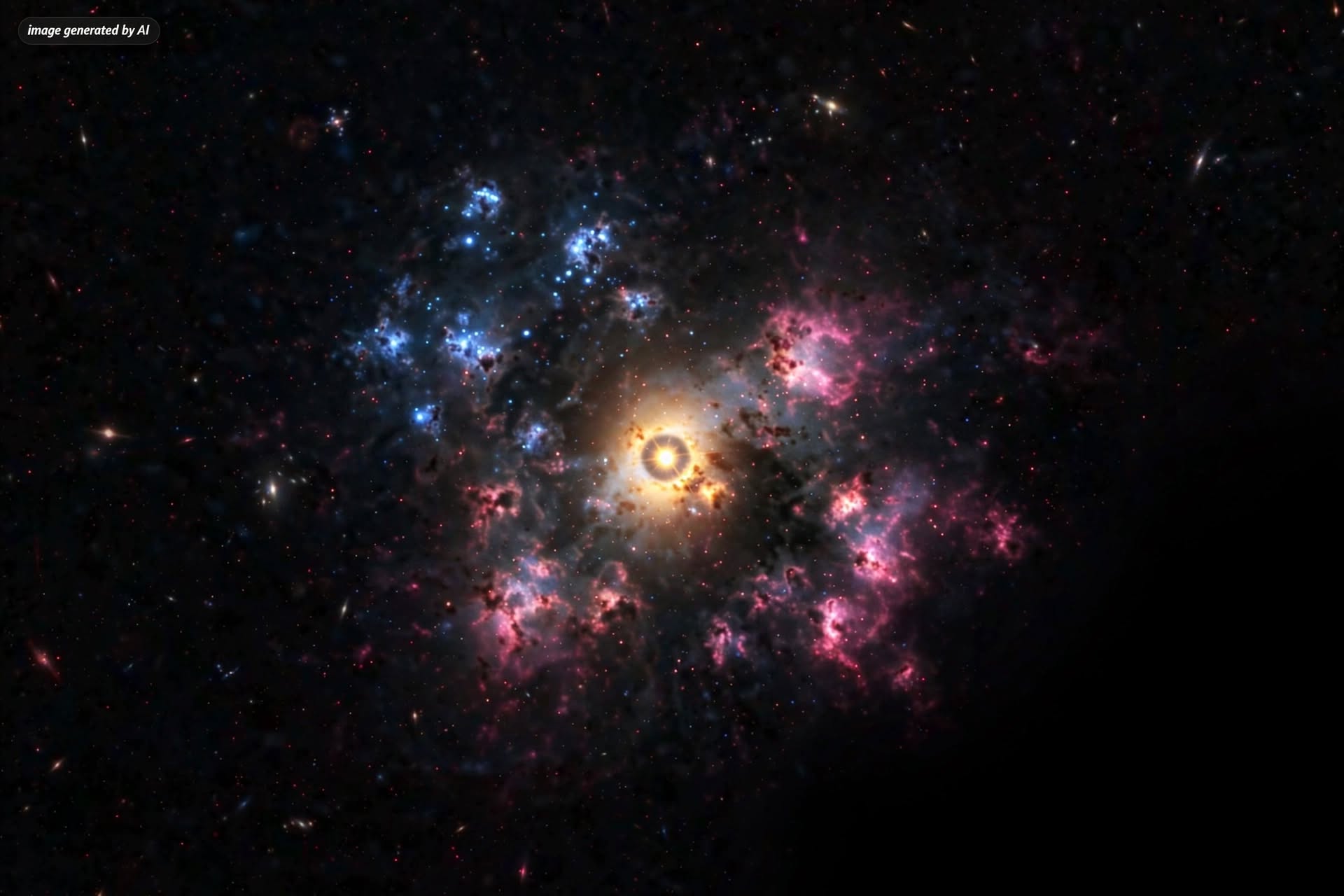
JWST Finds Possible Black Hole That Grew Faster Than Its Galaxy
Astronomers using the James Webb Space Telescope may have found a black hole that grew faster than its home galaxy. The candidate sits in a small clumpy galaxy called MARTA 3887, seen as it was about 12 billion years ago. It weighs about three million times as much as the Sun, while its galaxy holds about 145 million Suns worth of stars. That makes the black hole about two percent of the stellar mass, about 100 times higher than the ratio seen nearby. The team spotted a broad hydrogen signal moving at about 1,270 kilometres per second, which points to gas circling a black hole. The galaxy is young, low in heavy elements, and forming stars quickly in a recent burst. The result suggests early black holes could outpace star building in some galaxies. More observations are needed to rule out other explanations such as supernovae or outflows.