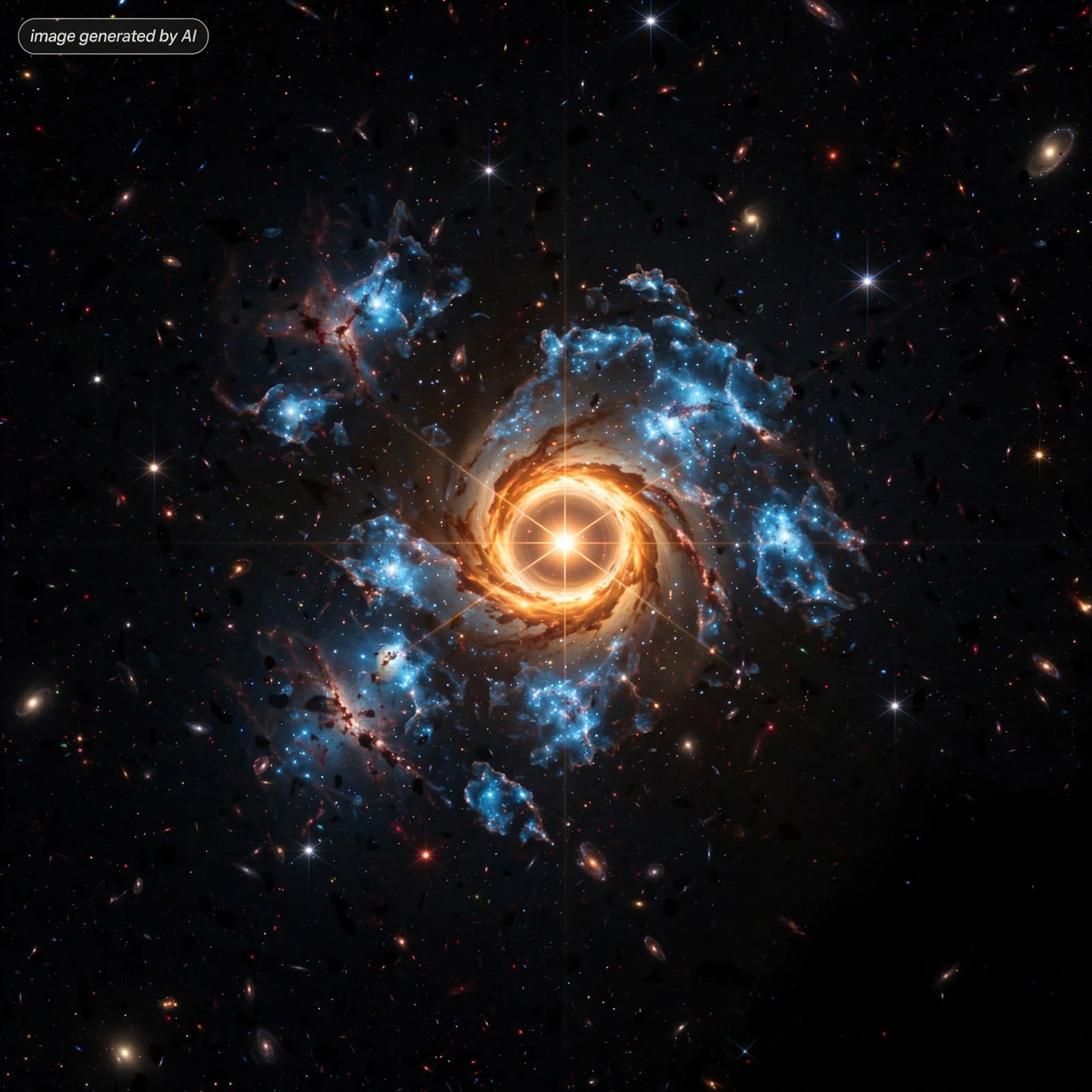
JWST Finds Possible Black Hole That Outgrew Its Galaxy
Astronomers have found a possible black hole that appears to have outgrown its host galaxy in the early universe. The object sits in MARTA 3887, a clumpy and metal-poor galaxy seen as it was about 12 billion years ago. Combining James Webb Space Telescope spectroscopy with Hubble imaging and archival Very Large Telescope data, the team detected a broad hydrogen line moving at about 1270 kilometers per second. That signal pointed to a black hole rather than an ordinary outflow. The team estimated its mass at about 3.3 million suns, while the galaxy holds about 145 million solar masses in stars. The black hole is therefore about 2.3 percent of the stellar mass, roughly 100 times higher than the relation seen nearby. The finding suggests black hole growth may have outpaced star buildup in this young galaxy.